RBT YouTube Videos: Official BACB Resources and How to Use Them
Searching for RBT YouTube videos can be a smart first step, especially if you want a short explanation before opening a handbook. It can also create a problem: a video may explain RBT certification without being the certification, the 40-hour training, the Initial Competency Assessment, or the official examination.
The safest route is to start from the Behavior Analyst Certification Board’s RBT page or BACB Videos library, then use the current RBT Handbook for rules. The BACB currently presents videos such as What is an RBT, How to Become an RBT, and Maintain Your RBT Certification. Use those videos for orientation, and use the live official documents for decisions and deadlines.
Table of Contents
Short answer: where to find official RBT videos
Start with the BACB RBT page or the BACB Videos library, not an unverified search result. The official pages link or embed BACB videos and organize them by certification topic. Then check the current RBT Handbook for the requirements that apply to your date and situation.
The BACB RBT page identifies RBT as a paraprofessional certification in behavior analysis and describes practice under the direction and close supervision of an RBT Supervisor and/or RBT Requirements Coordinator. The page also points learners to an updated RBT Handbook and video resources. That combination is more reliable than judging a YouTube thumbnail, channel name, or course badge.
The BACB Videos page is broader than RBT. It includes videos about BCBA, BCaBA, supervision, fieldwork, continuing education, and other topics. When you arrive there from YouTube, confirm the title, credential, source, and date before adding a video to an RBT study playlist.
That source-first habit is especially useful when a thumbnail uses broad phrases such as “RBT exam,” “RBT training,” or “RBT certification.” Several different learning jobs can hide behind the same phrase. A role-introduction video, an exam-orientation video, and a qualifying training program are not interchangeable just because all three mention RBT.
Think of the playlist as a signpost, not the whole road. Your handbook and application record are the route map.
Which official RBT videos to watch first
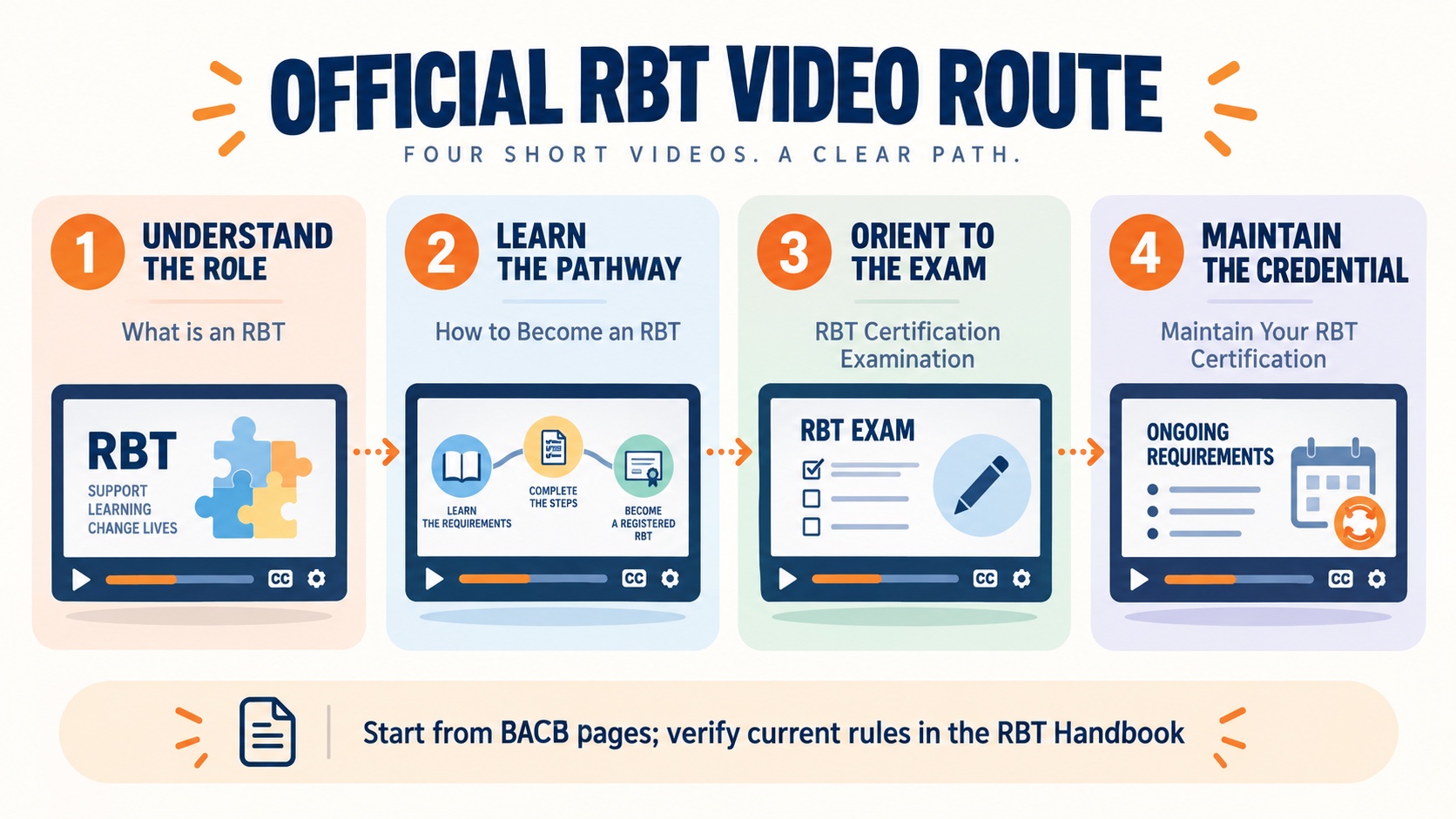
1. What is an RBT. This is an orientation video. It helps a prospective technician understand the role and how RBT certification is used. It is a good first watch for someone who is still deciding whether the credential matches the work they want to do.
2. How to Become an RBT. This video outlines the certification route, including eligibility, application, examination, and related steps. Use it to make a question list. When the video mentions a requirement, open the current RBT Handbook and confirm the exact rule, timing window, document, and responsible person.
3. Maintain Your RBT Certification. This video is useful after certification or while planning the maintenance cycle. It discusses ongoing supervision and renewal. Be careful with older versions: a video description may refer to an earlier cycle, while the current handbook may contain newer requirements. Treat the live handbook and current BACB resource page as the controlling sources.
4. RBT Certification Examination Video. This official BACB resource explains the examination context. It can reduce uncertainty about the exam, but it is not a practice exam and does not reveal future questions. Pair it with the current RBT Test Content Outline, handbook, and deliberate practice.
What a video can and cannot do
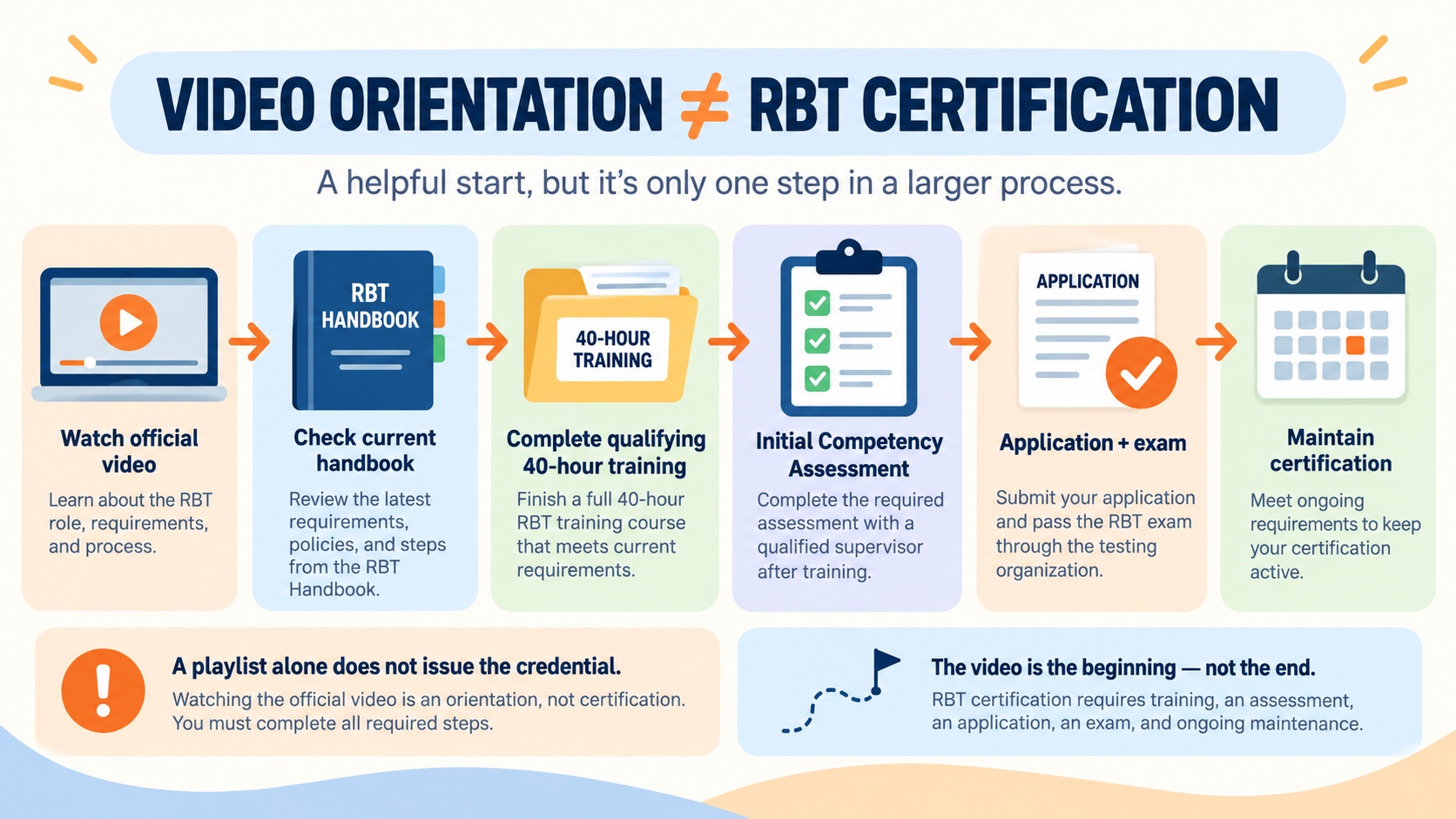
A video can introduce vocabulary, show the order of a process, and help you decide which official document to open next. It can also help a supervisor or instructor give a new technician a shared starting point. Those are valuable learning functions, but they are not the same as meeting a credential requirement.
Watching RBT videos does not, by itself, create an RBT credential. It does not automatically satisfy the current 40-hour training requirement, the Initial Competency Assessment, the application, the examination, or ongoing maintenance requirements. A third-party video playlist may be useful study support, but the creator cannot issue BACB certification just by marking a viewer’s progress complete.
Keep the boundaries visible when you study:
- Orientation: a video explains the role or route in accessible language.
- Training: a qualifying program must meet the current training requirements and document what was completed.
- Competency assessment: an authorized assessor evaluates performance using the current packet and method rules.
- Application and examination: the applicant follows BACB instructions and completes the required steps.
- Maintenance: a certificant follows current supervision, ethics, renewal, and other applicable requirements.
A video-plus-practice study session
Instead of letting videos play in the background, give each one a small job. Before watching, write one question: “What does an RBT do?”, “What are the next certification steps?”, or “What must I maintain?” During the video, record only the answer and the source document it points toward. Afterward, close the video and explain the process from memory.
Next, turn the explanation into retrieval practice. Make a short sequence card, answer two or three scenario questions, or explain why a training certificate is not the same as the RBT credential. If you miss a detail, return to the handbook rather than replaying the video repeatedly. The goal is accurate decision-making, not passive familiarity.
For instance, after an application video, close the tab and write the route in your own words: confirm eligibility, complete the applicable training, arrange the competency assessment, submit the application, wait for the determination, and follow the examination instructions. Then mark which steps came from the current handbook rather than from your memory. That small separation makes it easier to notice when a video is only giving an overview.
Repeat the same check for maintenance videos, because renewal and supervision details are easy to misremember.
For track-specific practice, the ABA Study Online RBT learning path and RBT practice questions can support review after you verify the official source version. The app review tools can help with spaced practice, but neither the website nor the app issues BACB certification or replaces the current official requirements.
How to check a third-party RBT video
- Identify the publisher: is the video on a BACB page or the official BACB channel, or is it from a course seller, tutor, or anonymous account?
- Check the date and edition: does it name the current handbook, TCO, or transition period?
- Separate explanation from authority: does the presenter clearly tell you to verify requirements in the live BACB sources?
- Look for scope: does it promise certification, a guaranteed pass, or a qualifying certificate merely for watching?
- Protect privacy: avoid videos that display identifiable client information or invite learners to record real sessions without appropriate authorization.
A polished video can still be outdated. A casual video can still explain a stable concept correctly. Evaluate the claim, the date, and the source separately. For changing rules—especially training, assessment, supervision, renewal, or transition requirements—open the current BACB page before acting.
It is also worth saving a short source note with your playlist: the official page where you found the video, the video title, the date you watched it, and the handbook or outline you used to verify the takeaway. If the video later disappears, changes its description, or is replaced by a newer version, you still know which official document should be checked next.
RBT YouTube FAQ
Does BACB have an official YouTube channel?
BACB’s official resource pages state that its videos are available through the BACB Videos page or the BACB YouTube channel. Starting from the BACB website helps you identify the intended video and avoid look-alike uploads.
Which RBT video should I watch first?
Start with What is an RBT if you are learning the role. Watch How to Become an RBT when you need the pathway. Use the examination and maintenance videos for those specific questions, and confirm current rules in the handbook.
Can watching RBT YouTube videos count as the 40-hour training?
Not automatically. A video playlist is not automatically a qualifying 40-hour training program. Confirm the current BACB training requirements and the provider’s documentation before treating any course as a training pathway.
Are all RBT videos on YouTube official?
No. YouTube contains official BACB videos and third-party study content. Check the publisher, link back to the BACB source, date, edition, and claims made by the presenter.