RBT Training: The Current 40-Hour Requirement and Next Steps
RBT training is the instructional preparation required before an applicant moves through the rest of the Registered Behavior Technician certification process. For applicants applying on or after January 1, 2026, the training must meet the current BACB 40-hour training requirements. The program must cover the required curriculum, fit the current time window, and include active learning components rather than relying on reading alone.
Training is still only one stage. A training certificate does not, by itself, make someone an RBT. The current pathway also separates the initial competency assessment, application documents, examination, and ongoing supervision. This guide explains how to evaluate a training program without endorsing a particular provider or treating a general course description as an eligibility decision.
What RBT training is—and is not
RBT training is structured instruction for people preparing to provide behavior-analytic services as Registered Behavior Technicians. The current BACB RBT page describes RBT as a paraprofessional certification and places RBT practice under the direction and close supervision of an RBT Supervisor and/or RBT Requirements Coordinator.
That means a training program should help a learner understand both procedures and professional boundaries. A learner may study measurement, reinforcement, skill acquisition, behavior reduction, documentation, and ethics, while also learning when to follow a supervisor’s plan, how to record observable information, and how to ask for feedback. Training should not encourage a new technician to design a complete intervention independently or make a certification decision for someone else.
Training is not the same as:
- RBT certification: completing a course does not replace the current application and examination process.
- Initial competency assessment: the assessment is a separate demonstration and evaluation of applicable skills after training.
- Ongoing supervision: a certificate does not remove the supervision and maintenance responsibilities that apply once a person is practicing.
- A state license or employer clearance: local laws, background checks, payer rules, and organization requirements may add conditions beyond BACB certification.
The current 2026 training rules
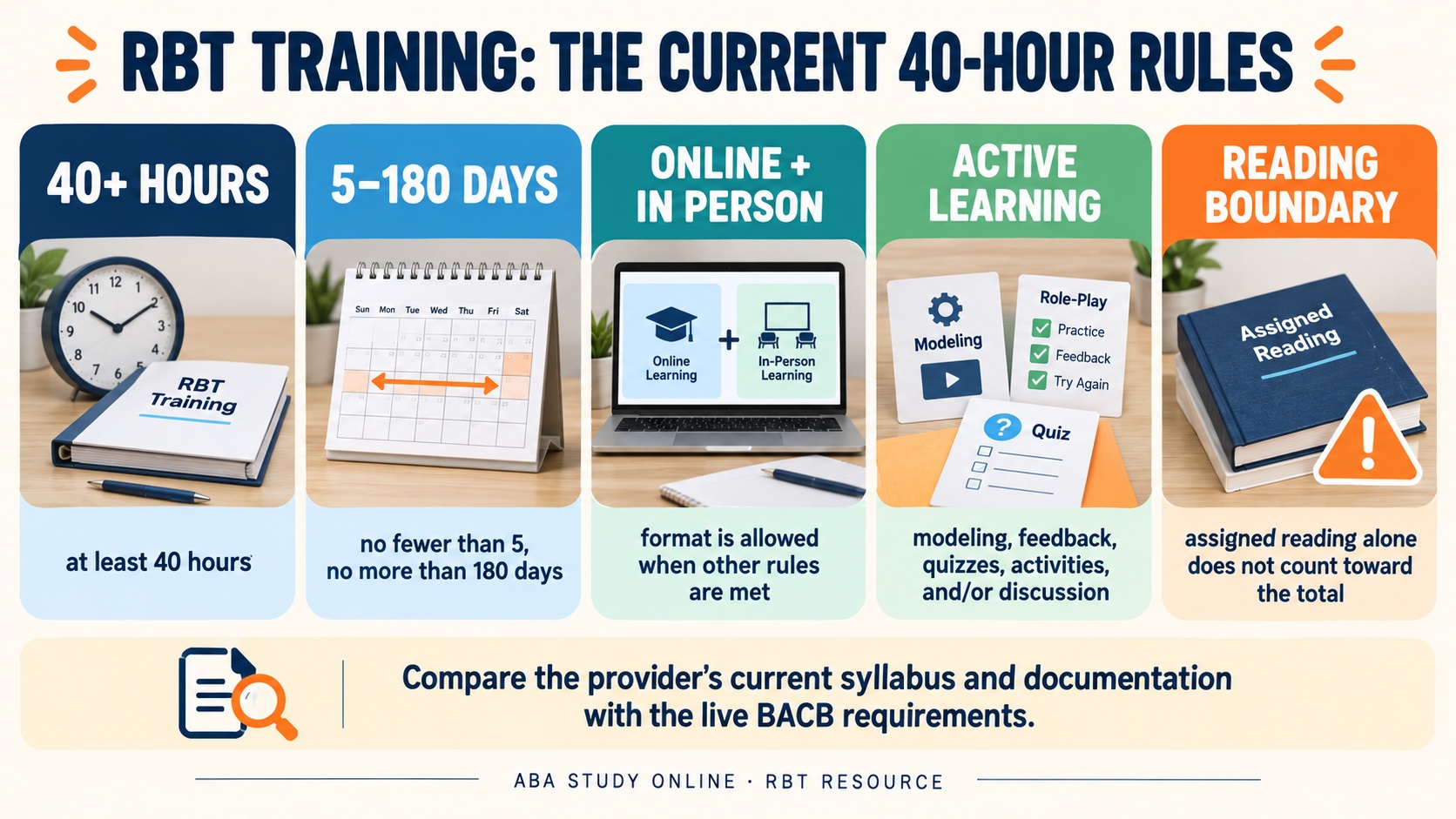
The current BACB 40-hour training requirements set several concrete boundaries:
- At least 40 hours: the training must cover the current curriculum outline and total at least 40 hours.
- No fewer than 5 days: the training cannot be compressed into a shorter period than the current minimum window.
- No more than 180 days: the start and end dates count toward the completion window. A provider should make the dates and attendance record clear.
- Online and/or in-person delivery: the current requirements allow these delivery formats when the program meets the other requirements. “Online” is a format, not a shortcut around quality or documentation.
- Active learning: the requirements describe behavioral-skills-training components that may include didactic or video instruction, modeling with exemplars and nonexemplars, in-vivo role-play with feedback, quizzes, interactive activities, and/or instructor-led discussion.
- Reading boundary: assigned readings alone may not count toward the overall training duration.
These rules are easy to turn into a misleading advertisement. For example, “40 hours online” does not tell you whether the course fits the full curriculum, includes interactive learning, keeps records, or provides the documentation needed for an application. Ask for the program’s current requirements statement and compare it with the live BACB source.
What the training should teach
The current training outline organizes content around the work of a behavior technician. It includes foundations of applied behavior analysis, preparing for service delivery, data collection and graphing, assisting with behavior assessments, behavior-change interventions, documentation and reporting, professionalism, and next steps in the certification process. The exact outline and durations belong to the current official document, so this list is a study orientation rather than a replacement for the curriculum.
When you review a provider’s syllabus, look for a connection between the heading and the skill. A section called “data” should give you a chance to describe behavior in observable terms, practice a recording procedure, summarize a result, and recognize why unreliable data matters. A section called “interventions” should connect procedures to the written plan, implementation fidelity, feedback, and the supervisor’s role. A section called “ethics” should address dignity, confidentiality, professional communication, and when to seek help.
Strong training does not have to look identical in every format. An online program might use demonstrations, practice prompts, quizzes, interactive slides, and role-play with feedback. An in-person program might use live modeling and coached practice. The relevant question is whether the learning activities help you do, describe, and reflect on the skill—not whether the course uses a particular platform.
The current RBT 3rd-edition Test Content Outline also helps connect training to examination study. Its content beginning in 2026 includes data collection and graphing, behavior assessment, behavior acquisition, behavior reduction, documentation and reporting, and ethics. Use the current outline to organize review, but do not assume that a study summary or provider quiz is an official BACB exam item.
How to evaluate a training provider
The BACB does not provide a universal list of recommended commercial 40-hour programs. A provider-evaluation checklist is therefore more useful than a brand ranking:
- Check the current date and version. Does the program explicitly say which 2026 requirements it follows? If the page only discusses older training rules, ask for clarification before enrolling.
- Confirm the total and window. Can the provider show at least 40 hours completed across no fewer than 5 and no more than 180 days?
- Review the curriculum map. Can you see how the major training areas are covered without relying on a vague “ABA basics” label?
- Look for active learning. Are there demonstrations, exemplars and nonexemplars, role-play with feedback, quizzes, interactive activities, or instructor-led discussion?
- Identify the responsible trainer. The current requirements identify a Responsible Trainer who is a BCaBA, BCBA, or BCBA-D with the required supervision training. Check the live source for the current trainer and assistant-trainer conditions.
- Ask about records. Will the provider record your start/end dates, completed hours, participation, responsible trainer, and required certificate information?
- Separate claims from guarantees. A provider can describe its curriculum and documentation. It should not promise BACB approval, a passing examination result, or a certification outcome it does not control.
Price, convenience, and delivery format can matter to your decision, but they do not replace the source audit. Save the course page, syllabus, receipt, attendance records, and certificate in one folder. If the provider updates its materials, record the version/date you completed rather than assuming a later page describes your course.
What happens after training
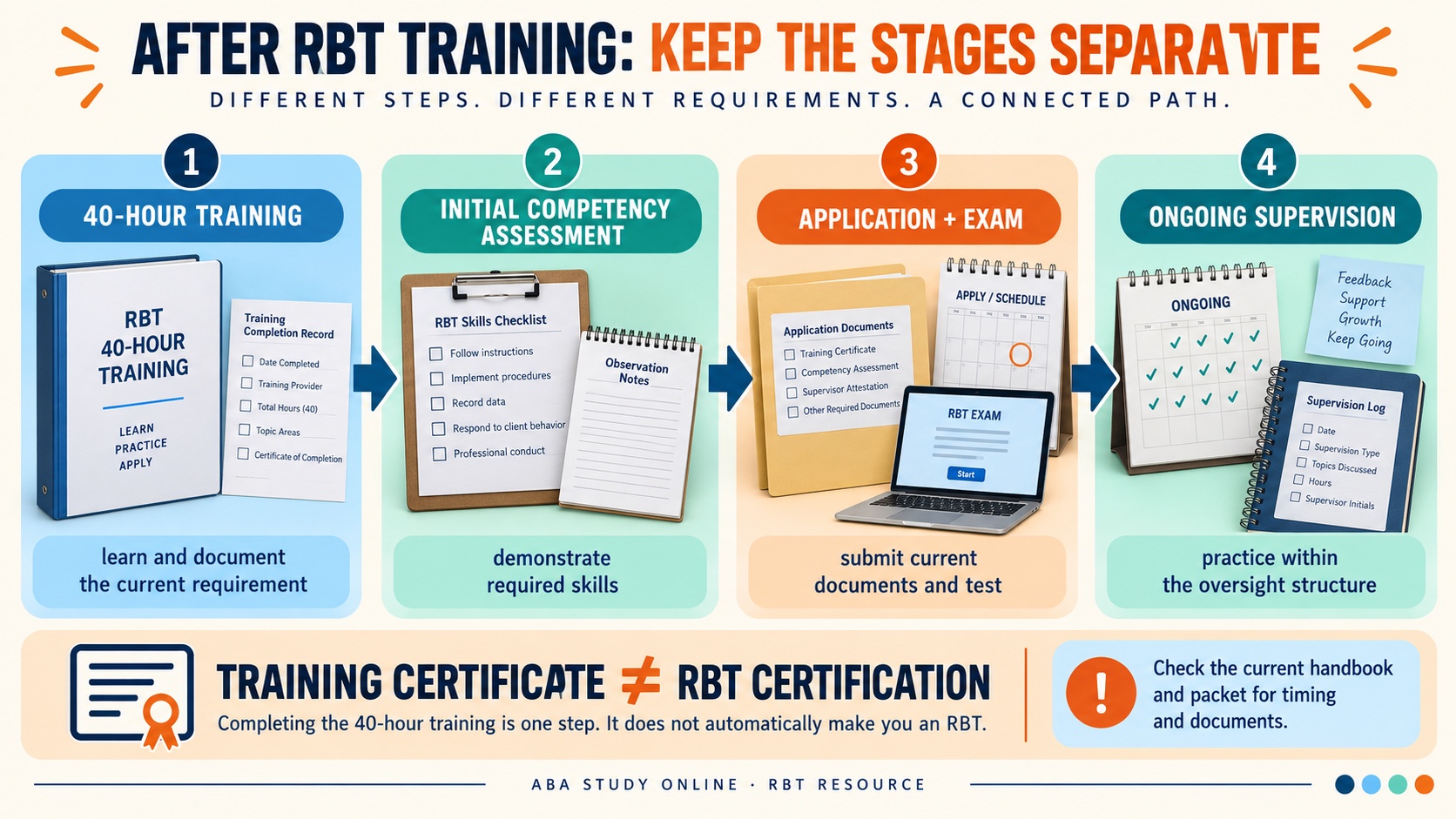
After completing the required training, the learner still needs to follow the current application pathway. The January 2026 RBT Handbook and the current initial competency assessment materials explain the timing and documentation rules. In general planning terms, the stages are:
- Complete and document the current training. Keep the certificate and the records that support it.
- Complete the initial competency assessment. This is a separate assessment of demonstrated skills after training and within the current application window. It is not the written examination.
- Submit the application and required documents. Use the current BACB Portal and the forms named in the current handbook/application instructions.
- Prepare for and take the examination. Use the current RBT Test Content Outline and official examination information. A training quiz is not automatically an official exam question.
- Practice under the current supervision structure. Once practicing, follow the ongoing supervision and maintenance rules that apply to RBTs.
The BACB supervision and training page separates the people who supervise ongoing RBT services, assess RBTs, and train RBTs. That separation is helpful when a provider says “our instructor can sign everything.” Ask which role the person is performing and which current document controls that role.
A practical planning example
Imagine Sam finds an online program advertising “RBT training in one weekend.” Sam likes the price and wants to begin quickly. Before enrolling, Sam checks the current requirements and notices two immediate questions: the program appears shorter than the minimum five-day window, and the page does not explain how interactive practice or feedback works.
Sam emails the provider for its current syllabus, start/end-date policy, responsible-trainer information, active-learning plan, attendance records, and certificate details. The provider cannot answer clearly, so Sam does not treat the advertisement as proof of eligibility. Sam compares another program’s documentation with the official BACB requirements and still confirms the personal application plan through the current handbook and supervisor.
This example is not a recommendation for one provider. It shows the decision habit that matters: convert a marketing claim into a source-backed question. “Fast,” “online,” “includes everything,” and “guaranteed” are not requirement categories. Hours, dates, curriculum, learning components, responsible trainer, records, assessment, application, examination, and supervision are.
Common mistakes and FAQ
How many hours is RBT training? The current requirement is at least 40 hours, completed in no fewer than 5 days and no more than 180 days. Check the live BACB requirements for the version that applies to your application.
Can RBT training be online? The current requirements allow online and/or in-person delivery when the program meets the other curriculum, learning, trainer, and documentation requirements. Online delivery alone does not prove that a program qualifies.
Does finishing the 40-hour course make me an RBT? No. Training is one eligibility step. The current pathway also includes the initial competency assessment, application, examination, and maintenance/supervision requirements.
Can assigned reading count as all 40 hours? The current requirements state that assigned readings may not count toward the overall training duration. Ask how the provider documents interactive instruction and participation.
What should I study after training? Review the current RBT Test Content Outline, revisit training materials, prepare for the initial competency assessment with the responsible assessor, and bring questions to your supervisor or program contact. Free RBT Theory Blocks and practice questions on ABA Study Online can support concept review, but they do not replace the official handbook or assessment.
Good RBT training leaves you with more than a certificate. It gives you an evidence trail, practice with feedback, a clearer understanding of professional boundaries, and a realistic next-step plan. Use the current BACB sources to verify the rules, then use study tools to make those rules and skills easier to retrieve.