RBT Training Providers: How to Compare a 2026 Course
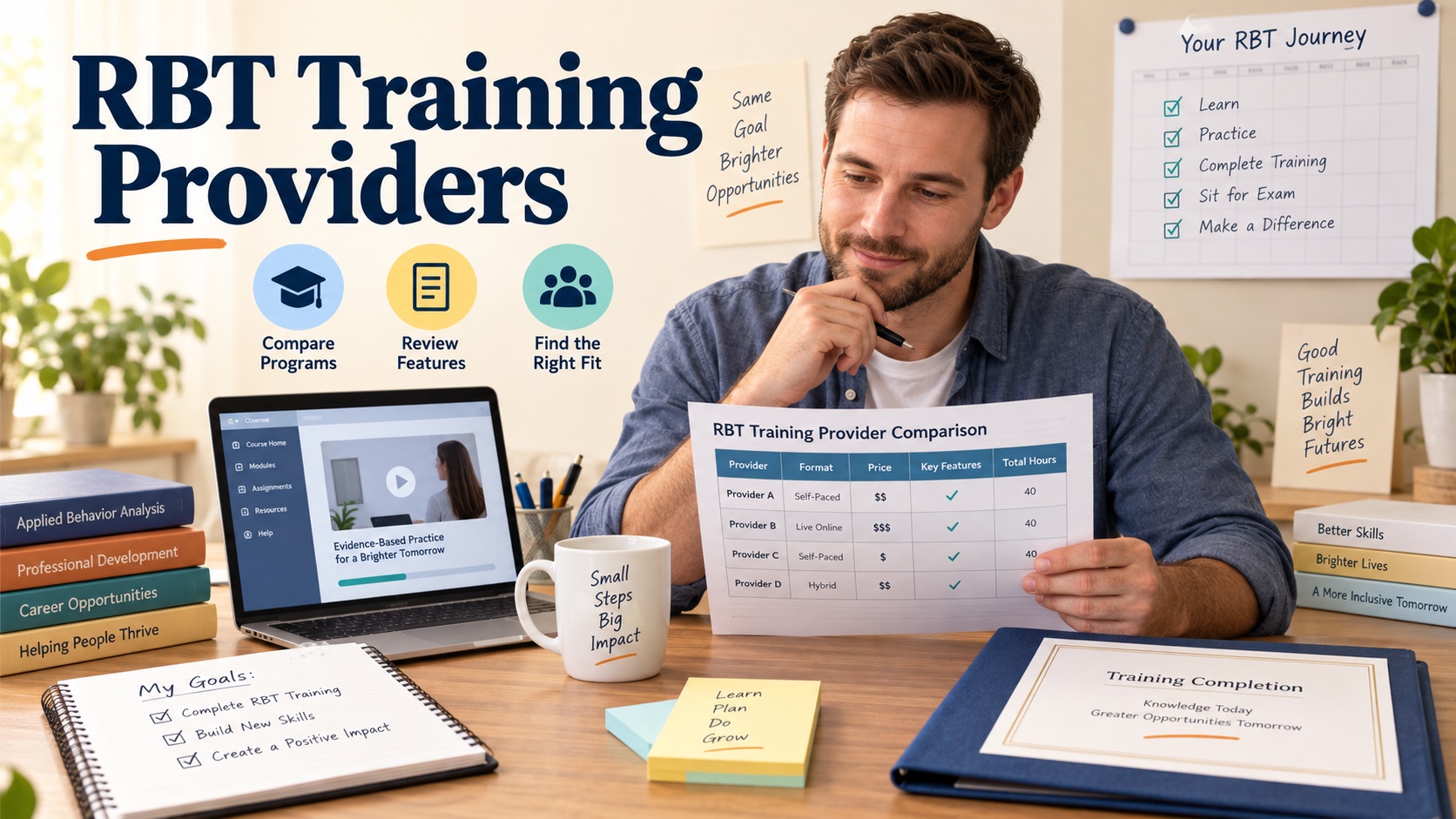
If you are comparing RBT training providers, the most useful question is not “Which provider looks most official?” It is “Can this provider show how its current course meets the requirements that apply to my RBT application?” In 2026, an RBT training program may be offered by an employer, a university, or an online program. The delivery format is only one part of the decision.
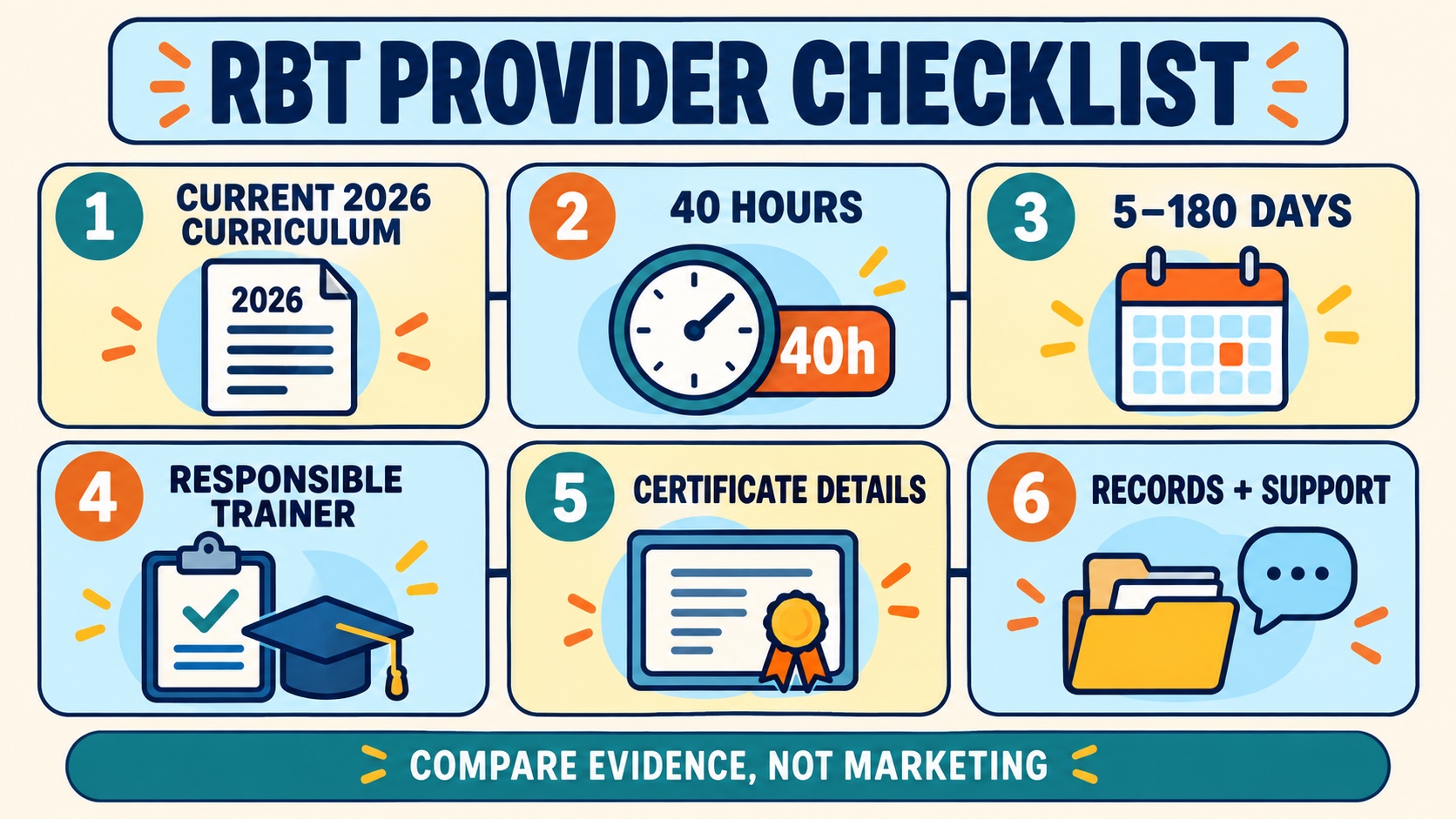
A careful comparison checks the current curriculum, at least 40 hours, the 5-to-180-day completion window, the responsible trainer, learning activities, certificate details, records, and support. It also keeps training separate from the Initial Competency Assessment, application, examination, and ongoing supervision. This guide gives you a neutral checklist. It does not rank providers, create a provider directory, or imply that the BACB recommends a particular course.
Table of Contents
Short answer: what should an RBT provider prove?
A responsible provider should make its course evidence easy to inspect. The current BACB RBT Handbook says the required training must meet the 2026 RBT 40-Hour Training Requirements and Curriculum Outline, be completed in no fewer than 5 days and no more than 180 days, and produce a certificate that can be included with the certification application. The Handbook also says the BACB does not provide 40-hour training, certificates of completion, or training-program recommendations.
That means a provider’s phrase such as “BACB approved,” “official RBT course,” or “get certified online” should not be your only evidence. Ask what the phrase means, which document version the course follows, who is responsible for the training, how completion is recorded, and which steps remain after the course. A clear answer is more useful than a badge that cannot be verified.
The 2026 RBT provider checklist
Use the following checks before enrolling. You can put each provider in a separate column and write down the evidence rather than relying on memory.
1. Current curriculum and version
Look for a direct reference to the current 2026 RBT training requirements. The course should explain how it addresses service-delivery preparation, data collection and graphing, assistance with behavior assessment, behavior-change procedures, documentation and reporting, ethics, and the other areas in the current outline. A general “ABA basics” description is not enough to show current coverage.
The RBT examination also has its own current Test Content Outline. Do not assume that a training course and an exam outline are the same document. A good provider explains its training scope without claiming that its lessons are official BACB examination content or that its quizzes predict a passing result.
2. At least 40 hours
The course must document at least 40 hours of training. Ask how the provider measures time and what counts toward the total. A platform that displays a 40-hour label but cannot explain attendance, lesson completion, activity time, or the final record gives you very little to verify.
3. The 5-to-180-day window
The current rule is not simply “finish whenever you want.” Training must be completed in no fewer than 5 days and no more than 180 days, counting the start and end dates. Before you begin, write down the start date and the latest allowable completion date. Then check whether live sessions, practice activities, feedback, or technical delays fit inside that window.
4. Responsible trainer and learning design
Find out who is responsible for the course and what qualifications apply to that role. The BACB’s supervision and training resource distinguishes training RBTs from assessing RBTs and supervising RBTs. Those responsibilities should not be blurred together in a sales page.
Then inspect how the course teaches. A useful program may combine explanation, modeling, examples and nonexamples, scenario decisions, role-play, feedback, quizzes, and opportunities to retrieve information. A video library can be helpful, but the number of videos alone does not show that the course teaches a learner to observe behavior, collect data, follow a written procedure, document sessions, or ask for supervisor direction.
5. Certificate details and records
Ask to see a sample certificate or a clear list of the information it will contain. Confirm the trainee’s name, course dates, total hours, responsible trainer information, and any current required statement. Read the certificate before you need it. If a spelling error, missing date, or unclear trainer field appears at the end, it may take time to correct.
Also ask how the provider retains records and handles a completion dispute. Save your enrollment confirmation, course version, start and end dates, progress records, activity evidence, provider contact information, and final certificate in one folder. Recordkeeping is not exciting, but it is part of making the training evidence usable.
6. Support that matches the learner’s needs
Price and pace matter, but support may matter more. Compare whether you can ask content questions, revisit lessons, receive feedback on activities, access captions or transcripts, and obtain help when a record is incomplete. A self-paced learner may need predictable response times; a live learner may need a policy for missed sessions. Write down the support promise instead of assuming that a large course catalog means personal help.
How to compare course formats
| Format | Potential strength | What to verify |
|---|---|---|
| Self-paced online | Flexible scheduling and easy review of lessons. | Time tracking, active practice, feedback, trainer access, and the 5-to-180-day record. |
| Live online | Real-time demonstrations, questions, and discussion. | Attendance, missed-session rules, practice feedback, and how completion is documented. |
| Blended | A mix of flexible study and scheduled practice. | Which activities count toward 40 hours and who signs off on the final record. |
| Employer or university | Potential access to workplace or academic support. | Whether the program meets the current outline and whether the provider is independent of the applicant where the rule requires it. |
There is no universal “best” format. Consider your available time, need for feedback, technology access, language or accessibility needs, and ability to maintain the date window. A polished interface is not proof of compliance, and a low price is not proof that a course is incomplete. Compare evidence first, then compare convenience and cost.
Training versus certification
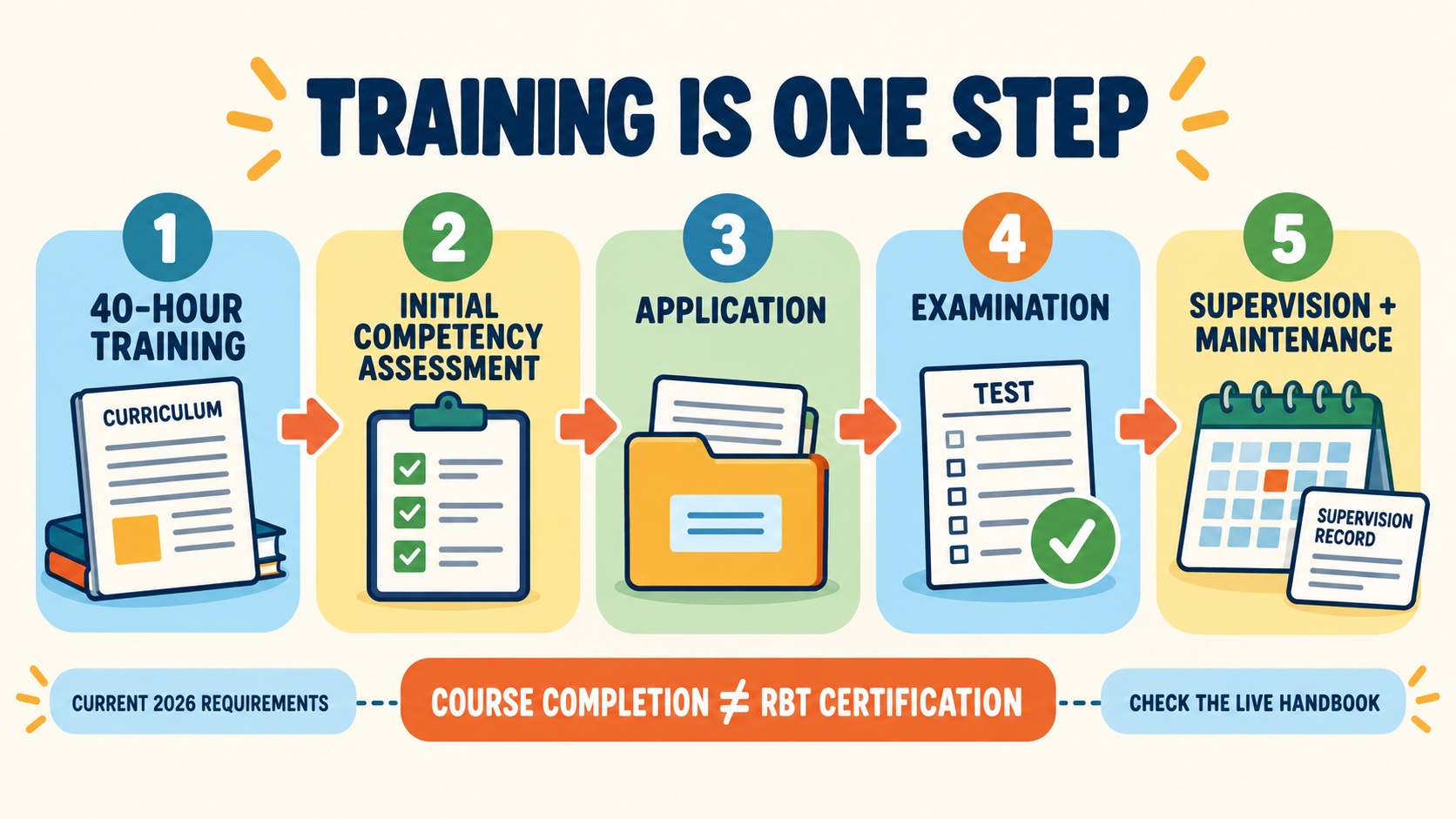
One of the most important provider checks is whether the sales page describes the rest of the pathway honestly. A qualifying 40-hour course is one requirement. It does not by itself make someone an RBT.
After training, the applicant must complete the applicable Initial Competency Assessment, prepare the application documents, follow the BACB application process, and take the official examination when authorized. After certification, ongoing supervision and maintenance requirements still apply. A course quiz is not the Initial Competency Assessment, and a practice exam is not the official RBT examination.
This boundary is useful when comparing providers. One provider may offer optional study questions; another may offer assessment coordination; a third may only offer the 40-hour course. Those services should be described separately so you can identify what is included, what costs extra, and which task belongs to someone else. The BACB’s current supervision and training page is the better source for role qualifications than a generic provider slogan.
Provider red flags
A red flag is a reason to verify, not automatic proof that a provider is dishonest. Pause before enrolling when a course:
- promises that one payment or certificate makes you an RBT;
- uses “BACB approved” or “official” language without identifying the current requirement and what the claim actually means;
- never names the 2026 curriculum, responsible trainer, or completion dates;
- encourages completing all 40 hours in less than 5 days or leaves the 180-day limit unexplained;
- counts reading or a timer as the entire learning experience and offers no meaningful practice or feedback;
- calls a multiple-choice quiz the competency assessment;
- cannot explain what will appear on the certificate or how records are corrected; or
- claims that its practice questions guarantee a passing score.
When a claim conflicts with the current Handbook, pause and use the official document as the controlling source. ACE Provider status also needs careful interpretation: ACE is a route for continuing education and professional development events, not a shortcut for proving that a private 40-hour initial RBT course is BACB-recommended.
A simple comparison worksheet and FAQ
For each provider, record the course name and version, total hours, start and end dates, delivery format, curriculum reference, responsible trainer, practice and feedback model, certificate fields, record-retention process, support contact, total price, and what happens after completion. Leave a blank beside any answer the provider cannot document. This worksheet turns a vague “best course” search into a decision you can explain.
Can RBT training be completed online?
Yes. The current BACB RBT Handbook allows the 40-hour training to be offered by an employer, university, or online training program. The provider still needs to meet the current requirements and document completion.
Does the BACB recommend a specific RBT training provider?
The BACB publishes requirements and resources, but it does not provide 40-hour training, completion certificates, or training-program recommendations. Compare provider evidence with the current Handbook and training outline.
Is an ACE Provider automatically an RBT training provider?
No. ACE Provider status concerns authorized continuing education and professional-development events. It should not be treated as automatic proof that a provider’s initial 40-hour RBT course meets every current requirement.
Can ABA Study Online certify me as an RBT?
No. ABA Study Online can support RBT theory review, practice questions, glossary work, and study organization. It does not replace a qualifying 40-hour training, Initial Competency Assessment, application, official examination, or ongoing supervision.
For study support, use the RBT learning path, free RBT practice questions, ABA glossary, free resources library, and app review tools. Keep the roles clear: a provider supplies a course, the BACB controls the certification requirements, and your evidence should show the difference.