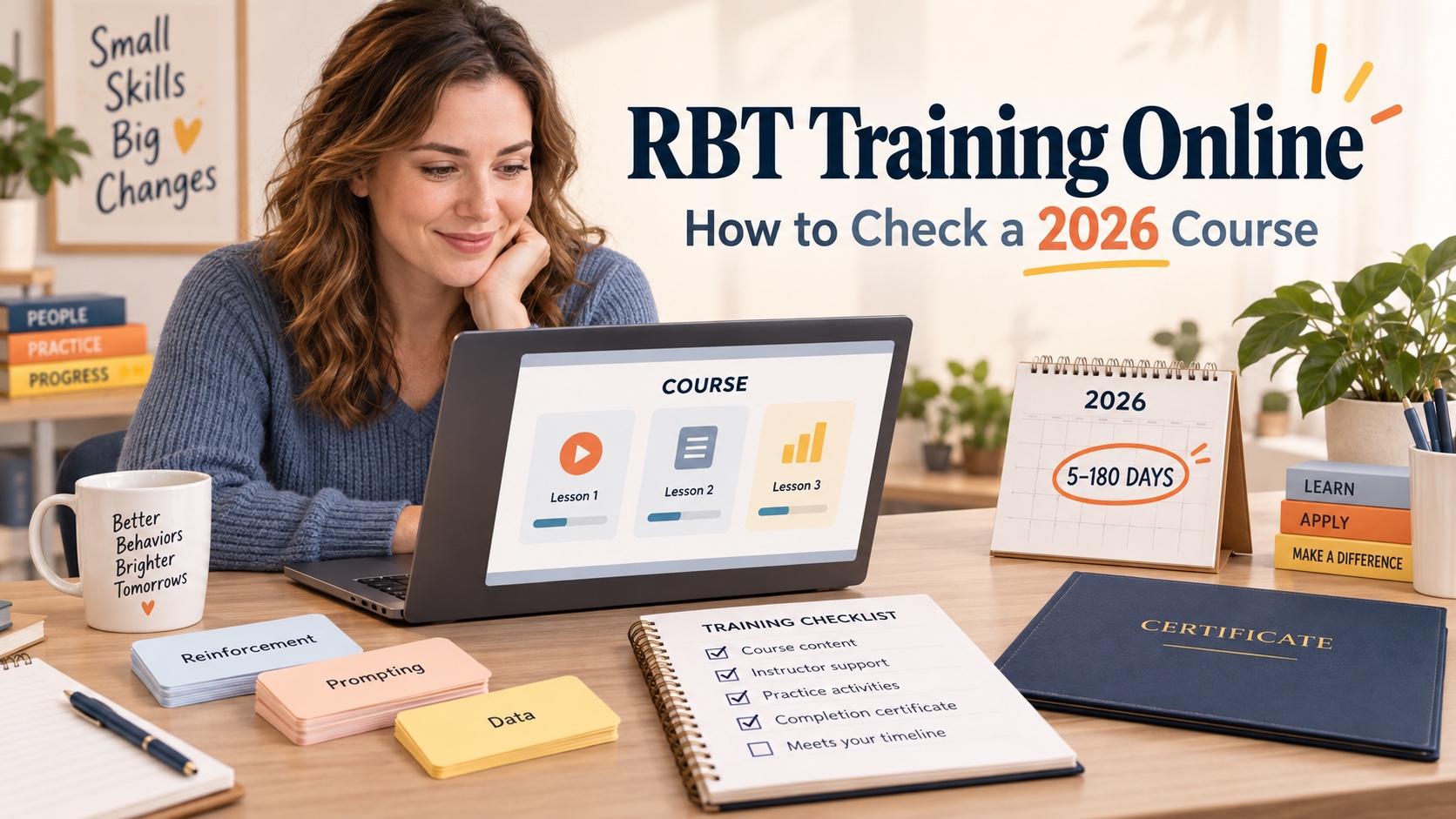
RBT Training Online: How to Check a 2026 Course
Yes, RBT training online can be an allowed delivery format under the current 2026 requirements. That answer comes with an important boundary: an online course is only one step in the RBT pathway. A qualifying course must meet the current 40-hour rules, use the required curriculum and learning activities, provide the right documentation, and be followed by the separate competency assessment, application, examination, and ongoing supervision steps.
Before you enroll, inspect the course evidence rather than relying on a “get certified online” headline. The BACB does not issue RBT certification through a private course, recommend a specific training provider, or turn a completion certificate into an automatic pass.
Table of Contents
What online RBT training can and cannot do
The current RBT Handbook allows the required 40-hour training to be offered by an employer, university, or online training program. The format can be online, in person, or a combination when the program meets the current requirements. This makes “online” a delivery choice, not a separate certification category.
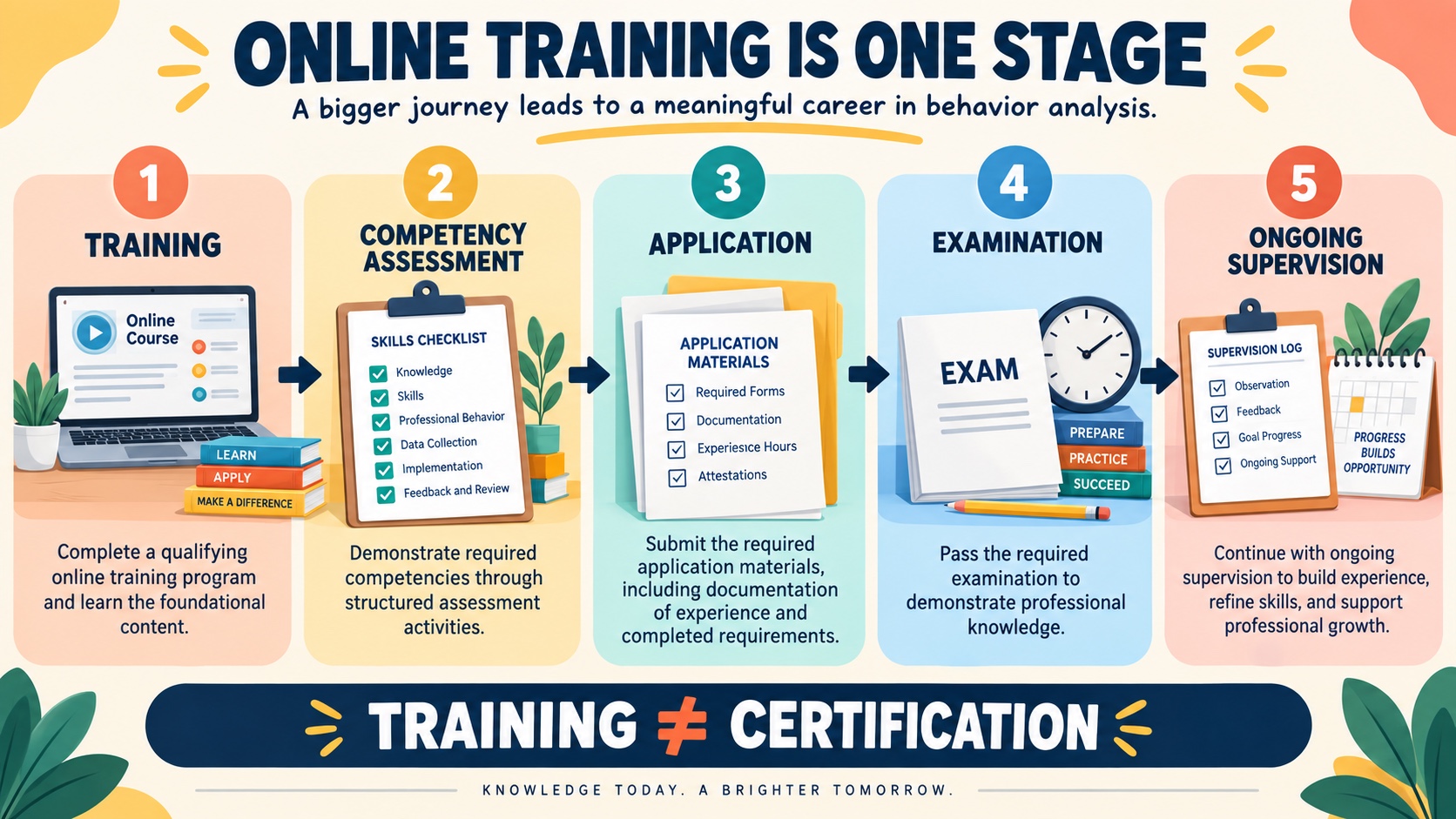
Completing the course can give you evidence that you completed the training requirement. It does not by itself make you an RBT. You still need the other eligibility steps that apply to your application, including the current initial competency assessment, application documents, examination process, and the ongoing supervision and maintenance requirements after certification.
That distinction protects you from two opposite mistakes. One is rejecting every online course as invalid even though online delivery is permitted. The other is assuming that any video library with a downloadable certificate satisfies the current requirements. The correct question is not “Is it online?” but “Does this specific program document all the required parts?”
The 2026 online-training checklist
Use these checks before paying or beginning the course.
1. At least 40 hours
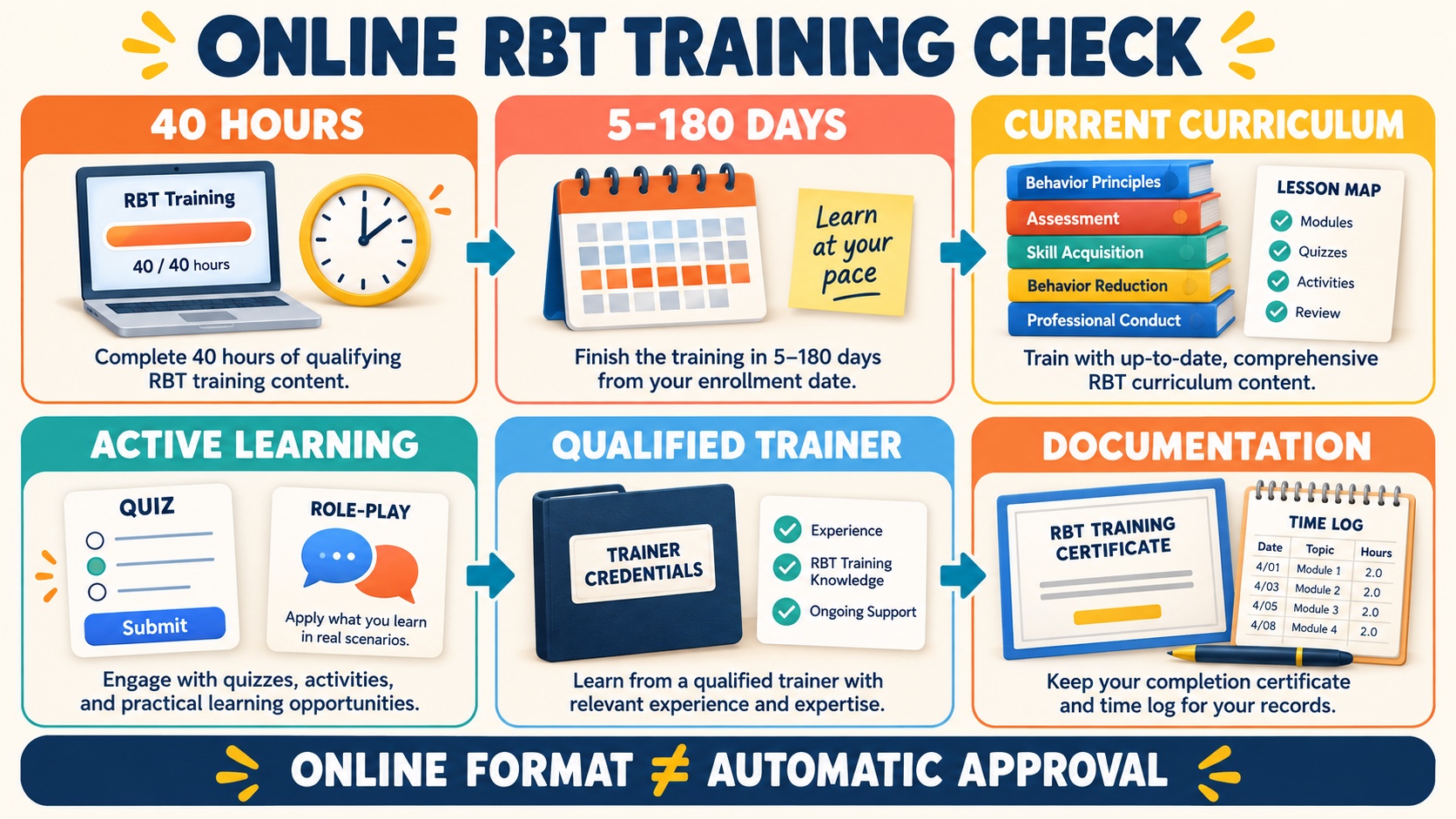
The training must include at least 40 hours covering the current curriculum outline. The official requirements note that the section minimums total 38 hours, with two additional hours allocated within the program to reach the 40-hour total. A provider should show how the hours are measured and how participation or completion is recorded.
2. A valid date window
Training must be completed in no fewer than 5 days and no more than 180 days. The start and end dates count in the window. A course that lets you click through all 40 hours in one afternoon may be convenient, but that schedule does not match the current timing rule. Look for a clear start date, end date, time log, or completion record.
3. Current curriculum coverage
The online program should identify the current 2026 curriculum rather than merely saying “ABA basics.” Broad topics include introduction to applied behavior analysis, preparation for service delivery, data collection and graphing, assisting with behavior assessments, behavior-change interventions, documentation and reporting, ethics, and professional conduct. You do not need a marketing page to reproduce every official task, but you do need enough information to see that the course is built around the current outline.
4. Active learning and behavioral skills training
The 2026 requirements allow online delivery but still expect components of behavioral skills training. A quality course may combine video or didactic instruction, modeling with examples and nonexamples, role-play with feedback, content quizzes, interactive activities, or instructor-led discussion. Assigned reading alone may not count toward the overall training duration.
This is where online programs can differ dramatically. A course with short lessons, scenario decisions, feedback, and opportunities to practice is easier to evaluate than a platform that only displays a timer beside a PDF. Ask how the program teaches you to observe behavior, collect data, follow procedures, document sessions, and respond to ethical situations—not only how many videos are in the library.
5. Responsible trainer and documentation
The current requirements identify a responsible trainer who is a BCaBA, BCBA, or BCBA-D with the required 8-hour supervision training. Assistant-trainer rules and provider conditions also apply. The course page should identify who is responsible for the program and explain how trainer information, attendance, hours, completion, and records are maintained.
The certificate is part of your application evidence. It should contain the information required by the current training document, including the trainee, dates, amount of training, responsible trainer information, and the required independent-of-BACB statement. Confirm the exact current wording and fields in the official source before relying on a provider’s older template.
Self-paced, live online, or blended?
There is no single best online format for every learner. Compare the support and evidence each format provides.
| Format | Potential strength | What to verify |
|---|---|---|
| Self-paced online | Flexible scheduling and the ability to revisit lessons. | How active practice, feedback, trainer access, time tracking, and attendance are documented. |
| Live online | Immediate instructor discussion, demonstrations, and questions. | Whether sessions are recorded or attended live, how role-play feedback works, and how missed sessions are handled. |
| Blended | A mix of flexible lessons and scheduled practice. | Which portions count toward the 40 hours and where the instructor documents participation and completion. |
For example, imagine two course pages. Course A says “40 hours online” but lists no responsible trainer, no date window, and no practice or feedback. Course B explains the current curriculum, shows a 5–180-day completion window, identifies the responsible trainer, includes scenario-based practice, and explains its certificate. Course B gives you more evidence to evaluate, even before you compare price or visual design.
Do not confuse convenience with quality. A longer course is not automatically better, and a polished interface is not proof of compliance. Look for transparent information and a support process you can actually use.
Save the evidence while you learn
Create a small training folder before you begin. Save the enrollment confirmation, course version or outline, start and end dates, time records, quiz or activity evidence, trainer details, and final certificate. If the program uses a learning platform, record how you accessed the lessons and how completion was verified. This is especially helpful when the course is self-paced and the screen showing your progress is not the same document as the final certificate.
Keep a separate note for questions that belong to the competency assessment or examination. A training lesson may teach a concept, while the assessment checks performance and the exam checks knowledge. Separating those notes helps you see what you still need to practice instead of assuming that finishing a video means every next step is complete.
Plan the date window before you click “start”
Choose a realistic start date and write the latest allowable completion date beside it. Then check the schedule for live sessions, feedback, holidays, and any required instructor interaction. A flexible online format should make the 5–180-day window easier to manage, not hide it. If a provider cannot explain how the dates are calculated, pause before enrolling.
Good planning leaves time for questions, practice, and documentation review before final submission.
What happens after the course
The next step is the initial competency assessment, not a claim that you are already certified. The assessment is a separate demonstration of RBT skills using the current packet and timing rules. It is more than a multiple-choice quiz about the videos. Confirm who may assess you, which version of the packet applies, how the tasks will be observed, and what documentation must be submitted.
After the assessment, the application stage requires the current forms and supporting documents. The written RBT examination is another separate stage. Passing a course quiz does not equal passing the BACB examination, and an online mock exam is not the official examination. After certification, ongoing supervision and maintenance still apply.
Online-training red flags
- Instant certification language: a course provider cannot promise that a certificate itself makes you an RBT.
- No current version: the page never identifies the 2026 training requirements or curriculum.
- One-day completion: the advertised schedule ignores the minimum 5-day window.
- Reading-only hours: the program counts assigned reading as the entire training experience.
- No responsible trainer: the provider hides who designed and oversees the training.
- Generic certificate: the certificate omits dates, hours, trainer information, or the current required statement.
- Official endorsement claims: the course uses BACB branding or implies that the BACB recommends it without evidence.
- No record process: there is no answer about attendance, completion, audit records, or how to correct a documentation error.
A simple decision plan and FAQ
What should I ask before enrolling?
Ask for the current curriculum reference, total hours, allowed date window, delivery format, behavioral-skills-training components, responsible trainer’s credentials, certificate fields, record-retention process, and what support is available for the separate competency assessment. Save the answers with your enrollment records.
Can I finish RBT training online in less than five days?
The current training requirement is no fewer than 5 days and no more than 180 days, so a program’s total duration and date window need to fit both boundaries. Use the current Handbook and training outline if a provider’s schedule is unclear.
Does an online RBT course include the competency assessment?
Not automatically. The competency assessment is a separate skill demonstration with its own packet, assessor, format, and timing rules. Some providers may offer assessment support, but you must verify that the assessment itself meets the current requirements.
Can ABA Study Online certify me as an RBT?
No. ABA Study Online can support RBT theory review, original practice questions, glossary work, and study organization. It does not replace a qualifying 40-hour training, an initial competency assessment, the application, the official examination, or ongoing supervision.
For independent follow-up, use the RBT learning path, free RBT practice questions, ABA glossary, free resources library, and app review tools. Keep the roles clear: an online format can make training accessible, but the current requirements and the complete certification pathway still govern the result.