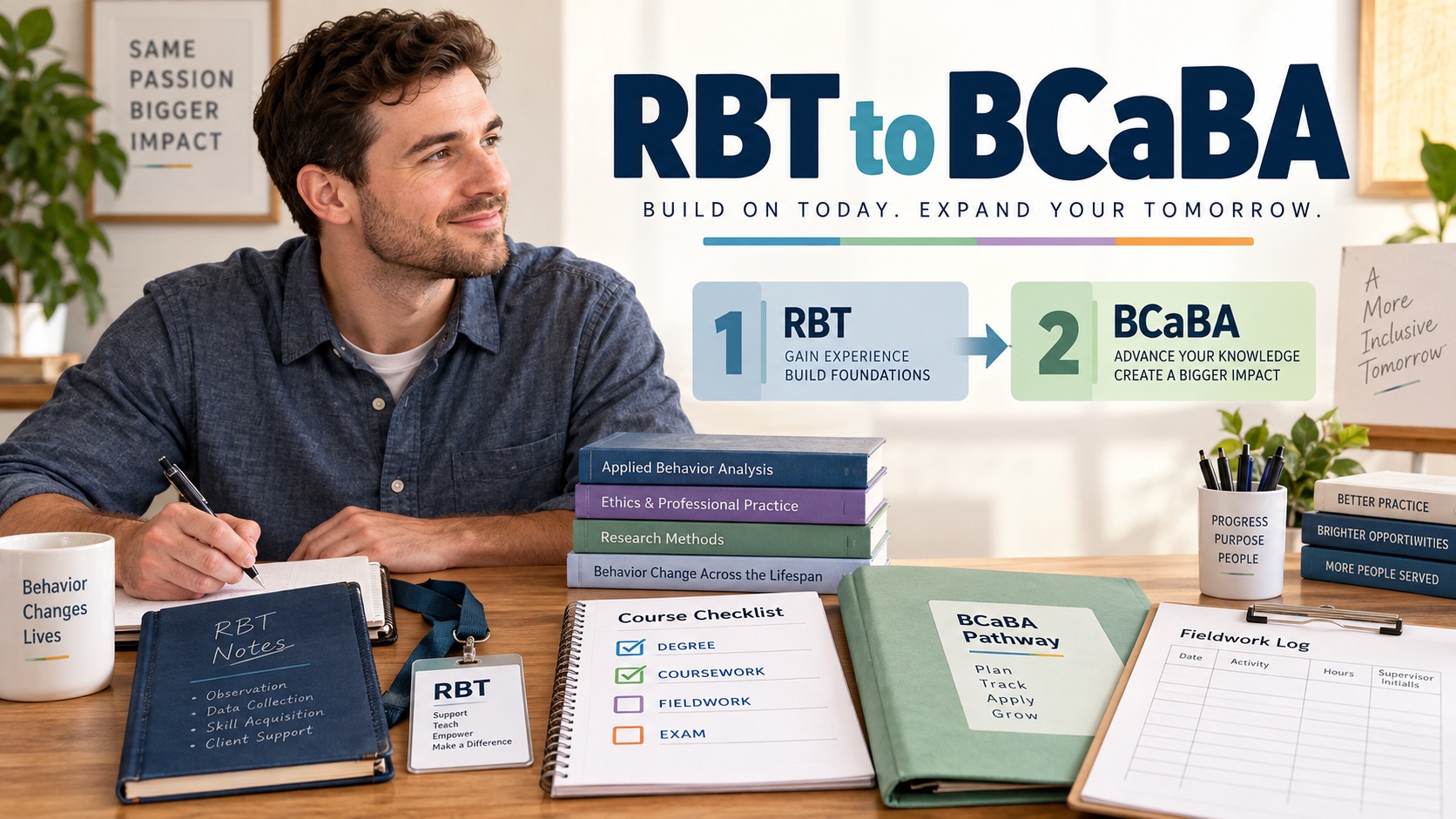
RBT to BCaBA: What Your Experience Can—and Cannot—Replace
If you are searching for an RBT to BCaBA path, you may already have practical experience with clients, data collection, skill acquisition, and behavior-analytic teamwork. That experience can make the next step feel familiar. It does not, by itself, turn an RBT credential into a BCaBA credential or guarantee that every RBT hour will count toward BCaBA fieldwork.
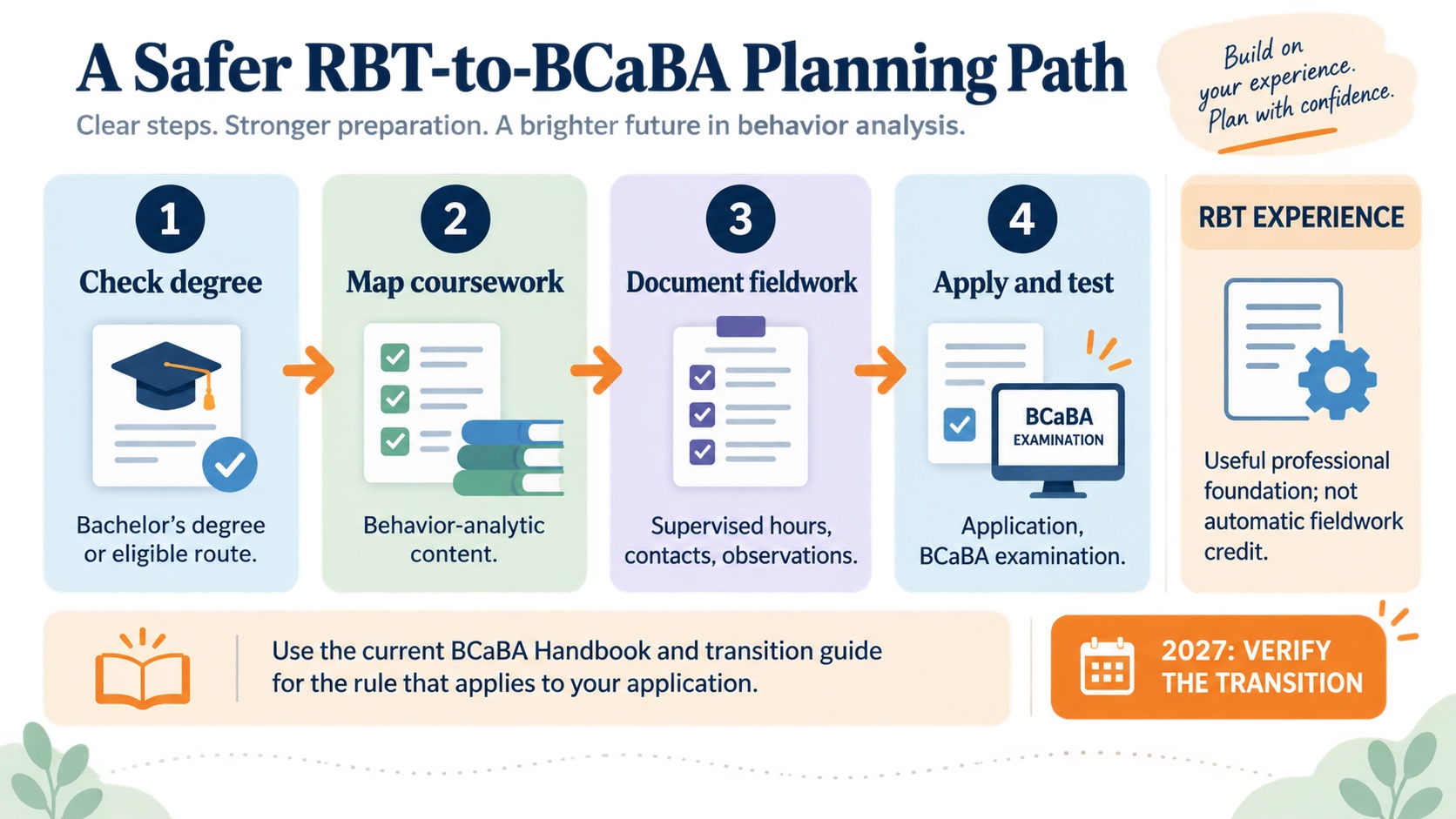
The safer way to plan is to treat your RBT background as a professional foundation, then audit the separate BCaBA requirements: an eligible bachelor’s degree, behavior-analytic coursework, supervised fieldwork, an application, and the BCaBA examination. The current BCaBA Handbook and the BACB’s 2027 transition materials control the details for your application.
Table of Contents
What an RBT background adds
RBT work can be valuable preparation because it puts behavior-analytic ideas into daily practice. You may already know how to follow a behavior plan, collect session data, prepare materials, communicate with a supervisor, and support skill-acquisition programs. Those habits can make coursework examples more concrete and help you recognize the difference between a definition in a textbook and a decision in a session.
Your RBT experience can also help you evaluate future fieldwork settings. You have seen how schedules, data systems, client preferences, caregiver communication, and team roles affect implementation. That perspective is useful when you ask whether a potential placement will expose you to the broader behavior-analytic activities expected of a BCaBA trainee.
But experience is not the same as a verified eligibility record. Keep two notes: skills and experience I have developed and activities that my BCaBA fieldwork documentation confirms. The first is a professional reflection. The second is an application record. Mixing them can create a false sense that your pathway is complete.
What BCaBA eligibility still requires
The BCaBA is an undergraduate-level certification. The BACB describes BCaBAs as professionals who provide behavior-analytic services under BCBA supervision and may supervise RBT work. Moving from RBT to BCaBA therefore changes the scope of preparation and responsibility; it is not simply a promotion attached to a certain number of RBT months.
At a high level, your plan needs to answer four questions:
- Do I have the right degree? Confirm the degree level, institution, date, and pathway that apply to your application.
- Does my coursework contain the required behavior-analytic content? A general bachelor’s degree is not automatically the same as a qualifying behavior-analytic coursework route.
- Is my fieldwork being supervised and documented under the current BCaBA rules? The fieldwork record must be more than a timesheet.
- Will I be ready to apply and take the BCaBA examination? Use the current handbook and Test Content Outline rather than an old RBT study plan.
For a starting overview of the RBT side, use the RBT learning hub. For the next credential, move to the BCaBA learning hub. The two tracks connect, but their scope, documentation, and examination tasks should remain clearly separated.
Why RBT hours do not transfer automatically
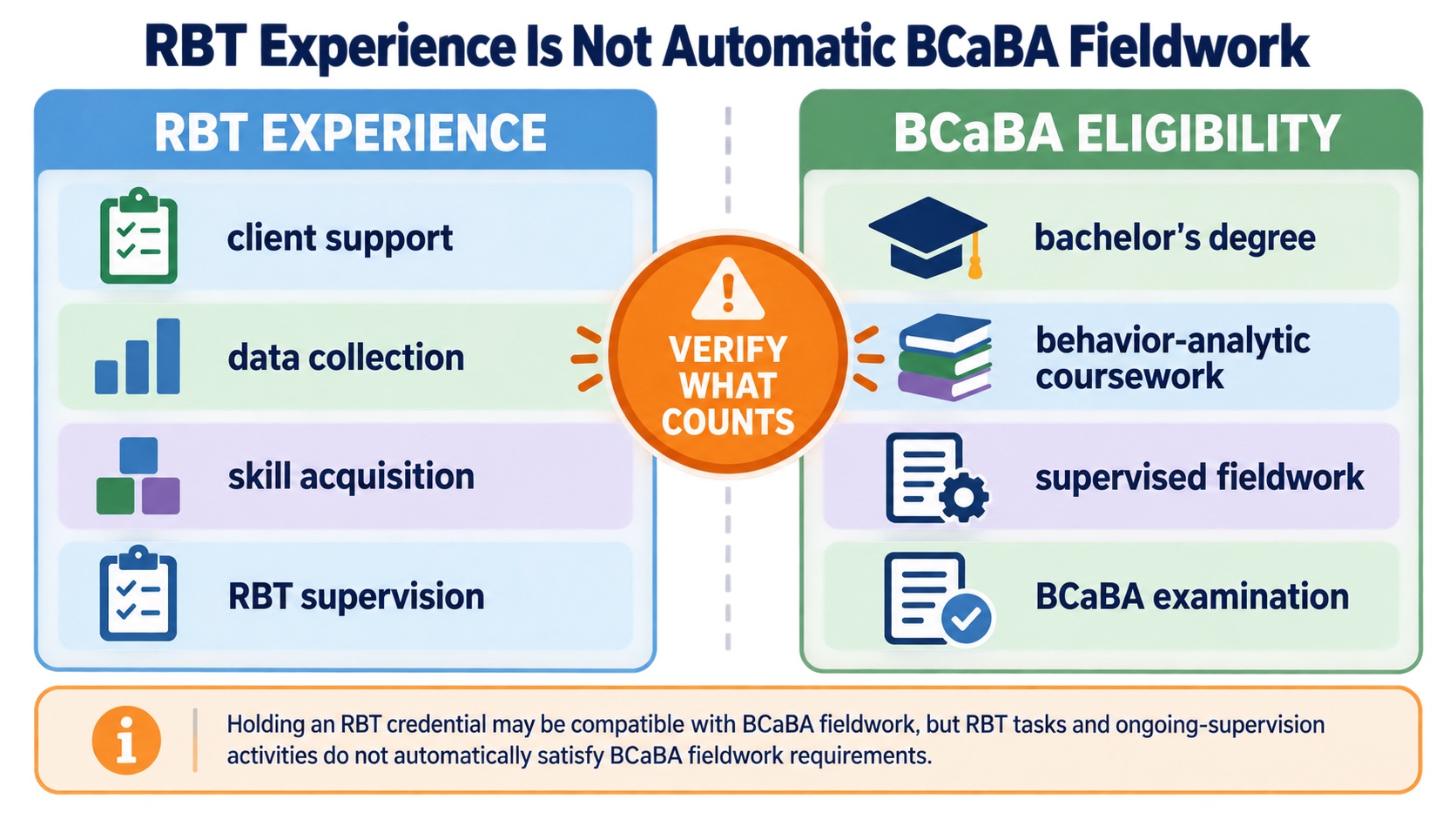
The current BCaBA Handbook states that trainees may hold an RBT certification while accruing fieldwork, while also warning that many tasks completed as part of RBT and RBT ongoing-supervision requirements may not count toward BCaBA fieldwork. That is the key boundary for this search query: holding both roles may be possible, but the role label alone does not approve every activity.
The handbook’s current high-level fieldwork snapshot describes either 1,300 hours of supervised fieldwork or 1,000 hours of concentrated supervised fieldwork when the more intensive supervision requirements are met. It also describes monthly ranges, contacts, client observations, supervision percentages, individual-supervision limits, and an unrestricted-activity requirement. These details make fieldwork a structured training record, not simply the total time you have been employed as an RBT.
Before counting an activity, ask whether it is being completed under the BCaBA fieldwork arrangement, whether it is documented on the correct form, whether the supervisor can verify it, and whether it represents the type of work the current requirement recognizes. Direct implementation of an RBT plan may be excellent clinical work without automatically being unrestricted BCaBA fieldwork.
What to save in your fieldwork folder
- The current handbook and fieldwork requirements you are using.
- Your supervisor’s qualification and supervision agreement.
- Monthly hours, contacts, observations, and activity descriptions.
- Notes that distinguish restricted implementation from unrestricted behavior-analytic activities.
- Completed verification forms and a record of any correction or resubmission.
If your employer calls all of your RBT work “fieldwork,” ask for the exact BCaBA documentation plan before relying on that statement. A supervisor or program contact can help you interpret your setting; the BACB makes the final determination through its formal application process.
Build an RBT-to-BCaBA plan
Step 1: map the degree route
Write down the degree you hold or plan to earn, the institution, the graduation date, and the pathway you expect to use. If you are still choosing a program, ask how it documents behavior-analytic coursework and whether the program has a current contact who can answer pathway questions. Do not choose a course because a sales page says “BCaBA track” without checking the current BACB materials.
Step 2: audit coursework before counting fieldwork
Make a table with course title, term, institution, behavior-analytic content, and supporting transcript or syllabus. This is especially useful if you are combining an undergraduate degree with behavior-analytic coursework. A clean coursework record makes it easier to identify a gap early instead of discovering it after months of fieldwork.
Step 3: interview the fieldwork arrangement
Ask who supervises you, what activities you will perform, how the monthly record is completed, how observations occur, and how the setting protects client privacy. Ask what happens if your RBT schedule changes or if you move to another employer. The best arrangement is not necessarily the one with the most hours; it is the one that can produce a complete, reviewable record under the applicable rules.
Step 4: separate learning from credential claims
Use practice questions, notes, and study tools to build fluency, but do not describe them as BACB materials unless they are actually published by the BACB. An independent resource can help you learn and still be independent. Read the current BCaBA Test Content Outline and compare your study plan to the domains it covers.
Check the 2027 transition
Significant BCBA and BCaBA requirement changes take effect January 1, 2027. If your RBT-to-BCaBA plan crosses that date, write the effective date beside every requirement document. The BACB’s transition notice says a complete application, including payment and required documents, must be received by December 31, 2026 to be reviewed under the current 2022 requirements. That is a formal timing boundary, not permission to submit an incomplete application.
For a 2027 case, compare the current BCaBA Handbook, the 2027 BCaBA Requirements, and the transition guide. Do not assume that your RBT credential determines which framework applies, and do not assume that a page written for BCBA candidates answers the BCaBA question. Save the version of every official document you used when making the plan.
Mistakes to avoid
- Assuming an RBT time total is a BCaBA fieldwork total: compare the activity and documentation requirements instead.
- Starting fieldwork before checking the degree and coursework route: a complete fieldwork log cannot repair an academic gap.
- Relying on a job title: “RBT,” “behavior technician,” or “trainee” does not by itself classify an activity.
- Using old transition advice: verify the handbook version and effective date for your application.
- Mixing BCBA and BCaBA requirements: the credentials are related but not interchangeable.
- Calling an independent practice resource official: keep study support and BACB source documents clearly labeled.
RBT to BCaBA FAQ
Can an RBT become a BCaBA?
Yes, an RBT may pursue BCaBA certification, but the RBT credential is not itself a BCaBA eligibility pathway. You still need to meet the applicable degree, coursework, fieldwork, application, and examination requirements.
Do RBT hours count toward BCaBA fieldwork?
Not automatically. The current BCaBA Handbook specifically warns that many activities completed as part of RBT and RBT ongoing supervision requirements may not count. Have the activity and documentation reviewed under the current fieldwork rules.
Do I need a bachelor’s degree to become a BCaBA?
The BCaBA is an undergraduate-level certification, and the applicable pathway includes a bachelor’s degree or another degree route described in the current BACB materials. Check the current handbook and requirements document for your application date.
Can my RBT employer provide BCaBA fieldwork?
Possibly, but the employer setting must support the applicable supervision, activity, documentation, and verification requirements. An employer’s informal statement that “RBT hours count” is not enough by itself.
Does 2027 create a new RBT-to-BCaBA shortcut?
No shortcut should be assumed. The 2027 materials change requirements and transition rules; they do not turn an RBT credential into automatic BCaBA eligibility. Use the current official transition guidance.