RBT Test Questions: How to Practice With the Current 2026 TCO
If you are looking for RBT test questions, the most useful question is not “How many can I finish?” It is “Does this question help me recognize the current RBT task, choose evidence from the scenario, and correct my reasoning?” A strong practice set should match the current RBT Test Content Outline (TCO), 3rd edition, use entry-level role boundaries, and explain why an answer is better than its distractors.
This guide uses the current 2026 exam boundary to show how to select, complete, and review questions. ABA Study Online questions are independent study material, not live or recalled BACB questions. Use the current BACB Handbook and TCO for official information; use practice to build understanding and retrieval.
Table of Contents
What RBT test questions should help you practice
The RBT examination assesses knowledge and skills at the entry-level behavior-technician level. That means a useful question often asks you to implement a procedure, collect or describe data, recognize an assessment component, document an event, or choose an ethical next step within the supervision structure. It should not quietly ask you to diagnose a client, independently rewrite a treatment plan, or make a decision reserved for a supervisor.
Look for five qualities in a question set:
- Current edition: the set identifies the RBT TCO 3rd edition and its 2026 examination boundary.
- Task connection: the question can be mapped to a domain and task, not just a broad topic such as “ABA.”
- Scenario evidence: the stem gives enough information to support one answer without guessing the writer’s intention.
- Distractor explanations: the rationale explains why the other choices fail, not only why the selected letter is correct.
- Role accuracy: the question stays inside RBT implementation, documentation, ethics, and supervision boundaries.
A question can be short and still be useful. One well-written scenario about frequency recording, prompt fading, reinforcement, or confidentiality can reveal more than a long list of unconnected definitions. The goal is to practice a decision, explain the decision, and notice the cue that should guide you next time.
The current RBT exam boundary
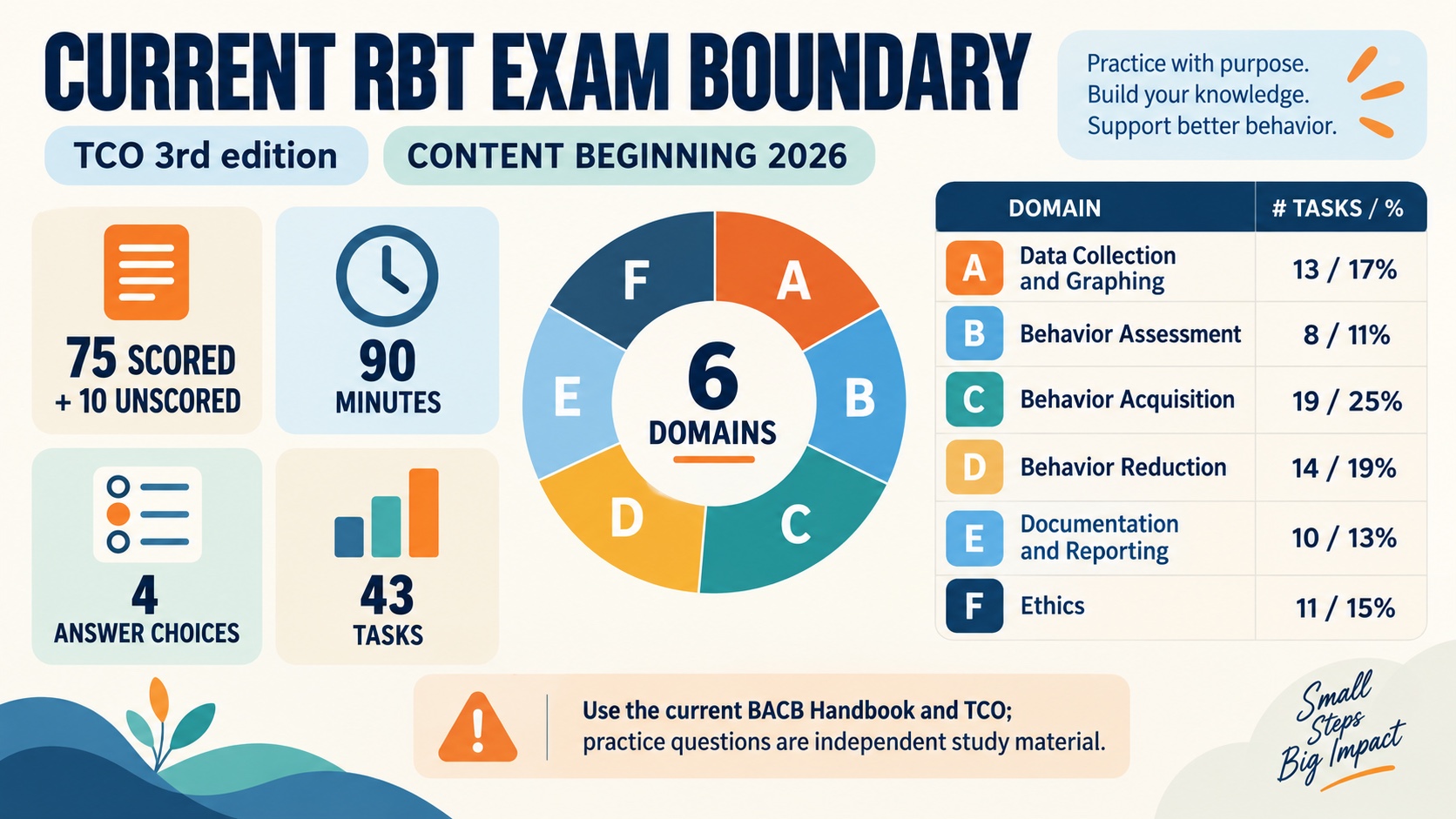
For examination content beginning in 2026, the BACB identifies the RBT Test Content Outline, 3rd edition, as the current blueprint. The previous RBT Task List, 2nd edition, applied through December 31, 2025. If an older study file uses only “RBT task list,” check its edition and revision information before using it.
| Current exam detail | What it means for practice |
|---|---|
| Questions | 75 scored questions plus 10 unscored pilot questions |
| Time | 90 minutes |
| Answer format | Four possible answers with one correct answer |
| Content map | 43 tasks organized into six domains |
| Scoring boundary | Questions are equally weighted; the result is based on overall performance, not six separate domain pass marks |
The unscored pilot questions are part of the exam’s total format but are not a signal that a practice website can identify which question will count. Do not label a question “unscored,” “experimental,” or “real” unless BACB itself has published that information for the context. A practice set should simply focus on the current content and explain the skill being rehearsed.
Choose questions by domain and task
The current TCO has six domains. The rounded distribution can help you allocate practice time, but it should not become a shortcut for memorizing six percentages. Use the domain to find a task, then use the task to decide what evidence should appear in a scenario.
| Domain | Rounded exam share | Question focus |
|---|---|---|
| A. Data Collection and Graphing | 13 questions / 17% | Measurement, data entry, graphs, trends, and reliable implementation |
| B. Behavior Assessment | 8 / 11% | Preference assessment, skill strengths/deficits, and participation in assessment components |
| C. Behavior Acquisition | 19 / 25% | Reinforcement, teaching procedures, prompting, chaining, shaping, and generalization |
| D. Behavior Reduction | 14 / 19% | Implementing reduction procedures, safety, and accurate response to behavior plans |
| E. Documentation and Reporting | 10 / 13% | Objective notes, communication, records, and reporting concerns |
| F. Ethics | 11 / 15% | Confidentiality, supervision, scope, professional boundaries, and the RBT Ethics Code |
Start with a small mixed sample if you are not sure where your weakness is. Tag every question with its domain and task. After 10–15 questions, look for a pattern: Are you missing the definition, the measurement calculation, the implementation step, the supervision boundary, or the evidence in the stem? Then select a short targeted set instead of repeating the same random mix.
For example, a question about partial-interval recording should make you notice the observation rule and the response definition. A question about least-to-most prompting should make you notice the prompt sequence and the reason for fading. A question about a caregiver request for private information should make you notice confidentiality, supervision, and the appropriate next communication step. These examples are not official exam items; they show how to read the skill under the vocabulary.
Use a question-review loop that teaches you something
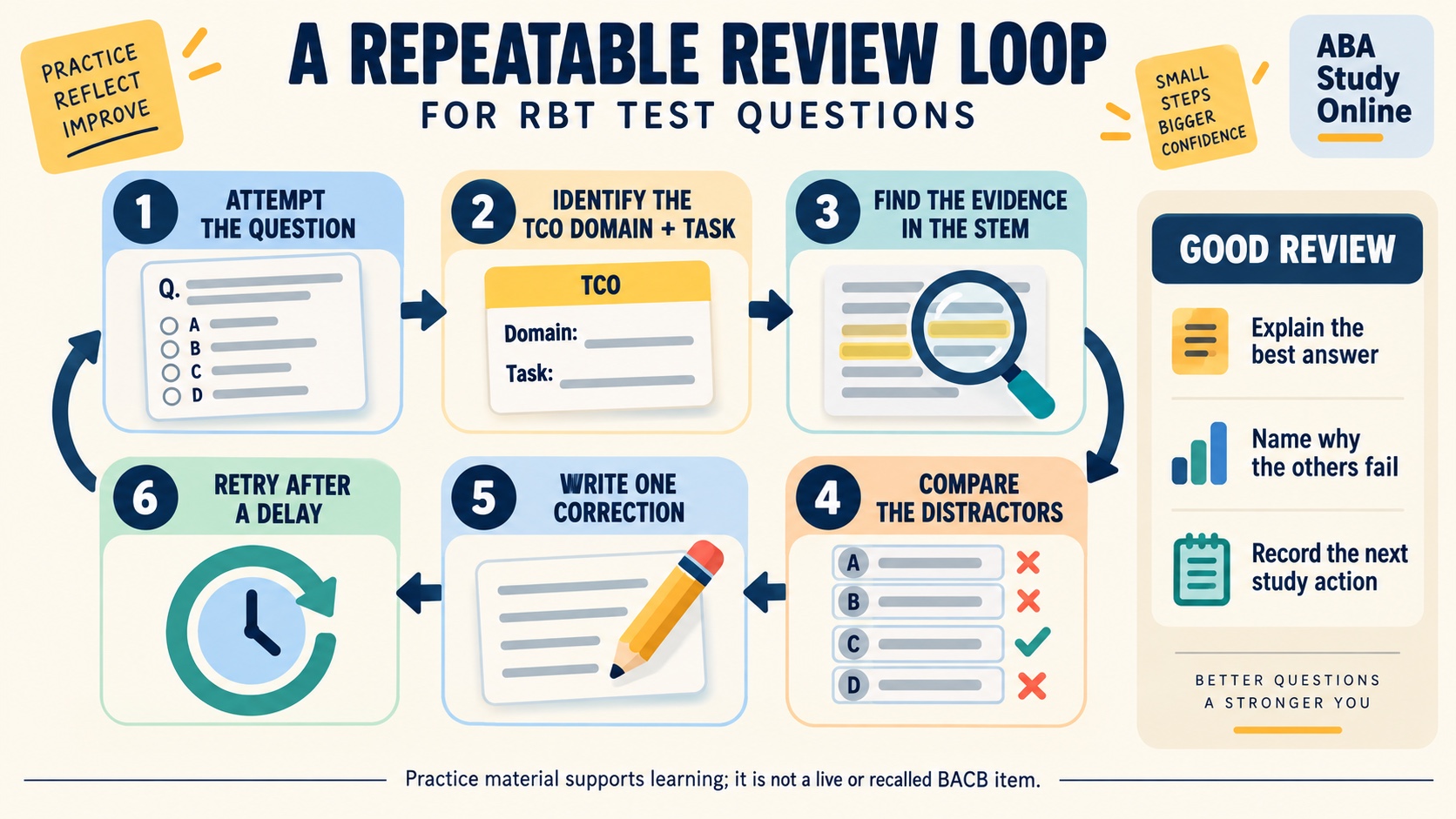
Completing questions is only the first part. Use the same short review routine whether the answer was correct or incorrect:
- Name the task. Write the domain and the specific action the question is testing.
- Underline the evidence. Identify the measurement, condition, client request, prompt level, consequence, or role boundary that matters.
- Explain the best answer. State what the RBT should do and why it fits the evidence and current role.
- Reject the distractors. For each wrong option, write whether it is too early, too broad, outside scope, based on an unsupported assumption, or aimed at a different task.
- Write one correction. Turn the miss into a short rule, example, or contrast you can retrieve later.
- Retry after a delay. Revisit the concept later without looking at the explanation first. If you can choose the answer but cannot explain it, the skill still needs work.
This loop keeps a wrong answer from becoming a discouraging score. It also makes the website and app useful for different parts of the same study process: use longer question explanations on the website, then use short flashcards, section practice, or progress review in the app. The app is a study destination, not a BACB portal, official exam, or score predictor.
Build a small weekly practice rhythm
A simple rhythm is easier to sustain than a single marathon session. Begin the week with a short mixed set so you can see which domains and tasks need attention. On the next study day, choose one narrow target, such as measurement, prompting, documentation, or confidentiality, and review each rationale in full. Later in the week, return to the same missed questions without looking at your notes. Finish with a new mixed set so you can check whether the correction transfers to a different scenario.
Keep two records separate: a practice record and an official eligibility record. Your practice record can include the question source, TCO domain, task, error type, correction, and retry date. It should not be treated as a BACB score report or evidence of certification eligibility. When a question exposes a gap in a procedure or a safety concern, bring that question to the appropriate supervisor or training context rather than improvising in client care.
If your review time is short, prioritize explanations over volume. Five questions that you can explain, correct, and retrieve later are more informative than fifty questions marked only right or wrong. Increase the set size only after your review routine is consistent.
How to spot outdated or misleading question sets
Check the edition label. A resource that uses the previous Task List without explaining the 2026 TCO boundary may not match the current exam. “Updated” is less useful than a named edition and source date.
Reject “real exam questions” claims. A practice writer should not imply access to live, recalled, or confidential BACB items. Original scenarios can teach the same task without pretending to reproduce the examination.
Look for explanations, not only answer letters. A letter key cannot show whether you misunderstood the measurement rule, missed a cue, or crossed a role boundary. Prefer a rationale that explains the evidence and distractors.
Check role level. RBT questions should not quietly require independent diagnosis, treatment-plan authorship, or supervisor-level decisions. The current RBT role is paraprofessional work under direction and close supervision.
Do not accept a pass guarantee. Practice scores can help you decide what to review next, but they do not determine BACB eligibility or predict a certification result. Training, competency assessment, application, and official examination requirements remain separate.
Common mistakes
Doing only random questions. Random practice is useful for diagnosis, but a learner who never tags errors may keep repeating the same confusion.
Studying the largest domain only. Behavior Acquisition has the largest rounded share, but the other five domains still represent important tasks and role boundaries. Use the distribution to plan, not to ignore ethics or documentation.
Memorizing a definition without applying it. Ask what the RBT would observe, record, implement, or communicate in a concrete situation.
Changing an answer because a distractor sounds more advanced. Entry-level questions reward the response supported by the evidence and supervision structure, not the response with the most impressive vocabulary.
Confusing practice with certification. Questions support learning. They do not replace the current 40-hour training, competency assessment, application, supervision, or BACB examination.
FAQ and official sources
Are RBT test questions the same as the real exam?
No practice website should claim that its questions are live or recalled BACB items. Good original questions can rehearse the current TCO tasks and decision patterns, but the official exam wording and form are not supplied by an independent study site.
How many questions are on the current RBT exam?
The current RBT Handbook lists 75 scored questions plus 10 unscored pilot questions, for 85 total questions, with 90 minutes to complete the examination.
Which RBT edition should I use?
For examination content beginning in 2026, use the RBT Test Content Outline, 3rd edition. Older resources may refer to the RBT Task List, 2nd edition, which applied through December 31, 2025. Check the current BACB source if your authorization period crosses an edition change.
Can practice questions guarantee that I will pass?
No. Practice can reveal what to review next, but it cannot guarantee a score, certification, or application outcome. BACB recommends the current TCO and materials from 40-hour training and the Competency Assessment.
Where can I continue reviewing?
Use the current BACB RBT Handbook and RBT TCO for the official boundary. For independent study, use the RBT practice questions, RBT learning path, ABA glossary, and the ABA Study Online app as separate layers of review.