Rbt Test Prep: A Clear ABA Guide
Searchers who type rbt test prep are usually trying to solve one immediate problem: they want a definition, a current requirement, a study decision, or a practical way to check their next step. Search results often mix official information, independent explanations, advertisements, and old checklists. This page narrows the question first, then shows how to use reliable information without turning an unofficial explanation into a certification rule.
RBT learners and technicians work within the current BACB RBT requirements, supervision expectations, ethics responsibilities, and task outline. The exact answer still depends on the current official source, the relevant track, and the purpose of the search. A short definition may be enough for recognition; a preparation or planning question needs a source check, an example, and a way to review what remains unclear.
What rbt test prep means
The most useful first move is to name the searcher’s job in one sentence. Is the person trying to understand a term, compare a requirement, prepare for an examination, choose a resource, or decide whether a document applies to them? The same words can produce very different answers when the job changes. A definition page should not quietly become a sales page, and a study page should not pretend to make an eligibility decision.
Use the exact wording as a doorway, not as a reason to repeat it in every paragraph. Explain the concept in plain language, identify the boundary that prevents a common misunderstanding, and then connect the idea to an observable example. For an exam-related phrase, distinguish the official content outline from independent preparation. For a practice or resource phrase, explain what the material can help someone do and what it cannot establish.
How to check the current source
Start with the organization responsible for the rule or credential. Read the page title, effective date, scope, and linked handbook or outline. Then check whether the wording applies to the learner’s track. A general ABA article can be helpful for foundations, but it cannot replace a current RBT, BCaBA, or BCBA handbook when the question involves application, supervision, ethics, fieldwork, examination, or maintenance.
Keep three notes while researching: what the official source says, what an independent explanation adds, and what is still unknown. This small separation prevents a common SEO problem in certification content: a useful study tip gets repeated as if it were an official requirement. It also makes future updates easier because you can see which sentence needs a new source check.
When a page uses words such as “approved,” “guaranteed,” “official,” or “required,” verify the claim rather than trusting the headline. A provider may offer a helpful course or worksheet without being an official certification body. Similarly, a practice score can show what you should review without predicting a real examination result.
A practical example
Imagine that a learner saves two pages about rbt test prep. The first page has a clear definition but no source or date. The second page links to the relevant official material, explains the terminology, and shows an original scenario with a rationale. The second page is easier to audit. It tells the learner where the rule came from, how to recognize the idea in practice, and what to revisit when the answer is uncertain.
A good example should stay within scope. It can show a measurement decision, a study choice, a documentation habit, or a distinction between two terms. It should not reveal secure exam questions, promise a credential, or give individualized legal or clinical advice. Write down the observable facts, the decision made, and the reason for the decision. That structure is more useful than a vague statement that someone should “know the concept.”
A simple study or decision workflow
- Clarify the job: write one sentence describing what you need to know or do with rbt test prep.
- Anchor the scope: locate the current official page, handbook, outline, or ethics source for the relevant track.
- Explain it once: write a plain-language definition and name the closest common confusion.
- Apply it: answer an original scenario, complete a small checklist, or explain the decision aloud.
- Record the gap: note what was unclear and schedule a later review instead of collecting another unrelated resource.
This workflow works for a free article, an app session, a study guide, or a teaching tool. It also creates a natural bridge between the website and practice: the website can explain the idea, while an app session can provide retrieval, feedback, and progress tracking. Keep that bridge optional and accurate. The app is a study support, not a replacement for the organization that controls a credential or rule.
If the topic has changed recently, add a review date to your notes. A current page can become outdated when a handbook, task outline, training requirement, examination schedule, or ethics rule changes. Checking the source again is part of responsible studying, especially for learners who are planning an application months in advance.
Common mistakes
- Repeating the keyword instead of answering it: use the phrase naturally, then add a real distinction or action.
- Mixing tracks: shared ABA vocabulary does not make RBT, BCaBA, and BCBA requirements interchangeable.
- Using an undated checklist: verify the current official source before relying on a requirement.
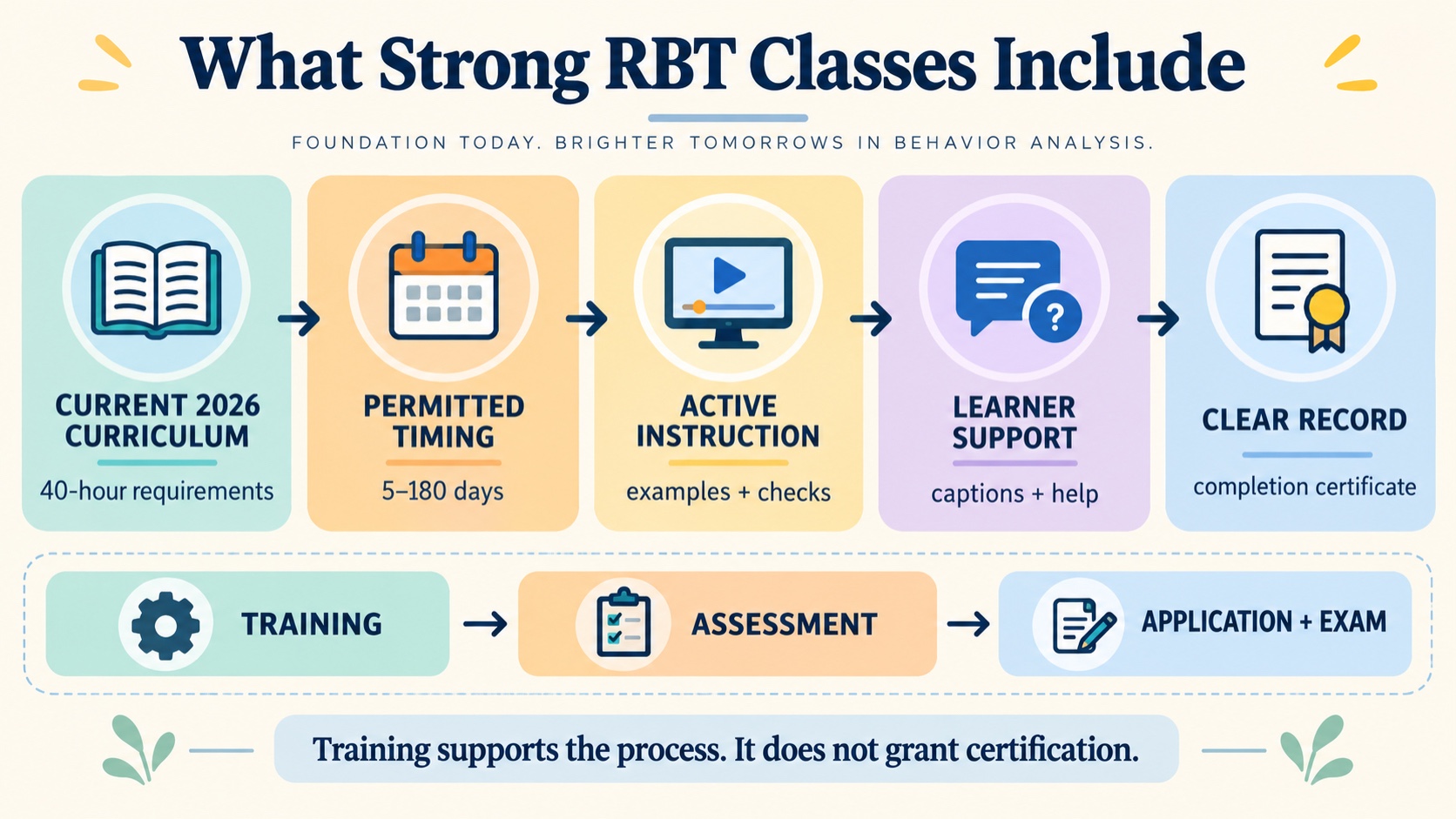
- Confusing learning support with authorization: a course, article, or app does not automatically issue a credential.
- Studying only recognition: add one original application example and review the reason for the answer.
FAQ
Is rbt test prep an official BACB term?
Search phrases are not automatically official terminology. Check the current BACB page, Handbook, or Test Content Outline to see how the organization names the relevant process or credential.
Can an ABA study website replace the official source?
No. An independent site can explain concepts, organize practice, and point to sources. The official organization remains the authority for current certification, examination, ethics, or maintenance rules.
What should I do if two pages disagree?
Compare publication dates, scope, and source links. Use the current official page for a rule, record the disagreement, and ask the responsible organization or qualified supervisor when the decision affects an application or professional responsibility.
Official sources
- BACB rbt
- BACB test-content-outlines-for-bacb-certifications
- BACB RBT-Handbook
- BACB examination-information
Next step: If you want a structured place to review rbt test prep, use the RBT learning path for explanations and original practice. It is an independent study resource, not a certification service, official examination content, or pass guarantee.
A final quality check is simple: can a reader tell what the phrase means, which source controls the answer, and what to do next? If not, shorten the claim, add the missing boundary, and return to the current official page. Clear scope is more valuable than a longer list of loosely related tips.
A final quality check is simple: can a reader tell what the phrase means, which source controls the answer, and what to do next? If not, shorten the claim, add the missing boundary, and return to the current official page. Clear scope is more valuable than a longer list of loosely related tips.