
RBT Terms and Definitions: A Plain-Language Study Guide
RBT study involves more than memorizing a list of behavior-analysis words. You need to recognize what a term means in a real session, what data it changes, and what belongs in your role as a Registered Behavior Technician. This guide groups common RBT terms by the work they support: observe, measure, teach, and report.
These are study definitions, not a replacement for the current BACB RBT Handbook or the applicable test-content materials. If a current rule, application requirement, or professional boundary is involved, return to the official source and ask your supervisor when the question is about your work situation.
Observe objectively
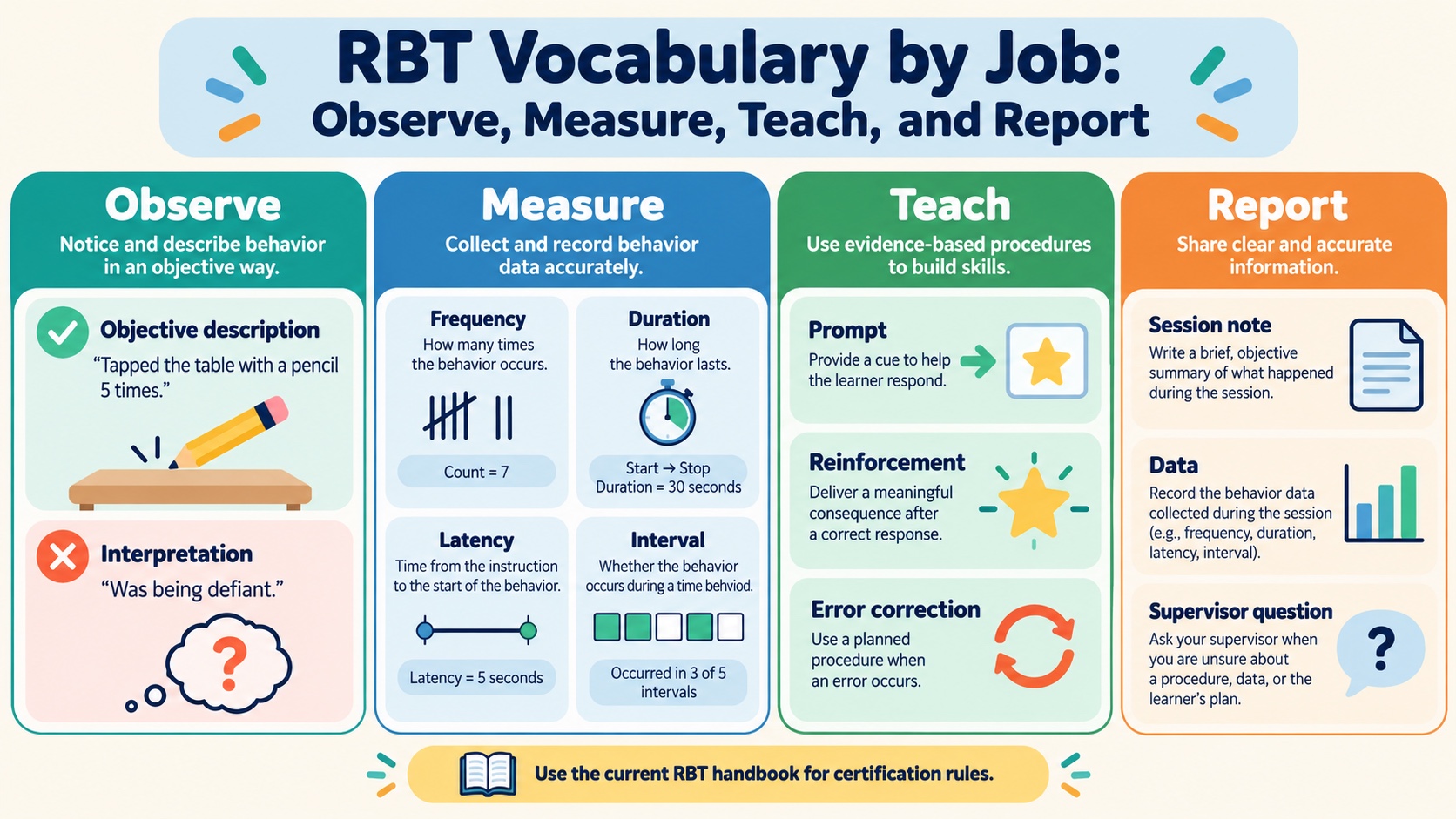
Behavior is an observable and measurable activity of an organism. A useful description says what a person does, not what the observer thinks the action means. “Tapped the table with a pencil five times” is more objective than “was being defiant.” The first statement can be counted and checked by another observer; the second is an interpretation that may need further investigation.
Antecedent is an event or condition that occurs before a behavior. Consequence is an event or condition that follows it. The words describe position in a sequence; they do not automatically mean “cause” and “punishment.” An ABC note becomes more useful when the antecedent, behavior, and consequence are written as specific events.
Operational definition is a precise description of a target behavior that tells observers what to count and what not to count. It should include enough detail for consistent observation. A label such as “tantrum” is not enough by itself; a team may need to define the topographies that count, the start and stop rules, and the measurement method.
Measure behavior
Frequency is how many times a behavior occurs. Rate expresses frequency relative to a unit of time, such as responses per hour. Duration is how long a behavior lasts. Latency is the time between an instruction or event and the start of the response. These measures answer different questions, so choose the one in the written plan rather than whichever is easiest to record.
Interval recording divides an observation into time intervals and records whether behavior occurred according to the programmed rule. Partial-interval, whole-interval, and momentary-time-sampling procedures are not interchangeable. The recording rule affects what the data mean. Permanent-product recording uses a lasting result of behavior, such as completed worksheets or assembled items, when the product reliably reflects the target.
Teach with a plan
Prompt is an added cue or assistance that helps evoke a correct response. A prompt is not the target skill itself. A good teaching plan states when the prompt is delivered, how it is faded, and what happens when the learner responds independently.
Reinforcement is a consequence that increases the future likelihood of a behavior. It is defined by its effect, not by whether the consequence sounds pleasant. Positive reinforcement adds a stimulus after behavior; negative reinforcement removes a stimulus after behavior. Both increase behavior when the arrangement works as planned. Reinforcement should not be confused with bribery or with delivering any preferred item without regard to the program.
Shaping reinforces successive approximations toward a target response. Chaining teaches component steps in a sequence. Error correction is a planned response to an incorrect or incomplete performance. These terms describe procedures that need training, fidelity, and supervisor direction. They are not invitations to change a learner’s program in the moment.
Report and communicate
Session note is a contemporaneous record of what happened during the service period. It should separate observation from interpretation and reflect the required format. Procedural integrity means implementing the written procedure as designed. When a step was missed or the environment changed, record the relevant fact and follow the reporting path rather than silently rewriting the procedure.
Generalization is responding under conditions that differ from those used during teaching, such as a new person, setting, material, or instruction. Maintenance is continued performance over time after teaching or intensive support changes. A learner can maintain a skill in one setting without generalizing it to another, so the data should identify which dimension was actually checked.
Supervision is the structured oversight and support required by the applicable role and current BACB materials. If you are unsure whether a change is allowed, whether a behavior meets the operational definition, or how to respond to a safety concern, bring the question to the supervisor. Asking for clarification is part of accurate practice.
Procedural fidelity is another useful study term. It asks whether the steps of the written plan were carried out as specified. Fidelity is different from outcome: a learner may not respond correctly even when the plan was implemented accurately, and a learner may respond correctly even when a step was accidentally skipped. Recording both the learner’s performance and relevant implementation facts helps the supervisor decide what needs attention.
Preference assessment refers to a systematic way of identifying items or activities that may be preferred at a particular time. Preference is not the same as reinforcement. An item can be selected during an assessment but fail to increase a target response when delivered as a consequence. The data from the teaching arrangement determine whether reinforcement is occurring.
How to study RBT definitions
Make each vocabulary card answer four questions: What does the term mean? What would it look like in a session? What data or decision does it affect? What is the most common confusion? For example, a frequency card should include “how many times,” a count example, the distinction from rate, and a reminder to use the programmed observation period.
Then practice discrimination. Compare frequency with duration, antecedent with consequence, positive reinforcement with punishment, and objective description with interpretation. Write a one-sentence example for each side of the comparison. Scenario practice is more useful than rereading when the goal is to recognize the term under exam-like wording.
Finally, keep the credential boundary visible. The RBT track uses shared ABA vocabulary, but the current handbook and content outline determine the applicable requirements and responsibilities. Use the ABA Definition Search for a single-term review, the RBT learning path for organized concepts, and RBT practice questions for applied retrieval. These are study supports, not official BACB decisions.
FAQ
What RBT terms should I learn first?
Start with objective observation, antecedent, consequence, operational definition, measurement dimensions, prompting, reinforcement, error correction, data, and supervision. Then practice how the terms work together in a session.
What is the difference between an observation and an interpretation?
An observation describes what can be seen or measured. An interpretation explains what someone thinks the behavior means. RBT documentation should lead with objective, observable information.
Are these definitions official BACB wording?
No. They are plain-language study explanations. Use the current BACB RBT Handbook and applicable content materials for official requirements, terminology, and role boundaries.