RBT Task List: Current 3rd Edition Study Guide
If you search for an RBT task list, you are probably looking for the content blueprint behind the Registered Behavior Technician examination. For the current exam, the official document is the RBT Test Content Outline (3rd ed.), which describes examination content beginning in 2026. Older resources may still use “task list” as the familiar label, so checking the edition is the first useful step.
This guide explains the six current domains, the difference between 75 scored questions and 85 total questions, and a practical way to turn the outline into study sessions. It is independent educational material, not official BACB examination content, a substitute for the required training or competency process, or a pass guarantee.
Quick answer: Use the RBT Test Content Outline (3rd ed.) for current examination content. It contains 43 tasks across six domains. The examination structure is 75 scored questions plus 10 unscored pilot questions, or 85 questions total, with 90 minutes to complete the exam. Use the current RBT Handbook for eligibility, training, competency assessment, testing procedures, supervision, and maintenance.
Why the numbers look different: “85 questions” describes the total form, while “75 questions” describes the scored portion. The 10 unscored pilot questions are included in the exam experience but are not part of the scored total. Keep that distinction in your notes so an old or simplified study page does not create unnecessary confusion.
What the current RBT outline does
The RBT Test Content Outline is an examination map. It names the knowledge, skills, and abilities expected at the entry-level behavior-technician level, then organizes them into six broad content areas. It does not provide the exact wording of future questions, replace hands-on training, or give permission to work outside an RBT’s role and supervision structure.
Before using a download or page labeled “RBT task list,” check four things:
- Does it say RBT rather than BCaBA or BCBA?
- Does it identify the 3rd edition and the 2026 examination period?
- Does it use the current domain names, not only older labels?
- Does it clearly separate exam preparation from training, competency assessment, ethics, and certification requirements?
The six RBT task-list domains
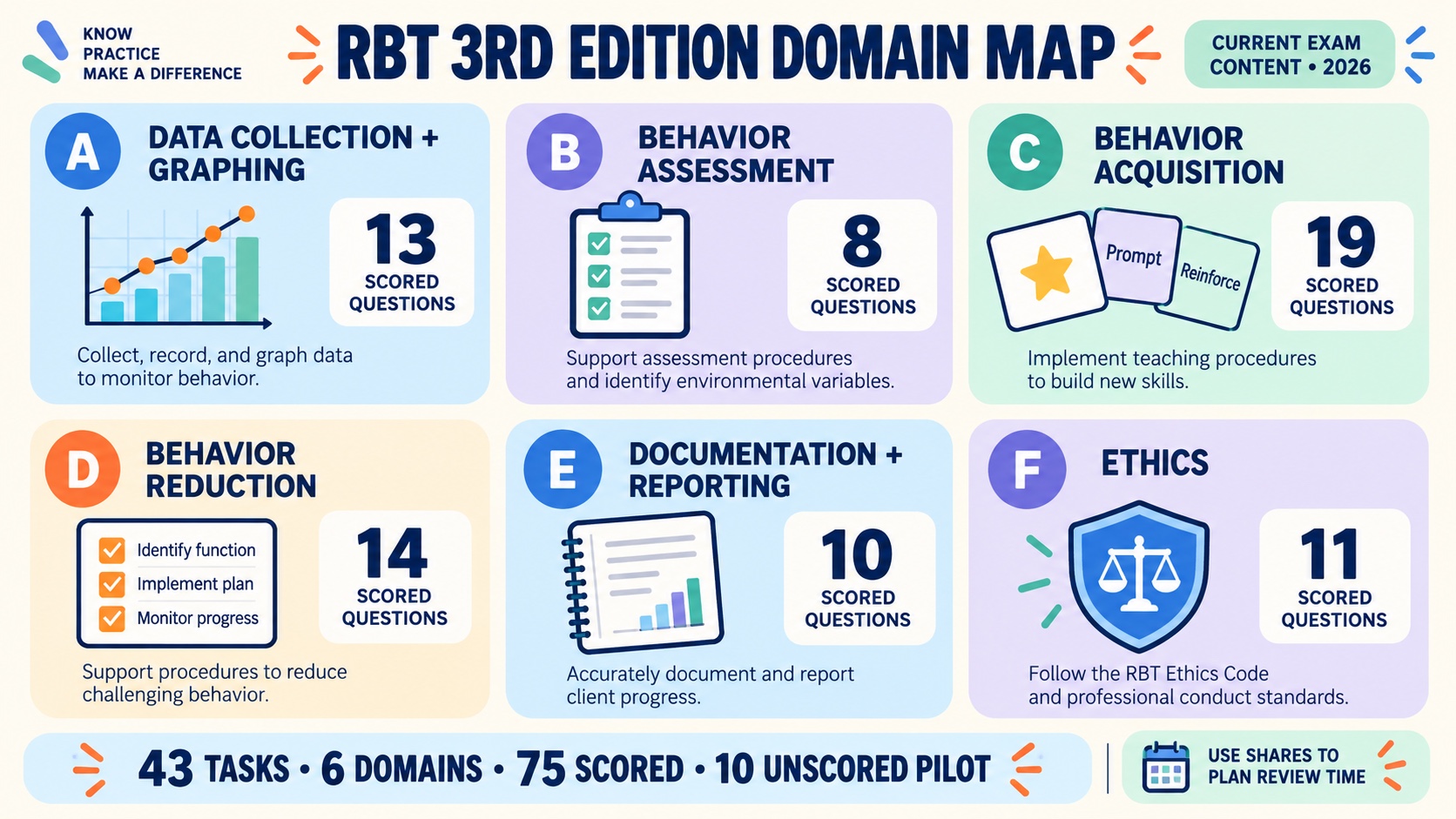
The official outline assigns rounded shares to the six domains. Use them to distribute review time, not to predict the order of questions or treat one domain as optional.
Measurement and assessment: A–B
A. Data Collection and Graphing — 13 questions, 17%: Practice continuous measurement, discontinuous measurement, permanent-product recording, data entry, graph updates, observable descriptions, summaries such as rate, and basic interpretation. Ask two questions every time: What exactly is being measured, and what decision could this measurement support? A clear behavioral definition is more useful than a vague label.
B. Behavior Assessment — 8 questions, 11%: Review the RBT’s role in assessment, preference assessments, skill assessments, and observation or data collection directed by the supervising team. The key study distinction is between recording what happened and making a clinical conclusion. When the scenario exceeds your role or direction, identify the point where you should seek supervisor guidance.
Teaching and behavior reduction: C–D
C. Behavior Acquisition — 19 questions, 25%: This is the largest domain. Study how to implement skill-acquisition plans, reinforcement, prompting and fading, shaping, chaining, discrimination training, generalization, maintenance, token economies, discrete-trial or natural-environment teaching, and related procedures named in the current outline. For each procedure, write the target response, the teaching cue, the consequence, and how independence will be checked.
D. Behavior Reduction — 14 questions, 19%: Connect common behavior functions with antecedent strategies, differential reinforcement, extinction, punishment procedures, secondary effects, and crisis or emergency procedures. Study the safety and role boundary as carefully as the vocabulary. An RBT implements a plan and follows direction; a difficult scenario is not an invitation to invent a new intervention independently.
Documentation and ethics: E–F
E. Documentation and Reporting — 10 questions, 13%: Practice objective session notes, timely communication, data integrity, reporting concerns, protecting confidential information, and following the chain of command. A strong answer usually describes what was observed, what was recorded, who needs to know, and when a supervisor should be contacted. Avoid turning a note into a diagnosis or an unsupported explanation.
F. Ethics — 11 questions, 15%: Use the current RBT Ethics Code (2.0) with the Handbook. Review confidentiality, competence, professional boundaries, accurate representation, client welfare, supervision responsibilities, and what to do when you are unsure. Ethics questions often look like ordinary workplace moments: a public conversation, a request for information, a social-media post, or an instruction you do not understand. Practice identifying the safest professional next step.
A four-week study routine
Four weeks is a flexible template, not a BACB requirement. Extend it if you need more time or compress it only when your training and supervisor support that choice.
- Week 1 — Map and measure: read the current outline, build six domain headings, and practice observable descriptions, measurement choices, graphs, and assessment boundaries.
- Week 2 — Teach: spend extra time on Behavior Acquisition. Work through prompting, fading, reinforcement, shaping, chaining, discrimination, generalization, and maintenance with short scenarios.
- Week 3 — Reduce and document: review behavior reduction procedures, safety boundaries, session notes, reporting, confidentiality, and supervisor communication.
- Week 4 — Mix and review: interleave all six domains, use timed practice, and revisit the exact task or distinction behind every missed or uncertain question.
Use a repeatable session rather than a long rereading block: recall yesterday’s idea, study one target, answer a few applied questions, explain the rationale aloud, and schedule the missed items for later review. The RBT study path can hold the theory step, and free RBT questions can hold the practice step. The ABA Study Online app is planned for flashcards, section practice, audio review, progress, and tools when a shorter loop fits your day.
How to practice the outline
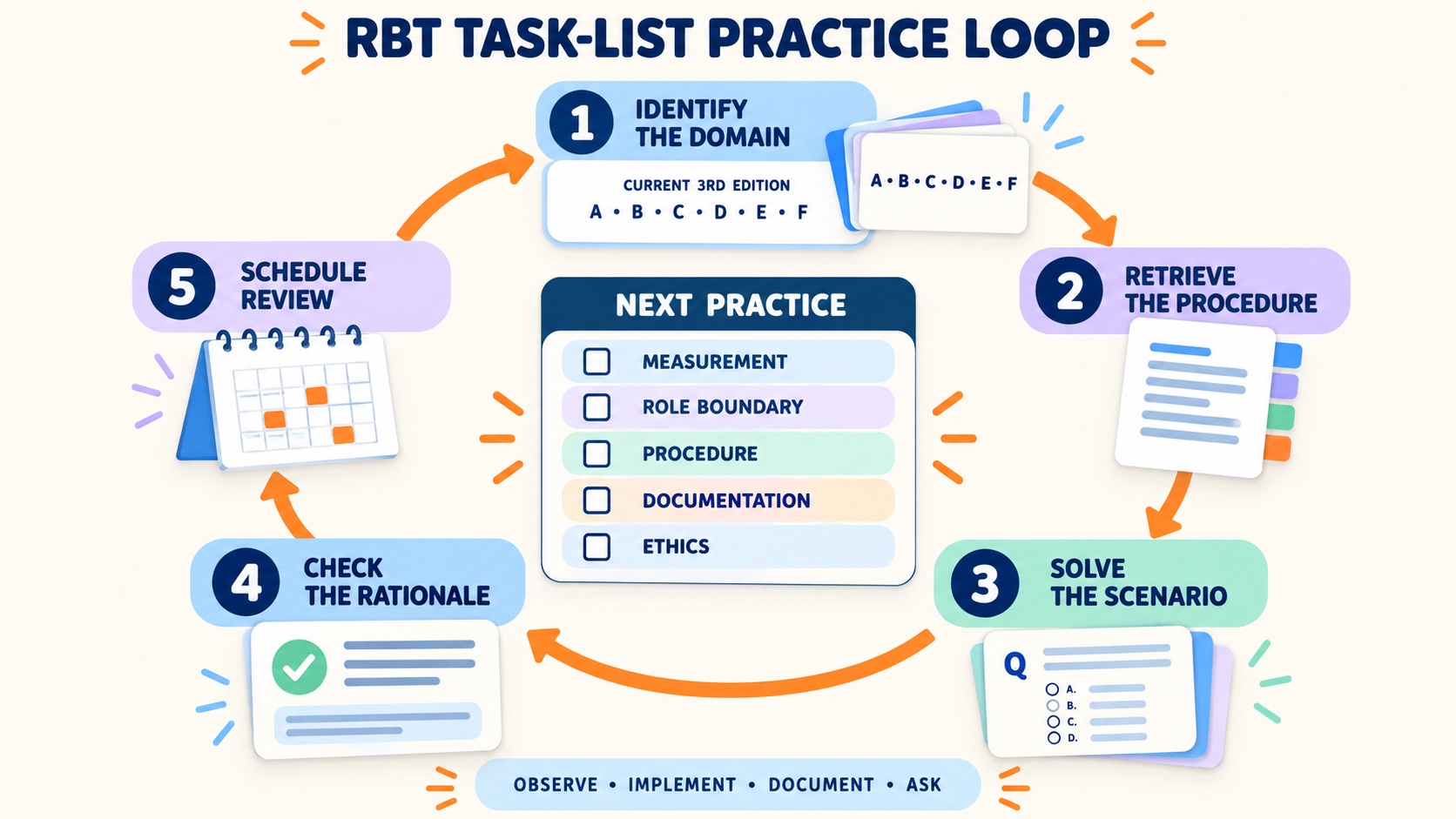
Before checking an answer, name the domain and the task action. Is the question asking you to measure, implement, document, report, or respond ethically? Then identify the observable facts and the role boundary. This keeps you from choosing an attractive answer that sounds helpful but skips the data, the written plan, or the supervisor.
Keep an error log with five columns:
- Domain: which of the six areas was involved?
- Task action: what were you being asked to do?
- Miss type: knowledge, discrimination, measurement, procedure, or reading?
- Evidence: which detail in the scenario should have controlled the answer?
- Next repetition: what will you retrieve again, and when?
For example, if you confuse partial-interval recording with momentary time sampling, make a comparison card with the observation rule and likely measurement effect. If you choose a behavior-reduction procedure without noticing the supervision cue, write a short scenario that forces you to identify who should be consulted. Retrieval practice and spaced review are general learning methods supported by educational research; they are not official RBT requirements or a guarantee of exam performance.
Common RBT task-list mistakes
- Studying an old edition without checking the year: use the current 3rd edition TCO for the 2026 exam.
- Calling the exam “75 questions” without context: 75 are scored, while the full form includes 10 unscored pilot questions.
- Confusing the outline with the 40-hour training: the outline maps exam content; training and competency assessment are separate parts of the certification process.
- Memorizing terms without implementing steps: practice what you would record, say, do, or report in a real session.
- Inventing a solution outside the plan: RBT work remains connected to direction, supervision, documentation, and scope.
- Leaving ethics until the final day: confidentiality, client welfare, and supervisor communication appear inside ordinary scenarios, not only in a separate vocabulary chapter.
RBT task list FAQ
What is the current RBT task list?
The current examination blueprint is the RBT Test Content Outline (3rd ed.), which describes examination content beginning in 2026. “RBT task list” remains a common search phrase, especially in older study resources.
How many items and domains are on the RBT outline?
The current outline contains 43 tasks organized into six domains: Data Collection and Graphing, Behavior Assessment, Behavior Acquisition, Behavior Reduction, Documentation and Reporting, and Ethics.
Is the RBT exam 75 or 85 questions?
Both numbers describe the current structure: 75 scored questions plus 10 unscored pilot questions, for 85 questions total. Candidates have 90 minutes and each question has four answer choices with one correct answer.
Does the RBT task list replace training or competency assessment?
No. The outline describes exam content. Use the current RBT Handbook for eligibility and application requirements, and use your 40-hour training and Competency Assessment materials as separate preparation sources.
Is ABA Study Online official RBT exam content?
No. ABA Study Online provides independent explanations and practice. Use the current BACB TCO, Handbook, and Ethics Code for official information.