RBT Task List 3rd Edition: What the 2026 TCO Covers
If you search for the RBT Task List 3rd Edition, you are probably looking for the current blueprint used to describe RBT examination content. The BACB’s current name is the RBT Test Content Outline (3rd ed.), often shortened to RBT TCO. “Task list” remains common search language, but it is important to use the official document when you plan your study.
The third edition is especially important for people preparing during the 2026 transition. It describes six content domains, the task areas inside them, and the relative emphasis used to build the examination. It is not a set of live exam questions, a guarantee of the exact questions at your appointment, or a replacement for the current BACB handbook. This guide explains how to read it and turn it into a useful study map.
Table of Contents
What does “RBT Task List 3rd Edition” mean?
It is a search-friendly way to ask for the third edition of the BACB’s RBT examination content outline. The wording does not mean that the internet has a separate, official “task list” document that can replace the TCO. When you see an older guide call itself the RBT Task List, check its edition, publication date, and whether its tasks still match the current BACB outline.
That naming distinction protects your study plan from a common error: downloading a familiar PDF and assuming that it is current. The live BACB RBT examination page and the BACB test-content-outline page should be your source of truth. A course, flashcard deck, question bank, or app can organize the material, but it should point back to the current official outline rather than silently rewrite it.
What the current RBT TCO tells you
The outline is a map of examination content. In the current 3rd-edition materials reviewed for this article, the RBT examination is described as having 75 scored questions and 10 unscored pilot questions. The outline groups its content into six domains and assigns each domain a percentage. These details help you allocate review time; they do not tell you which individual items will appear on your appointment.
The TCO also gives each domain a set of task statements. A task statement is more useful than a broad label such as “learn data collection” because it points you toward an observable skill or decision. Read each statement as a prompt for three questions:
- Can I define the term in plain language?
- Can I recognize it in a short ABA scenario?
- Can I choose or describe the appropriate action while staying within the RBT role?
This approach keeps your studying connected to application. It also prevents the outline from becoming a memorization list with no link to measurement, teaching, safety, documentation, or ethics.
The six RBT content domains
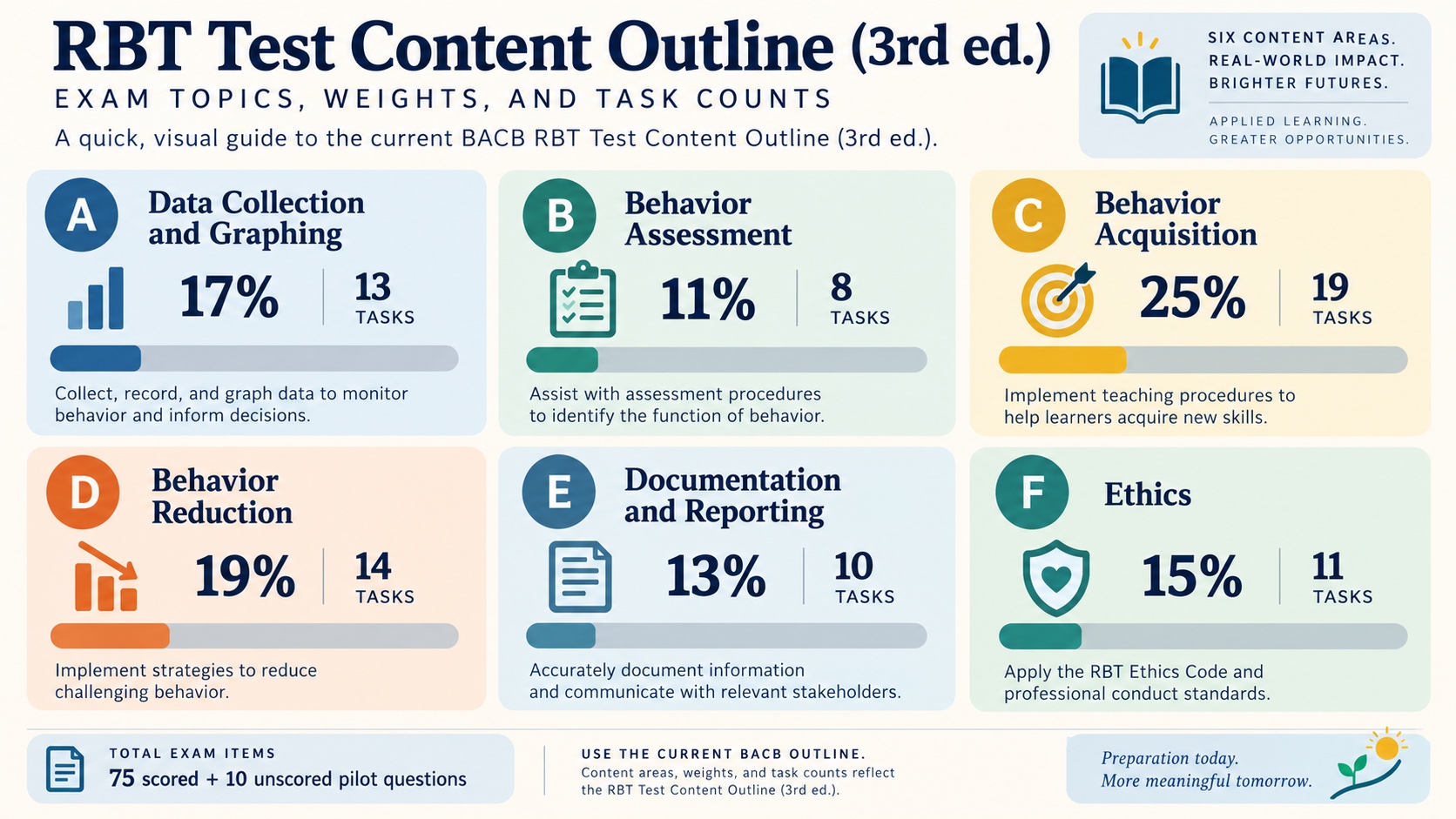
The six domains in the current outline are:
- Data Collection and Graphing: measurement language, recording procedures, data display, and interpreting what a graph does and does not show.
- Behavior Assessment: the RBT’s role in assessment activities, observing behavior, describing patterns, and following the supervising behavior analyst’s direction.
- Behavior Acquisition: teaching procedures, prompting, reinforcement, skill practice, generalization, maintenance, and accurate implementation of a written plan.
- Behavior Reduction: recognizing behavior-change procedures, following a plan safely, responding to risk, and avoiding unsupported or out-of-scope changes.
- Documentation and Reporting: objective notes, timely communication, accurate records, data integrity, and knowing what information should be shared with the supervisor.
- Ethics: professional boundaries, client dignity, confidentiality, competence, supervision, and responding appropriately when a concern needs to be reported.
The current outline assigns the largest share to Behavior Acquisition, followed by Behavior Reduction and Data Collection and Graphing. That does not make the smaller domains optional. Ethics and documentation can change the answer to a scenario even when the scenario appears to be about teaching or measurement.
How to use the domain percentages
Percentages are a prioritization tool, not permission to skip content. A practical plan is to make one study column for each domain, then give additional practice time to the domains with greater examination emphasis. Keep a second column for “uncertain” tasks. If you miss a question about a smaller domain twice, that topic moves into your next review block regardless of its percentage.
For example, a learner might start with a short diagnostic set, sort each missed question by TCO domain, and then schedule the next sessions in this order:
- Repair one measurement or assessment misconception.
- Practice a behavior-acquisition scenario and explain the prompting or reinforcement decision.
- Practice a behavior-reduction scenario with a safety and scope check.
- Finish with documentation and ethics questions that test professional judgment.
The point is not to reproduce an alleged exam order. The point is to combine blueprint weighting with feedback from your own errors. A strong study map says both “this domain matters in the outline” and “this is the exact task I still cannot apply reliably.”
How to study from the outline
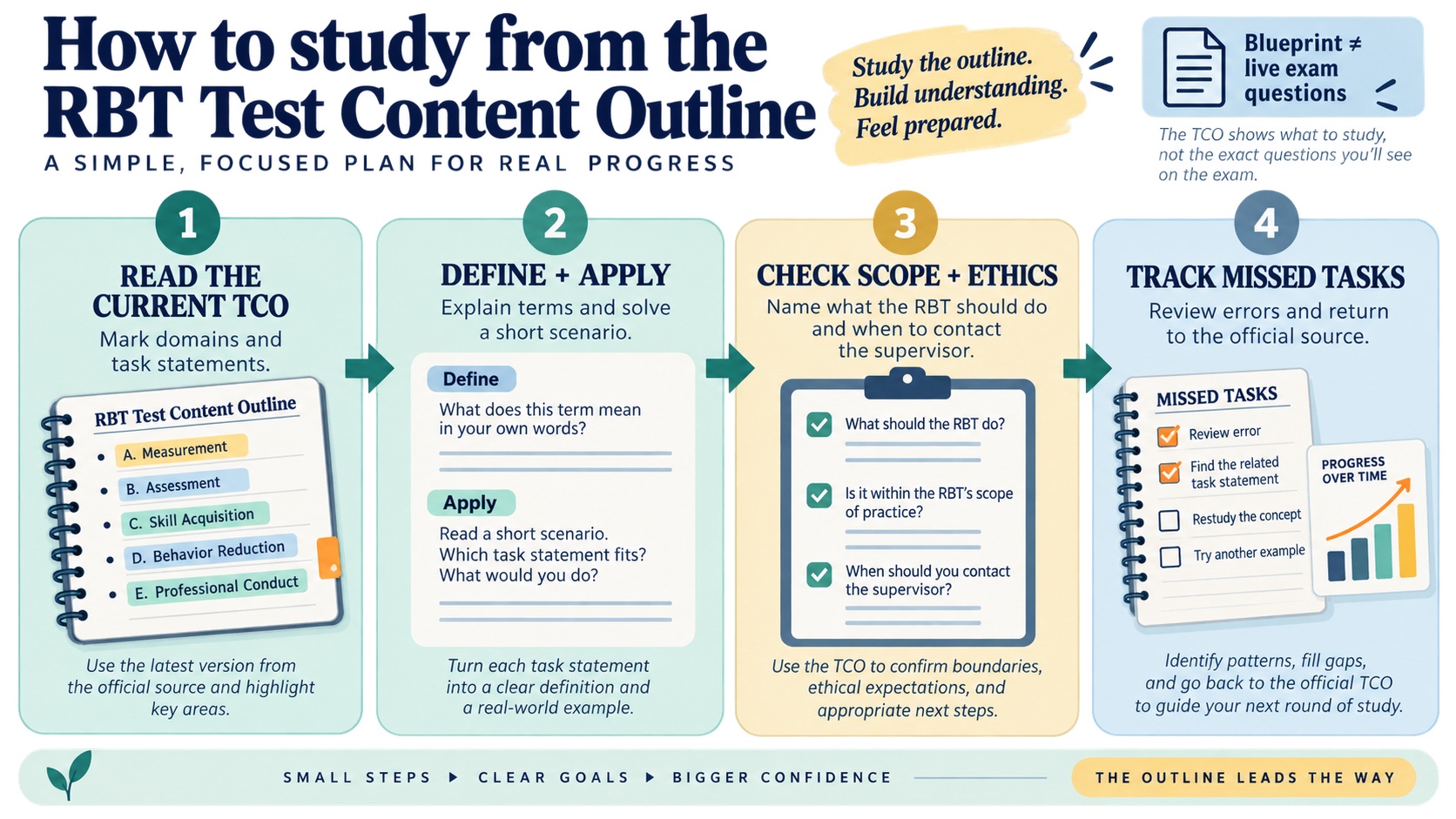
Begin with the official TCO, then add a source-supported explanation for unfamiliar terms. After that, use original practice scenarios that require a decision. A useful three-pass routine looks like this:
- Pass one—recognize: highlight the task statements and define unfamiliar terms without copying a long paragraph.
- Pass two—apply: answer a short scenario and state what the RBT should do, what the RBT should not do, and when to contact the supervisor.
- Pass three—explain: teach the idea aloud or in writing using a concrete example, a measurement detail, and a boundary statement.
Keep the official document open while you study. If a practice question uses a label that does not appear in the TCO, do not automatically assume the question is wrong; first check whether it is a related ABA term. But if a resource claims that a task belongs to the current exam blueprint, verify that claim against the BACB source.
Make your notes traceable. Write the domain letter, the task idea, the example that helped you understand it, and the source you used. When a practice explanation conflicts with the TCO, place both statements side by side and resolve the difference before moving on. This small habit is useful during a version transition because it shows whether you are correcting a misunderstanding, using an older term, or applying an administrative rule that belongs in the handbook rather than the content outline.
What to check during the 2026 transition
Transition-year searches are full of mixed language. Before you commit to a course or question bank, check the edition named by the provider, the publication date, and whether it links to the current BACB TCO. Also confirm the current RBT Handbook and examination page for application, eligibility, scheduling, and testing rules. The content outline cannot answer every administrative question.
Use this boundary:
- The TCO tells you the content areas and task coverage.
- The RBT Handbook tells you broader certification and application requirements.
- The examination page tells you current testing information and links.
- Your practice resource helps you rehearse; it is not the source of official exam questions.
ABA Study Online’s RBT learning resources, free question previews, and app review tools can support concept review and error tracking. They do not replace the current BACB outline, handbook, eligibility process, or examination appointment rules.
Common study mistakes
- Using an old edition: a familiar PDF is not automatically the current blueprint.
- Studying only the biggest domain: the percentage guides time, but every domain can affect your preparation.
- Memorizing labels without scenarios: RBT work requires observable, applied decisions.
- Confusing TCO tasks with live questions: the outline describes coverage; it does not release test items.
- Ignoring scope and ethics: a technically plausible procedure can still be wrong if it exceeds the RBT role or violates professional boundaries.
- Treating a provider’s “3rd edition” claim as proof: verify the source and date yourself.
FAQ and official sources
Is the RBT Task List 3rd Edition the official name?
“Task list” is common search language. The current BACB document reviewed for this page is the RBT Test Content Outline (3rd ed.). Use the live BACB source and its edition label when you study.
How many domains are in the RBT 3rd edition outline?
The current outline reviewed here describes six domains: Data Collection and Graphing, Behavior Assessment, Behavior Acquisition, Behavior Reduction, Documentation and Reporting, and Ethics.
Does the TCO tell me the exact RBT exam questions?
No. It describes content coverage and task areas. It is not a release of live questions and should not be used to claim that a practice item will appear on your appointment.