
RBT Supervision Requirements: The Monthly Checklist
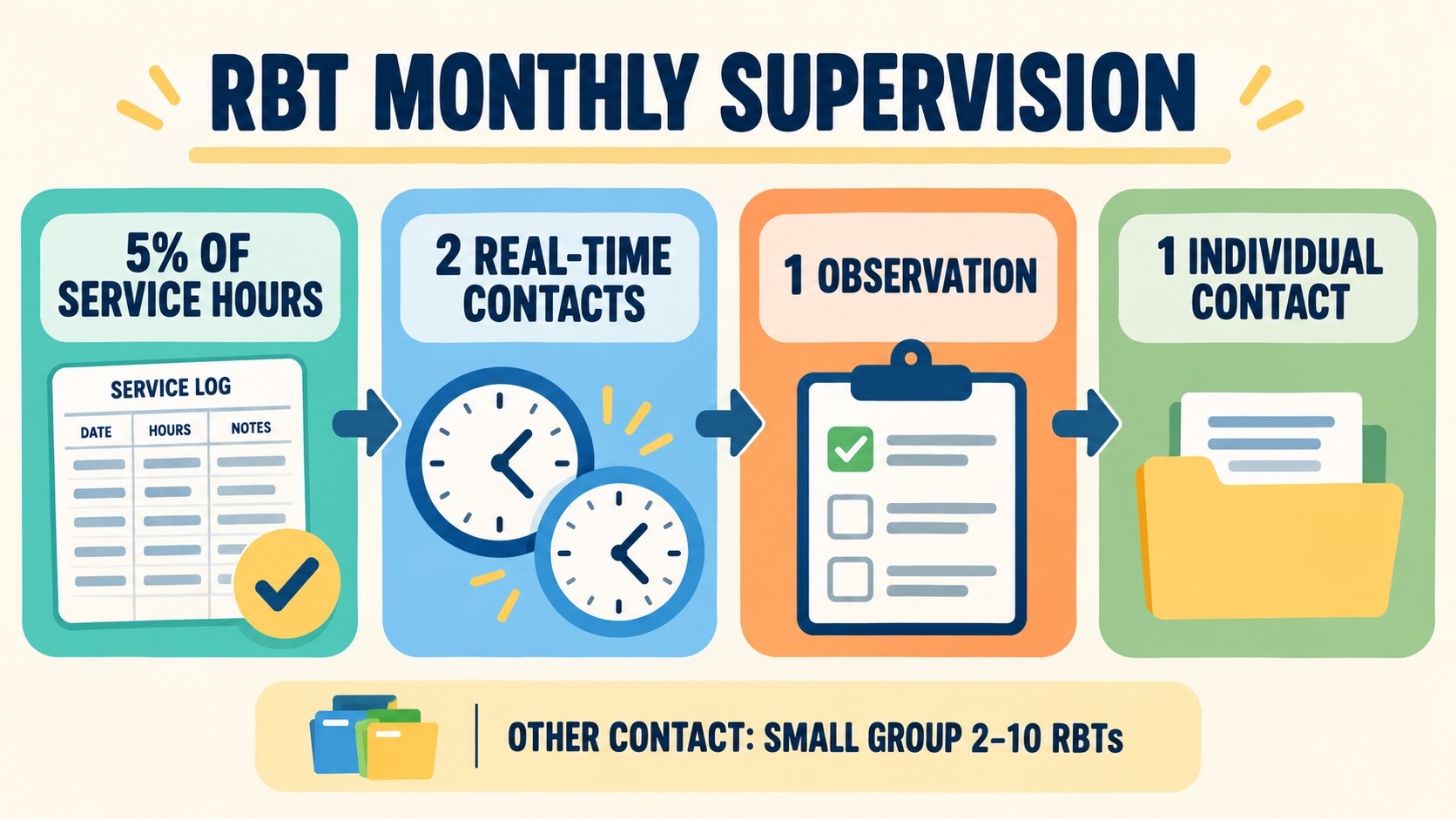
If you are searching for RBT supervision requirements, start with the monthly rule: an RBT must receive ongoing supervision for at least 5% of the hours spent providing behavior-analytic services in each calendar month. That supervision must include at least two face-to-face, real-time contacts, an observation of service delivery in at least one contact, and at least one individual contact. The current BACB Handbook also explains who can supervise, how an RBT Requirements Coordinator fits in, and what records must be retained.
This is a practical explanation of the current June 2026 RBT Handbook. It is not an individual compliance decision. Your supervisor, organization, client relationship, jurisdiction, and current BACB instructions matter. If a document or supervisory arrangement is unclear, review the handbook with the responsible supervisor or coordinator and use the BACB’s current resources.
Table of Contents
The monthly RBT supervision rule
The current RBT Handbook describes ongoing supervision as a maintenance requirement for an RBT who is providing behavior-analytic services. Calculate the minimum from the hours you spend providing those services during that calendar month. It is not a flat number of meetings for every person and it is not a percentage of every hour you are paid.
The minimum has several parts that work together:
- 5% minimum: ongoing supervision must equal at least 5% of the relevant service hours for the month.
- Two contacts: supervision must include at least two face-to-face, real-time contacts each month.
- One observation: the supervisor must observe you providing services in at least one of those monthly contacts.
- One individual contact: at least one of the two contacts must be individual; the other may be a small interactive group.
For example, if an RBT provides 80 hours of behavior-analytic services in a calendar month, 5% is a minimum of 4 hours of ongoing supervision. The example illustrates the calculation only; the handbook’s contact, observation, role, documentation, and client-specific requirements still apply. Your supervisor should confirm how the organization records the relevant service hours.
Ongoing supervision is also separate from professional development. A meeting can include useful feedback and learning, but one event cannot be counted twice just because it is described as both supervision and professional development. Client-focused supervision and general professional development answer different questions.
Choose the supervision structure
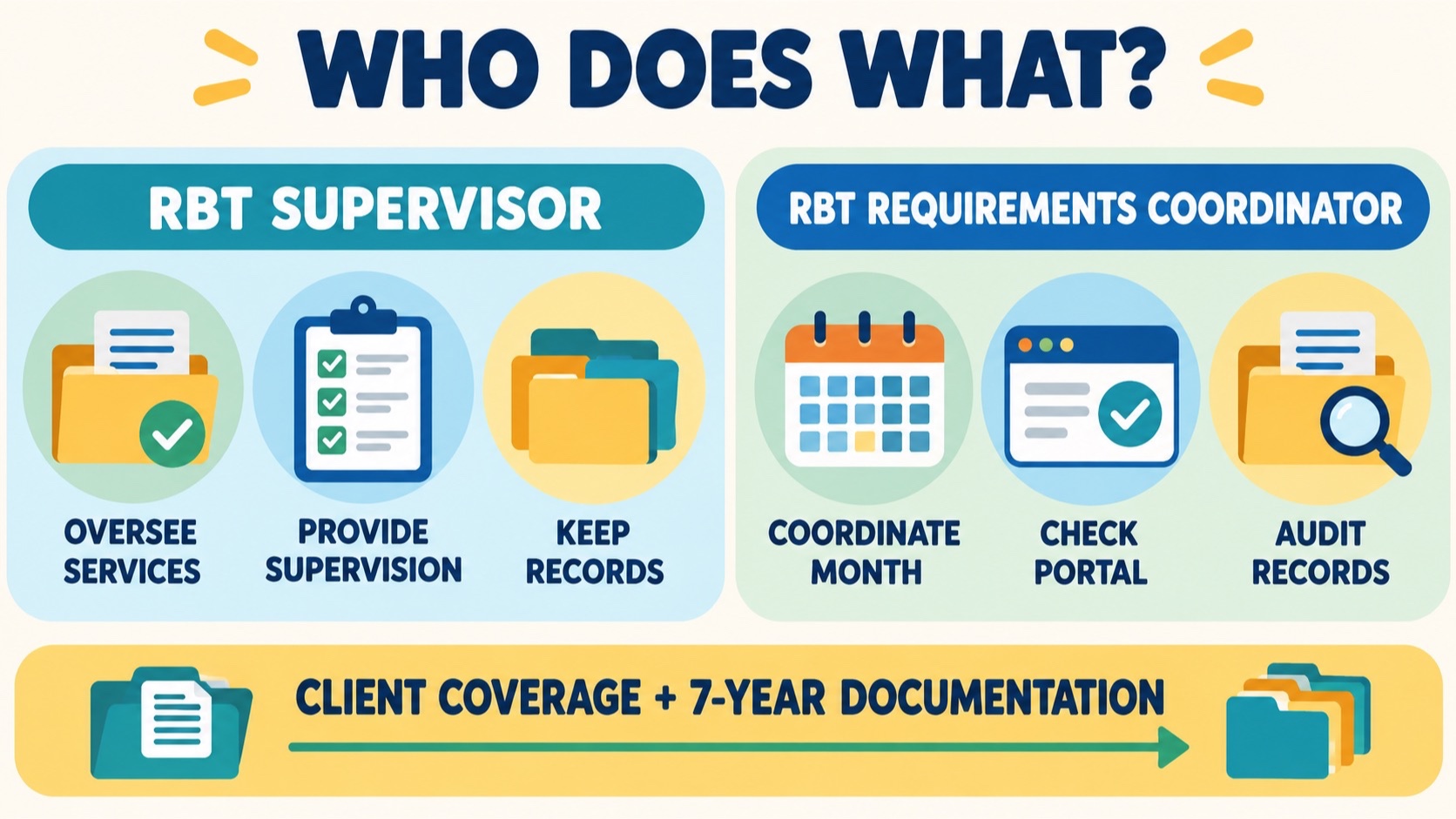
Organizations generally use one of two arrangements. In an RBT Supervisor structure, one or more RBT Supervisors provide supervision and are responsible for the services the RBT provides. Multiple supervisors at the same organization may collaborate to meet the monthly requirements, but the records and responsibilities need to be clear.
In an RBT Requirements Coordinator structure, the RBT may receive service oversight and supervision from several RBT Supervisors while one coordinator monitors whether the organization is meeting the requirements. The coordinator communicates with supervisors, keeps the organization’s records organized, and may also provide supervision. An RBT may have only one coordinator per organization, even if the organization has multiple coordinators for different RBTs or regions.
The difference is not just a job title. Ask which person is responsible for the whole monthly requirement, which people provide direct supervision, who is listed in the BACB portal, where records are stored, and who will respond if the organization is audited. Put the answer in writing during the first month.
What the supervision contacts must include
The handbook says supervision may include setting performance expectations, observing service delivery, behavioral skills training, performance feedback, modeling professional and ethical behavior, reviewing written materials, and evaluating the effects of service delivery. The contact should help the supervisor understand the RBT’s work and help the RBT improve it.
“Face-to-face” means real-time interaction. Supervision may use web cameras or videoconferencing instead of physical presence when it complies with applicable law. A recording or passive video feed by itself is not automatically supervision because it may not include real-time interaction or feedback. Phone calls and email alone do not satisfy the handbook’s face-to-face, real-time contact rule.
At least one of the two monthly contacts must be individual, with no other RBTs or trainees present. The other may be an interactive small-group meeting involving 2–10 RBTs with similar experiences. A large staff lecture is not automatically the same as the small-group supervision described by the handbook.
Supervisor qualifications, clients, and portal records
The current RBT Handbook lists BCBAs and BCaBAs as possible RBT Supervisors, with a BCBA serving as an RBT Requirements Coordinator. Before providing supervision, RBT Supervisors and coordinators must complete training based on the Supervisor Training Curriculum Outline (2.0) and upload it to their BACB portal account. The BACB’s supervision resource explains this training boundary in more detail.
The supervisor or coordinator also needs enough client-specific knowledge to inform the clinical direction of the RBT’s work. The relationship should connect the supervising person to the organization or client through employment or a contract. Every client with whom the RBT works needs appropriate supervision coverage; having a supervisor for three clients does not cover a fourth client automatically.
For an RBT’s certification to be active for practice, billing, or representation as an RBT, the supervisor or coordinator must be listed in the relevant BACB records. The exact portal action depends on the structure. In the coordinator model, the coordinator is the primary person on record for the RBT at that organization; direct supervisors provide their supervision details to the coordinator.
Documentation, audits, and multiple organizations
A useful monthly record connects service hours to supervision evidence. The current handbook identifies records such as:
- the days and times the RBT provided behavior-analytic services;
- the dates and duration of supervision;
- whether each contact was individual or group;
- the dates of direct observation with a client;
- the names of the people who provided supervision;
- evidence of the supervisor’s relationship to the client; and
- additional records when notes or totals do not match.
The RBT and supervisor or coordinator must retain supervision documentation for at least seven years, even if the supervisory relationship ends or another person takes responsibility. Use a shared, access-controlled record system that can still be understood if a supervisor goes on leave or leaves the organization. Keep client information secure and follow applicable privacy requirements.
If an RBT works for more than one organization, the supervision requirements are met independently at each organization. The current handbook gives the useful warning that 3% at organization A plus 2% at organization B cannot be combined into one 5% total. Each organization needs its own structure, client coverage, service-hour calculation, contacts, and records.
What to do when supervision breaks down
If a meeting is missed, a supervisor leaves, a client has no coverage, or the 5% calculation is unclear, raise the issue early. Ask the responsible supervisor or coordinator how the organization will correct the schedule, document the gap, and communicate with the BACB if required. Do not quietly backfill a missed month with an unrelated group meeting or relabel client training as supervision.
An RBT may practice only when a qualified supervisor or coordinator is on record with the BACB and the supervision requirements are being met. If you are not currently providing behavior-analytic services as an RBT, monthly supervision is not required to maintain certification, but the other maintenance requirements still apply. If you will be away from practice for an extended time, review whether voluntary inactive status is appropriate.
Substantial noncompliance can affect certification or eligibility for recertification. The safest response is prompt communication, accurate records, and a current handbook review—not a retroactive spreadsheet designed to make the numbers look complete.
Common mistakes and a monthly checklist
Counting every training event as supervision. Supervision must be client-focused, real-time, and documented under the current structure.
Combining employers. Calculate and meet the requirements independently at each organization.
Using passive video as the observation. Observation must be part of a real-time supervisory contact; a recording without interaction and feedback is not automatically enough.
Ignoring the portal relationship. The RBT, supervisor, and coordinator should know who is on record and when a relationship begins or ends.
At the start and end of each month, ask:
- Did we calculate 5% from the correct service hours for each organization?
- Did we complete two face-to-face, real-time contacts?
- Was at least one contact individual and at least one an observation of service delivery?
- Does every client have appropriate supervisory coverage?
- Are the responsible supervisor or coordinator and portal records current?
- Are the dates, duration, format, observation, names, client relationship, and discrepancies recorded?
- Is the documentation stored securely for the required retention period?
FAQ and official sources
Is RBT supervision always 5%? The current RBT Handbook states a minimum of 5% of the hours spent providing behavior-analytic services each calendar month. The percentage is only one part of the rule; contacts, observation, structure, client coverage, and documentation also matter.
Can an RBT have group supervision? One of the two required monthly contacts may be an interactive small-group meeting of 2–10 RBTs with similar experiences. At least one of the two contacts must be individual.
Can an RBT supervisor be a BCaBA? The current handbook lists a qualified BCaBA as an RBT Supervisor. The supervisor must also meet the applicable supervision-training and relationship requirements. A BCaBA is not the RBT Requirements Coordinator role described in the current structure.
Where should I verify the final rule? Start with the current RBT Handbook, the BACB RBT supervision resources, and the supervision and training page. Use the RBT learning blocks, RBT practice questions, and ABA glossary for study support, not as a substitute for the organization’s supervisory process.
RBT supervision works best when the monthly requirement is visible before the month begins: calculate the service hours, schedule the contacts, observe the work, record the evidence, and check that the portal and client coverage match the structure. When a detail is uncertain, use the current handbook and involve the responsible supervisor early.