RBT Study Guide: A Current 3rd Edition Plan
A good RBT study guide should do more than collect definitions. It should show you what the current examination outline covers, help you divide your time across six domains, and give you a way to explain your answer when a short workplace scenario feels ambiguous.
This guide is written for the current RBT examination content beginning January 1, 2026. It keeps the exam blueprint separate from the rest of the certification process: a study guide can organize learning, but it does not replace the 40-hour training, Competency Assessment, supervision, eligibility steps, or official BACB instructions. It is independent educational material, not official BACB examination content or a pass guarantee.
Quick answer: Use the current RBT Test Content Outline (3rd ed.) as your map, your 40-hour training and Competency Assessment materials for depth, the RBT Handbook for application and testing rules, and the RBT Ethics Code for professional boundaries. The current examination includes 75 scored questions plus 10 unscored pilot questions, or 85 questions total, with 90 minutes to complete it. Study by domain, then mix domains so you practice recognizing the relevant procedure before choosing an answer.
Keep the numbers together: “85 questions” means the total testing experience described in the outline, while “75 questions” refers to the scored portion. The 10 unscored pilot questions are not extra points to earn. They are included in the examination structure, but do not contribute to the scored result.
The current RBT exam map
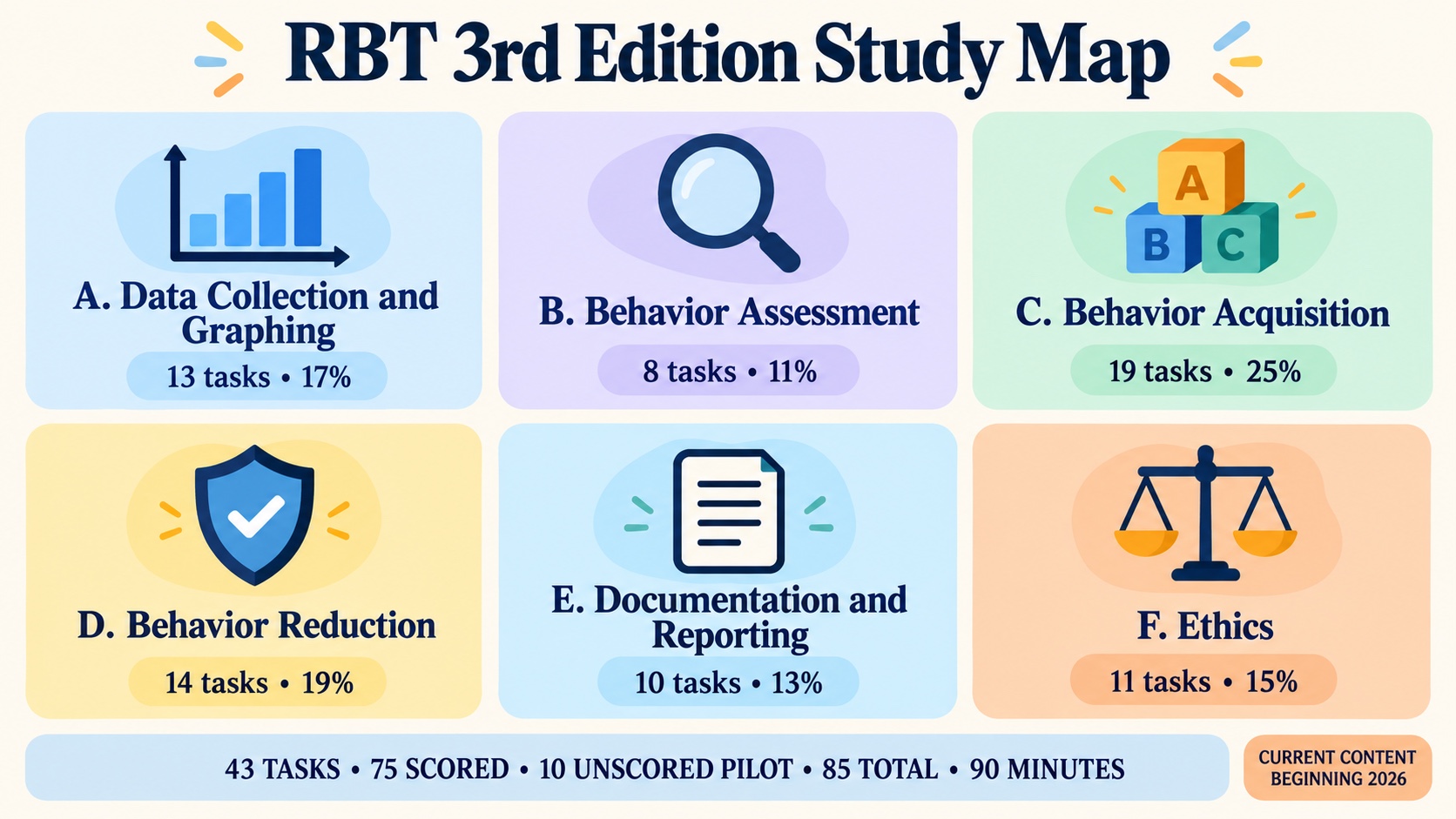
The current RBT Test Content Outline (3rd ed.) describes examination content beginning in 2026. It contains 43 tasks organized into six domains. The exam uses four answer choices with one correct answer and provides 90 minutes of testing time. The domain percentages are useful for allocating review time, but they are not six separate pass thresholds.
A practical study guide has four layers:
- Source layer: read the current TCO and keep the Handbook and Ethics Code nearby for boundaries and process questions.
- Concept layer: build plain-language comparisons for measurement, assessment, teaching, behavior reduction, documentation, and ethics.
- Application layer: answer original scenarios that ask what an RBT should do next, what to record, or when to involve a supervisor.
- Feedback layer: record the reason for each miss and turn it into the next review task.
The official outline is the content boundary. It is not a promise that a commercial guide, a free PDF, or a practice question bank reproduces the actual exam. Be especially cautious with pages that imply official approval, guarantee a pass, or blur the difference between studying and meeting certification requirements.
The six study-guide domains
The six domains have different rounded shares, so they should not receive identical study time. Still, a smaller domain is not a reason to skip it: the exam result is based on overall performance, and every domain represents skills used in practice.
Measurement and assessment: A–B
A. Data Collection and Graphing — 13 questions, 17%: Review continuous and discontinuous measurement, permanent products, data entry, graphs, trends, rate, mean duration, percentage, observable descriptions, and the risks of unreliable data or poor procedural fidelity. A useful check is to ask, “What dimension of behavior does this measurement actually represent?”
B. Behavior Assessment — 8 questions, 11%: Study preference assessments, skill-strength and deficit assessments, descriptive assessment, and the RBT’s participation in functional-assessment components. Keep observation and interpretation distinct. An RBT can collect and communicate information without independently turning a limited observation into a definitive functional conclusion.
Teaching and behavior reduction: C–D
C. Behavior Acquisition — 19 questions, 25%: This is the largest domain. Build comparisons for reinforcement, conditioned reinforcers, discrete-trial teaching, naturalistic teaching, task-analyzed chaining, discrimination training, prompting and fading, generalization, maintenance versus acquisition, shaping, and token economies. For each procedure, be able to name the target, the cue or antecedent, the response, the consequence, and the feedback that tells you whether implementation is working.
D. Behavior Reduction — 14 questions, 19%: Review how to follow an authorized plan, collect data accurately, recognize possible side effects, protect dignity, and report concerns. The question is rarely just “Which procedure is this?” It is often “What should the technician do within the written plan, and what should be brought to the supervisor?”
Documentation and professional boundaries: E–F
E. Documentation and Reporting — 10 questions, 13%: Practice objective session notes, timely reporting, accurate data handling, privacy, and communicating what occurred without adding unsupported motives or diagnoses. A strong note separates what was observed, what was measured, what was implemented, and what needs follow-up.
F. Ethics — 11 questions, 15%: Review competence, supervision, confidentiality, public statements, multiple relationships, gifts, feedback, collaboration, cultural humility, and professional communication. Use the current RBT Ethics Code rather than an old summary. If a situation falls outside your competence or authorization, the safe study answer usually includes following the chain of supervision and documenting the concern appropriately.
A six-week RBT study routine
Six weeks is a planning example, not a BACB requirement. Adjust the pace to your training, assessment, work schedule, authorization, and available support.
- Week 1 — Build the outline: read the current TCO once, make six domain headings, and mark the task verbs: identify, describe, implement, participate, calculate, and communicate.
- Week 2 — Make data visible: study Domain A with short measurement comparisons, graph-reading exercises, and examples of observable versus inferred language. Add Domain B preference and assessment distinctions.
- Week 3 — Practice acquisition: spend the largest block on Domain C. Work through reinforcement, prompting, fading, teaching formats, chaining, discrimination, generalization, and maintenance.
- Week 4 — Follow plans safely: review Domain D, then connect behavior-reduction questions to implementation fidelity, dignity, data, and supervisor communication.
- Week 5 — Write and communicate: combine Documentation and Reporting with Ethics. Practice changing a vague note into an objective one and identifying when a question requires supervision.
- Week 6 — Mix and repair: use timed mixed practice, review every uncertain item, and revisit the exact domain or task that explains the error. Finish by checking your study notes against the current outline.
Use a repeatable session: retrieve yesterday’s material, learn one small target, answer a few applied questions, explain the rationale, and schedule weak items for later review. The RBT study path can hold the theory step, free RBT questions can hold the practice step, and the ABA Study Online app is planned for flashcards, section practice, audio review, progress, and tools.
How to practice workplace decisions
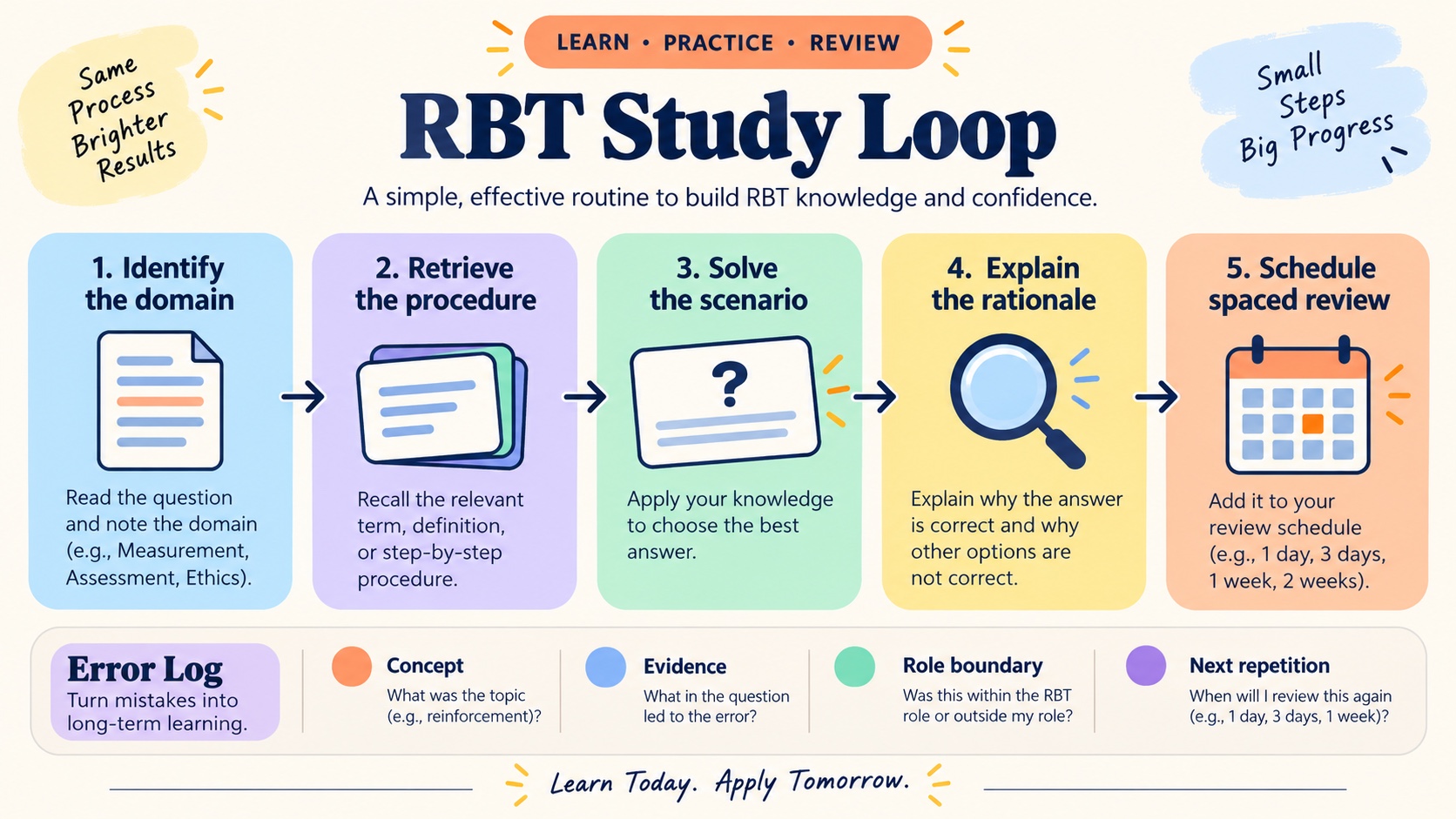
Before looking at an answer, write five short notes: the domain, the target behavior or skill, the relevant measure, the instruction or plan you are expected to follow, and the person who should be consulted if the situation is outside your role. Then choose an answer and explain why the other options are weaker.
Keep an error log with:
- Domain and task: which part of the outline was being tested?
- Concept distinction: which two terms, procedures, or measurement systems did you confuse?
- Role boundary: did you act like an RBT should, or did you independently design, diagnose, or change something outside the plan?
- Evidence boundary: did you add an interpretation that the observation or graph could not support?
- Next repetition: what will you retrieve again, and when?
For a data question, return to the graph and describe the pattern without guessing its cause. For a teaching question, identify the target, prompt, consequence, and fading plan. For a documentation question, rewrite the sentence with observable language. For an ethics question, name the relevant boundary and the supervisor or coordinator who should be involved. Retrieval practice and spaced review are general learning methods supported by education research; they are not BACB requirements or a prediction of your exam result.
Common RBT study-guide mistakes
- Using an old outline: check that your materials reflect the RBT Test Content Outline (3rd ed.) beginning in 2026.
- Confusing 85 total with 75 scored: keep both numbers visible and label the 10 unscored pilot questions clearly.
- Treating percentages as pass thresholds: use them to allocate attention, not to create six separate pass/fail goals.
- Studying procedures without role limits: an RBT implements authorized procedures and communicates concerns; a study guide should not encourage independent plan changes.
- Memorizing notes without practicing: use short scenarios, rationale explanations, and delayed re-testing.
- Assuming every PDF is official: compare claims with the BACB TCO, Handbook, and Ethics Code.
RBT study guide FAQ
What is the current RBT task list for studying?
For examination content beginning in 2026, use the RBT Test Content Outline (3rd ed.). “RBT task list” remains common search language, but your study file should identify the current edition and link to the BACB source.
How many questions are on the RBT exam?
The current structure includes 75 scored questions and 10 unscored pilot questions, for 85 questions total. Candidates have 90 minutes, and each question has four answer choices with one correct answer.
Which RBT domain should I study first?
Use your baseline practice to find the first weak area. If you have no baseline, start by mapping all six domains, then give extra time to Behavior Acquisition because it has the largest rounded share, 25%. Do not skip the smaller domains.
Does an RBT study guide replace the 40-hour training or Competency Assessment?
No. A guide can organize review, but it does not replace the training, assessment, supervision, application, or other requirements described by the BACB.
Is ABA Study Online official RBT exam content?
No. ABA Study Online provides independent explanations and practice. Use the current BACB TCO, Handbook, Ethics Code, and official resource pages for certification and examination information.
Sources
- BACB RBT Test Content Outline (3rd ed.)
- BACB RBT Handbook, updated January 2026
- BACB Test Content Outlines for BACB Certifications
- BACB Registered Behavior Technician resources
- BACB RBT Ethics Code
- Carpenter, Pan, and Butler (2022), spacing and retrieval practice review
- Dunlosky et al. (2013), effective learning techniques review