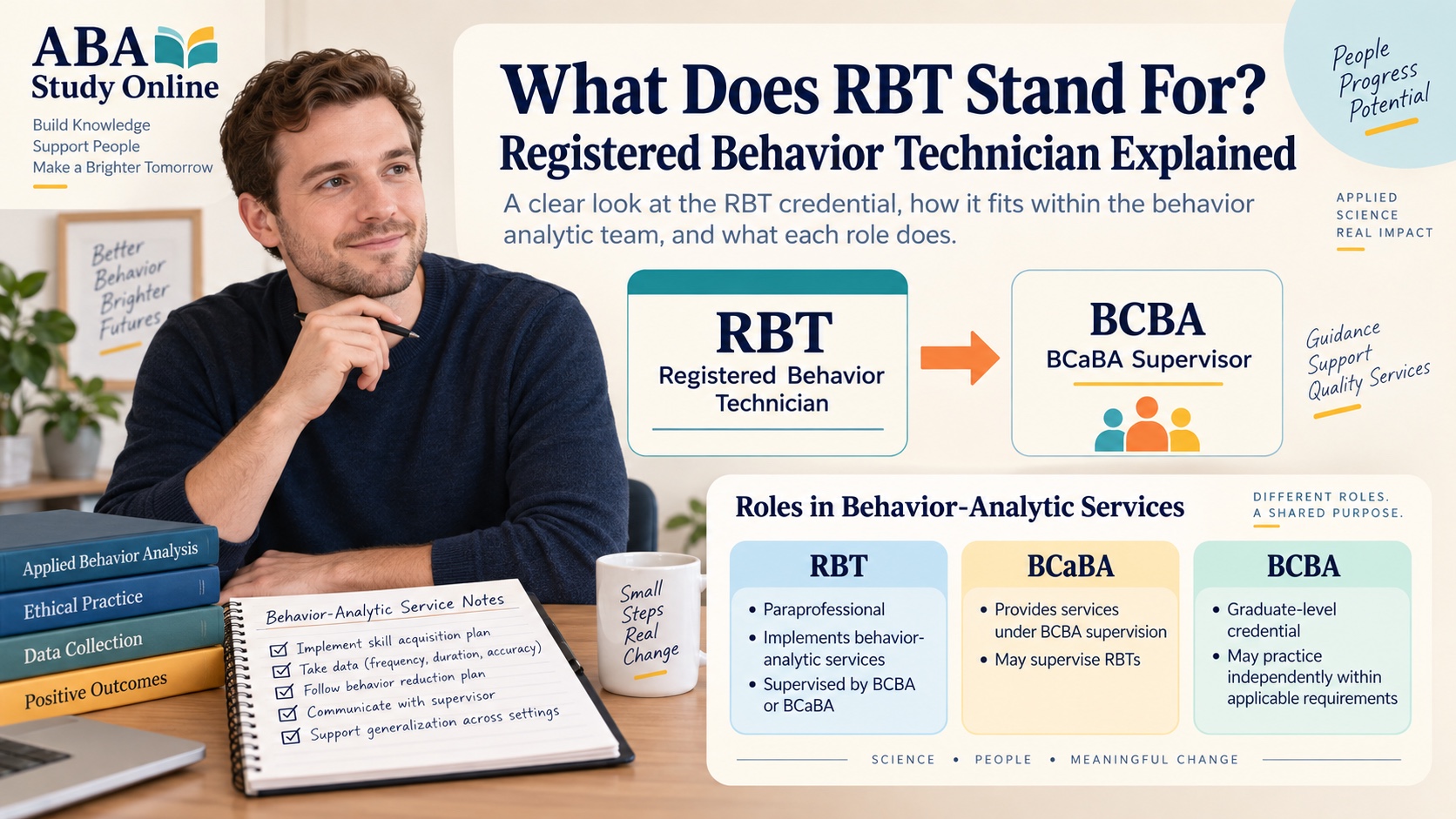
What Does RBT Stand For? Registered Behavior Technician Explained
RBT stands for Registered Behavior Technician. The Behavior Analyst Certification Board describes RBT certification as a paraprofessional certification in behavior analysis. RBTs assist in delivering behavior-analytic services and practice under the direction and close supervision of an RBT Supervisor and/or RBT Requirements Coordinator who is responsible for their work.
That short definition answers the acronym, but it does not explain every part of the role. An RBT is not the same credential as a BCaBA or BCBA, and completing a course does not give someone authority to practice without supervision. This guide explains the role in plain language, shows where RBT fits in the behavior-analysis team, and points you to the current certification and supervision resources.
For current requirements, start with the BACB RBT resources and the RBT Handbook. Requirements, forms, and examination content can change, so a definition page should not replace those official sources.
Table of Contents
What RBT means
Each word in Registered Behavior Technician carries useful information:
- Registered: the credential is part of a formal certification system. “Registered” does not mean that every person who works as a technician automatically holds the credential.
- Behavior: the work focuses on observable behavior and the conditions that influence learning and performance. It is not a general title for every support or care role.
- Technician: the role is a paraprofessional service-delivery role. The RBT implements assigned procedures, collects information, communicates with the supervising team, and receives ongoing oversight.
RBT is a professional credential, not a degree title and not a synonym for “ABA therapist.” Employers may use different job titles, and local rules or payer requirements may add conditions. Check the credential in the BACB registry and verify any state or workplace requirements that apply to the job.
What an RBT does
An RBT may work directly with a client while implementing a behavior plan or teaching program developed and overseen by qualified professionals. Depending on the setting and the plan, tasks may include preparing materials, arranging teaching opportunities, prompting a response, delivering reinforcement, recording data, supporting communication or daily-living skills, and reporting observations to the supervisor.
Consider a bounded example. A supervising clinician defines a teaching procedure for requesting a break. The RBT prepares the visual, presents the instruction as written, records the learner’s response, follows the reinforcement step, and tells the supervisor what happened. If the data suggest that the procedure needs to change, the RBT reports the information; the RBT does not quietly rewrite the full intervention independently.
The exact activities depend on the service plan, setting, training, and applicable requirements. A good RBT training curriculum teaches the role, data collection, behavior-change procedures, ethics, and supervision expectations together rather than presenting a list of techniques without context.
RBT vs. BCaBA vs. BCBA
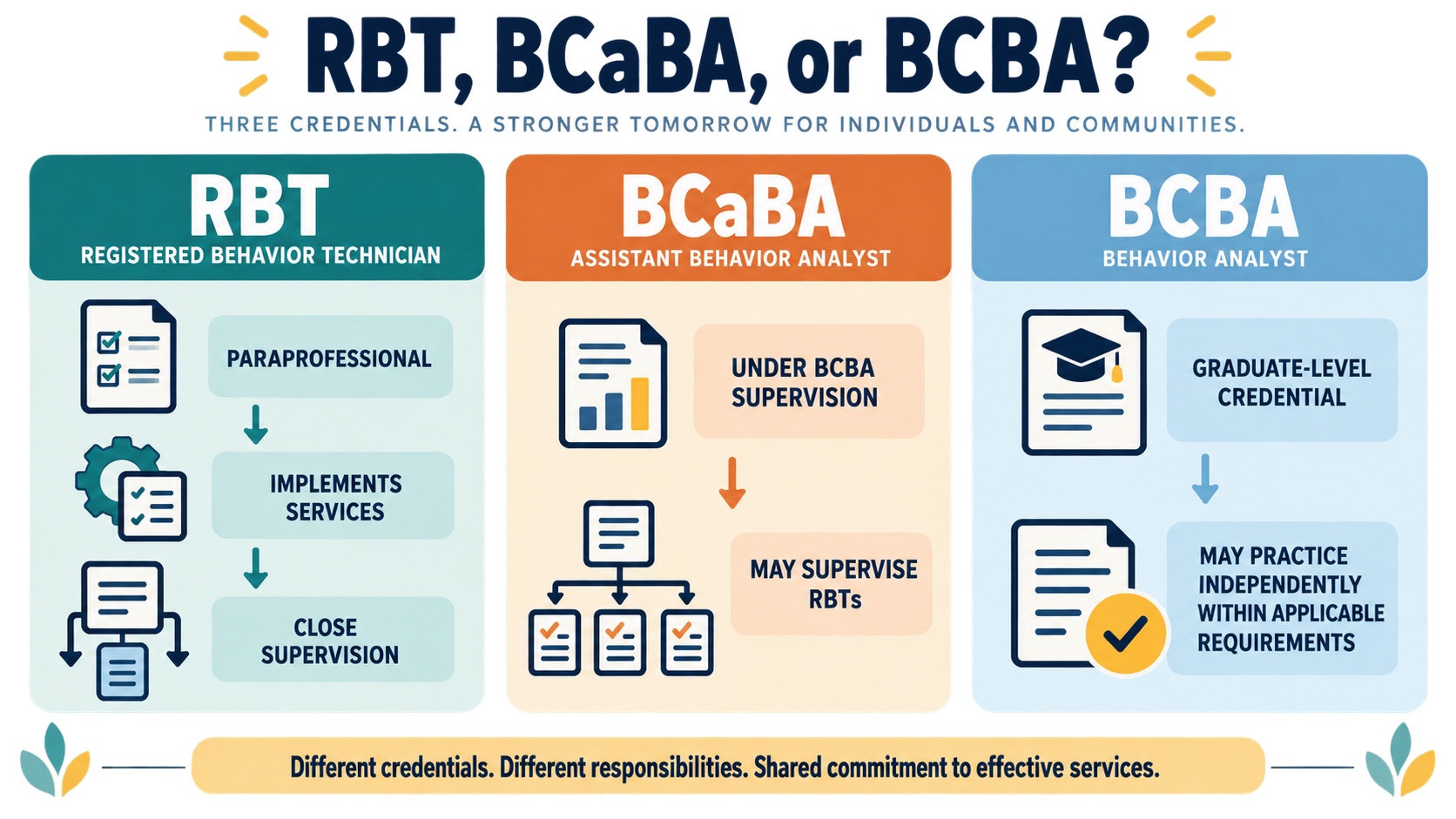
The three BACB credentials are connected but not interchangeable:
| Credential | Plain-language role | Supervision and responsibility |
|---|---|---|
| RBT | Paraprofessional who assists with behavior-analytic service delivery | Works under close, ongoing supervision from an RBT Supervisor and/or Requirements Coordinator. |
| BCaBA | Undergraduate-level behavior analyst credential | Provides behavior-analytic services under BCBA supervision and may have defined supervision responsibilities for RBTs. |
| BCBA | Graduate-level behavior analyst credential | May practice independently within applicable requirements and supervise behavior-analytic work. |
The table is a high-level orientation, not a replacement for each handbook. An RBT’s role can be highly skilled and important without being the same as the role of the professional who designs, evaluates, or supervises the overall program.
Why supervision is part of the definition
Supervision is not an optional footnote to the RBT title. The BACB describes RBTs as practicing under the direction and close supervision of an RBT Supervisor and/or RBT Requirements Coordinator responsible for their work. The current supervision structure includes oversight, feedback, training, documentation, and the required contacts or observations described in the handbook.
That structure protects two things at once: the learner’s access to effective services and the RBT’s access to guidance while building professional skill. If an RBT is unsure whether a procedure was implemented correctly, the appropriate next step is to pause when necessary, follow the safety and plan instructions, and contact the responsible supervisor. It is not to hide the uncertainty or invent a new procedure.
The BACB’s supervision, assessment, training, and oversight page identifies the roles and resources involved. Use the current handbook for the exact supervision and documentation requirements that apply to your status.
How the RBT certification path fits together
Knowing what RBT stands for is only the first step. The current pathway generally includes the following sequence:
- Eligibility and training: complete the applicable RBT training requirements, including the current 40-hour curriculum when required.
- Competency assessment: complete the current initial competency assessment with the responsible qualified assessor.
- Application: submit the required materials through the BACB process and wait for the application determination.
- Examination: after authorization, schedule and take the current RBT examination through the authorized testing process.
- Ongoing supervision and maintenance: keep the status and supervision requirements current after certification.
A training provider, practice website, or app may help with learning and review. None of those labels alone proves that the provider issues certification or makes the BACB application decision. For a full process guide, see the ABA Study Online RBT certification resources and RBT exam resources.
What RBT does not mean
It does not mean independent practice
RBTs work under the direction and close supervision described by the BACB. The credential does not mean that the technician independently diagnoses, designs the entire behavior program, or replaces the supervising professional.
It does not mean “any ABA job”
Some employers use “behavior technician” broadly. Ask what credential, training, supervision, and duties the position actually requires. A job title and a BACB certification are not automatically the same thing.
It does not mean a guaranteed outcome
Certification and training can support competent service delivery, but they do not guarantee a particular client result. Outcomes depend on assessment, goals, implementation, supervision, context, and the learner’s needs.
How to study the role
When reviewing RBT material, connect vocabulary to a job responsibility. For example, do not memorize “data collection” as a disconnected term; ask what response is defined, what measurement is used, how the data are recorded, and when the supervisor reviews them. For reinforcement, identify the contingency and follow the plan rather than guessing from the word “reward.” For ethics, consider consent, dignity, confidentiality, scope, and the responsibility to seek supervision.
Use the current RBT Test Content Outline as the examination boundary and treat third-party questions as unofficial practice. ABA Study Online’s RBT practice questions can help you retrieve concepts and explain choices, but they do not replace official requirements or supervision.
FAQ and official sources
What does RBT stand for?
RBT stands for Registered Behavior Technician.
What is an RBT?
An RBT is a paraprofessional certified in behavior analysis who assists with behavior-analytic services under the direction and close supervision of an RBT Supervisor and/or RBT Requirements Coordinator.
Is an RBT the same as a BCBA?
No. RBT and BCBA are different credentials. An RBT is a paraprofessional service-delivery role, while a BCBA is a graduate-level behavior analyst credential with different education, supervision, and responsibility requirements.
Can an RBT work without supervision?
The RBT role is defined around close, ongoing supervision. Follow the current RBT Handbook and the supervision arrangement recorded for your certification status.
Where can I learn more about becoming an RBT?
Start with the BACB RBT page and current RBT Handbook, then review the training, competency assessment, application, examination, and supervision resources that apply to your situation.