
Do RBTs Have to Follow Skill Acquisition Plans Exactly?
If you are asking whether RBTs must follow skill acquisition plans exactly, an RBT should implement the current program as written and trained, but “exactly” does not mean blindly guessing, hiding a problem, or making independent program changes. The RBT’s job is faithful implementation within training and scope. The supervisor’s job is to clarify, evaluate, and authorize program decisions that are outside that implementation role.
That distinction matters in real sessions. A plan may describe a target, prompt sequence, reinforcement arrangement, mastery criterion, and data method. If those directions are clear and workable, follow them consistently. If a step is missing, unsafe, impossible to run as written, or no longer matches the learner’s situation, do not silently rewrite it. Protect the learner, follow the applicable agency procedure, contact the responsible supervisor, and record what happened.
The quick answer
An RBT normally follows the current skill-acquisition program as written, after receiving the training and supervision needed to implement it. That includes using the specified materials, instructions, prompts, reinforcement rules, response definitions, mastery criteria, and data procedures. Consistency allows the supervising behavior analyst to interpret the data and decide whether the teaching procedure is working.
Following a plan does not give an RBT permission to design a new intervention. An RBT should not independently change the target behavior, rewrite the operational definition, skip required teaching steps, move the mastery criterion, introduce a new consequence, or present a personal variation as though it were the approved program. Those decisions can change what the data mean and may create a scope, safety, or ethics problem.
What fidelity means
In this context, fidelity means carrying out the authorized procedure in the way it was taught, with the details that make the procedure recognizable. It is more than being generally helpful. It is also more realistic than expecting every session to look mechanically identical. Learners respond in context, materials can need replacement, and the supervising team may issue an updated version of a program. The RBT should use the current version and make ordinary implementation decisions that the plan or training already covers.
A useful question is: Am I implementing an existing instruction, or am I deciding what the instruction should be? Choosing the listed reinforcer from approved options is implementation. Creating a new reinforcement rule or removing a prompt level because progress seems slow is a program change that needs supervision. BACB RBT resources place the role within direction and close supervision, so asking for help with a confusing or ineffective-looking plan is part of responsible practice.
What to follow in a plan
Before a session, look for the current program name or version and confirm that you understand the parts that affect implementation:
- Target and response definition: what skill is being taught and what counts as a response.
- Materials and setting: which materials, arrangement, and natural opportunities are approved.
- Instruction and prompts: what direction to give, how to prompt, and how to fade prompts when the plan specifies it.
- Reinforcement: what consequence or reinforcement arrangement is described, including timing and choice rules.
- Mastery and error criteria: how progress is measured and what information should be recorded.
- Generalization or maintenance steps: whether the plan includes other people, materials, settings, or delayed checks.
If you understand the instructions and have been trained on them, implement them consistently. Use a substitute only when the plan or supervisor has approved that kind of substitution; otherwise, ask before treating a new material as equivalent.
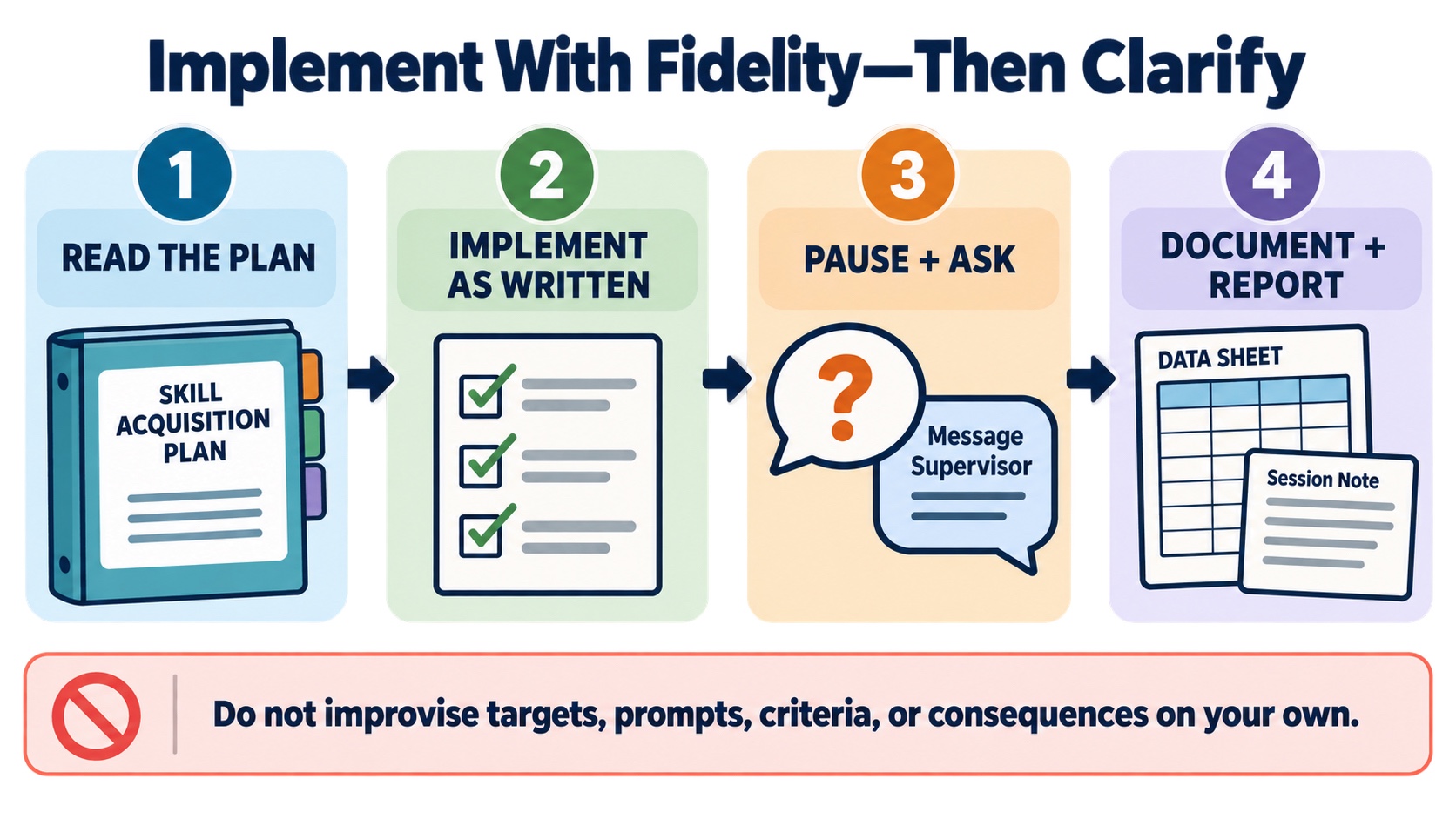
When to pause and clarify
Contact the supervisor when the program does not provide enough information to implement it responsibly. Common examples include a missing prompt definition, two documents that give different mastery criteria, an instruction that conflicts with the learner’s current support needs, or a procedure that cannot be carried out with the available materials. A plan that repeatedly produces no opportunity to practice may also need review, but the RBT should bring the observation and data to supervision rather than changing the teaching procedure independently.
Safety concerns deserve especially careful handling. If an instruction appears to create an immediate risk, follow the current emergency or safety policy, protect the learner and others within your training, and notify the responsible supervisor promptly. Do not use “following the plan” as a reason to ignore an urgent concern. Do not use a safety concern as a reason to invent a long-term replacement plan either. The immediate response and the later program decision are separate steps.
Clarification can be brief and specific: “The program says to use the least-to-most prompt sequence, but the current materials show a different sequence. Which version should I use today?” Questions like this preserve fidelity because they make the uncertainty visible.
A practical example
Imagine a program for requesting a preferred item. It states that the RBT should present the opportunity, wait briefly, use a specified prompt hierarchy if needed, provide the item after the learner’s defined response, and record the prompt level. During a session, the learner does not respond to the first prompt level. The RBT should use the next trained prompt level if the written procedure says to do so, deliver the programmed consequence, and record the response accurately.
Now imagine that the preferred item listed in the plan is unavailable, or that the plan’s prompt hierarchy conflicts with a newer supervisor instruction. The RBT should not replace the item, skip the data, or choose a new prompt hierarchy without checking the current direction. The RBT can describe the problem, use any already-approved alternative, and ask the supervisor what to do. The difference is not whether the RBT is flexible; it is whether the flexibility was authorized and remains faithful to the program.
How to document the issue
Good documentation helps the supervisor distinguish learner performance from implementation conditions. Follow the organization’s required record format, and keep the note factual. Include the program or version used, the relevant instruction, what occurred, the data you collected, who you contacted, the guidance received, and any approved temporary step. Avoid writing that the program “did not work” when the real observation is that a material was unavailable or a direction was unclear.
For example: “Requesting program version 3 was used. The listed item was not available. I paused the item opportunity, recorded the missed opportunity, and messaged the supervisor at 10:15. Supervisor directed use of the approved alternate item and continuation of the same prompt hierarchy. Data were recorded under the alternate-item note.” That note does not turn an RBT into a program designer. It creates a traceable record for the supervising team.
Session checklist
- Confirm that you are using the current program and have been trained on the relevant steps.
- Identify the target, response definition, prompt procedure, reinforcement rule, and data method.
- Implement the written procedure consistently within your training and scope.
- Do not independently change targets, definitions, criteria, consequences, or long-term teaching decisions.
- Pause and contact the supervisor when the plan is unclear, conflicting, unsafe, or not workable as written.
- Document the observation, data, communication, and approved direction.
For broader RBT learning, use the ABA Study Online RBT learning route alongside the current BACB handbook and supervision guidance. It does not replace supervision or an individualized program.
FAQ
Can an RBT change a skill-acquisition program?
An RBT should not independently redesign the program. An RBT can report observations, collect data, implement approved updates, and ask for clarification. The supervising team evaluates whether the target, procedure, criterion, or reinforcement arrangement should change.
Does following a plan mean ignoring learner assent or safety?
No. Following a plan does not erase safety procedures, ethical responsibilities, or the need to report a concern. Address an immediate concern according to current policy and training, notify the supervisor, and do not silently create a permanent replacement procedure.
What if the plan is not working?
Keep accurate data and bring the pattern to supervision. Check whether you used the correct current version and whether implementation was trained and consistent. Do not change the intervention on your own simply because the first few sessions were difficult.
Is this an official BACB exam answer?
This article is an independent study explanation, not official BACB exam content. For current role, ethics, supervision, and examination information, use the BACB sources below and follow the instructions that apply to your situation.