RBT Renewal Competency Assessment: What Changes in 2027
If you searched for RBT renewal competency assessment, you are probably trying to answer a practical question before a certification deadline: Do I need an assessment, who completes it, which packet should I use, and what happens when the 2027 rules begin? The BACB usually uses the term recertification rather than renewal. That wording matters because the current assessment requirement is tied to a specific maintenance cycle, not to a permanent rule that can be copied from an older checklist.
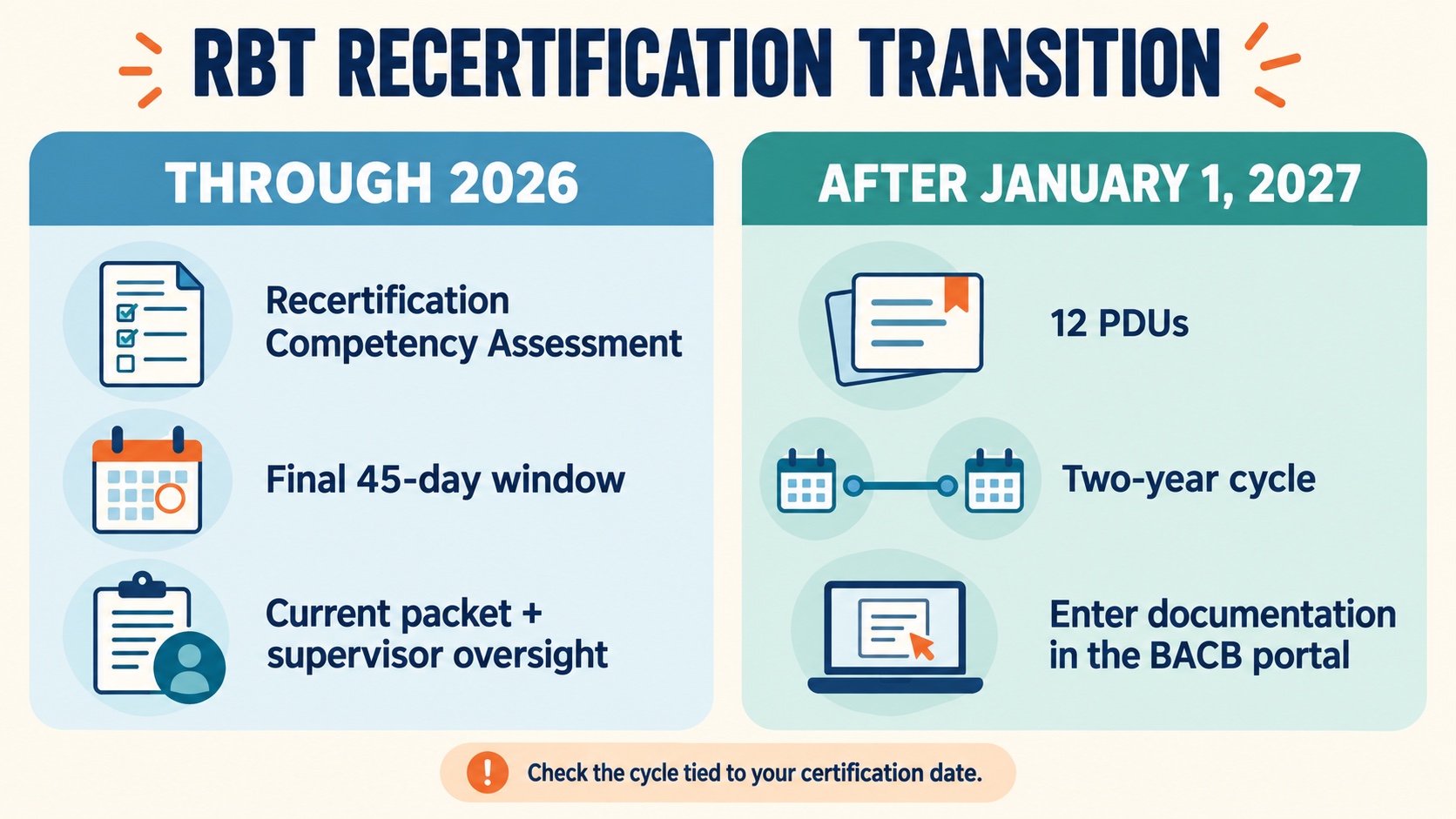
As of the June 2026 RBT Handbook, RBTs recertifying through December 31, 2026 still use the RBT Recertification Competency Assessment. For recertification after January 1, 2027, the standard process moves to a two-year cycle with 12 professional development units, or PDUs, and the recertification competency assessment is no longer part of that standard cycle. Special situations such as reinstatement, return from inactive status, or reentry can have their own rules, so use the live Handbook and current BACB portal instructions for your situation.
Table of Contents
What the RBT renewal assessment means
“RBT renewal competency assessment” is a useful search phrase, but it blends two ideas: the everyday word renewal and the BACB’s official word recertification. The official document you need is the RBT Recertification Competency Assessment Packet, not the RBT Initial Competency Assessment Packet. The two packets support different points in the certification journey.
The recertification assessment is a performance check. It is designed for an already certified RBT to demonstrate continued competence with the applicable behavior-technician tasks before the current maintenance cycle ends. It is not a multiple-choice exam, a practice quiz, a general supervisor meeting, or a document that a study website can sign for you.
That distinction protects the meaning of the requirement. A free worksheet can help you review vocabulary or organize questions for your supervisor, but it cannot replace the official packet, the qualified assessor’s observation, the required signatures, or the upload in your BACB portal account. If a resource uses “renewal assessment” casually, compare its advice with the current BACB wording before relying on it.
How the process works through 2026
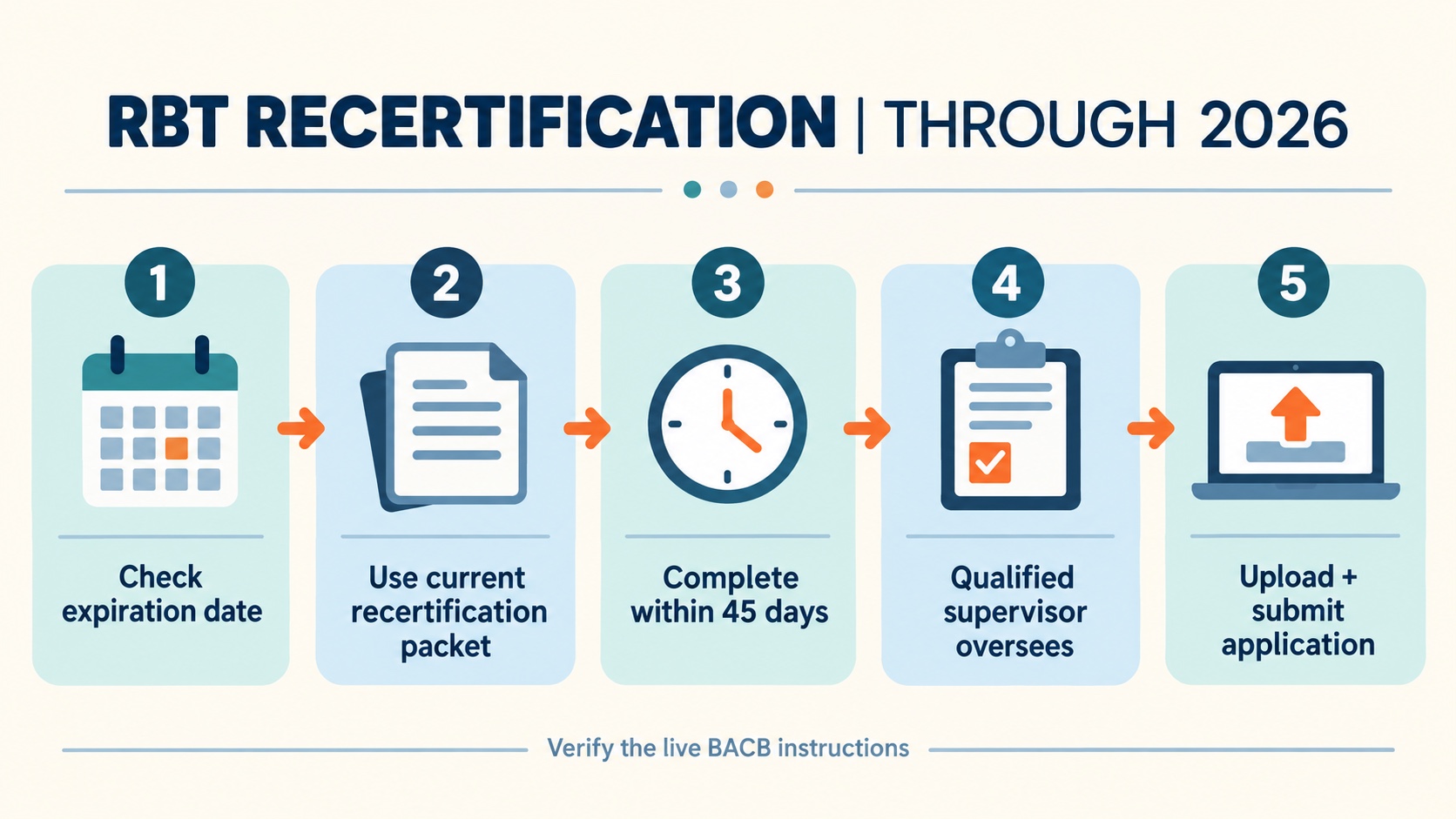
The 2026 process is easiest to understand as a sequence. Your exact portal screen and account status control what you can submit, but the Handbook gives the maintenance logic.
- Find your expiration date. Check the date in the BACB portal account associated with your RBT certification and compare it with the Certificant Registry if needed. Do not estimate from a coworker’s date or from an old email.
- Use the current recertification packet. The assessment must be based on the current version of the RBT Recertification Competency Assessment Packet. The BACB’s application-processing page currently lists the recertification packet version as 8/2025, but document versions can change, so check the live page before starting.
- Stay inside the timing window. The Handbook says the assessment must be completed no more than 45 days before your expiration date. Starting too early can create a document-timing problem even if the tasks were performed well.
- Arrange qualified oversight. The assessment is overseen by a qualified BACB-certified RBT supervisor. The person responsible for the assessment and sign-off must follow the current packet’s instructions; self-rating your own performance is not a substitute.
- Demonstrate the applicable tasks. The assessor observes the required performance and completes the fields, task decisions, method notes, identifying information, and signatures requested by the current form. Do not copy an initial-assessment checklist into the recertification packet.
- Upload the completed document. The completed assessment is submitted with the RBT Recertification Application in the BACB portal account associated with your certification. The Handbook also describes reporting supervision status and completing the required self-reporting questions truthfully.
- Submit before the expiration date. Give yourself time to correct a missing page, signature, date, or upload. A study plan cannot extend the BACB deadline.
A useful planning habit is to work backward from the expiration date. Put a “document check” on your calendar before the 45-day window opens, then place the assessment, upload, and final application review inside the official window. Treat that calendar as a preparation aid, not as an alternative to the BACB portal’s current instructions.
What changes after January 1, 2027
The biggest change is that standard RBT recertification moves away from the annual competency-assessment cycle. The June 2026 Handbook says that RBTs who become certified in 2026 or recertify in 2026 move into a two-year recertification cycle, and that recertification after January 1, 2027 requires 12 PDUs during each two-year cycle.
For the standard 2027-and-later cycle, the maintenance job becomes an education-and-documentation loop:
- Earn 12 professional development units during the applicable two-year recertification cycle.
- Keep documentation for each activity and enter the information in the BACB portal as instructed.
- Do not count activities from the wrong cycle, repeat the same activity as new credit, or carry extra units forward automatically.
- Complete the recertification application, including payment, by the recertification date to avoid a lapse and possible late fees.
The Handbook describes three PDU activity types: organization in-service training related to behavior-analytic service delivery, professional-development events from an Authorized Continuing Education provider, and qualifying didactic behavior-analytic university courses. It also draws boundaries around what does not count. Ongoing RBT supervision, client-specific training, and supervised fieldwork toward BCaBA or BCBA certification are not interchangeable with the PDU requirement.
Keep the evidence trail simple: record the activity date, provider, title, hours, and the document that proves participation. A supervisor can help you think through whether an activity is relevant, but the BACB’s published PDU categories and documentation rules control acceptance. If an activity is repeated, client-specific, or missing its supporting form, do not assume that it can be counted simply because it was educational. Enter documentation as the cycle progresses instead of reconstructing two years of records at the last minute.
This is why an older article can be misleading. A 2026 RBT may still need the competency assessment for the recertification step that starts within the final 45 days of the current cycle. A later cycle may instead require the PDU record. Do not delete an assessment task or start collecting PDUs based only on the year shown in a search result; confirm which recertification cycle applies to your portal account.
Who can oversee the assessment
The assessment is not a self-study certification. The current Handbook uses the phrase “qualified BACB-certified RBT supervisor,” and the BACB’s supervision and training page identifies BCBA and BCaBA roles in the assessment and supervision system. The current packet and Handbook control the final qualifications, oversight, delegation, and sign-off instructions.
That means the practical first conversation should be with your current supervisor or RBT Requirements Coordinator. Ask which official packet applies, when the assessment window opens, what tasks will be observed, and how the completed form will be returned to you for upload. If the person supervising your work is not sure whether they may assess or sign the form, pause and check the current BACB guidance rather than guessing.
ABA Study Online can help explain ABA concepts and help you prepare questions, but it cannot assess performance, approve a packet, confirm your supervisor’s status, interpret an individual account, or decide whether your documents satisfy BACB requirements.
What to prepare and upload
Before the assessment, build a small document check rather than waiting until the final submission screen:
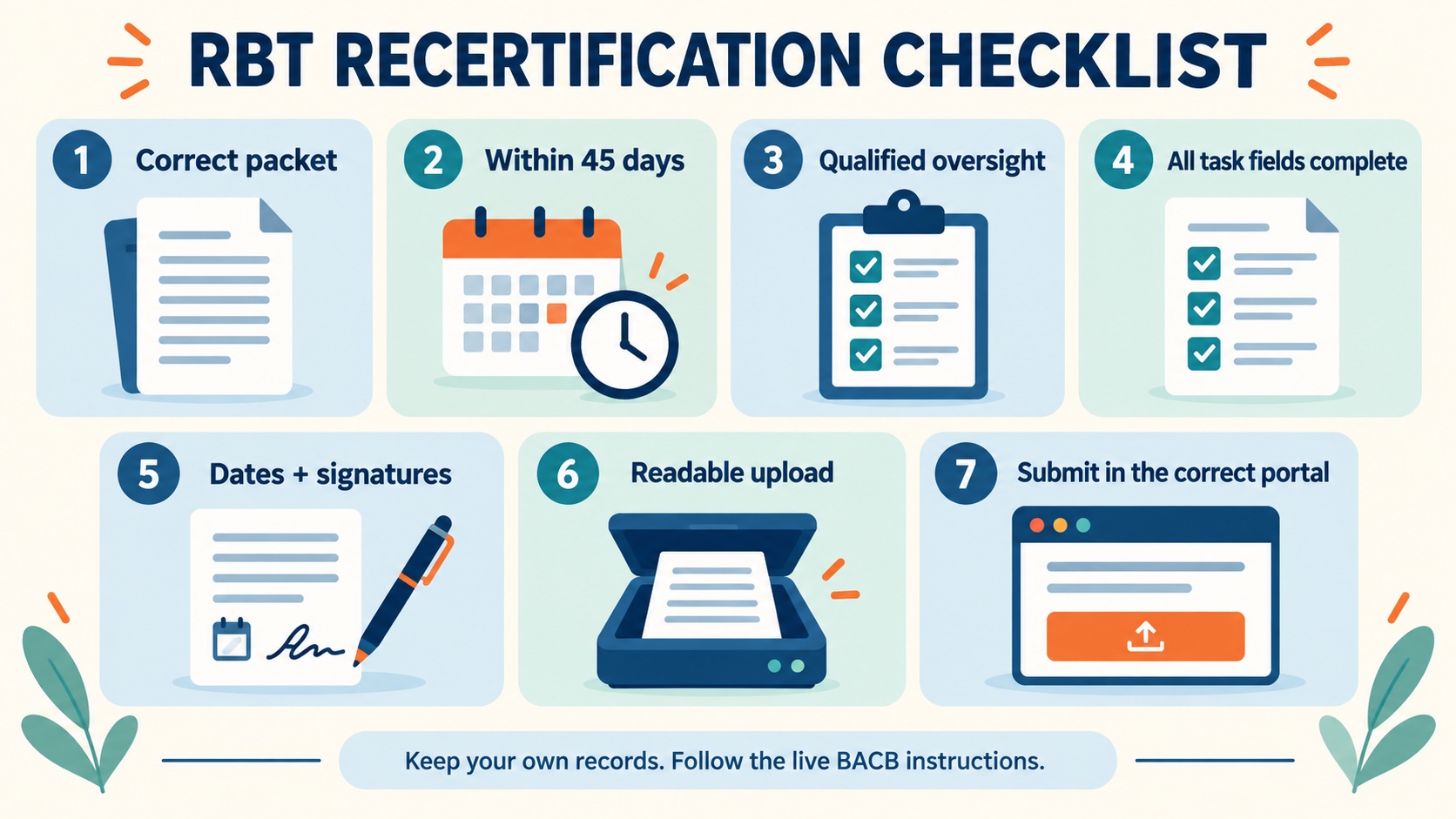
- Correct packet: confirm that the title says recertification, not initial competency assessment, and that the version matches the current BACB instruction.
- Correct account: use the existing BACB portal account associated with your certification. Creating a second account can send you to the wrong application path.
- Complete fields: review dates, task decisions, assessment methods, printed names, certification numbers, and signatures against the form’s instructions.
- Readable file: combine pages as required by the portal and make sure every page is legible before upload.
- Matching identity: application documents should match the name in your BACB portal account. If your name changed, follow the BACB name-update process.
- Supervision record: answer the supervision questions truthfully. If the application asks for an explanation or additional documentation, use the portal’s Action Items.
What happens if you miss the deadline
Do not keep practicing as though the certification were active while a deadline problem is unresolved. The Handbook explains that a missed recertification deadline can place the certification in an inactive or reinstatement period. During inactive status, an RBT may not practice, bill, or represent themselves as an active RBT. If the certification expires after the reinstatement period, the person may need to reapply under the requirements then in effect and retake the examination.
If you are close to the deadline, use the BACB portal and official Contact Us path for account-specific help. Save submission confirmations and action-item messages. A practice provider, supervisor, or coworker may help you organize information, but none of them can extend the BACB deadline or guarantee an application decision.
Common mistakes to avoid
Using “renewal” as if it were the official document name
Search engines and workplaces may say renewal, while the BACB document says recertification. Search with both phrases, then verify the packet title and current version on the BACB site.
Using the initial competency packet
Initial and recertification assessments are not interchangeable. The BACB archive specifically warns that the recertification form has its own task requirements. Read the label at the top of the packet before anyone begins.
Completing the form outside the 45-day window
Good performance at the wrong time can still create a submission problem. Count from the expiration date shown in your account and confirm the live rule before scheduling the observation.
Assuming the 2027 rule applies to every special situation
The routine post-2027 recertification cycle uses PDUs, but inactive status, reentry, reinstatement, or other account situations can have separate requirements. Read the Handbook section that matches your status.
Treating study materials as official maintenance documentation
Flashcards, videos, app practice, and worksheets can support learning. They do not replace the BACB packet, supervisor oversight, PDU documentation, or portal submission.
FAQ and official sources
Is the RBT renewal competency assessment still required in 2026?
For RBT recertification through December 31, 2026, the current Handbook says yes: complete the RBT Recertification Competency Assessment within no more than 45 days before the expiration date, under qualified oversight, using the current packet, and submit it with the recertification application.
Do RBTs need the competency assessment for standard recertification after January 1, 2027?
The current Handbook says standard recertification after January 1, 2027 uses a two-year cycle with 12 PDUs, and the recertification competency assessment is no longer required for that standard cycle. Special reentry or inactive-status rules may differ, so verify your status in the live Handbook.
Can I complete the assessment myself?
No. It is an observed competency process overseen by a qualified BACB-certified RBT supervisor and documented on the current official packet.
What is the difference between the initial and recertification packet?
The initial packet supports the first certification process. The recertification packet supports maintenance for an already certified RBT. Use the packet whose title and instructions match the application in your BACB portal.
What should I do if I am unsure which rule applies?
Check the current BACB RBT resource page, the Application Processing Updates page, and the June 2026 RBT Handbook. Then ask your supervisor or use BACB’s official contact path for account-specific guidance.
For concept review, you can continue with the ABA Study Online RBT learning hub, review original RBT practice questions, or check an unfamiliar term in the ABA glossary. Those resources are educational support; the BACB portal and current Handbook remain the source of truth for certification maintenance.