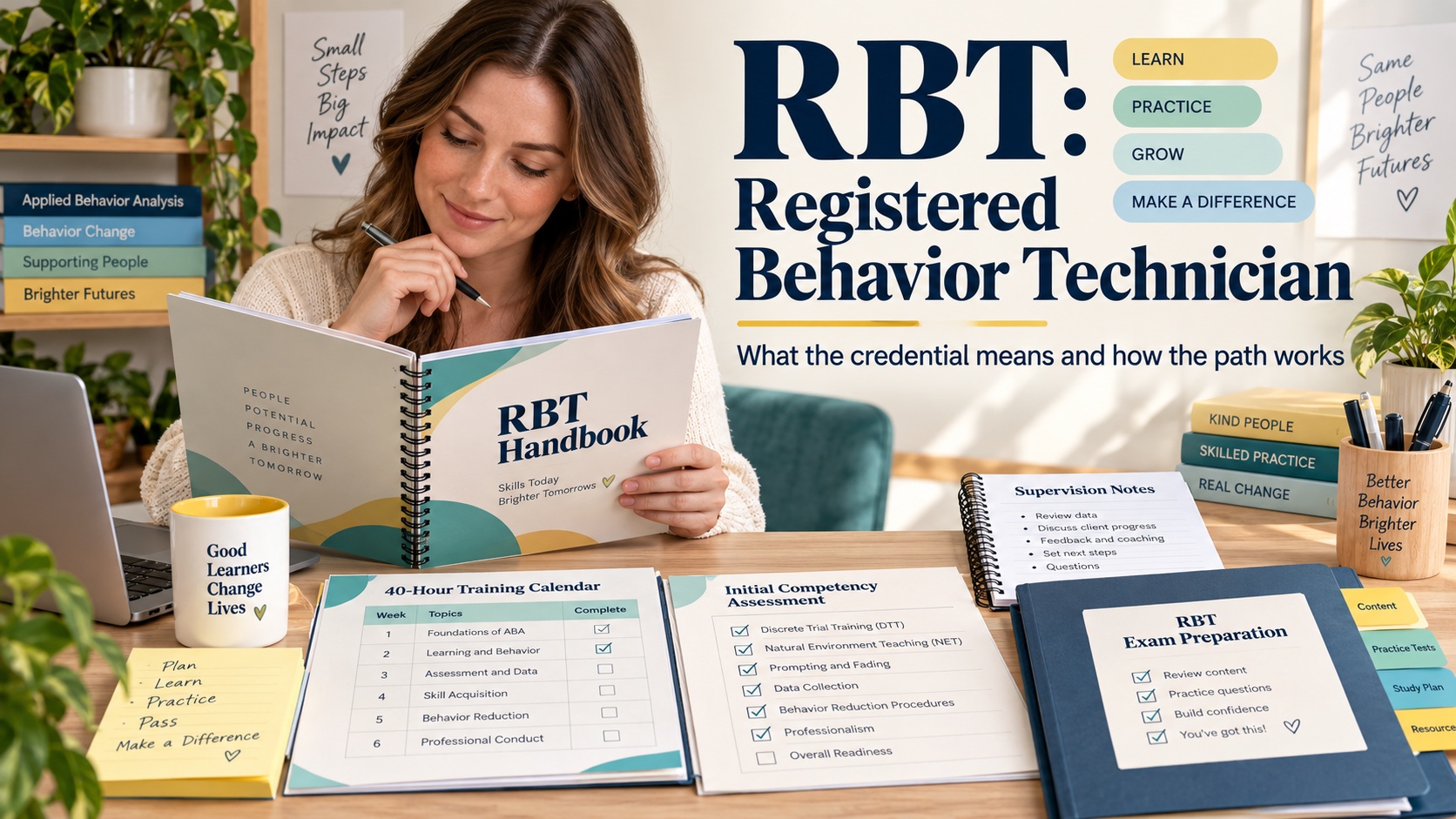
RBT: Registered Behavior Technician—What the Credential Means and How to Become One
If you searched for RBT Registered Behavior Technician, you may be trying to understand the job title, decide whether RBT certification is right for you, or find the next step after a 40-hour training course. The short answer is that an RBT is a paraprofessional certified in behavior analysis who assists with behavior-analytic services under close, ongoing supervision. The credential is meaningful, but it does not mean the RBT independently diagnoses, designs a complete treatment plan, or works without qualified oversight.
This guide explains the role, the high-level certification path, the difference between an RBT and a general behavior technician, and the boundaries that protect clients and learners. BACB requirements and documents can change, especially during the 2026 transition, so use the current RBT Handbook and BACB resource pages for the official details.
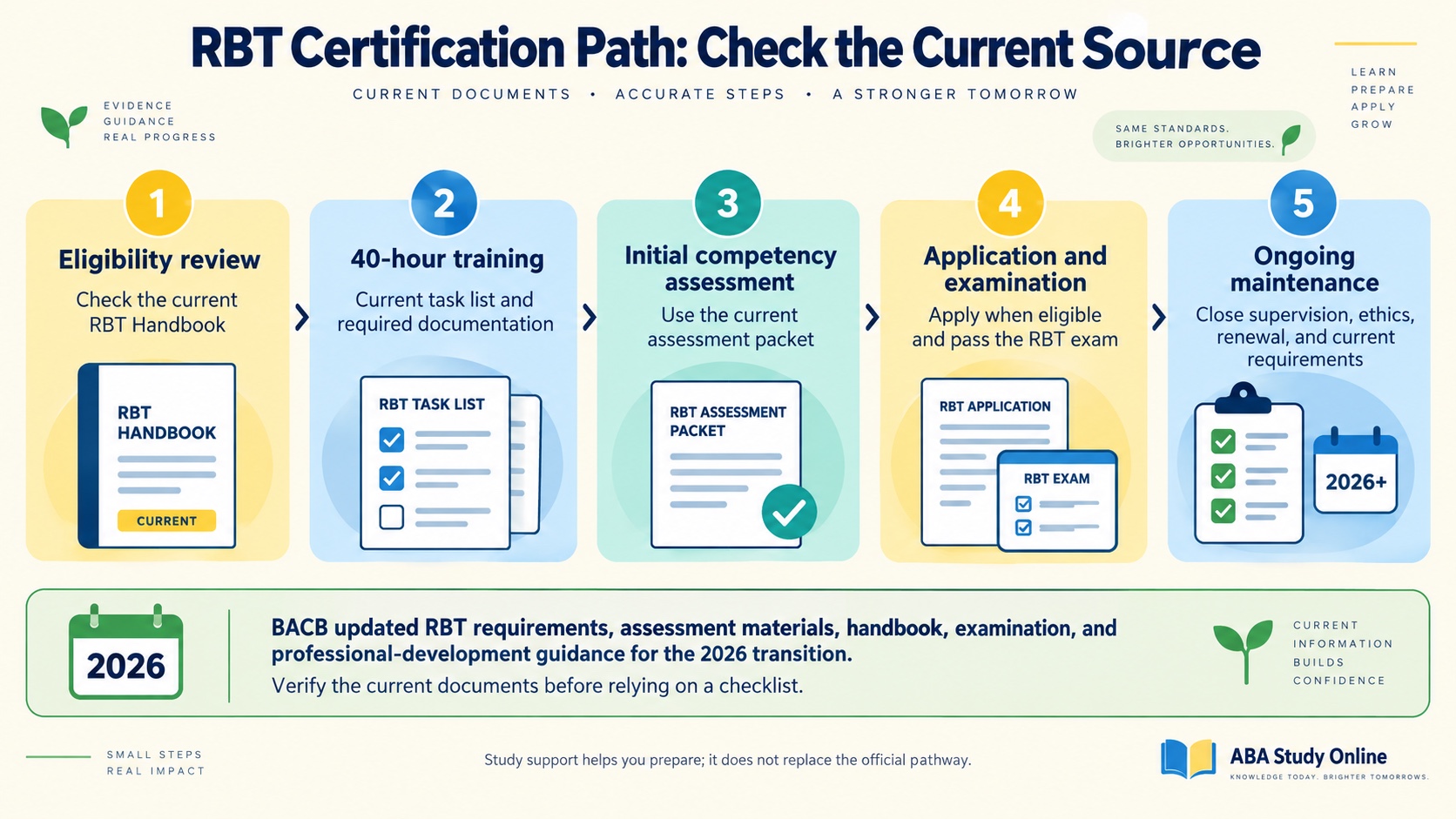
Quick answer: RBT stands for Registered Behavior Technician. The BACB describes the RBT as a paraprofessional certification in behavior analysis. RBTs assist in delivering behavior-analytic services under the direction and close supervision of an RBT Supervisor and/or RBT Requirements Coordinator who is responsible for their work. The path generally includes reviewing eligibility, completing the required training, completing an initial competency assessment, applying, passing the RBT examination, and meeting ongoing supervision and maintenance requirements.
What does a Registered Behavior Technician do?
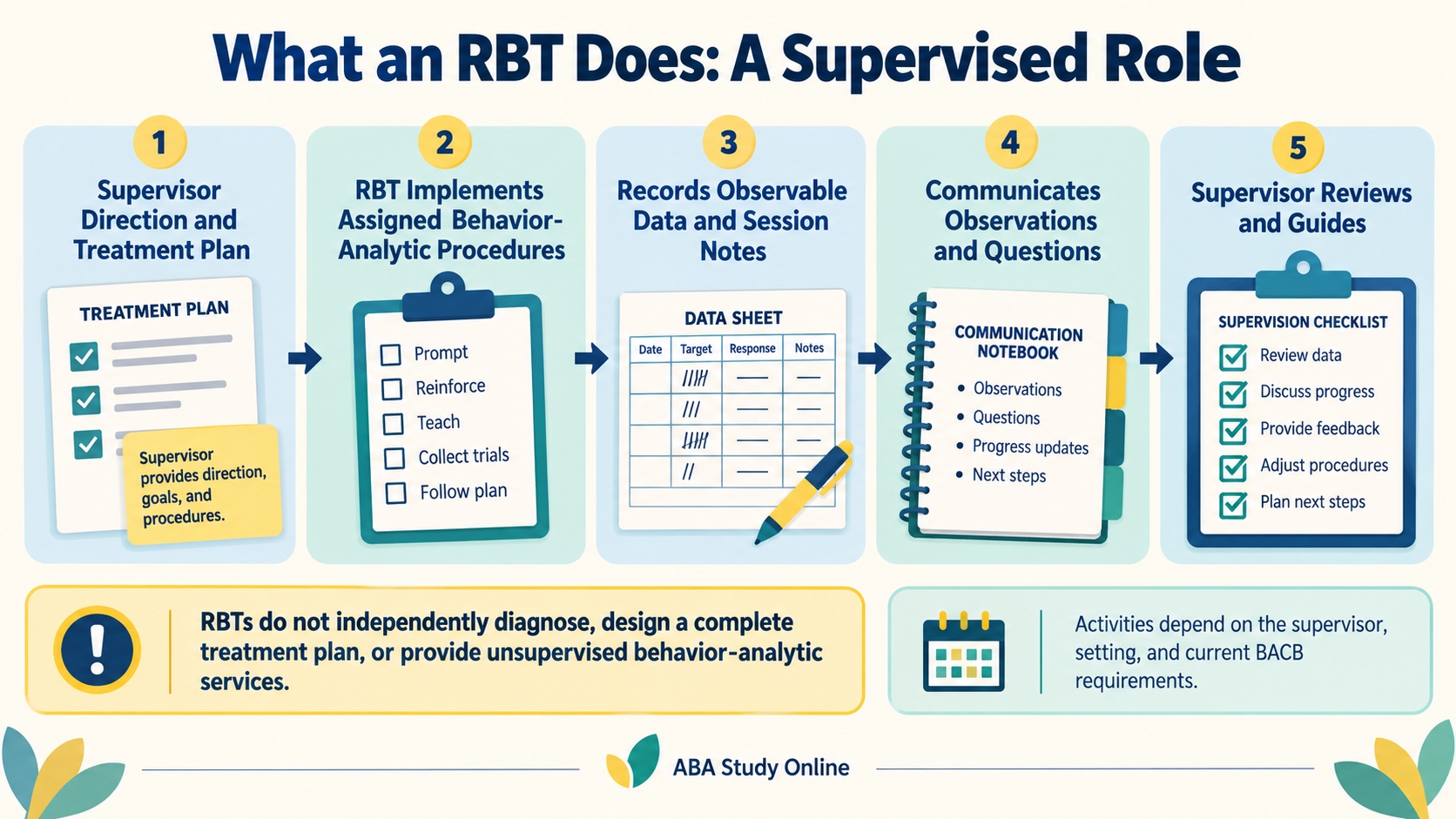
An RBT carries out assigned procedures and records what happens so the supervising professional can evaluate progress and make informed decisions. Depending on the setting, supervisor, treatment plan, and client needs, an RBT may help with preference assessments, implement discrete-trial teaching procedures, collect session data, practice communication or daily-living skills, follow behavior-reduction procedures, and write objective session notes.
The important phrase is assigned and supervised. The RBT is not simply given a credential and left to decide what treatment a client needs. The supervisor establishes the clinical direction, explains procedures, monitors performance, provides feedback, and remains responsible for appropriate oversight. The RBT contributes direct implementation and careful observation within the role.
A strong RBT session is therefore more than “doing activities.” It includes following the current plan, using procedures as trained, recording observable information, protecting dignity and privacy, communicating questions, and responding to feedback. When a procedure is unclear or a client’s behavior changes, asking the supervisor is part of competent practice—not a sign that the RBT should improvise.
The supervision and scope boundary
RBT certification does not authorize independent clinical practice. An RBT should not independently diagnose a client, create a complete treatment plan, change clinical goals without direction, promise a clinical outcome, or provide behavior-analytic services without the required supervision. Job titles used by employers can vary, but the RBT credential has a specific BACB meaning.
Supervision also is not just a quick signature. The current RBT Handbook describes close, ongoing supervision and states that an RBT must obtain supervision for at least 5% of the hours spent providing behavior-analytic services each calendar month. The handbook and applicable organizational procedures control the complete requirements, including supervision at each organization where the RBT provides services.
For an everyday example, imagine that a learner begins avoiding a teaching activity. The RBT can record what happened before and after the behavior, follow the current procedure, and tell the supervisor what was observed. The RBT should not independently decide that the learner has a new diagnosis or redesign the intervention without qualified direction. Observation, implementation, documentation, and communication are different from independent clinical decision-making.
How to become an RBT
Use the current BACB RBT Handbook as the source of truth. At a high level, the path looks like this:
- Review eligibility: check the current age, education, background, residency or jurisdiction, and other requirements that apply to your application.
- Complete the required training: finish the current 40-hour training course with the required content, timing, trainer, and documentation.
- Complete the initial competency assessment: use the current assessment packet and the qualified assessor process described by the BACB.
- Apply and schedule the examination: submit the required application materials, wait for an eligibility determination, and follow the current examination instructions.
- Pass the RBT examination: prepare using the current RBT examination content and the official candidate materials.
- Maintain the credential: work under ongoing supervision, follow the RBT Ethics Code (2.0), complete applicable maintenance steps, and renew according to the current rules.
This is a route map, not a substitute for the handbook. The BACB has updated RBT training, assessment materials, handbook language, examination information, and professional-development guidance for the 2026 transition. When a checklist, course page, or social-media post conflicts with the current BACB documents, pause and verify before relying on it.
Once you know the pathway, you can use the ABA Study Online app for RBT concept practice, review, and question-based study. The app is a learning aid; it does not replace the official application, required training, assessment, examination, or supervision.
The 40-hour training step
The RBT 40-hour training is one formal step in the application pathway. The BACB’s 2026 training outline describes at least 40 hours of training, completed in no fewer than 5 days and no more than 180 days, with the required content based on the current RBT Task List outline. The responsible trainer and documentation requirements also matter.
Do not assume that any “ABA basics” course counts. Before enrolling, check the course version, learning objectives, timing, activities, trainer qualifications, completion record, and how the provider handles questions or missed work. The BACB does not provide or recommend 40-hour programs, so a provider’s marketing language should not be mistaken for an official BACB endorsement.
The 40-hour training is also not the same as the initial competency assessment or the RBT exam. Training teaches and practices the required content; the assessment evaluates performance through the current process; the exam evaluates knowledge. Keep the documents separate and do not present one as proof of all three steps.
Assessment, application, and examination
After the training step, the candidate still needs to complete the current initial competency assessment process. The exact assessor qualifications, forms, timing, and transition rules belong to the current BACB assessment packet. Read the version date before using a downloaded form, because older checklists can remain online after a requirement changes.
The application comes after the candidate has assembled the required evidence. The BACB explains that a candidate must meet applicable eligibility requirements, submit a certification application, receive an approved determination, and then take and pass the examination. An exam-preparation resource can help organize concepts and practice questions, but it cannot approve an application.
Supervision and maintaining certification
Certification is not the end of learning. RBTs practice under close, ongoing supervision, follow the RBT Ethics Code (2.0), and complete the applicable maintenance and renewal requirements. Supervision helps maintain behavior-analytic, professional, and ethical skills and supports high-quality services to clients.
For a new RBT, useful questions for a prospective employer or supervisor include: Who is the RBT Supervisor or Requirements Coordinator? How is supervision scheduled and documented? What happens when a procedure is unclear? How are data and feedback reviewed? Which current handbook and assessment materials does the organization use? Clear answers help the learner understand the work environment before accepting a role.
RBT vs. BT, behavior therapist, and BCBA
RBT: a BACB paraprofessional certification with defined eligibility, examination, ethics, supervision, and maintenance requirements.
Behavior technician or BT: an employer’s job title that may describe direct-care work. A person can be called a BT without holding the RBT credential. Always ask which certification, training, and supervision requirements apply to the position.
Behavior therapist: a broad workplace or public-facing label that may vary by organization and jurisdiction. It is not a safe substitute for the specific RBT role definition.
BCBA: a graduate-level professional who can practice independently within the applicable rules and may provide supervision to RBTs and BCaBAs. An RBT does not become a BCBA by completing the RBT pathway; the BCBA pathway has separate education, fieldwork, examination, ethics, and maintenance requirements.
How to prepare with study resources
Good study support turns the official outline into active practice. Start with the current task list and handbook, then use a simple cycle: learn the term, see a concrete example, answer a question, explain why the answer fits, and record what still feels unclear. Practice objective language, data concepts, teaching procedures, behavior-reduction procedures, professional conduct, and scope boundaries.
Free articles and practice questions are useful for vocabulary, review, and confidence. The free resources library and ABA glossary can help you build a foundation. They do not automatically count as the required 40-hour course, initial competency assessment, supervised work, continuing education, or examination evidence.
Common mistakes
- Calling every behavior technician an RBT: RBT is a specific credential; an employer’s title may be broader.
- Assuming the 40-hour course completes the pathway: competency assessment, application, examination, supervision, ethics, and maintenance remain separate.
- Working without qualified oversight: an RBT’s role is supervised and the supervisor is responsible for the work within the applicable requirements.
- Using old documents: check the date and current BACB source, especially during the 2026 transition.
- Improvising clinical decisions: record observable facts and ask the supervisor when a procedure or situation is unclear.
- Confusing study support with certification evidence: learning value and formal documentation are not the same.
FAQ
What does RBT stand for?
RBT stands for Registered Behavior Technician. The BACB describes it as a paraprofessional certification in behavior analysis.
Is an RBT a therapist?
“Therapist” can be a broad workplace term, but it does not explain the RBT credential or its supervision boundary. An RBT assists with behavior-analytic services under close, ongoing supervision and should be described according to the role and requirements that actually apply.
Can an RBT work independently?
RBTs do not independently practice behavior analysis. They work under the direction and close, ongoing supervision of the qualified supervisor or Requirements Coordinator responsible for their work.
Is the RBT 40-hour training the exam?
No. The 40-hour training, initial competency assessment, application, and RBT examination are separate steps with separate purposes and records.
Are RBT requirements changing in 2026?
Yes, the BACB has published 2026 RBT transition materials, updated handbook and assessment resources, examination information, and professional-development guidance. Use the current BACB RBT page and handbook rather than relying on an older checklist.