
RBT Recertification: 2026 Transition and 2-Year Maintenance
If you are searching for RBT recertification, the most important fact is that the maintenance pathway is changing. The answer depends on when you recertify and which cycle your BACB account places you in. In broad terms, RBTs recertifying in 2026 still use the recertification competency assessment, while the newer two-year cycle introduces professional development units, or PDUs, and a new way to plan documentation.
This guide explains the transition as a planning map, not as a replacement for your BACB account or the current RBT Handbook. Your account’s due date and the instructions attached to your application control your actual submission. Check the official sources again before you upload documents or pay a recertification fee.
Table of Contents
Short answer: how RBT recertification works
RBT recertification is the process of maintaining an existing RBT credential through the requirements and timing that apply to your certification cycle. It is not the same as applying for initial RBT certification, and it is not simply repeating the original examination. The relevant maintenance questions are:
- What is the recertification date shown in your BACB account?
- Are you completing the 2026 transition recertification competency assessment?
- Are you in a two-year cycle that requires 12 PDUs?
- Which form or record documents your professional development?
- Have ongoing supervision, ethics, self-reporting, and application requirements also been addressed?
The common mistake is to remember one old annual checklist and apply it to every year. The BACB transition materials deliberately separate the timing periods. Use the date in your account, the current handbook, and the exact application instructions rather than relying on a screenshot, a coworker’s previous cycle, or an older blog post.
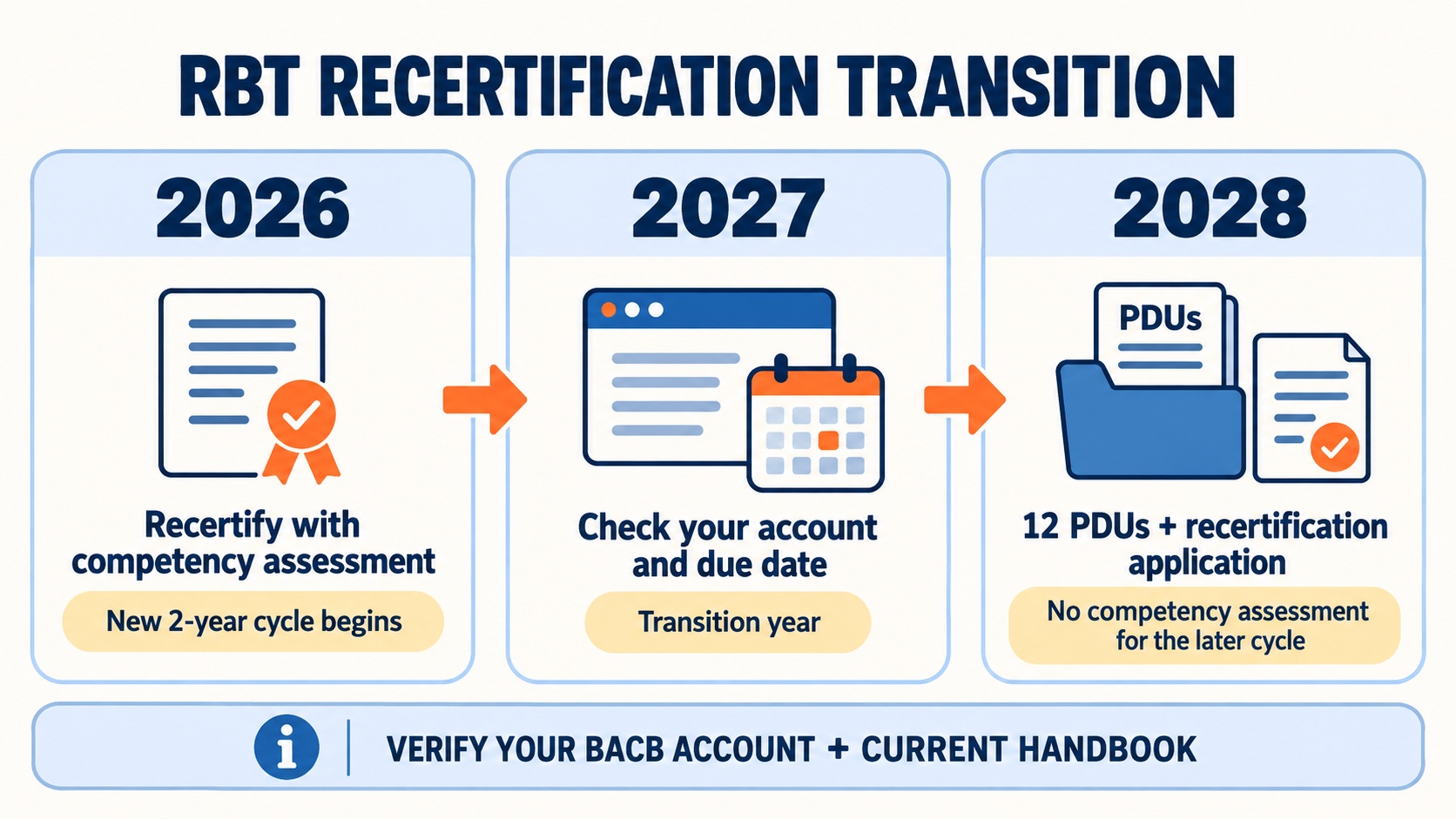
The 2026 transition in plain language
The BACB’s transition guidance distinguishes current RBTs from newly certified RBTs and separates 2026 from later cycles. For a current RBT recertifying in 2026, the guidance says to complete the RBT Recertification Competency Assessment. After an RBT becomes certified or recertifies in 2026, the next recertification date moves to a two-year cycle. The guidance also identifies a new PDU record area in the BACB account.
The practical meaning is that 2026 is a bridge year. Do not assume that the 12-PDU requirement replaces every 2026 step immediately. If your current recertification date falls in 2026, follow the 2026 recertification instructions attached to your account, including the assessment and application requirements. After that cycle is established, plan for the later two-year maintenance period.
The guidance also says current RBTs will not need to recertify in 2027 under the transition schedule described there, while newly certified RBTs have their own two-year window. Because a person’s certification date and account status matter, treat this as a general transition explanation, not permission to skip a due date. If your portal shows an application or a different instruction, pause and contact the BACB through its current support channel.
This is also why “renewal” and “recertification” may appear differently across older materials. The BACB uses recertification terminology for the maintenance pathway. When you compare sources, check the publication date and whether the document describes the annual transition period or the later two-year cycle.
The two-year cycle and 12 PDUs
For the two-year cycle described in the current handbook, an RBT must earn 12 professional development units in the BACB account. The purpose is ongoing professional development, not a second initial training course. The handbook identifies several routes, including qualifying in-service training through the service organization, professional-development events from an authorized ACE Provider, and eligible didactic behavior-analytic university coursework.
Keep the source and documentation for each activity. A useful record includes the date, title, provider or organization, number of PDUs, and the form or evidence the BACB requires. Do not wait until the last week of the cycle to reconstruct every event from memory. If a supervisor, employer, ACE Provider, or university must provide documentation, ask about the record before the activity is complete.
Not every learning activity counts. The current handbook distinguishes professional development from ongoing supervision, client-specific training, and supervised fieldwork toward BCaBA or BCBA certification. Repeating the same professional-development activity does not automatically create new or expanded knowledge for the maintenance requirement. Read the current handbook and the professional-development guidance before assuming an activity qualifies.
PDUs are also not a replacement for responsible practice. Ongoing supervision, ethics, self-reporting, and the requirements of the setting remain part of maintaining the credential. A complete maintenance plan tracks both the units that must be recorded and the professional responsibilities that must continue throughout the cycle.
Application, supervision, and documentation
The recertification application is submitted through the BACB account. The current handbook explains that recertification applications become available close to the recertification date and that the required PDUs must be entered before the application can be completed under the two-year process. Follow the portal’s actual sequence for uploading evidence, confirming requirements, and paying the application fee.
Do not confuse completing an activity with entering it in the portal. A certificate in your email folder is useful evidence, but the account record and application still need to be completed correctly. Keep copies of forms and source documents in one secure folder, and use the same name and identifying information that appears in your BACB account.
Supervision remains a separate maintenance question. The RBT works under direction and close supervision, and the responsible supervisor or requirements coordinator has responsibilities that are not transferred to a course provider. If your supervisor changes, your employer changes, or your work pauses, ask how the change affects the supervision and maintenance requirements before the next application deadline.
Finally, do not assume that submitting an application automatically prevents a lapse. Submit by the date required in your account, confirm that payment and documents were received, and save the confirmation. If a portal status is unclear, ask the BACB rather than relying on a coworker’s experience from a different transition year.
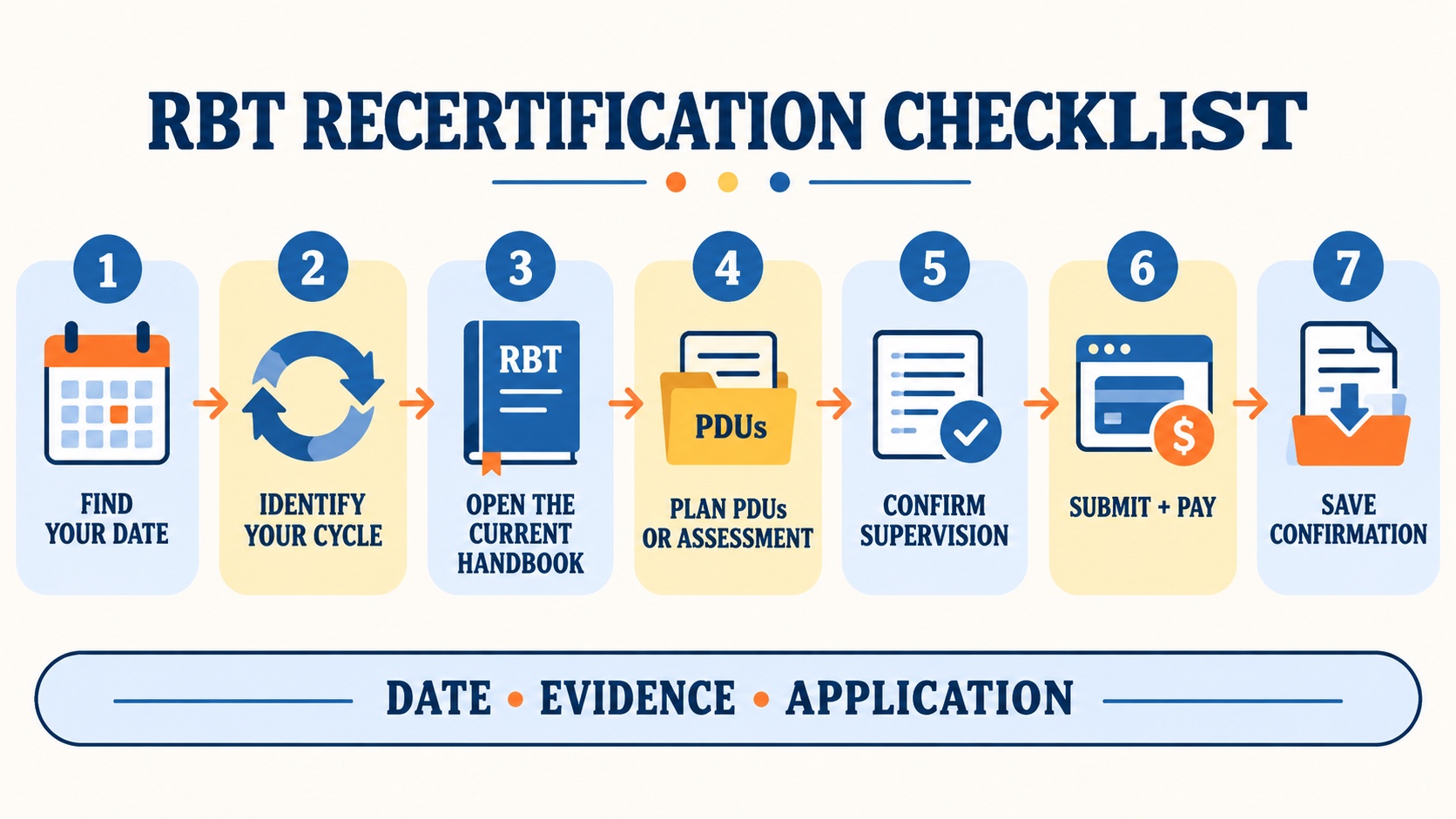
An RBT recertification checklist
Use this sequence early in the cycle:
- Find your date. Check the recertification date in your BACB account and write it in a personal planning calendar.
- Identify your cycle. Determine whether your next action is the 2026 recertification competency assessment or a later two-year PDU cycle.
- Open the current handbook. Save the relevant maintenance section and note the version date.
- Plan the evidence. For each PDU or assessment, identify who provides the form and where you will store it.
- Check supervision. Confirm the responsible supervisor or requirements coordinator and ask how changes will be documented.
- Enter records before the deadline. Do not leave portal entry, application payment, or confirmation for the final day.
- Keep the readback. Save the submitted status, receipt, and confirmation email with the rest of your maintenance records.
Common mistakes to avoid
- Using an annual checklist forever: the 2026 transition changes the later cycle and documentation expectations.
- Waiting for the portal to remind you: keep your own calendar and check the account early.
- Counting client-specific training as a PDU: read the maintenance definition and eligible routes first.
- Assuming a course certificate is enough: complete the required portal entry, form, assessment, or application step.
- Ignoring supervision changes: a new employer or supervisor can change the documentation conversation.
- Confusing recertification with the initial exam: maintenance is a separate pathway after certification.
- Trusting an old screenshot: return to the current BACB Handbook and your account for the actual instruction.
RBT recertification FAQ
Do RBTs recertify every year or every two years?
The answer depends on the transition period and your certification or recertification date. The BACB’s 2026 guidance describes a final transition-style recertification step for current RBTs and a later two-year cycle with PDUs. Check your BACB account and the current handbook instead of relying on a general annual or biennial statement.
Do I need a recertification competency assessment in 2026?
The transition guidance says current RBTs recertifying in 2026 use the RBT Recertification Competency Assessment. Your account and current application instructions control your specific case, especially if your certification status or due date differs from the general transition example.
How many PDUs does an RBT need?
The current handbook describes 12 PDUs during the two-year recertification cycle that follows the transition. The eligible activity types and documentation rules matter as much as the number, so verify that an activity qualifies before counting it.
Do supervision or client-specific training count as PDUs?
Do not assume they do. The handbook distinguishes ongoing supervision, client-specific training, and supervised fieldwork from eligible professional development. Use the current PDU guidance and documentation rules for the activity you plan to record.
What happens if I miss my recertification date?
Do not guess. The current handbook explains lapse and late-application boundaries, which can depend on the timing and status of the credential. Check the BACB account and contact the BACB promptly so you follow the current reinstatement or late-submission instructions.
Sources and verification notes
- BACB: RBT recertification resources
- BACB: Registered Behavior Technician Handbook
- BACB: Guidance for Meeting RBT Requirements During the 2026 Transition
- BACB: RBT professional development and ACE events
- BACB: Recent and Upcoming Changes to Requirements
- ABA Study Online RBT learning hub and RBT practice questions