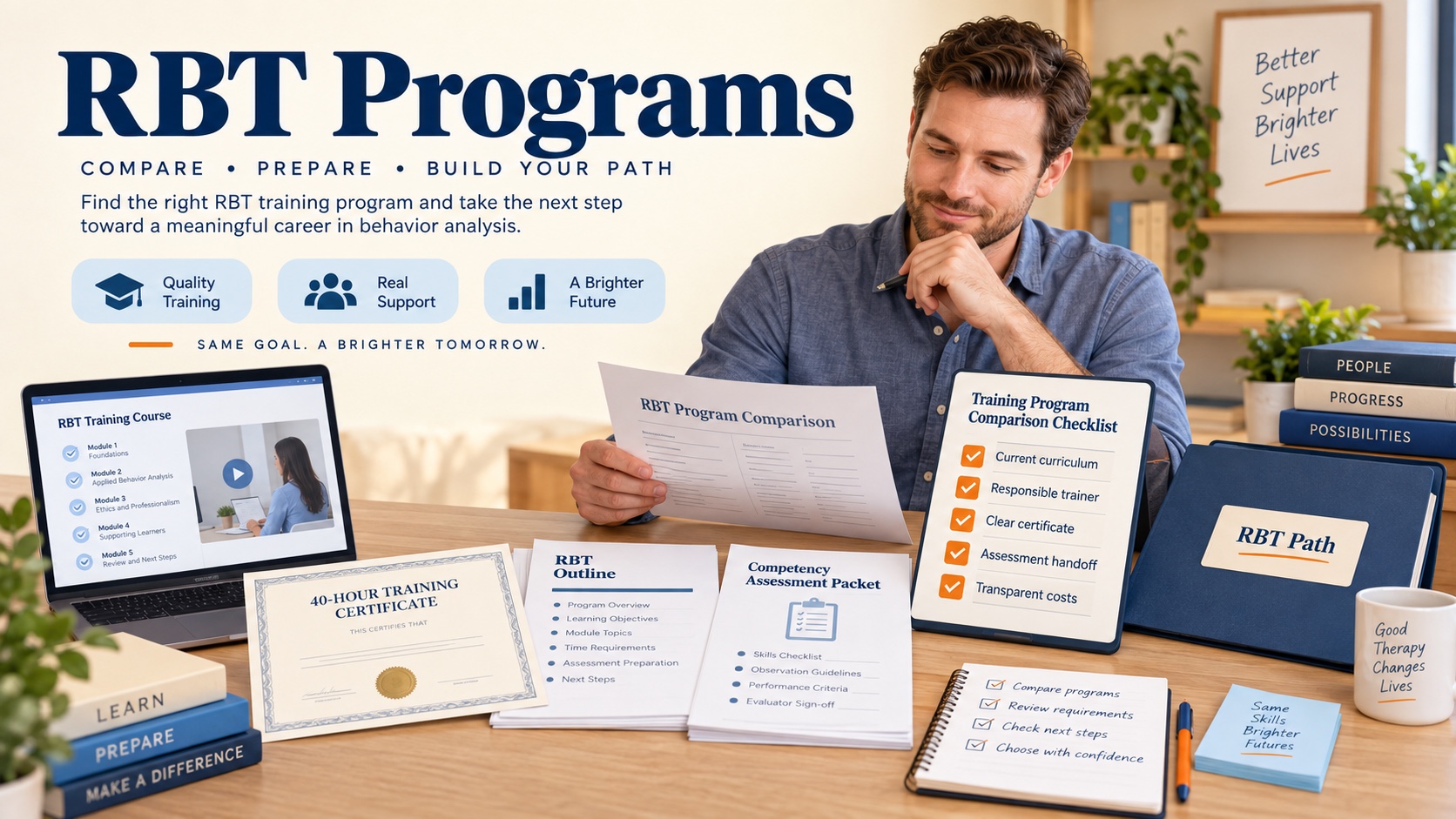
RBT Programs: How to Choose One That Fits the Current Certification Path
If you are searching for RBT programs, you may be comparing online courses, employer training, university options, and programs that promise a quick route into behavior analysis. The right question is not only “Which program is cheapest?” It is “Will this program give me the training, documentation, and next-step support I need under the current RBT requirements?”
An RBT program does not grant RBT certification by itself. The current BACB path also includes eligibility checks, an initial competency assessment, an application, an examination, and ongoing supervision. This guide gives you a practical screening checklist while keeping program advertising separate from BACB requirements.
Quick answer: a useful RBT program should clearly map its curriculum to the current 40-hour training requirements, state the start and end dates, explain who is responsible for training, provide a verifiable completion certificate, and tell you what still remains: the initial competency assessment, application documents, exam, and supervision. The BACB does not provide RBT training, certificates, or program recommendations, so you must evaluate the provider and keep the official handbook as the authority.
The current RBT certification path
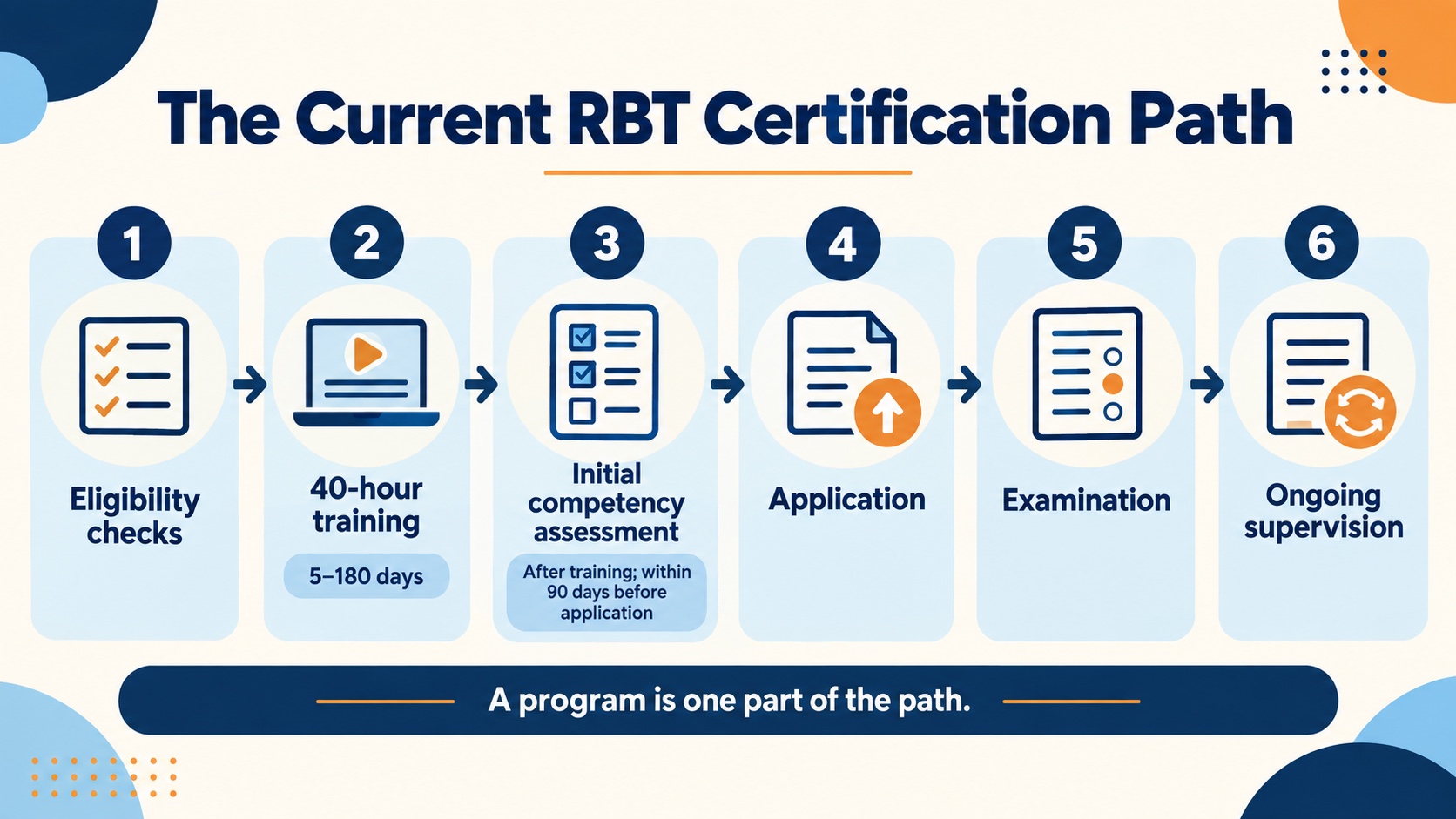
The current June 2026 RBT Handbook describes a sequence rather than a single class:
- Meet the basic eligibility conditions. You must be at least 18, have at least a high-school-level education, and satisfy the current criminal-background and abuse-registry check requirements.
- Complete the required training. The 40-hour training must meet the current RBT 2026 training requirements and be completed in no fewer than 5 days and no more than 180 days, counting the start and end dates.
- Complete the initial competency assessment. After the training and no more than 90 days before submitting the certification application, demonstrate the required tasks with the responsible assessor and complete the current packet.
- Apply through the BACB Portal. Upload the application attestation, training certificate, and completed initial competency assessment with the application.
- Schedule and pass the examination. The application must receive the appropriate determination before you follow the scheduling instructions.
- Maintain the credential. Ongoing supervision, ethics, and the current recertification or professional-development requirements continue after certification.
This sequence is why a program page that says only “become certified with us” is incomplete. Training is important, but it is not the same as the assessment, application, examination, or supervision steps. Use the current RBT Handbook for the rule set that applies when you apply.
How to screen an RBT program
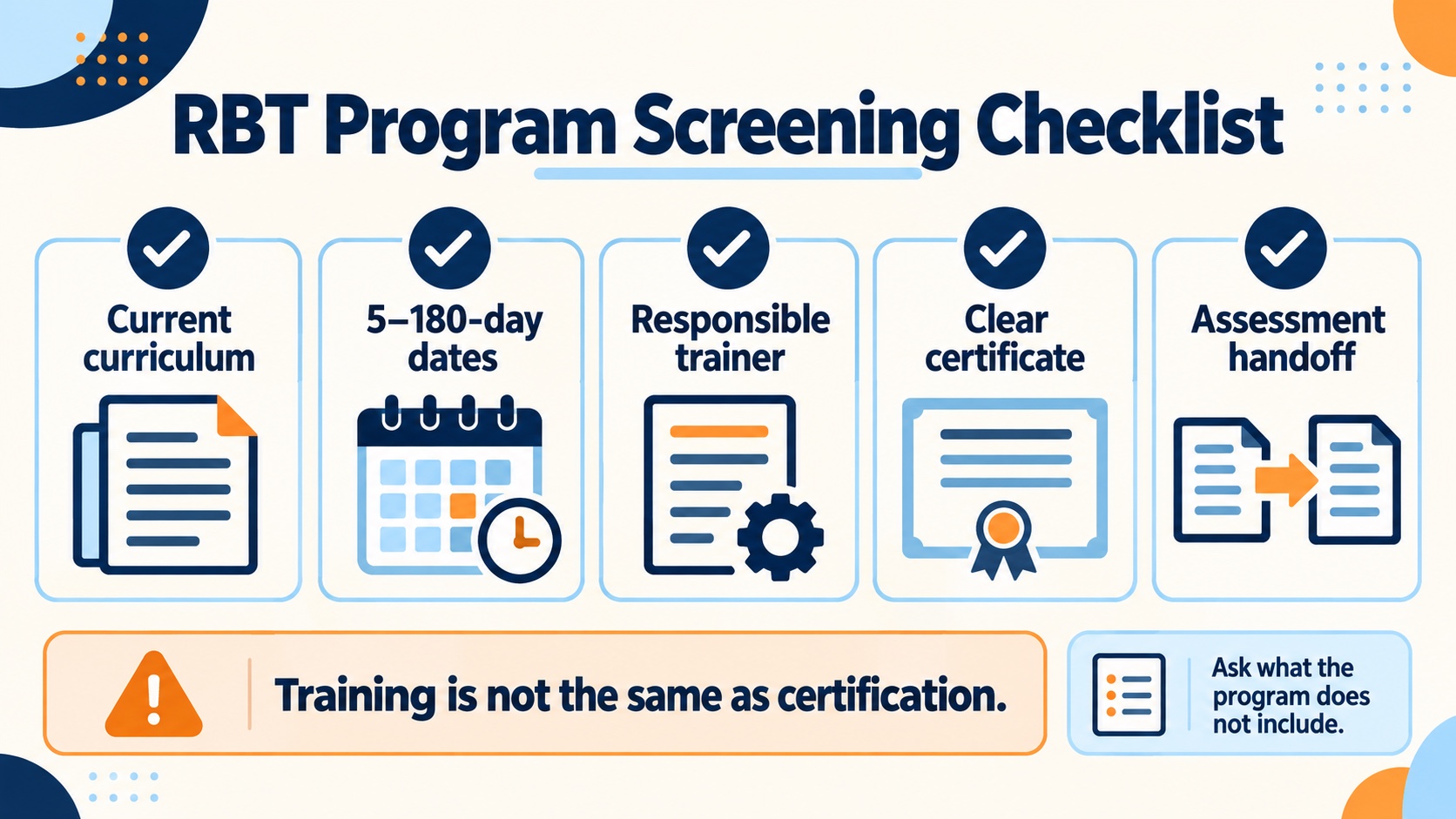
Check the curriculum and current date
Ask for the course outline before paying. It should identify the current RBT training requirements it follows, the topic coverage, the learning activities, and the person responsible for the training. Since the RBT examination content changed for 2026, an old “40-hour course” label is not enough. Ask when the course was revised and whether the certificate will identify the correct training dates.
Confirm the 5-to-180-day window
The current handbook says the 40-hour training must be completed in no fewer than 5 days and no more than 180 days, with the start and end dates included in the calculation. A program should make its pacing and completion record clear. If the course lets you click through an entire 40 hours in one sitting or gives vague dates, ask how the provider documents compliance before enrolling.
Identify the responsible trainer
The program should explain who is responsible for the training and how any assistant trainers or recorded lessons fit into that structure. You should be able to identify a real instructor or responsible trainer rather than only a generic company name. Ask how questions are answered, how your participation is recorded, and what happens if you need accessibility support.
Review the certificate
Find out what the completion certificate contains: your name, the course identity, the completion date or date range, the total hours, and the responsible provider or trainer. The certificate is an application document, so the information should match your BACB Portal identity and the course records. Keep the certificate and any supporting completion evidence in a durable folder.
Ask what the program does not include
A transparent program will tell you whether it does not include the initial competency assessment, the BACB application fee, the examination fee, exam scheduling, or ongoing supervision. Those exclusions are not automatically a problem. Hidden exclusions are the problem because they make the total cost and timeline difficult to plan.
Online, employer, and university programs
The current RBT Handbook says the 40-hour training may be offered by an employer, a university, or an online training program. Format alone does not decide quality. Compare how each option handles interaction, questions, practice, accessibility, records, and the connection to a qualified assessor and supervisor.
| Program setting | Questions to ask | Potential planning issue |
|---|---|---|
| Employer-based | Who trains me, who assesses me, and who will supervise the work afterward? | Employment, training, assessment, and supervision roles may be related but are not automatically interchangeable. |
| University-based | Does the course issue the required 40-hour documentation and identify the responsible trainer? | A university course can be educational without being a complete certification application package. |
| Online provider | How are participation, questions, completion dates, and accessibility handled? | Convenience does not remove the 5-to-180-day, curriculum, certificate, assessment, or application requirements. |
Do not assume that an online course is “BACB approved” simply because it uses the words RBT or 40-hour. The BACB states that it does not provide training, certificates, or training-program recommendations. Look for accurate language about alignment with current requirements rather than an invented endorsement.
What happens after the program?
After completing the training, confirm the initial competency-assessment timing. The current handbook requires the assessment after the 40-hour training and no more than 90 days before the certification application. The assessor completes the current packet, and the completed assessment is uploaded with the application. A training program may help you practice, but it should not imply that its quiz or completion badge is the official competency assessment unless the responsible assessor and current packet say so.
Next, gather the application documents, check your name and dates, submit the application, and wait for the appropriate determination before scheduling the exam. The application may also require the attestation and current background-check information. Keep copies of everything you submit. If the application is not approved, use the BACB action items and current instructions rather than relying on an old provider checklist.
Certification also includes ongoing supervision and ethics responsibilities. An RBT works under the direction and close supervision of an RBT Supervisor and/or RBT Requirements Coordinator. A program that focuses only on getting a certificate but says nothing about the work relationship after the exam is leaving out an important part of the role.
Red flags and common mistakes
- “Guaranteed certification”: a provider cannot guarantee BACB approval or an exam result.
- “BACB-approved program” without evidence: the BACB does not provide training-program recommendations.
- One-day completion: the current 40-hour training must meet the 5-to-180-day window.
- No named trainer: you should know who is responsible for the training and certificate.
- Training quiz called the competency assessment: the initial assessment uses the current BACB packet and assessor process.
- No completion record: if a provider cannot explain the certificate and date evidence, pause before paying.
- “Program equals certification”: eligibility, assessment, application, exam, supervision, and maintenance remain separate.
- Old outline language: verify that the program reflects the current RBT requirements and 2026 examination content.
FAQ
Does the BACB recommend RBT programs?
No. The current RBT Handbook says the BACB does not provide 40-hour training, certificates of completion, or training-program recommendations. Evaluate a program against the current requirements and keep the BACB sources as the authority.
Can an RBT program be online?
Yes, the current handbook says the 40-hour training may be offered by an online training program. The online format still needs to meet the current curriculum, timing, completion-document, and application requirements.
Does finishing a program make me an RBT?
No. After training, you still need the initial competency assessment, application, determination, examination, and later supervision and maintenance steps that apply to your situation.
What should I study after an RBT program?
Use the current RBT Test Content Outline, original practice questions, error review, and role-specific examples. The RBT learning path, RBT practice questions, and ABA glossary can support study; they do not replace the current application or supervision requirements.
Can ABA Study Online issue my RBT certificate?
Not unless a current, separately verified training arrangement says so. ABA Study Online should be described as an educational and practice resource, not as BACB, as a certification decision-maker, or as a source of a pass guarantee.