
RBT Practice Exam: A Domain-by-Domain Study Guide
If you are searching for an RBT practice exam, the most useful first step is not simply taking more questions. It is using practice questions to find the domain where your reasoning needs the most work, then reviewing that domain with a short, repeatable study loop.
This guide explains how to use an RBT practice exam with the current RBT Test Content Outline (3rd ed.). Beginning January 1, 2026, the RBT examination is based on that outline. It includes 75 scored questions, 10 unscored pilot questions, 43 tasks, and six domains. This page is independent educational material, not official BACB content or a guarantee of certification.
Quick answer: Take a short baseline, tag each miss by domain and error type, review the smallest useful concept, and return to a similar question. The current outline gives you a study map; your practice results decide where to spend the next session.
Study boundary: ABA Study Online provides independent educational materials. This guide is not official BACB content, recalled or leaked exam content, individualized supervision, certification advice, or a pass guarantee.
Try free RBT practice questions after you read the study method, then use the ABA Study Online App for focused domain and task-list review.
What should an RBT practice exam help you learn?
A practice exam is most useful when it gives you three kinds of information:
- Recognition: Can you identify the relevant ABA concept in a short scenario?
- Discrimination: Can you tell two similar procedures, measurements, or professional responses apart?
- Next action: Can you choose the response that stays within your role, follows the plan, and uses observable information?
A score by itself does not tell you why an answer was missed. After each question, record whether the problem was vocabulary, measurement, scenario reading, procedure discrimination, or professional judgment. That small note turns a practice exam into a study map.
The six RBT practice exam domains
The current RBT outline organizes the examination into six domains. The percentages below come from the official outline and are useful for deciding how to distribute your study time. They are not a prediction of the exact questions you will see.
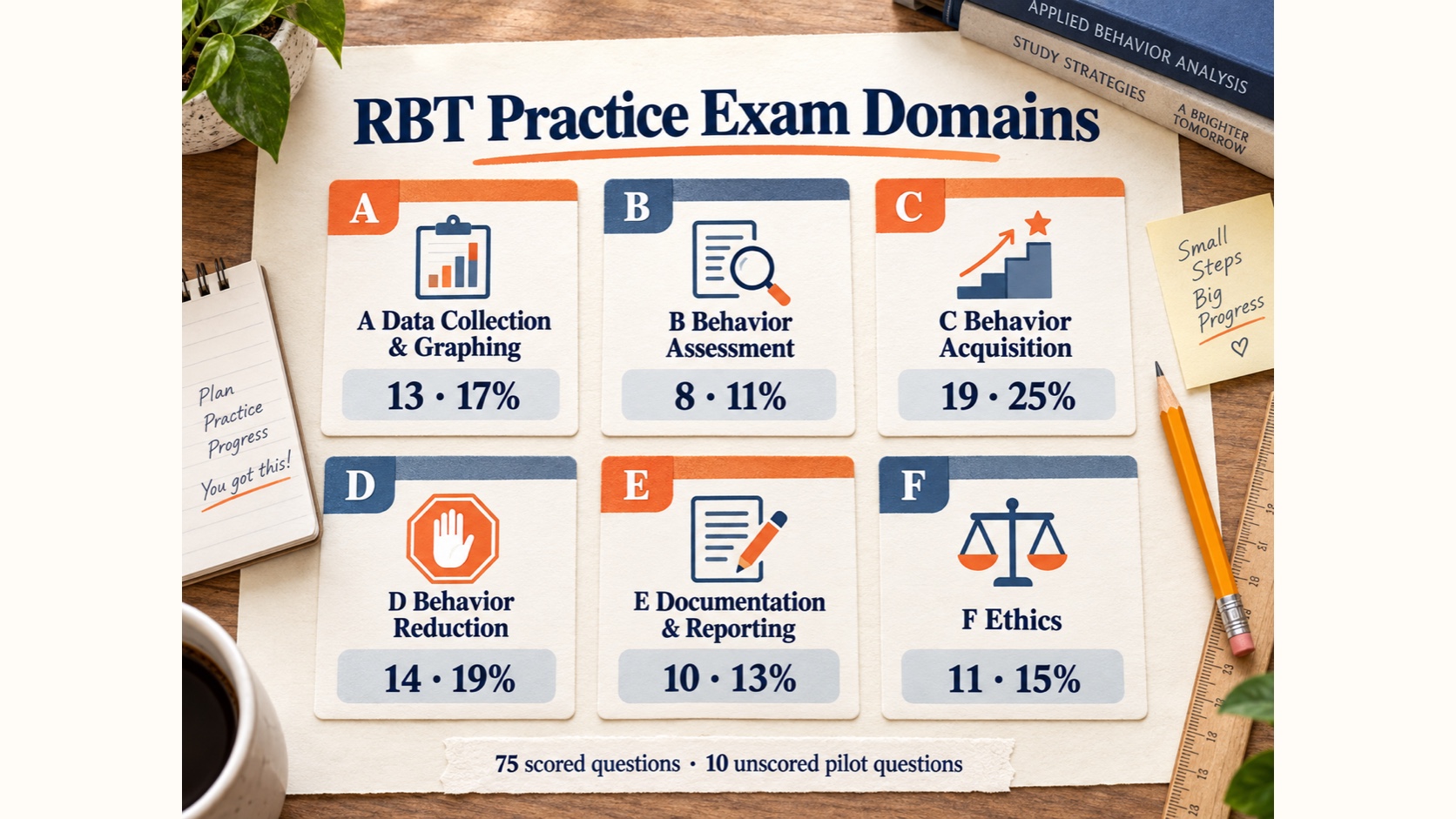
Domain A: Data Collection and Graphing — 13 questions, 17%
Review what is being measured, how the measurement is defined, and how the record supports later decisions. Practice distinguishing frequency, rate, duration, latency, interval recording, and permanent-product measures. When a question includes a graph, slow down and ask what the axes, data path, and change in level or trend actually show.
Your review question should be: What observable event is being counted, and does the measurement match the behavior? Avoid choosing a measurement because it sounds familiar. Choose it because it captures the dimension of behavior named in the scenario.
Domain B: Behavior Assessment — 8 questions, 11%
Focus on the RBT’s role in collecting information, following supervisor direction, and reporting observations accurately. Know the difference between describing what happened and guessing why it happened. An RBT practice question may include an antecedent, behavior, and consequence; your job is to record the events clearly and avoid turning a brief observation into an unsupported diagnosis or function statement.
Domain C: Behavior Acquisition — 19 questions, 25%
This is the largest domain in the current outline. Review prompting, prompt fading, reinforcement, shaping, chaining, discrete-trial teaching, naturalistic teaching, generalization, and maintenance. Look for the teaching objective, the learner’s current response, the prompt used, the consequence delivered, and the next planned step.
When two answer choices both sound helpful, ask which one follows the teaching procedure as written and which one preserves the learner’s opportunity to respond independently. Good practice is not about making the prompt as large as possible; it is about using the least intrusive support that the plan and supervisor direct.
Domain D: Behavior Reduction — 14 questions, 19%
Review objective definitions, antecedent strategies, replacement behavior, reinforcement-based procedures, response blocking when directed, and accurate documentation. Stay inside the plan and your training. A practice question is often testing whether you can identify the safe, observable next step rather than inventing a new intervention.
For every behavior-reduction scenario, ask: What was observed? What did the written plan say to do? What should be documented and communicated to the supervisor? Those questions help prevent answers that rely on assumptions, punishment, or unsupported clinical decisions.
Domain E: Documentation and Reporting — 10 questions, 13%
Strong documentation is objective, timely, and connected to what was observed. Practice rewriting vague statements such as “the learner was difficult” into observable descriptions such as “the learner pushed the materials away and left the table for two minutes.” Also review incident reporting, communication with caregivers and supervisors, data integrity, and the difference between a session note and a clinical recommendation.
Domain F: Ethics — 11 questions, 15%
Ethics questions often involve boundaries, confidentiality, supervision, accurate records, respectful treatment, conflicts of interest, and what to do when you are unsure. The safest answer usually protects the learner, follows the relevant code and workplace process, and brings the issue to the appropriate supervisor rather than hiding it or acting outside your role.
Use the BACB RBT resource page and the current RBT Handbook for current certification and examination information. This article is a study aid and does not replace those sources.
How to use an RBT practice exam without wasting review time
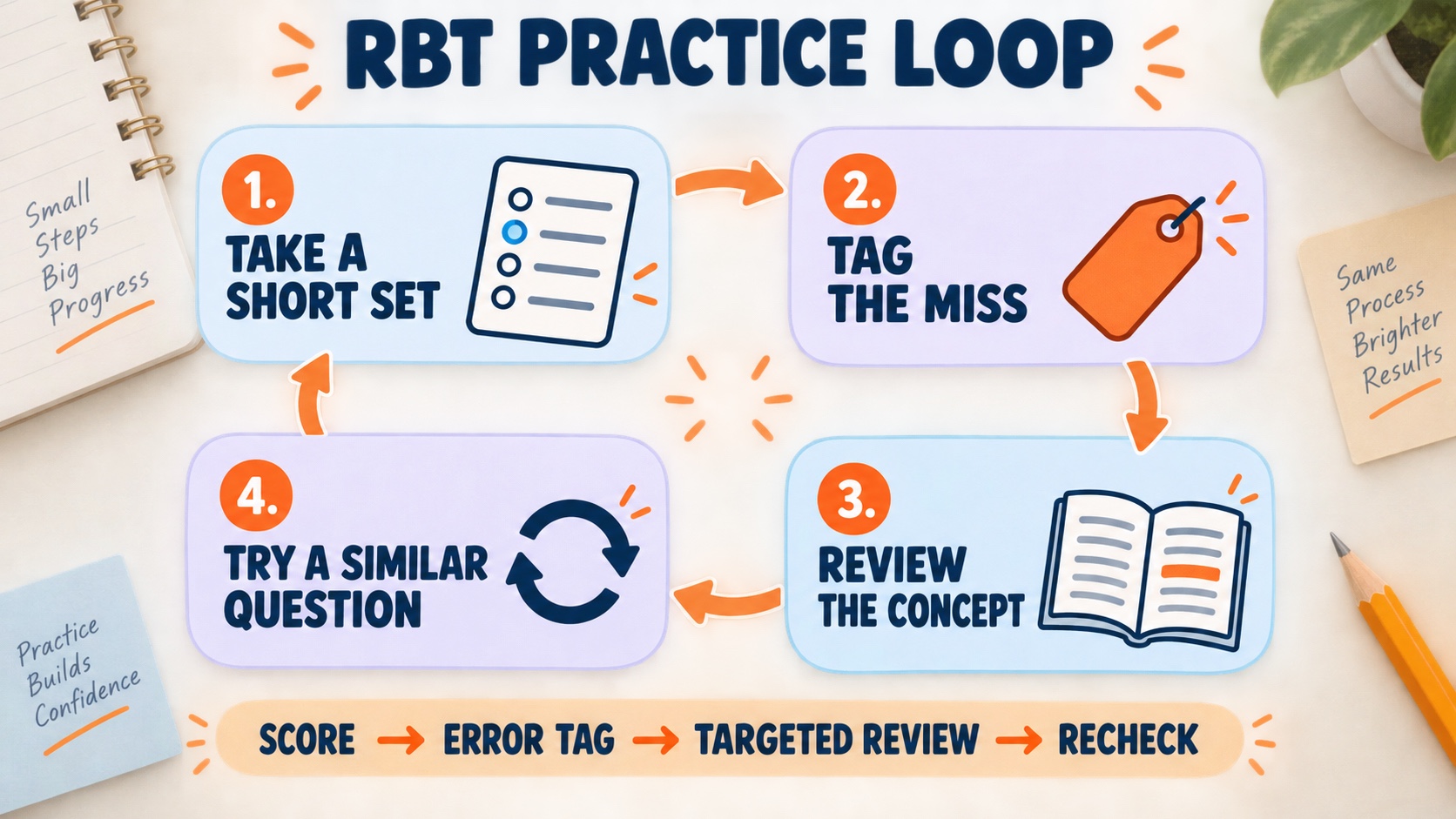
- Take a short baseline. Start with 15–25 questions when you are rested. The goal is a useful signal, not an impressive score.
- Tag every miss. Use one label: concept, measurement, scenario, procedure, ethics, or careless reading.
- Separate unknown from uncertain. An unknown answer needs teaching. An uncertain answer needs discrimination practice. A careless error needs a reading habit.
- Review the smallest useful unit. Move from the missed question to the domain, task, definition, or example that explains it.
- Return to a similar question. Do not stop after reading a rationale. Answer a new question that tests the same distinction.
For example, if you missed a question about latency, do not review all of measurement at once. Define latency, compare it with duration and rate, write one simple example, and answer two new questions. Smaller loops make it easier to see whether the distinction is actually becoming clearer.
How to read your score and plan the next study session
Use your first result to rank domains, not to label yourself. A simple review table can look like this:
| Result pattern | What it may mean | Next action |
|---|---|---|
| Misses across several domains | Study routine or core vocabulary needs structure | Use short theory blocks, then retest one domain at a time |
| Misses concentrated in one domain | A targeted concept or procedure gap | Review that domain and its related task-list topics |
| Correct answer but low confidence | Discrimination is not stable yet | Explain why the other choices are less appropriate |
| Correct answer after changing it twice | Reading or decision confidence may be the issue | Underline the observable facts before choosing |
In the ABA Study Online App, this type of review can become a repeatable loop: choose the RBT track, select the domain or task-list area, practice a short set, review the rationale, and return later for spaced review. The website remains the place to begin with free explanations and question previews; the app is designed for the continuing practice loop.
A simple seven-day RBT practice plan
- Day 1: Take a short baseline and rank your two weakest domains.
- Day 2: Review measurement or assessment distinctions from the missed questions.
- Day 3: Study one skill-acquisition procedure and complete a new practice set.
- Day 4: Review behavior-reduction scenarios and write the supervisor-communication step.
- Day 5: Practice objective documentation and reporting examples.
- Day 6: Review ethics, boundaries, confidentiality, and supervision scenarios.
- Day 7: Take a mixed set, compare your error tags, and choose the next domain to revisit.
Keep the sessions short enough that you can explain your choices. A practice exam is not a race to collect question counts. It is a way to make the next study decision more specific.
Common RBT practice exam mistakes
- Studying only the largest domain and ignoring ethics or documentation;
- Memorizing definitions without applying them to observable examples;
- Choosing the most dramatic intervention instead of the written-plan response;
- Confusing a data description with a function statement;
- Reading the rationale once but never answering a similar question;
- Treating an independent practice item as an official BACB question.
Continue with free RBT practice
Start with the free RBT practice questions, use the RBT Theory Blocks when a concept needs more depth, and use ABA Definition Search when a term is slowing you down. When you want a repeatable review loop, continue in the ABA Study Online App.
Study boundary: ABA Study Online provides independent educational study materials. This page is not official BACB content, recalled exam content, individualized supervision, certification advice, or a pass guarantee.
RBT practice exam FAQ
How many questions should I answer in one practice session?
Start with 15–25 questions so you have time to review every answer. Increase the set only when you can explain your errors instead of simply collecting a higher question count.
Should I study every RBT domain equally?
Cover every domain, but use your practice results to spend more time where your reasoning is weakest. The official outline shows different question distributions, but the outline is not a prediction of the exact exam form.
Is ABA Study Online an official RBT practice exam?
No. ABA Study Online offers independent educational content and practice materials. Use the current BACB resources for official examination and certification information.
What should I do after I finish a practice exam?
Tag each miss, choose one domain, review the relevant concept or procedure, and answer a similar question. Then schedule a later mixed set to check whether the distinction holds.