RBT Practice Exam Questions: How to Learn From Every Item
Searching for RBT practice exam questions usually means you want more than a list of answer letters. You want to see the kind of scenario the question describes, choose the best response, understand why the other choices are weaker, and know what to practice next. That is the difference between a question bank that builds judgment and a quiz that only produces a percentage.
The current RBT examination is based on the RBT Test Content Outline (3rd ed.) beginning in 2026. Independent practice can help you prepare for the content and format, but it is not BACB examination content, does not predict a result, and cannot replace the current eligibility and application requirements. This guide focuses on how to choose and review original questions without confusing practice with the real exam.
Table of Contents
Short answer: what makes a good RBT practice question?
A useful RBT practice question has an observable scenario, one best answer, plausible distractors, a clear connection to a current content area or task, and an explanation that teaches the distinction. It should also tell you whether it is original and unofficial. Avoid pages that claim to provide “real” or “leaked” BACB questions, hide the content edition, or give a score without a rationale.
Use each item as a small reasoning exercise:
- What decision is the question asking me to make?
- Which facts in the scenario control that decision?
- What RBT task, domain, or role boundary is involved?
- Why is the best answer stronger than the distractors?
- What should I study or retry if I missed it?
Use the current RBT exam boundary
The BACB lists an RBT examination with 85 multiple-choice questions: 75 scored questions and 10 unscored questions. Each item has four possible answers with one correct answer, and candidates have 90 minutes. Those facts are useful when you want to rehearse pacing, but an independent practice set cannot tell you which of its questions would be scored on the BACB exam.
The RBT Test Content Outline (3rd ed.) organizes the current content into six areas: Data Collection and Graphing, Behavior Assessment, Behavior Acquisition, Behavior Reduction, Documentation and Reporting, and Ethics. The outline lists 43 tasks. Use the areas as a coverage map, not as six separate pass thresholds. A strong question bank should let you see the task or domain behind an item so a missed question becomes actionable.
Before using a resource, look for the outline edition, the date it was reviewed, the number of choices, the explanation policy, and whether the provider clearly says the questions are original. The BACB states that it does not endorse specific study guides and that purchasing study materials does not guarantee passing.
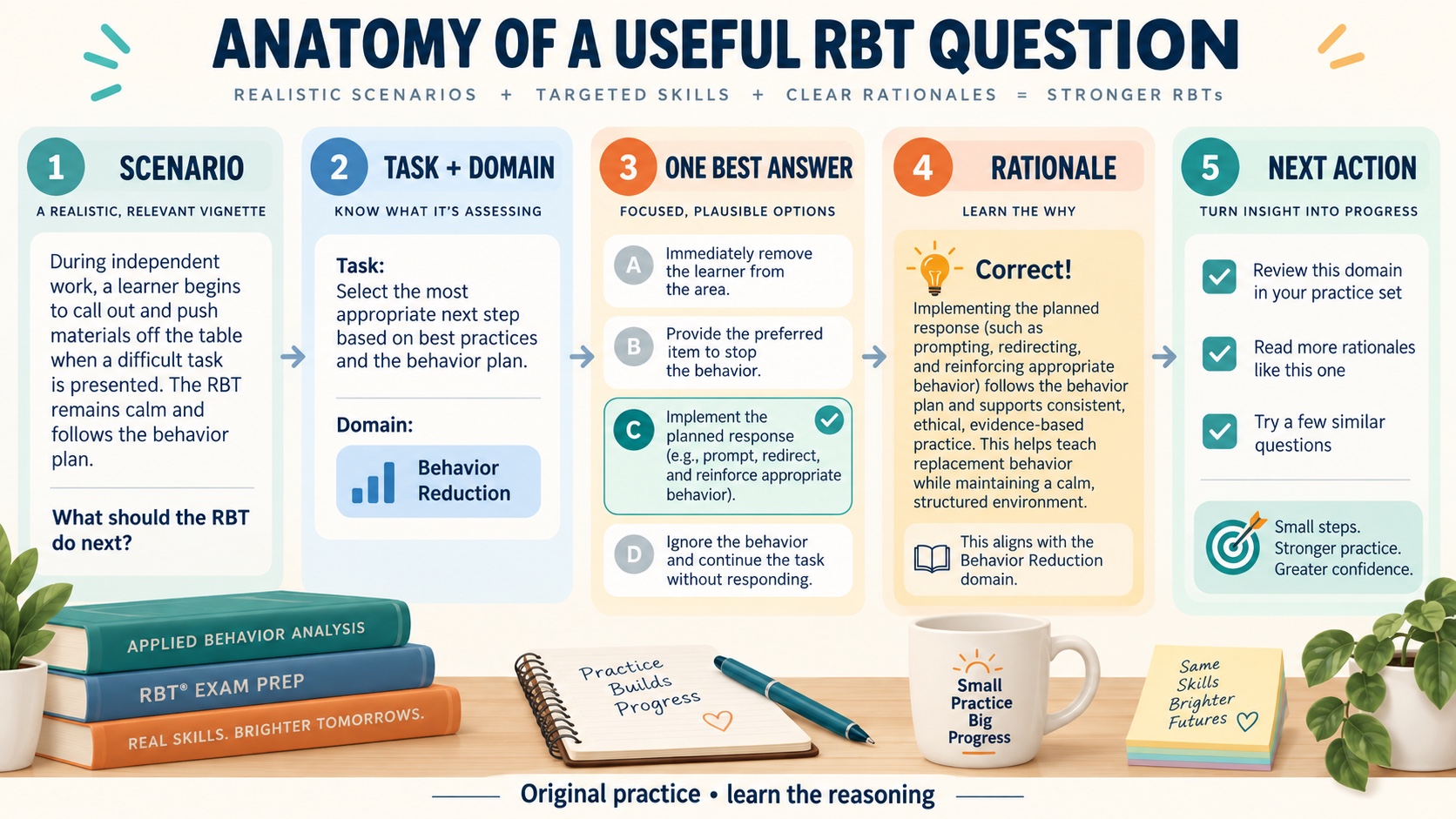
The anatomy of a useful question
1. A concrete scenario
The stem should give enough information to make a decision without hiding the answer in vague jargon. A good scenario may include the behavior, measurement, setting, instruction, consequence, or professional role that matters.
2. One defensible best answer
RBT questions can test whether you recognize the most appropriate action, not whether every other choice is impossible in every situation. The explanation should name the qualifier that makes one answer best, such as objective documentation, immediate supervisor contact, or the correct measurement dimension.
3. Teachable distractors
A distractor should represent a realistic mistake: confusing frequency with rate, choosing a more intrusive procedure too quickly, interpreting instead of observing, or acting outside the RBT role. If a distractor is silly, it does not help you practice discrimination.
4. A next action
After the rationale, tag the weak concept or task. The next action might be a definition review, a short domain set, a supervisor question, or a retry with a new scenario. The goal is not to collect wrong answers; it is to reduce repeated reasoning errors.
Three original practice examples
The examples below are original educational samples written for this article. They are not BACB questions, retired questions, or predictions of live exam content.
Example 1: response rate
Scenario: During a 30-minute observation, a learner engages in four instances of hand biting. What is the response rate per hour?
- A. 4 per hour
- B. 8 per hour
- C. 30 per hour
- D. 120 per hour
Best answer: B. Thirty minutes is one-half hour. Four responses in one-half hour equals eight responses per hour. The item tests rate, not raw frequency or duration. If you chose A, tag the difference between a count and a time-adjusted measure.
Example 2: prompting and independence
Scenario: A learner completes a step only after a verbal prompt. The written teaching plan says to fade prompts according to the supervisor’s procedure. What should the RBT do next?
- A. Add several louder prompts until the learner responds independently
- B. Follow the written fading procedure and record the learner’s response accurately
- C. Remove the target because the learner needs too much help
- D. Create a new prompting hierarchy without discussing it
Best answer: B. The scenario gives the RBT a current plan and a supervisor-directed fading procedure. The key decision is to implement and document that procedure rather than invent a new hierarchy or abandon the target.
Example 3: objective documentation
Scenario: A caregiver says a learner was “very upset” before session. Which note is the most objective starting point?
- A. The learner was uncooperative all morning
- B. The learner seemed emotionally dysregulated
- C. The caregiver reported that the learner slept four hours; the learner cried for two minutes when the table activity began
- D. The learner had a bad day and did not want to work
Best answer: C. It separates the caregiver’s report from an observable event and includes a duration. The other choices rely on interpretation or broad labels. If this item was difficult, review objective documentation and the difference between reported context and direct observation.
How to review the answer and distractors
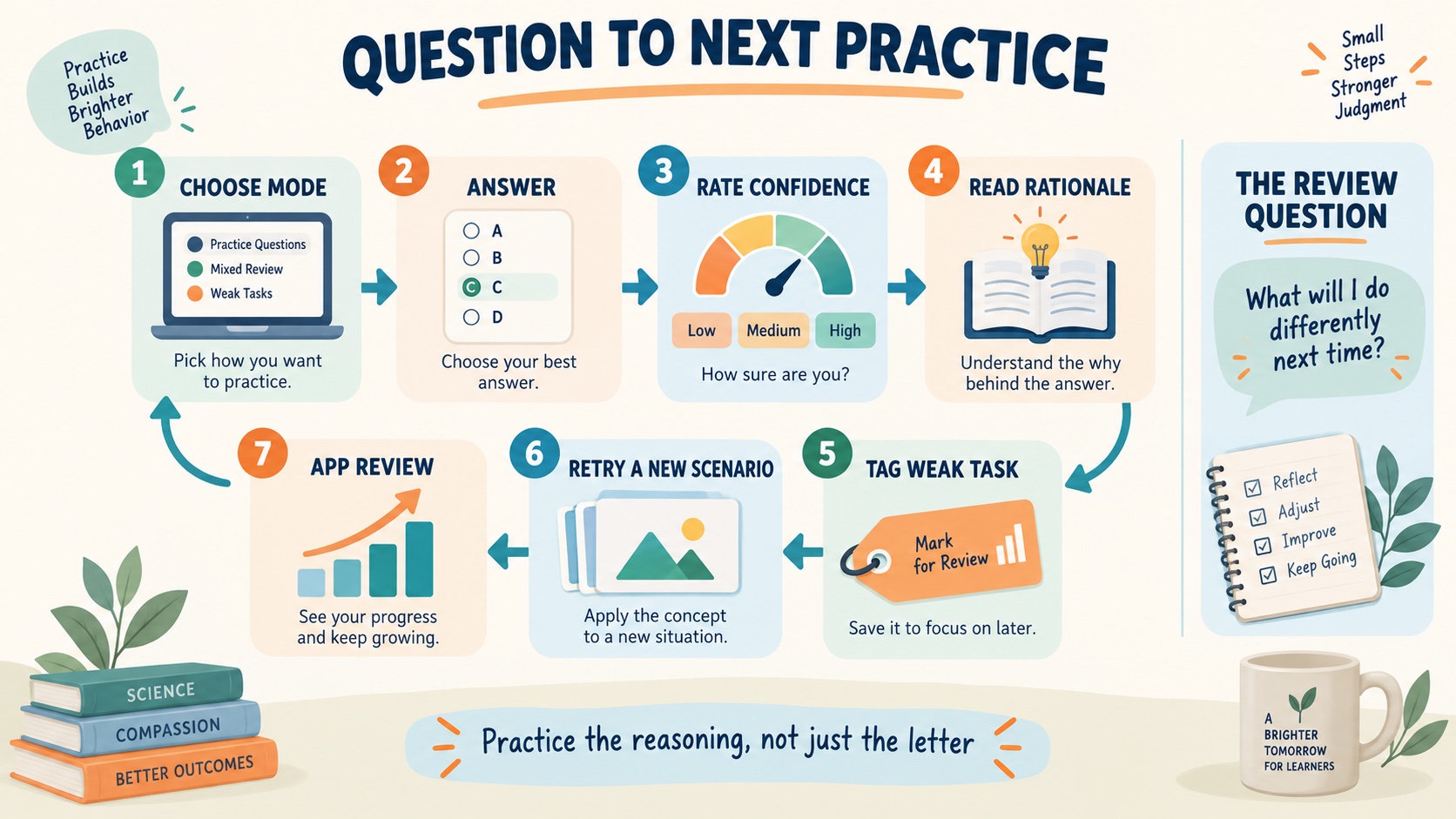
Do not stop at “I got it right.” Mark your confidence before opening the rationale. A correct answer chosen with low confidence may need reinforcement. A wrong answer chosen with high confidence may reveal a misconception that deserves priority. Then explain the result in your own words and name why each distractor is weaker.
Tag the miss using a small set of labels: knowledge gap, discrimination error, application error, reading error, or pacing error. Add the content area and task when available. For example, a missed rate item might be a measurement calculation problem, while a missed prompt item might be an application problem even if you know the definition of prompting.
After the review, use a new scenario for the retry. Repeating the same question until you remember the letter measures memory for that page. A new scenario checks whether the distinction transfers. If it does not, go back to a theory block, the relevant training material, or a supervisor-led explanation before taking a longer set.
Choose the right question mode
- Learning set: use 5–15 questions from one domain and read every rationale.
- Mixed diagnostic: combine domains, mark confidence, and look for repeated task errors.
- Timed rehearsal: use a longer set only when you need pacing and sustained attention. The full current exam boundary is 85 questions in 90 minutes.
Do not use a short learning set as an official readiness score, and do not force every study session into a full simulation. The mode should match the job. Question practice is for learning and diagnosis; the official BACB examination is a separate high-stakes event.
Common question-bank mistakes
Buying “real” questions
Unofficial resources should not promise live or leaked BACB questions. Choose original questions with transparent explanations instead.
Ignoring the edition
Check whether the resource reflects the RBT Test Content Outline (3rd ed.) and the current handbook. A familiar title can still hide stale content.
Using the answer key as the lesson
A letter without a rationale does not teach you how to discriminate the scenario. If the explanation does not identify the evidence and distractor logic, the item has limited learning value.
Forgetting the role boundary
When the question involves a change to a plan, an unusual client event, or a concern about service delivery, check what belongs with the supervisor or Requirements Coordinator. Do not turn practice confidence into permission to act outside the RBT role.
Ready for a short RBT question loop?
Use ABA Study Online’s original, unofficial RBT practice questions to answer a scenario, read the rationale, and tag the concept you need to revisit. Then use the ABA Study Online app for shorter flashcard and section-review loops between longer website sessions.
FAQ and official sources
How many questions are on the current RBT exam?
The BACB lists 85 questions: 75 scored and 10 unscored. An independent question set may be shorter or longer, but it should describe its own format honestly.
Are these RBT practice questions official?
No. ABA Study Online questions are original, unofficial educational materials. They do not reproduce live or retired BACB examination content and do not guarantee a result.
Should I practice by domain or use mixed questions?
Use domain sets when learning or repairing one skill, then use mixed questions to test transfer and identify which task needs more work.
Can practice questions replace the 40-hour training?
No. Practice questions support study. They do not replace the current training, competency assessment, application, supervision, or other BACB requirements.