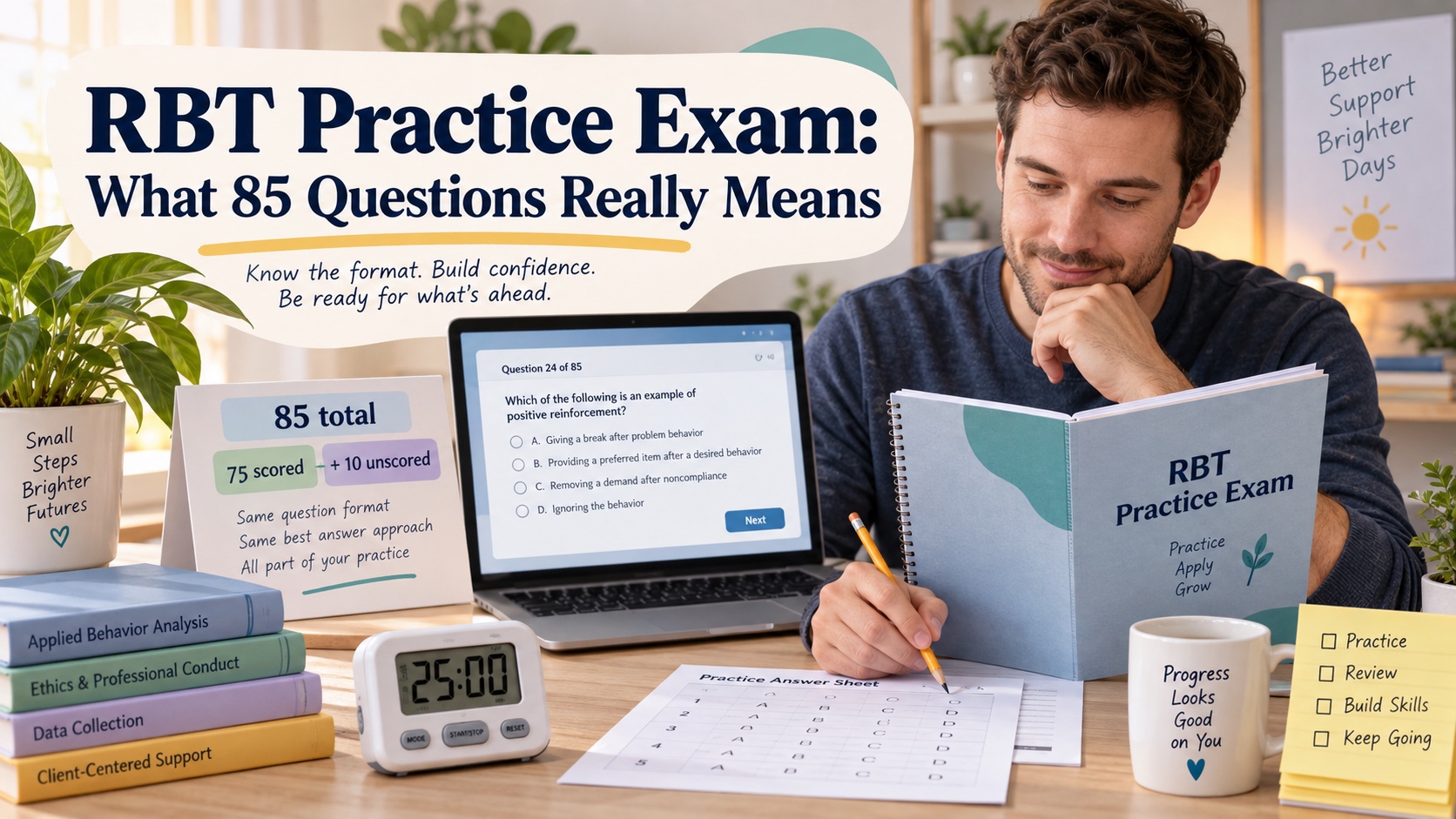
RBT Practice Exam: What 85 Questions Really Means
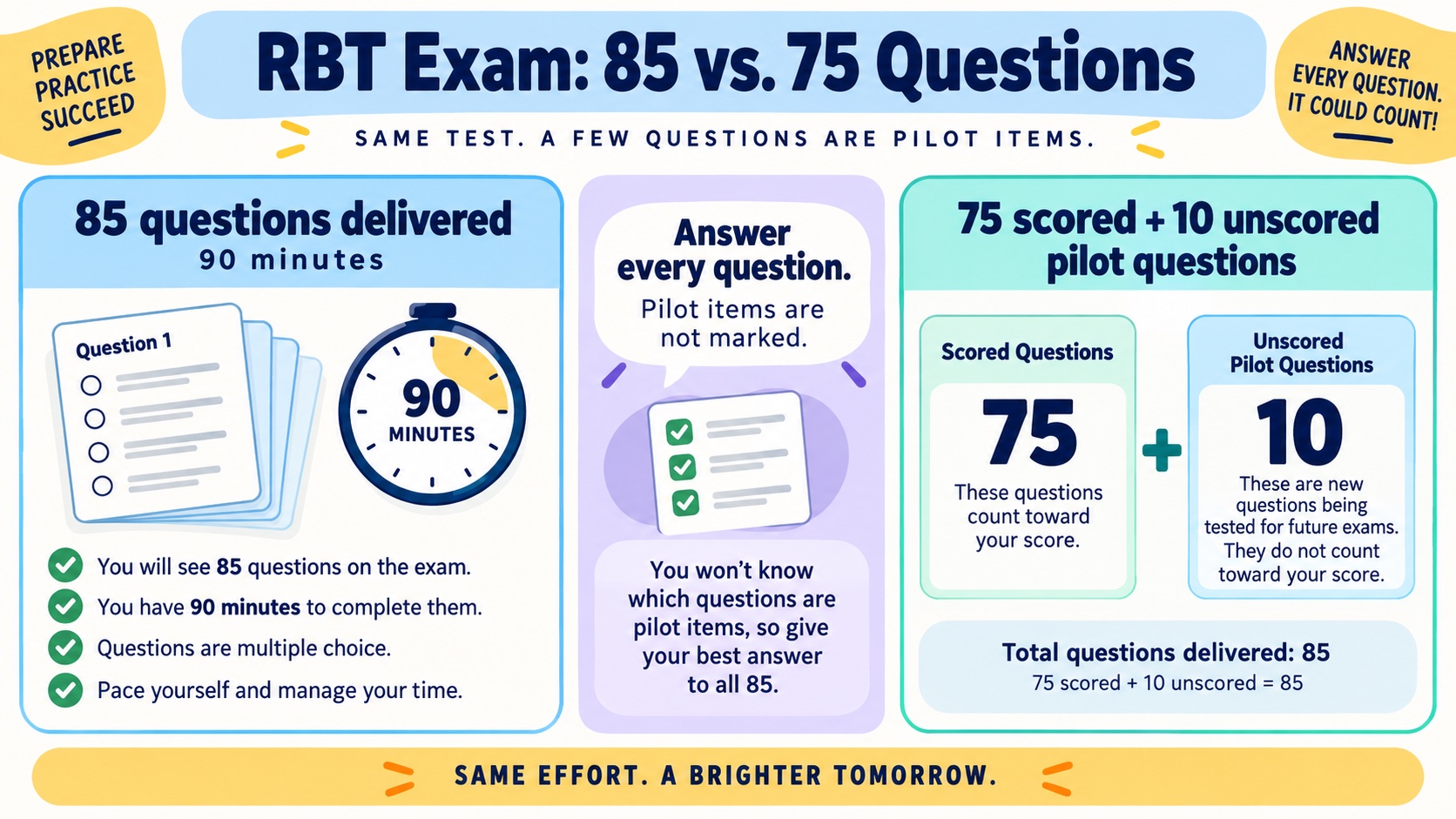
If you search for an RBT practice exam with 85 questions, you may be trying to match the length of the current testing experience, practice pacing, or understand why some resources mention 75 questions instead. Both numbers can appear in accurate explanations, but they describe different parts of the examination. The current RBT examination delivers 85 questions in 90 minutes. BACB materials distinguish 75 scored questions and 10 unscored pilot questions.
The practical study decision is simple: prepare to answer all 85 questions. You cannot reliably identify pilot items while testing, and an independent practice exam does not know which items would be scored on a live form. Use the current RBT Test Content Outline and Handbook for official boundaries, then use practice questions to rehearse retrieval, application, pacing, and error review.
Table of Contents
Short answer: is the RBT exam 75 or 85 questions?
The current testing experience is described as 85 questions with 90 minutes. The scored portion is 75 questions, and 10 questions are unscored pilot items. The pilot items are mixed into the examination and are not marked for the candidate. That is why a practice page should state clearly whether it offers 75 questions, 85 questions, a short sample, or a full timed rehearsal.
A 75-question set can be useful for a focused study block or for aligning roughly to the scored portion of the blueprint. An 85-question rehearsal can be useful for pacing and stamina. Neither one is an official examination form, and a practice percentage is not an official BACB result. The best resource makes its question count, source alignment, explanations, and limitations clear.
How 85 total and 75 scored fit together
Think of the numbers as two views of the same appointment:
- 85 questions delivered: the number of questions you should expect to see and answer during the current examination experience.
- 75 scored questions: the questions that contribute to the scored portion described by current BACB materials.
- 10 unscored pilot questions: new items being evaluated for possible future use; they are not identified for you during the appointment.
- 90 minutes: the current time boundary for the RBT examination, subject to current official information and any approved accommodation.
Do not interpret the ten pilot questions as ten questions you can skip or guess through. Treat every item as important. Also do not treat a practice provider’s own experimental questions as equivalent to the BACB pilot items. A practice website may test new questions for its own quality process, but it cannot label the live exam’s pilot items.
What an 85-question practice exam should rehearse
Content alignment
Start with the current RBT TCO rather than the headline number. A practice set should cover the current task areas in a way that gives you opportunities to identify, describe, apply, and discriminate among important concepts. The six domains are a map, not six separate pass thresholds. A practice resource should disclose the edition or date it follows, especially because the RBT TCO 3rd edition began the current examination-content transition in 2026.
Question reading
RBT questions may include a definition, a short workplace scenario, a measurement decision, a prompting or reinforcement example, a documentation issue, or an ethical boundary. Practice reading the whole stem before looking for a familiar keyword. Ask what happened first, what changed, what the learner did, and what the question actually asks you to select.
Reasoning and explanation
A correct answer is more useful when you can explain why it is correct and why the alternatives are weaker. For example, a question about reinforcement is not solved by choosing the answer that sounds positive. You need to consider whether a consequence follows a behavior and whether the behavior becomes more likely in the relevant context. A practice explanation should make that controlling feature visible.
How to pace 85 questions in 90 minutes
Ninety minutes for 85 questions is an average of a little over one minute per question. That is a planning average, not a command to spend exactly the same time on every item. Some questions will be quick; others will require careful reading. Use a simple three-part pacing rule:
- Read and decide: answer when the evidence is clear.
- Flag and move: if you are stuck between two options, make the best provisional choice and continue.
- Return with purpose: use remaining time to reread the stem, compare the two alternatives, and check the controlling feature.
Do not spend the first half of a practice set trying to create a perfect score. Practice the recovery skill too. A difficult item should not turn into ten rushed decisions because you refused to move on. The goal is steady attention across the entire 85-question experience.
How to review a practice result
The result becomes useful only after review. For each missed or uncertain item, record:
- the domain or concept;
- your answer and the stronger answer;
- the key distinction you missed;
- whether the error came from knowledge, reading, application, or pacing;
- one new example or question to revisit later.
Separate “I knew it but rushed” from “I never understood it.” The first needs pacing and careful reading; the second needs a clearer explanation and another retrieval cycle. Use the RBT learning resources to revisit a concept, then return to practice questions after a delay. The purpose is not to defend yesterday’s percentage. It is to make the next decision more accurate.
What to check in a free practice resource
Free practice can be valuable, but judge it by transparency instead of price. Check whether the resource:
- states whether it follows the current RBT TCO and what date or edition it uses;
- explains whether it provides 75, 85, or another number of original questions;
- offers rationales rather than only an answer letter;
- covers more than one domain and avoids repeating one easy question type;
- separates unofficial practice scores from official BACB results;
- avoids claims about real, recalled, or leaked BACB questions;
- keeps the RBT role, supervision, ethics, and application boundaries accurate.
A page that calls itself “official” without linking to a BACB source deserves caution. The BACB is the authority for the certification examination and its policies. A learning website or app can create original practice and explanations, but it should not imply endorsement or access to secure examination content.
Common RBT practice-exam mistakes
- Counting 75 as the whole exam: the current delivered experience is 85 questions.
- Trying to identify pilot items: they are not marked, so answer all 85 carefully.
- Using one score as a pass prediction: practice forms vary and are not the BACB examination.
- Memorizing answer letters: learn the feature or decision rule behind the answer.
- Ignoring timing: a correct untimed result may not show whether you can sustain attention across 90 minutes.
- Skipping explanations: the rationale is where a missed distinction becomes a study target.
- Studying outside the RBT role: keep examples within the current training, supervision, and professional boundary context.
A three-mode practice routine
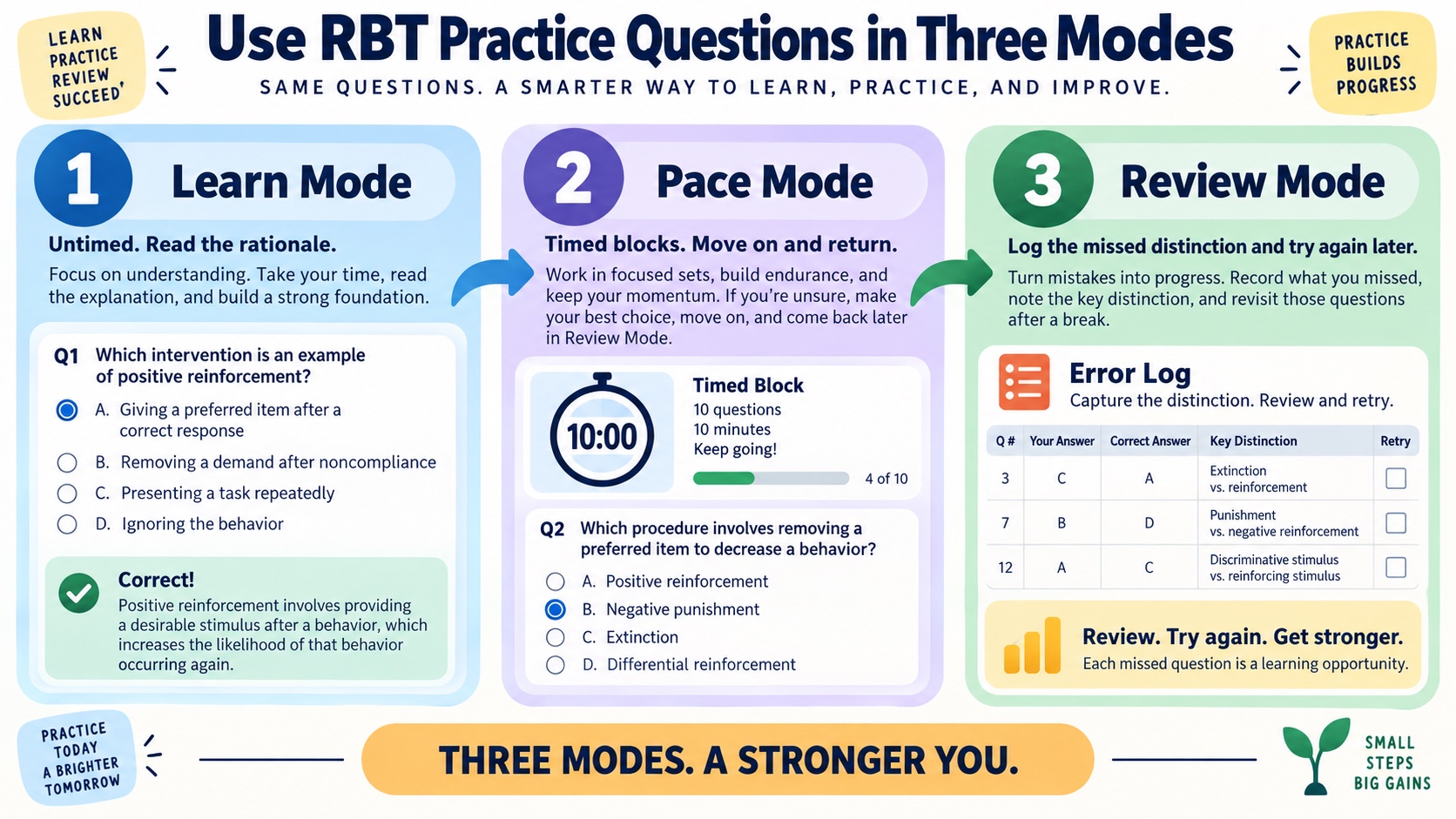
Use one question set three different ways:
- Learn mode: work untimed, read every rationale, and pause to look up the controlling concept.
- Pace mode: use a focused timed block, practice moving on, and return to flagged items.
- Review mode: reopen missed items after a delay, state the distinction from memory, and answer a new example.
The ABA Study Online app can support short review sessions, flashcards, section practice, audio review, and progress tracking, while the website’s mock-exam area can serve a longer rehearsal. Keep mock performance as study evidence, not a certification result. The same loop works with a free question set, a printable tool, or a notebook.
RBT practice exam FAQ
Is the current RBT exam 75 or 85 questions?
Both numbers describe different parts of the current structure: 85 questions are delivered, including 75 scored questions and 10 unscored pilot questions. Candidates should answer all 85.
How long do I have for 85 RBT questions?
The current examination information lists 90 minutes. Confirm the current BACB source and any approved accommodation information before testing.
Can a free RBT practice exam predict my score?
No. A free practice exam can show which concepts, question types, or pacing decisions need work, but it is not an official form and cannot establish certification eligibility or a passing result.
Should a practice exam use 75 or 85 questions?
Both can have a purpose. A 75-question set can support a focused content block; an 85-question set can rehearse the delivered length and stamina. A transparent resource states what it is designed to do.
Sources and boundaries
- BACB RBT certification resources
- BACB RBT Handbook
- BACB Test Content Outlines
- BACB Examination Information
- Dunlosky et al. (2013), effective learning techniques review
- Carpenter, Pan, and Butler (2022), spacing and retrieval practice review
- ABA Study Online RBT resources, free questions, app review, and mock exams