RBT Practice Exam: What 75 Free Questions Really Mean
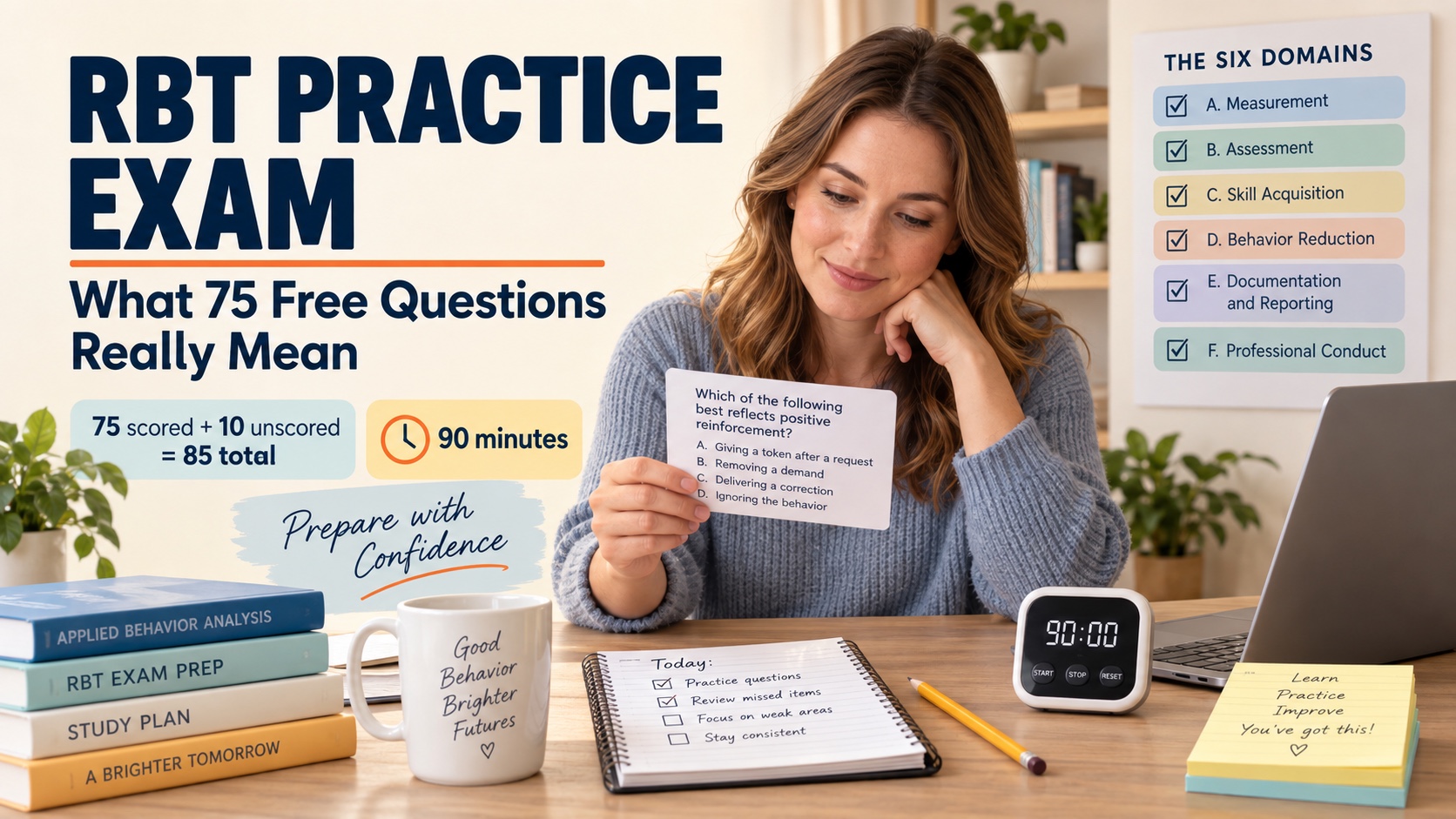
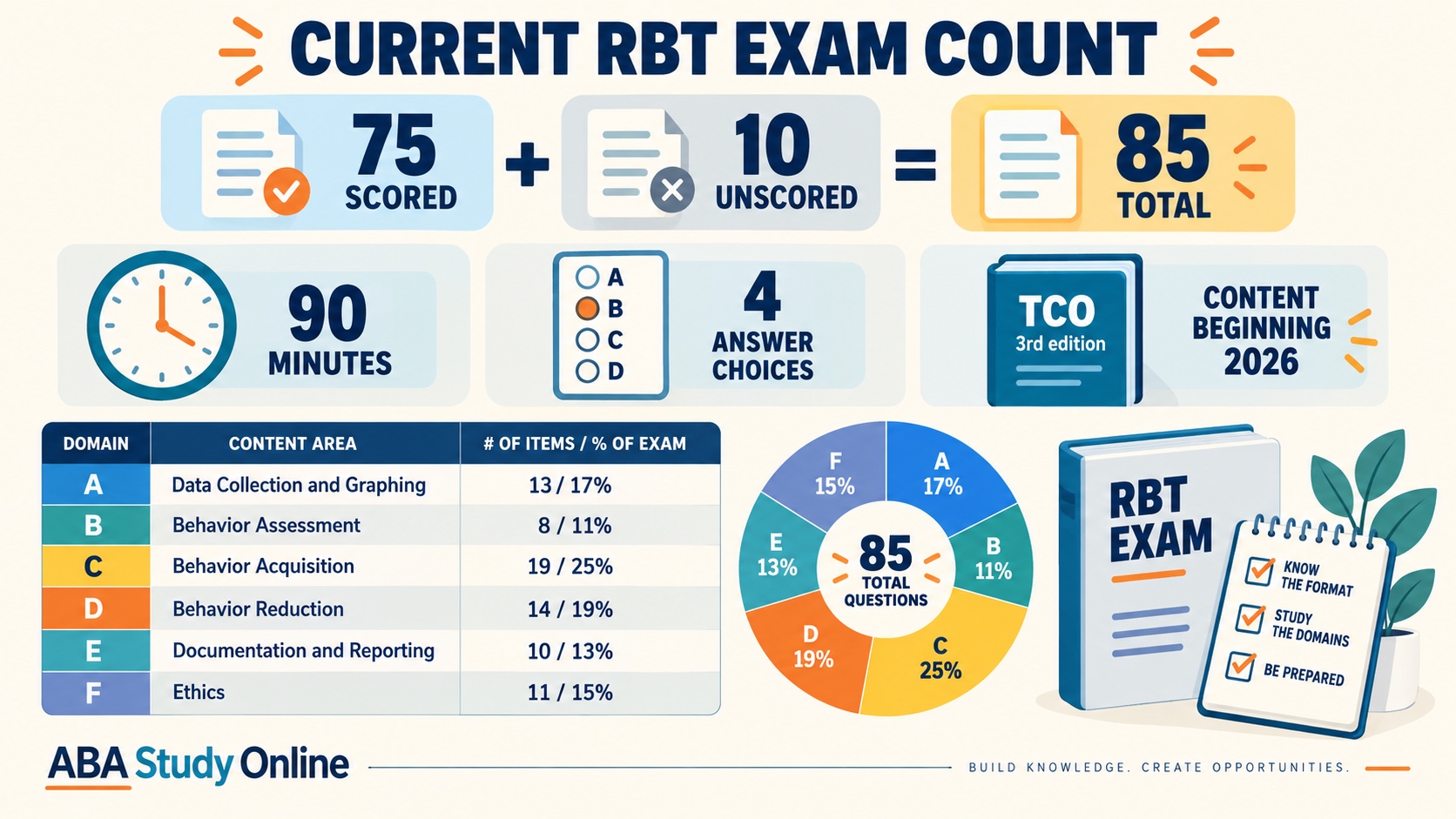
If you search for an RBT practice exam with 75 questions free, you may be looking for a realistic study session without paying for a large question bank. The number 75 is meaningful, but it needs one important explanation: the current RBT examination includes 75 scored questions plus 10 unscored pilot questions, for 85 questions total.
A free 75-question set can be a useful study format when it is aligned to the 2026 RBT Test Content Outline (TCO), clearly labeled as independent practice, and accompanied by explanations. It cannot identify which official questions will count, reproduce a live exam, or guarantee a result. This guide shows how to use the number correctly and how to turn a free practice session into a better next step.
Table of Contents
What “75 questions” means
The current RBT exam has two counts:
| Count | Meaning | How to use it in practice |
|---|---|---|
| 75 | Scored questions in the current content blueprint | A free 75-question set can mirror the scored-content target for a study session. |
| 10 | Unscored pilot questions included in the appointment | Do not try to guess which questions are unscored; a practice site cannot reveal that. |
| 85 | Total questions delivered during the examination | A full timed rehearsal should disclose whether it uses 75 or 85 questions. |
| 90 minutes | Current examination time | Use timing practice after you can review answers thoughtfully. |
This distinction protects you from two opposite mistakes. A website that calls a 75-question practice set a complete copy of the RBT exam is overstating what it provides. A learner who sees “85 questions” and assumes all 85 are part of the scored blueprint is also using the number incorrectly. A transparent resource states its question count, whether the questions are original, the TCO edition it follows, and what the explanations cover.
The current 2026 RBT exam boundary
For examination content beginning in 2026, the BACB identifies the RBT TCO 3rd edition as the current blueprint. The earlier RBT Task List 2nd edition applied through December 31, 2025. If a free PDF or question bank says only “RBT task list” without an edition or revision boundary, check it before relying on the material.
The current RBT Handbook describes 43 tasks organized into six domains. Questions have four possible answers with one correct answer, and the examination result is based on overall performance rather than separate pass marks for each domain.
| Domain | Scored blueprint share | Practice focus |
|---|---|---|
| A. Data Collection and Graphing | 13 questions / 17% | Measurement, data entry, graphs, trends, and fidelity |
| B. Behavior Assessment | 8 / 11% | Preference, skill, and functional-assessment participation |
| C. Behavior Acquisition | 19 / 25% | Reinforcement, teaching, prompting, chaining, and generalization |
| D. Behavior Reduction | 14 / 19% | Implementing reduction procedures and responding safely to plans |
| E. Documentation and Reporting | 10 / 13% | Objective notes, communication, records, and reporting concerns |
| F. Ethics | 11 / 15% | Confidentiality, supervision, boundaries, and the RBT Ethics Code |
What a useful free 75-question set should include
Free does not have to mean vague. Before you begin, look for five signals that the question set is worth your review time:
- Edition clarity: the page names the RBT TCO 3rd edition or identifies the 2026 boundary.
- Domain coverage: the questions are distributed across the six current domains rather than using “ABA” as one undifferentiated topic.
- Original wording: the publisher says the items are independent practice questions and does not claim access to live or recalled BACB content.
- Reasoned explanations: the answer key explains the relevant cue, procedure, measurement rule, or ethical boundary.
- Entry-level role accuracy: the question asks an RBT to implement, record, communicate, or seek direction rather than independently diagnose or rewrite a treatment plan.
A free set is especially useful when each question has a domain or task label. The label lets you separate a content gap from a reading error. For example, missing a question about partial-interval recording may mean you need to review the observation rule. Missing a question because you ignored the direction to contact a supervisor is a role-boundary issue. Both are “wrong answers,” but they require different repairs.
Also check what “free” means. Some pages offer a genuinely accessible set, while others show a few previews and place the rest behind an account, email form, or payment screen. That can still be a legitimate product path, but the page should disclose the scope before you spend time preparing for a full session. Free access also does not make a question official.
How to review a free practice result
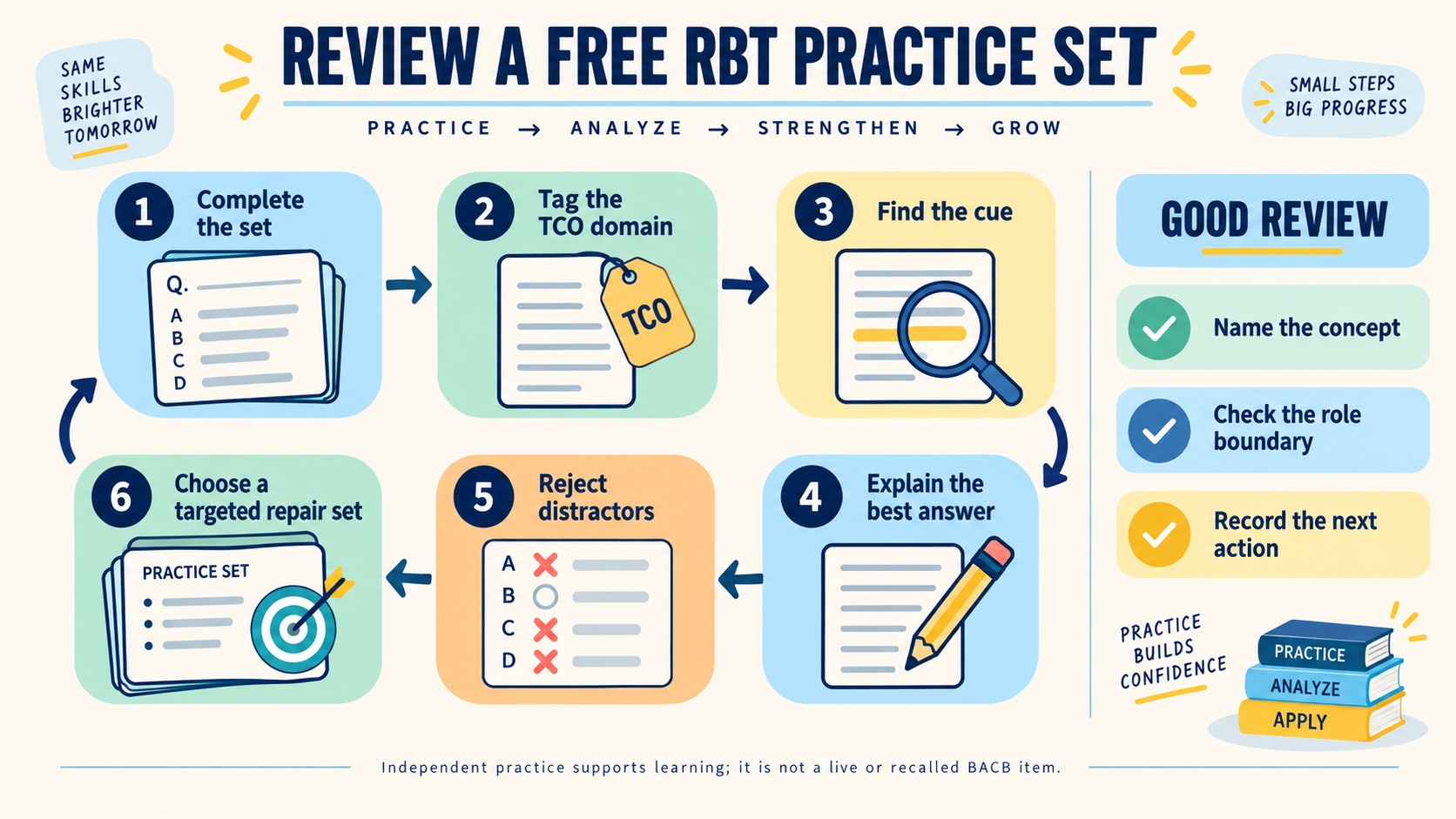
Do not use the percentage as the only output. After completing the set, create a short error log:
- Tag the domain. Mark A through F and identify the task when possible.
- Classify the miss. Choose concept, measurement, data interpretation, procedure, role boundary, or ethics.
- Find the cue. Write the word, condition, or data feature that should have changed your choice.
- Explain the best answer. Say what the RBT should do and why it fits the current role and scenario.
- Reject the distractors. Note whether each wrong choice is too early, too broad, unsupported, or reserved for a supervisor.
- Choose a small repair set. Revisit five to ten questions on the same task after a delay, then mix in a different domain.
Suppose a free 75-question set shows repeated misses in data collection and documentation. Your next step is not automatically to take another random 75-question test. Review the relevant TCO tasks, read the explanation, write a contrast such as “frequency versus rate” or “objective note versus interpretation,” and then answer a short targeted set. The goal is to learn what the cue means, not simply to make the score move once.
How to plan a 75-question study session
A 75-question session works best when you decide what it is measuring before you start. If you are learning the current blueprint, use the session to sample all six domains and pause when an explanation teaches a new distinction. If you are rehearsing timing, use a visible 90-minute limit and postpone detailed review until the end. Mixing those two purposes without labeling them can make the result hard to interpret.
For a first pass, divide the set into three blocks of 25 questions. Record the domain, task, confidence, answer, and reason for any change. A question changed from correct to incorrect may show uncertainty; a question changed from incorrect to correct may show that the first reading missed a cue. Neither pattern is a diagnosis by itself, but both give you a better review target than a single percentage.
Keep the scoring language modest. You can report the number correct in your own study log, but do not convert it into a predicted BACB result or a separate domain pass mark. The official format, eligibility rules, and examination decision belong to the current BACB materials. The independent practice set has a narrower job: reveal which concept, procedure, measurement rule, or role boundary deserves the next deliberate review.
Free-practice traps to avoid
Counting 75 as the whole appointment. The delivered exam includes 85 questions. A 75-question practice set should disclose that it aligns to the scored blueprint or is simply a study sample.
Using the old task list without checking the edition. The 2026 examination uses the TCO 3rd edition. Older resources may still contain useful foundational concepts, but they should not be presented as a complete current map without a review.
Believing “real questions” language. BACB examination content is confidential. Avoid any page that claims to provide live, recalled, leaked, or reconstructed items.
Downloading a PDF without an answer rationale. A static answer letter cannot show whether you missed a measurement rule, a procedural step, or a supervision boundary. Use it only as a prompt for your own review, not as a complete learning system.
Turning a free score into a pass prediction. A practice percentage is a sample from one question set. It does not establish eligibility, predict a BACB result, or replace the 40-hour training, Competency Assessment, supervision, application, or official examination.
FAQ and official sources
Is the current RBT exam 75 or 85 questions?
Both numbers describe different parts of the format. The current examination has 75 scored questions and 10 unscored pilot questions, for 85 total questions delivered in 90 minutes.
Can a free 75-question practice test be useful?
Yes, if it clearly states its scope, follows the current RBT TCO 3rd edition, uses original questions, provides explanations, and helps you identify a next study action. It is not the official examination.
Can I know which questions are unscored?
No. An independent practice site cannot identify which official questions are unscored. Treat every practice question as a learning opportunity and use the official format only to plan timing and coverage.
Which RBT domains should a free set cover?
A useful current set should represent all six TCO domains: Data Collection and Graphing, Behavior Assessment, Behavior Acquisition, Behavior Reduction, Documentation and Reporting, and Ethics. Use the rounded blueprint shares for planning, not as separate pass cutoffs.
Where can I practice next?
Use the current RBT Handbook and RBT TCO for the official boundary. For independent study, use the RBT practice questions, RBT learning path, ABA glossary, and ABA Study Online app as study layers, not as official BACB content.