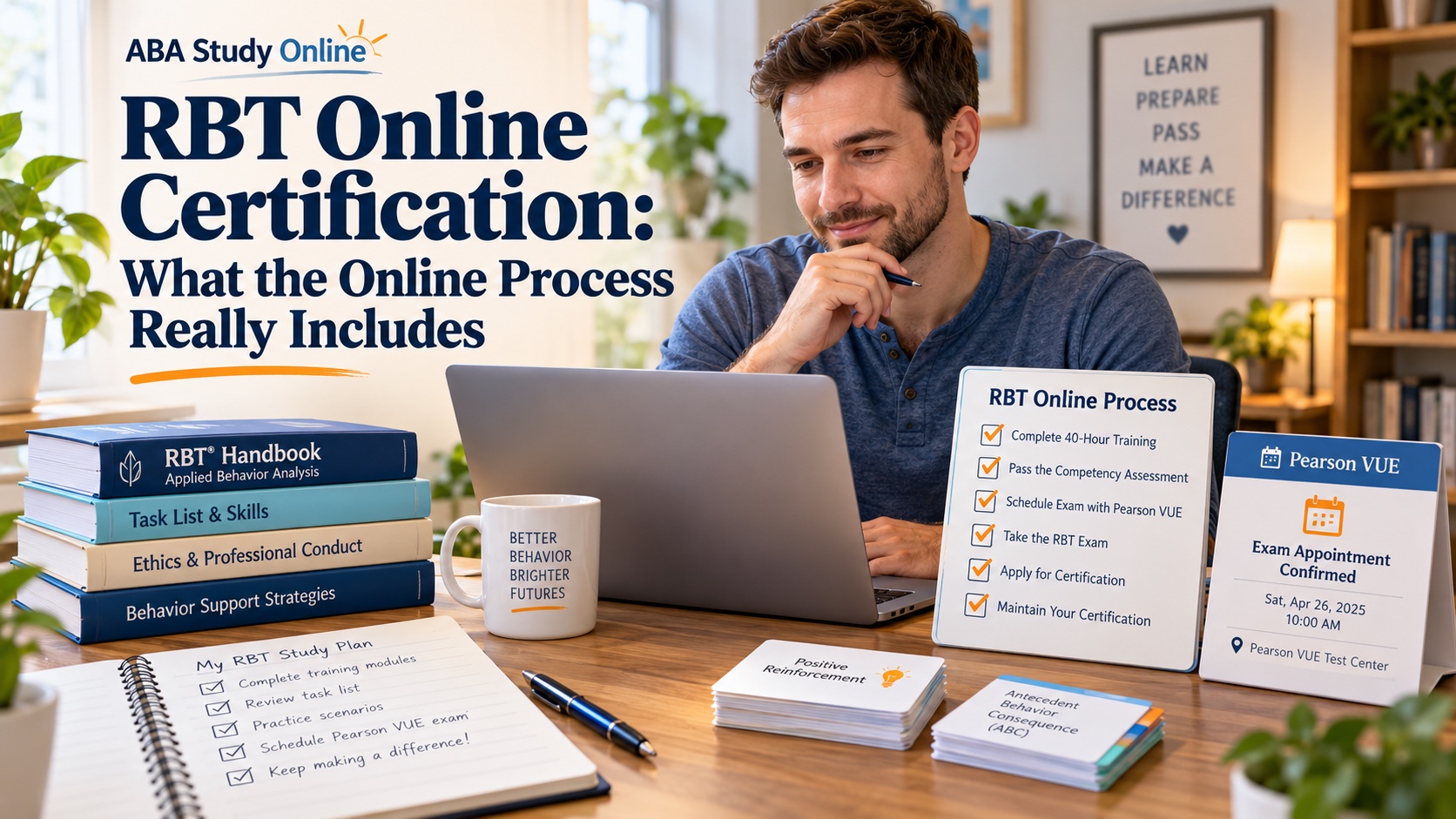
RBT Online Certification: What the Online Process Really Includes
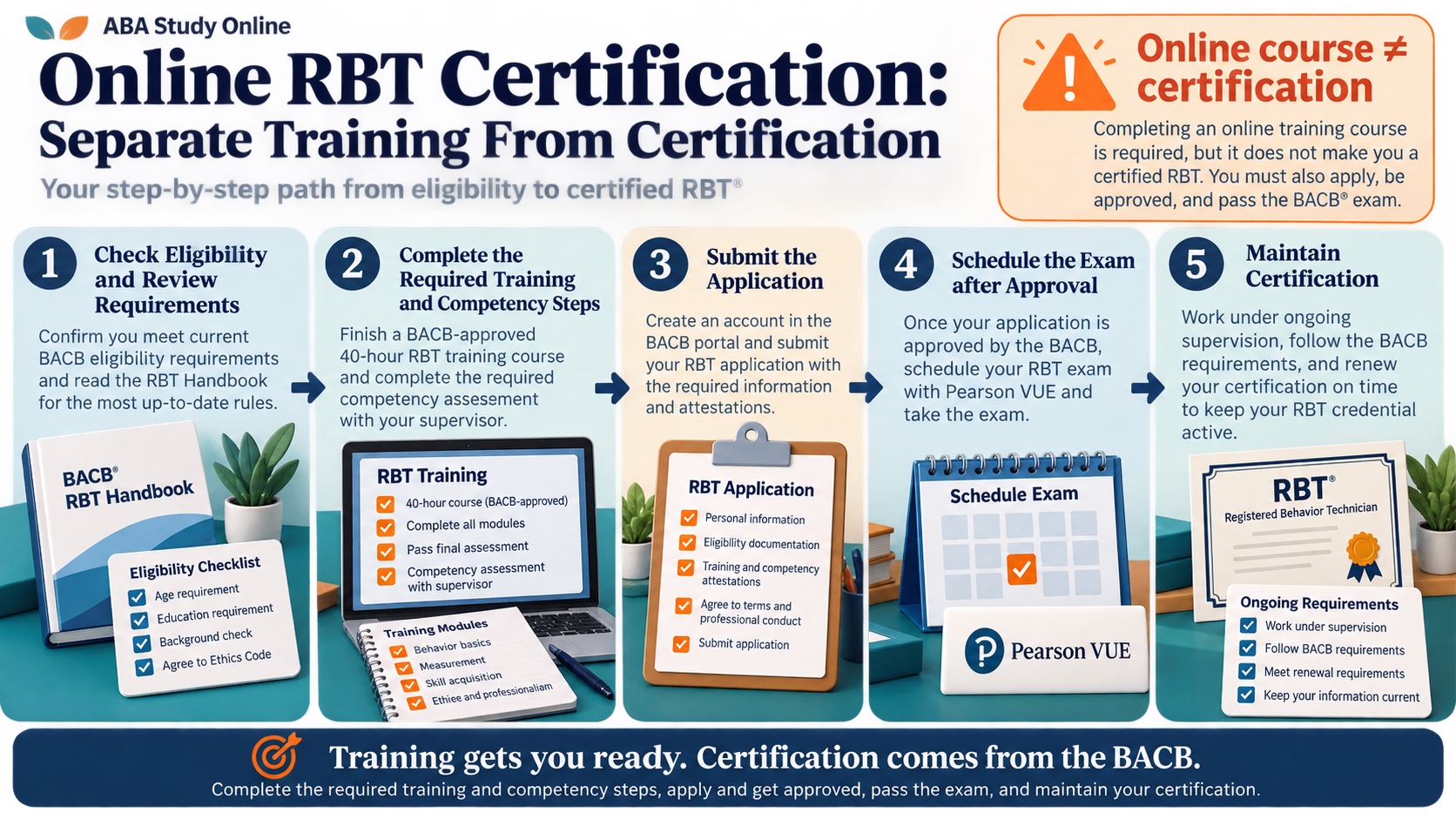
When people search for RBT online certification, they may mean an online RBT course, an online study program, or the full path to becoming a Registered Behavior Technician. Those are related, but they are not the same thing. An online course may help you complete training and prepare for the next steps. It does not, by itself, make you a certified RBT.
The credential comes through the current Behavior Analyst Certification Board (BACB) process. That process includes checking the applicable requirements, completing the required preparation and competency steps, submitting an application, receiving approval, scheduling and passing the examination, and maintaining the credential. Because requirements and materials can change, the current BACB RBT Handbook should be the final authority for your situation.
What “online RBT certification” means
There are three common meanings behind the phrase:
- Online training: lessons, assessments, or a course that helps you learn the material and complete a required training component.
- Online exam preparation: flashcards, practice questions, notes, videos, or a study app that helps you review the RBT content areas.
- Online application support: account, document, and status steps completed through the BACB’s digital process.
These pieces can be completed or supported online, but they serve different purposes. Training helps you learn. Study tools help you practice. The application is an administrative step. Certification is the credential issued after the applicable requirements and examination process are satisfied.
The certification path
The exact requirements should always be checked in the current RBT Handbook, especially during a transition year. At a high level, the path looks like this:
- Check current eligibility. Start with the BACB’s RBT page and handbook. Confirm that the requirements you are using match your application timeline and jurisdiction.
- Complete required training and competency steps. An online course may support the training portion, but the course must fit the current BACB requirements. A study app or free article is not automatically a qualifying course.
- Prepare the application. Gather the information, attestations, and documents requested by the current process. Do not rely on a screenshot or an old checklist if the handbook has changed.
- Submit and wait for the determination. The examination step follows the applicable application process. Approval is not the same as course completion.
- Schedule and take the examination. BACB’s examination information explains that approved candidates schedule and pay through Pearson VUE. Use the current handbook for the examination rules and timing.
- Maintain the credential. Certification is not the end of the process. Ongoing supervision, professional conduct, renewal, and other current requirements matter after passing.
What to look for in an online course
A course page may use the words “RBT certification” because it is describing the learner’s goal. Read the details carefully before treating that phrase as a credential claim. A useful course or study resource should make its role clear.
- Current source alignment: It should identify the handbook, test content outline, or other materials it uses and show when the information was reviewed.
- Clear completion evidence: If the course is intended to support a required training step, it should explain what completion record or assessment it provides and how that fits the current process.
- Practice with explanations: Questions should teach the reasoning behind an answer instead of only displaying a score.
- Role boundaries: Content should distinguish the RBT role from the supervisor’s role and avoid suggesting that a learner can practice independently before meeting the applicable requirements.
- Update discipline: A course that still presents old requirements as permanent should be treated cautiously during a transition.
Free material can be valuable for discovery, terminology, and daily review. It should not be described as an official BACB course or a substitute for the current application and examination process unless the provider has evidence for that claim. This distinction protects learners from paying for the wrong thing and protects the site from making an unsupported certification promise.
Why current requirements matter
The BACB RBT page currently highlights changes and directs applicants to updated resources. That is a signal to use a source-led workflow: check the current handbook first, then compare a course or study plan with the current source. A page written from memory can be useful for concepts but unreliable for dates, fees, forms, eligibility details, or maintenance rules.
If you started a course under an earlier set of materials, do not assume that every lesson, form, or assessment remains sufficient. Ask the provider how it handles the current transition. Then confirm the answer against the BACB handbook or contact the BACB when your situation is unclear.
A practical online study plan
Use an online resource as a study system rather than as a promise of certification. First, make a source checklist: current handbook, relevant content outline, ethics materials, and the application/examination instructions. Next, study in short sections. After each section, answer scenario questions without looking at the explanation, then write down the rule or distinction you missed.
Keep a separate “process” list and “content” list. The process list tracks eligibility, documents, application status, approval, scheduling, and maintenance. The content list tracks concepts such as measurement, assessment, skill acquisition, behavior reduction, documentation, and professional conduct. Mixing these lists is a common reason learners finish a course but still feel unsure about the next administrative step.
Near the exam, use mixed practice rather than reviewing only the topics you already like. Read each question for the observable facts, the role involved, the data pattern, and the ethical or procedural boundary. Then review the current source when the question depends on a rule that could have changed.
For daily practice, ABA Study Online can serve as a study route with free explanations, review materials, and app-based practice. The route is preparation support; the BACB remains the authority for certification requirements, application decisions, and examination rules.
FAQ
Can I become an RBT completely online?
Some training, study, and administrative steps may be completed or supported online, but “completely online” is too broad to promise. You must follow the current BACB requirements, application process, examination instructions, and maintenance rules.
Does an online RBT course make me certified?
No. A course may support preparation or a required training component. Certification still depends on meeting the applicable requirements, completing the application process, receiving approval, passing the examination, and maintaining the credential.
Is an online RBT study app useful?
It can be useful when it offers current explanations, mixed practice, feedback, and a clear boundary between study support and official certification. It should supplement—not replace—the current BACB source documents.
What should I do if a course and the BACB handbook disagree?
Pause before relying on the course for a current requirement. Check the handbook and the BACB’s current RBT page, then contact the BACB or your qualified supervisor if your case needs clarification.
Choose a study route
If you are looking for a structured way to review RBT concepts, start with the ABA Study Online RBT learning path and use the free resources to identify gaps before moving into mixed practice. Use the current BACB handbook to verify every certification requirement and application decision.