RBT Notes Examples: How to Write Objective Session Notes
When someone searches for RBT notes examples, they usually need more than a sentence to copy. They need to see how a useful session note connects what happened, what was measured, which procedure was used, how the client responded, and what the team should know next. A note should be specific enough for service verification and team communication while remaining within the RBT’s role.
The examples below are fictional and de-identified. They are study examples, not a universal employer template. Your supervisor, workplace, payer, and applicable laws may require a particular format. When a current requirement or clinical decision is unclear, use the current BACB materials and ask your supervisor.
What makes an RBT note objective?
An objective note begins with what the RBT directly saw, heard, counted, or timed. “During the transition from blocks to table work, the learner dropped to the floor for 45 seconds” gives the reader observable information. “The learner was upset about work” may be possible context, but it is an interpretation unless the person directly stated it. Put the observable event first, and label a reported statement as a report rather than as a fact you personally observed.
Objective does not mean cold or incomplete. A useful note can include the setting event reported by a caregiver, the instruction delivered, the prompt used, the response, the consequence, and the relevant data. It simply avoids guessing about motivation, personality, diagnosis, or intent. Avoid words such as lazy, manipulative, attention-seeking, noncompliant, or anxious unless the authorized clinical plan defines exactly how the term is being used and your documentation system requests it.
A repeatable session-note frame
Use your organization’s required fields first. As a study framework, a complete note can answer nine questions:
- When and where did the service occur, and who was present?
- Which approved targets or skills were addressed?
- What instruction, transition, or antecedent occurred?
- What did the learner do in observable terms?
- What data were collected, and which measurement dimension was used?
- What supervisor-approved procedure or prompt was implemented?
- What consequence followed, and what was the learner’s response?
- What environmental variable affected the session?
- What question, safety issue, or follow-up belongs with the supervisor?
This frame is not permission to invent a procedure or change a program. It is a way to check whether the note tells the next authorized reader what occurred. If a planned step could not be implemented, document the relevant fact according to workplace policy and notify the supervisor rather than silently presenting the session as typical.
RBT notes examples
Vague: “The learner had a bad transition and refused to work.”
More objective: “At 10:15 a.m., after the instruction ‘put the blocks away,’ the learner pushed two blocks from the table, said ‘no,’ and walked 6 feet toward the hallway. The RBT repeated the programmed transition cue and delivered the planned visual prompt. The learner returned within 30 seconds, put three blocks in the bin with a gestural prompt, and then began the first table task.”
The second version does not decide why the learner moved away. It describes the instruction, topography, distance, timing, prompt, and response. If the program calls for frequency or duration data, add the recorded value. If the event met a defined target behavior, use the operational definition from the plan rather than replacing it with a casual label.
Vague: “Great communication today; the learner was very cooperative.”
More objective: “Across eight opportunities to request a break, the learner used the break card independently in six opportunities and after a verbal prompt in two. The RBT delivered the programmed consequence after each request. No unsafe behavior occurred during this teaching block.”
That example lets the reader see the skill, the number of opportunities, the independence level, and the relevant safety observation. It does not turn a single session into a broad claim about progress.
Add data and procedure details
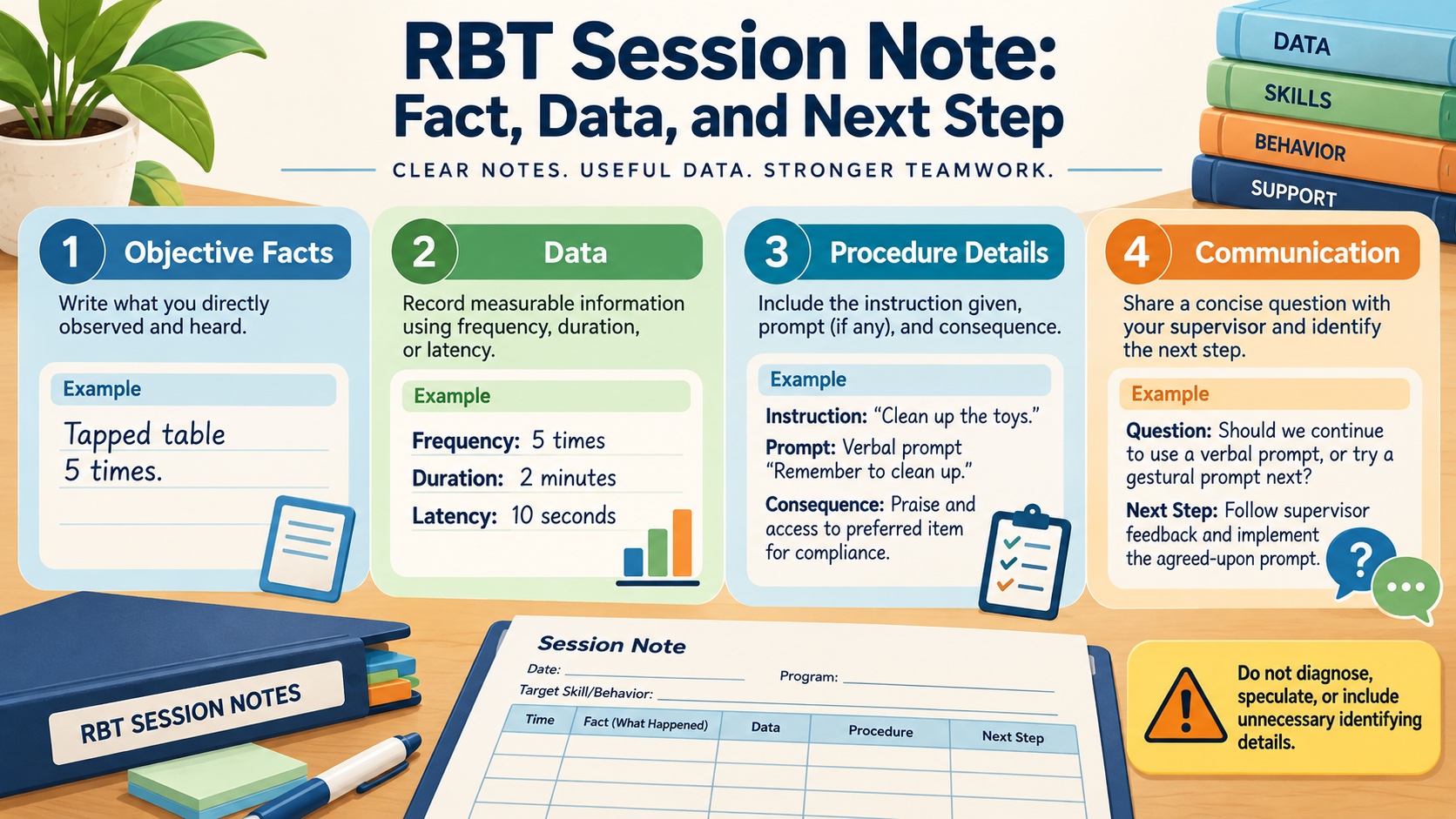
Choose the measurement named in the written program. Frequency answers how many times a response occurred. Duration answers how long it lasted. Latency answers how long it took to begin after a specified event. Rate adds a time unit to a count. These are not interchangeable. “Five times” and “two minutes” communicate different dimensions, and the note should identify which one was recorded.
Procedure details should be brief but meaningful: include the instruction, prompt level, teaching arrangement, and programmed consequence when those details explain the data. For example: “The RBT presented the picture-choice array, waited 5 seconds, used a gestural prompt on two trials, and delivered the programmed reinforcer following the defined response.” Do not turn a session note into a new treatment plan, and do not claim that a consequence was reinforcing simply because it was delivered; the authorized data and supervisor review determine how the plan is evaluated.
Also note relevant variables without speculation. A caregiver report that the learner slept poorly can be recorded as a report. A room change, late start, illness report, missing material, or interruption may be relevant if it affected implementation or measurement. Keep the wording neutral and follow the workplace process for urgent health or safety information.
Privacy, scope, and supervisor communication
Use only the information needed for the job and the required record. Do not place unnecessary identifying details, photographs, or client stories in a public example, personal device, social post, or study document. The RBT Ethics Code addresses accurate documentation and protecting client confidentiality and privacy. For a practice note, use a fictional name or no name at all, and remove dates, locations, and combinations of details that could identify a real person.
RBT notes also show professional boundaries. An RBT can describe what occurred, implement trained procedures, report variables, and ask for direction. An RBT should not use the note to diagnose, independently change the function hypothesis, introduce an unfamiliar intervention, or promise an outcome. A useful follow-up sentence might be: “The room change made the visual schedule unavailable for the first activity; supervisor direction is requested about the replacement materials for the next session.”
Common mistakes
- Mind-reading: Replace “wanted attention” with the observable response and the events around it.
- Unanchored praise: Replace “excellent session” with the target, opportunities, data, and response.
- Missing measurement units: State whether a number is a count, rate, duration, latency, percentage, or trial result.
- Procedure drift: Record what was implemented and contact the supervisor when the written plan does not fit the situation.
- Privacy leakage: Remove unnecessary identifiers and keep records in the approved system.
- Overclaiming: Describe this session’s data instead of declaring a permanent change after one observation.
For more practice, review the ABC data sheet tool, look up related terms in the ABA Definition Search, follow the RBT learning path, and test retrieval with RBT practice questions. These learning resources support study; they do not replace your employer’s documentation policy, the current BACB materials, or supervisor direction.
FAQ
Can I copy an RBT notes example into my work record?
No. Use examples to learn the kind of detail a note may need, then follow your organization’s approved template and document only what actually occurred.
Should an RBT session note include an ABC sequence?
Include antecedent, observable behavior, and consequence when they are relevant to the approved program or required form. Use the operational definition and data procedure in the plan rather than inventing your own labels.
What if I am unsure how to describe an event?
Write the directly observed facts, preserve the required data, and ask your supervisor for direction. Do not fill the gap with a diagnosis, motive, or unsupported conclusion.