RBT Mock Exam: How to Practice Under the Current 2026 Blueprint
Searching for an RBT mock exam usually means you want more than a few sample questions. You may need a short warm-up, a mixed diagnostic, or a full rehearsal that feels close to the current testing conditions. The right choice depends on where you are in your preparation and what you do with the results afterward.
The current RBT examination is based on the RBT Test Content Outline (3rd ed.), which applies beginning in 2026. A meaningful mock exam should make its edition, question design, domain coverage, timing, answer explanations, and originality clear. This guide shows how to evaluate and use one without confusing an unofficial practice result with a BACB decision. ABA Study Online practice is original educational material; it is not BACB-endorsed, does not contain live or recalled examination questions, and cannot guarantee certification.
Quick answer: Start with a topic set if you are learning a concept, use a mixed diagnostic to find weak domains, and save a full-length rehearsal for pacing practice. The current RBT examination has 85 total questions—75 scored and 10 unscored—90 minutes, four answer choices, and six content areas. A mock exam is useful when its questions are original, its coverage is visible, its rationales teach, and its review changes what you do next.
What the current 2026 RBT exam includes
Before you compare mock exams, anchor your expectations to the current RBT Handbook and RBT Test Content Outline (3rd ed.). The official materials—not a practice website—define the examination requirements.
- 85 total questions: 75 scored questions and 10 unscored pilot questions.
- 90 minutes: the stated time allowed for the examination.
- Four answer choices: one correct answer is presented for each question.
- 43 tasks: organized into six current content areas.
- Overall result: questions are equally weighted, and the result is based on overall examination performance rather than a separate pass result for every domain.
The unscored questions cannot be identified while you are taking the examination. For that reason, a practice session should train you to respond carefully to every item rather than trying to guess which questions “count.” The 90-minute limit also makes pacing part of preparation, but timing should be added gradually. A learner who is still confusing duration and latency needs explanation and examples before a long timed form becomes useful.
The BACB recommends reviewing the current TCO together with materials from the 40-hour training and Competency Assessment. A mock exam supports that preparation; it does not replace eligibility steps, training, competency assessment, the application process, or the official examination.
Three useful mock-exam modes
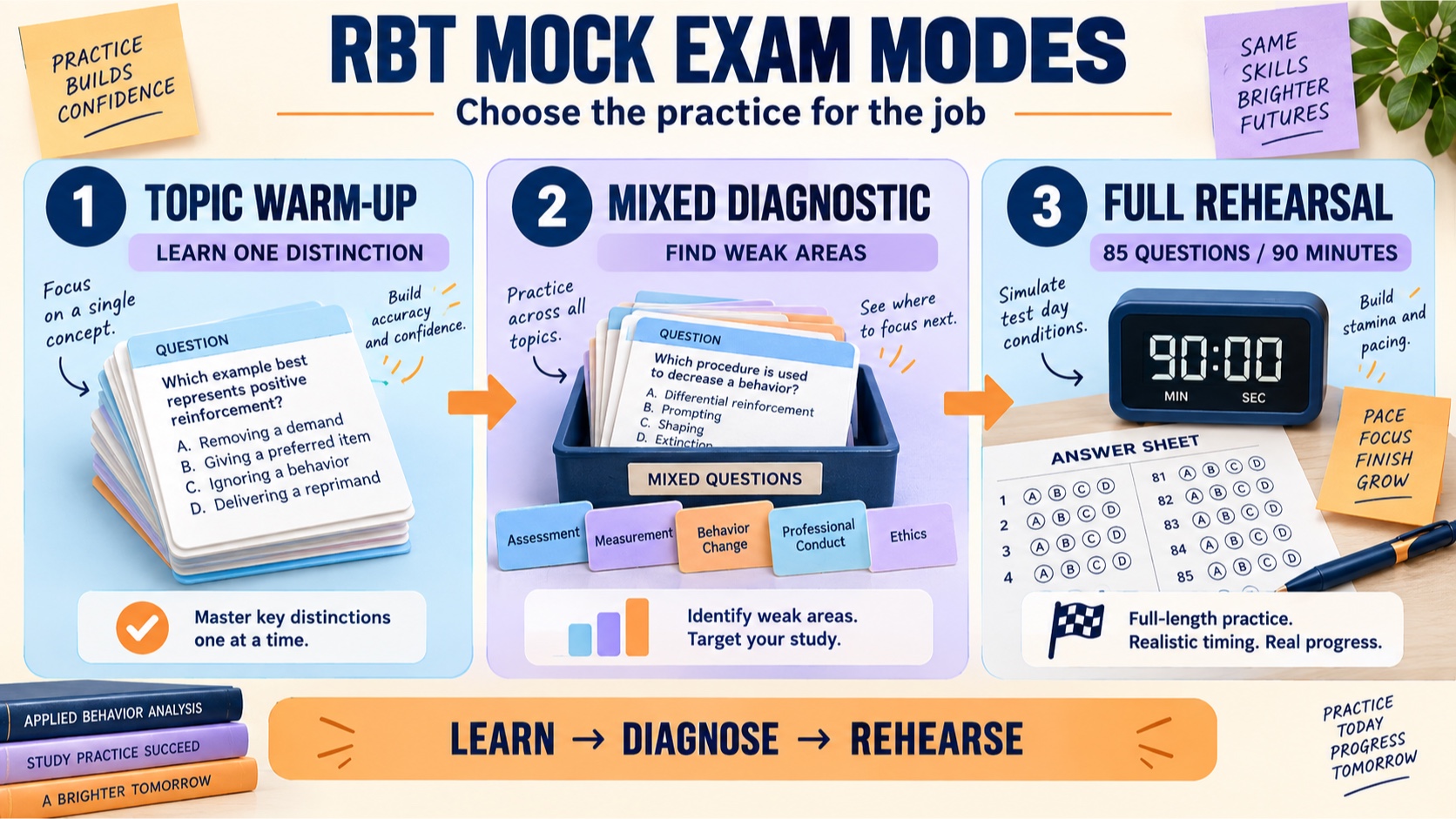
“Mock exam” can describe several different tools. Decide what the session is supposed to accomplish before you choose the length.
| Practice mode | Best use | What to record |
|---|---|---|
| Topic warm-up | Learn or refresh one distinction, such as measurement, prompting, reinforcement, or documentation. | Definition gap, confusing pair, and one example to try again. |
| Mixed diagnostic | Practice identifying the task and domain without being told what concept to expect. | Domain, error type, rationale, and the next focused review block. |
| Full rehearsal | Practice pacing and concentration in a structure related to 85 questions and 90 minutes. | Time checkpoints, flagged items, careless errors, and patterns across domains. |
Topic warm-up
A topic set is a good first move when a concept is still new. If you are reviewing frequency, rate, duration, and latency, it is helpful to see several related examples together and compare the measurement choice. If you are learning prompting or reinforcement, a short set lets you read the rationale while the distinction is still fresh.
Do not judge readiness from a topic score. The set is doing a teaching job. Mark the questions you answered correctly for the wrong reason; those are not secure skills yet.
Mixed diagnostic
A mixed set removes the label that tells you what to retrieve. The question may describe a data-collection problem, a teaching procedure, an ethics boundary, or a documentation decision without naming the domain. Your first task is to identify what the scenario is asking, then choose the answer supported by the observable details.
Mixed practice is especially useful after a round of topic review. It shows whether the concept transfers when the prompt no longer announces its name.
Full rehearsal
A full rehearsal should make its relationship to the current format explicit. A shorter test is not automatically bad, but it should not be advertised as a complete simulation if it contains only 20 questions. Use a full-length-style session when you have enough content fluency to learn from pacing data rather than simply becoming exhausted.
During a timed rehearsal, use a simple rhythm: read the stem, identify the behavior or decision, eliminate answers that exceed the RBT role or ignore the evidence, choose the best supported option, and flag only genuine uncertainty. The average time per question is a little over one minute, but some questions will take less and some will take more.
Use the six-domain blueprint
The current TCO makes domain coverage visible. The counts below describe the 75 scored questions; the percentages are rounded planning weights:
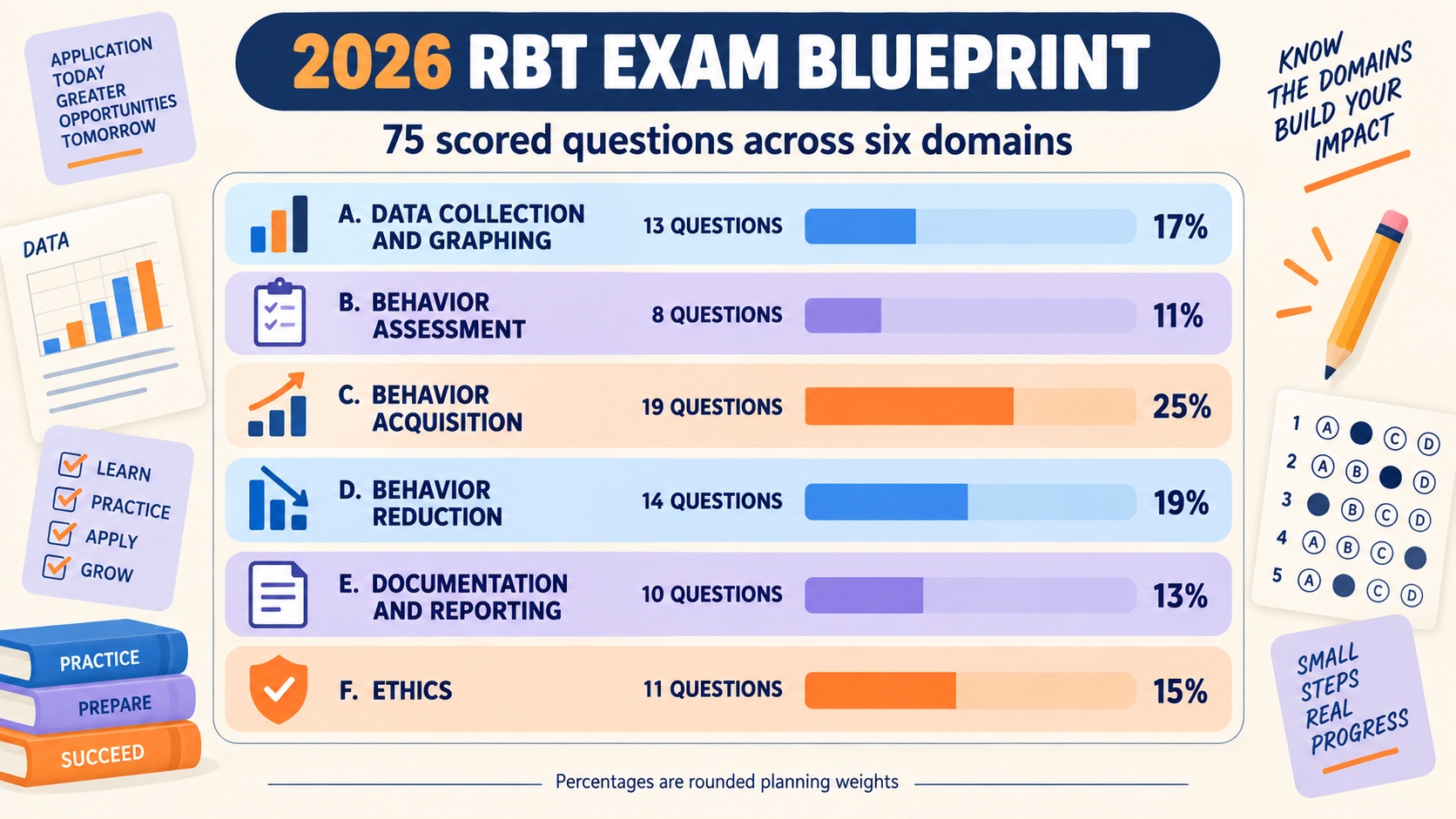
- A. Data Collection and Graphing: 13 questions, 17%. Review continuous and discontinuous measurement, permanent product, graph updates, observable definitions, calculations, trends, and the risk of unreliable data.
- B. Behavior Assessment: 8 questions, 11%. Review preference assessments, skill-strength and deficit assessments, and the RBT’s participation in components of functional assessment.
- C. Behavior Acquisition: 19 questions, 25%. Review reinforcement, conditioned reinforcers, discrete-trial and naturalistic teaching, chaining, discrimination training, prompting and fading, generalization, maintenance, shaping, and token economies.
- D. Behavior Reduction: 14 questions, 19%. Review objective definitions, replacement behavior, antecedent and consequence procedures, implementation of the written plan, and safe communication when a problem falls outside your role.
- E. Documentation and Reporting: 10 questions, 13%. Practice objective notes, data integrity, confidentiality, reporting concerns, and communicating information through the appropriate supervision structure.
- F. Ethics: 11 questions, 15%. Review dignity, privacy, professional boundaries, supervision, competence, accurate representation, and the RBT Ethics Code (2.0).
Coverage is not the same as a prediction. A mock exam should use the current blueprint to distribute practice responsibly, but it cannot know which specific items will appear on a future form. Beware of any page that presents its question list as a leaked preview or says it can tell you the exact live questions.
What makes a mock exam worth using?
Question count and a bold “pass first try” headline are easy to advertise. They are not enough to evaluate a practice product. Before you begin, look for the following signals.
Current edition and clear scope
The page should identify the RBT TCO (3rd ed.) and explain whether its sets are topic practice, mixed practice, or full-length rehearsal. A page that still organizes itself only around the old task-list language may need closer checking before you use it for 2026 preparation.
Original, role-appropriate scenarios
Good practice asks you to make decisions an RBT can actually make: collect data, follow a teaching or behavior-reduction plan, use trained procedures, document what occurred, protect confidentiality, and seek supervisor direction when needed. It should not ask you to independently diagnose, change a treatment plan, or make a clinical decision that belongs to another role.
Rationales that teach
An answer key that says only “B” cannot show whether you understood the item. Look for an explanation of the relevant concept, the evidence in the stem, and why the most tempting distractor is weaker. When two answers sound helpful, the rationale should explain which one stays within the described role and current plan.
Review and accessibility
A useful tool lets you revisit missed or flagged items, see domain tags, and record an error type. It should also be readable on a phone or laptop, avoid unnecessary motion, and make the next action obvious. Accessibility is not an extra feature for a mock exam; it affects whether the practice reflects your reasoning or the interface’s friction.
Most importantly, the product should state what it is not. The BACB says it cannot endorse specific study guides and that buying preparation materials does not guarantee passing. RBT examination content is confidential. A responsible practice site should never present questions as live, recalled, leaked, or reconstructed BACB content.
A three-pass practice workflow
Use the mock exam in stages rather than taking the longest form first.
- Pass one—learn. Choose a small topic set. Read every rationale, write down the distinction you missed, and return to your training notes or an independent theory explanation.
- Pass two—diagnose. Take a mixed set without domain labels if possible. Tag each item as a knowledge gap, discrimination error, application error, role-boundary error, documentation error, or pacing/careless error.
- Pass three—rehearse. Complete a full-length-style form under a 90-minute timer. Review it after a break, and compare your time checkpoints with your error log rather than looking only at the percentage.
Use delayed retry. If you answer a question and immediately repeat the same item until it feels familiar, your score may reflect memory of the wording rather than transfer of the skill. Wait, review the concept, and then answer a new scenario that requires the same decision.
Turn your score into an error log
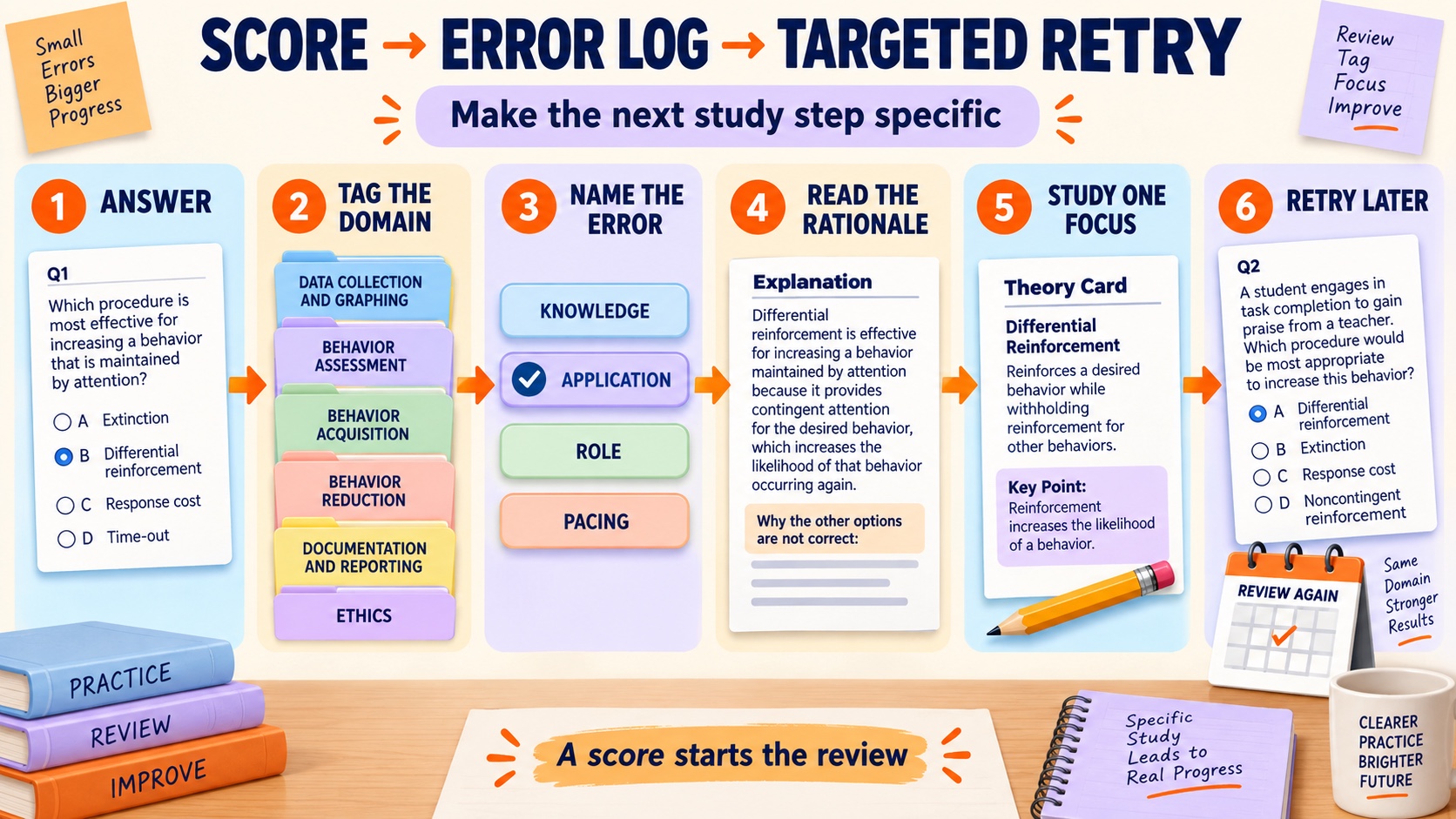
Imagine that Jordan scores 72% on a mixed diagnostic. Instead of immediately searching for a harder form, Jordan sorts the missed questions. Four involve measurement calculations, three involve prompt fading, two involve objective documentation, and one involves confidentiality. The pattern suggests several small study blocks rather than a complete restart.
Jordan writes one sentence for each missed item: “The scenario gives me ___, so the best answer is ___ because ___.” If the blank cannot be completed with evidence from the question, the issue may be reading or discrimination rather than a missing definition. After reviewing the relevant material, Jordan completes new questions in the same areas two or three days later.
Correct answers deserve review too when they were guesses. A guessed answer is a useful warning because the next version of the scenario may change one detail. Confidence should come from explaining the choice, not from recognizing a familiar phrase.
Choose your next practice step
Once you know whether you need a topic set, mixed diagnostic, or full rehearsal, choose a practice destination that makes the boundaries visible. Keep the official BACB materials, your 40-hour training, and competency-assessment materials as the foundation. Use independent practice to retrieve concepts, apply them to original scenarios, and review errors.
Ready for an original RBT mock-exam practice session?
Explore the ABA Study Online mock-exam area for structured RBT practice, domain-aware review, and explanations designed to turn missed questions into the next study step. These are original, unofficial learning materials—not BACB-endorsed or recalled questions—and they do not guarantee certification.
After the website mock exam, use short RBT practice questions to revisit one weak distinction, open the RBT theory path for explanation, and use the ABA Study Online app for spaced review. The mock exam remains a website practice destination; the app supports the review loop that follows it.
RBT mock exam FAQ
How many questions should a full RBT mock exam have?
The current examination has 85 total questions, including 75 scored and 10 unscored questions. A shorter set can still be valuable, but it should be described as a diagnostic or topic practice rather than a full-length rehearsal.
How long should I time a mock exam?
The current examination time is 90 minutes. Start untimed while learning, add mixed practice, and then use the 90-minute boundary for a full rehearsal when the review process is ready.
Can a mock-exam score predict whether I will pass?
No unofficial score can make that guarantee. Use the result to identify knowledge, application, role-boundary, documentation, and pacing gaps. The official BACB process and examination determine certification.
Are mock-exam questions the real BACB questions?
They should not be. BACB examination content is confidential. Responsible practice materials use original questions informed by public outlines and training concepts, not live, recalled, leaked, or reconstructed items.
Should I take a full mock exam every day?
Usually not. A full form can be useful for pacing, but daily repetition may create fatigue and wording familiarity. Alternate focused review, mixed sets, and occasional full rehearsals so the practice result remains informative.