RBT Meaning: What Registered Behavior Technician Really Means
RBT means Registered Behavior Technician. In the current Behavior Analyst Certification Board system, it is a paraprofessional certification in behavior analysis. RBTs assist in delivering behavior-analytic services under the direction and close supervision of an RBT Supervisor and/or RBT Requirements Coordinator who is responsible for their work.
That short definition answers the search, but it leaves out the distinctions that matter in practice. An RBT credential is not the same as a job title, a college course, or permission to practice independently. Training, an initial competency assessment, an examination, and ongoing supervision are related parts of the pathway, but they are not interchangeable. This guide separates those ideas and explains what the current 2026 exam language means.
What RBT stands for
RBT is the abbreviation for Registered Behavior Technician. The word “registered” does not mean that a person may provide any kind of healthcare service without limits. It identifies a certification administered through the BACB’s credentialing system. The current BACB RBT page describes the certification as paraprofessional and places the technician’s work inside a supervision structure.
You may see “RBT” in a clinic profile, job posting, session note, study guide, or conversation about ABA. Those uses are not automatically proof that a person currently holds the credential. A job may use the broader phrase “behavior technician,” while a certified RBT is expected to meet the applicable BACB requirements and maintain the credential. When credential status matters, use the current official records and employer process rather than guessing from a title.
The abbreviation also does not describe the whole field of applied behavior analysis. RBTs work as part of a service team. Their responsibilities depend on the procedures they have been trained and assessed to implement, the supervision arrangement, the client context, and applicable organizational or local requirements.
What an RBT does—and does not mean
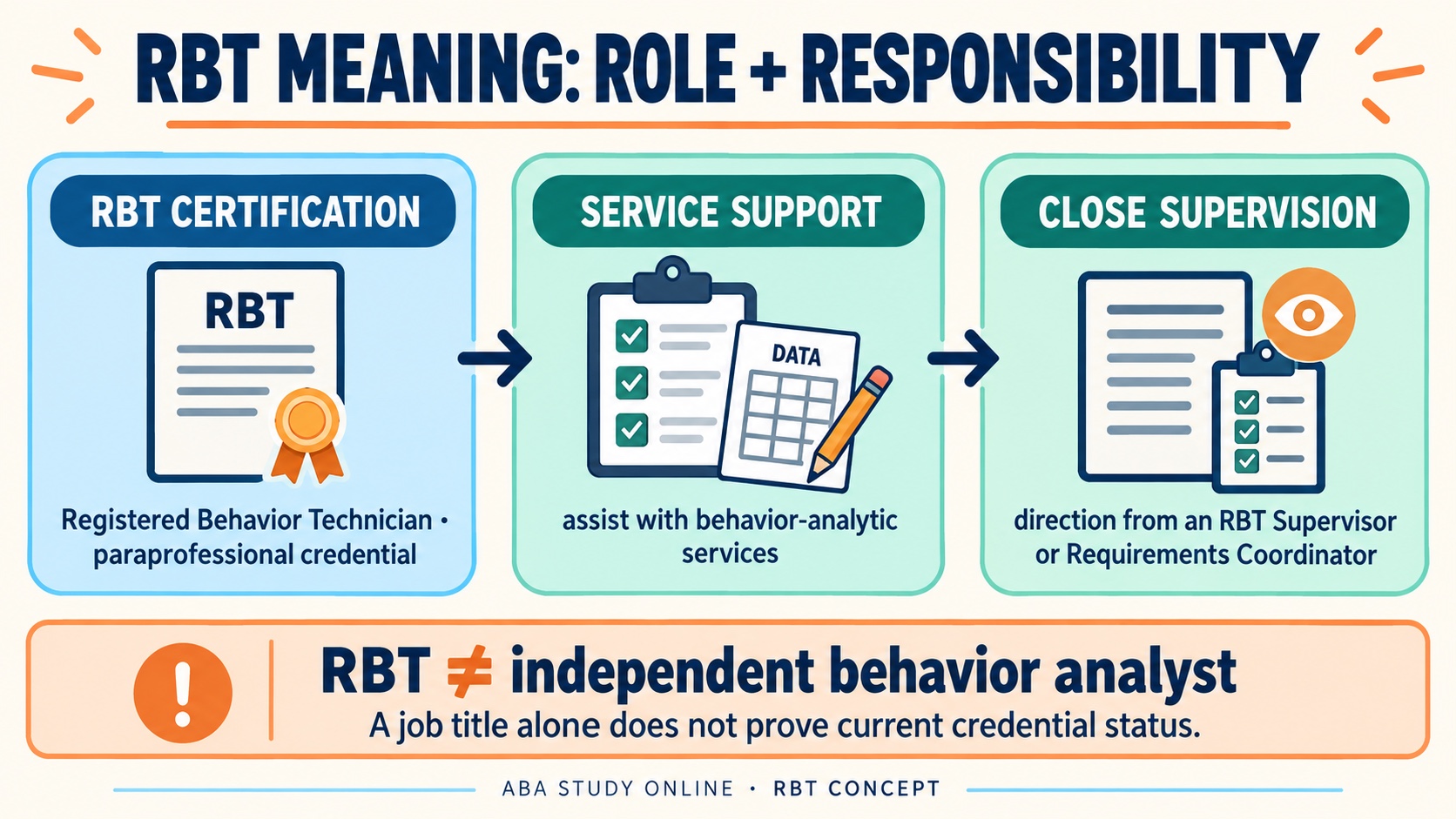
An RBT may implement behavior-analytic procedures that have been selected, taught, and overseen within the service team. Depending on the plan and setting, that can include collecting data, supporting skill-acquisition procedures, following behavior-reduction protocols, documenting sessions, communicating observations, and asking for feedback. The exact task is not determined by the three letters alone; it is determined by the current plan, training, competency, supervision, and workplace process.
Close supervision is part of the definition, not a footnote. The BACB’s current guidance says that RBTs practice under the direction and close supervision of an RBT Supervisor and/or RBT Requirements Coordinator. The current RBT Handbook also describes supervision and record expectations. If an RBT is not sure who is responsible for supervision, what can be implemented, or how a concern should be documented, the appropriate next step is to ask the responsible supervisor—not to improvise a new clinical procedure.
RBT does not mean “BCBA in training.” Some RBTs later pursue BCaBA or BCBA certification, but those are separate credentials with different education, fieldwork, examination, and supervision requirements. An RBT can build useful experience while remaining within the RBT role. Experience alone does not convert one credential into another.
RBT also does not mean “independent behavior analyst.” An RBT does not independently diagnose, design a complete behavior-analytic treatment plan, determine a client’s eligibility for services, or make a certification decision for someone else. Those boundaries protect clients and keep the service team clear about who is responsible for which decisions.
How training, assessment, examination, and supervision fit together
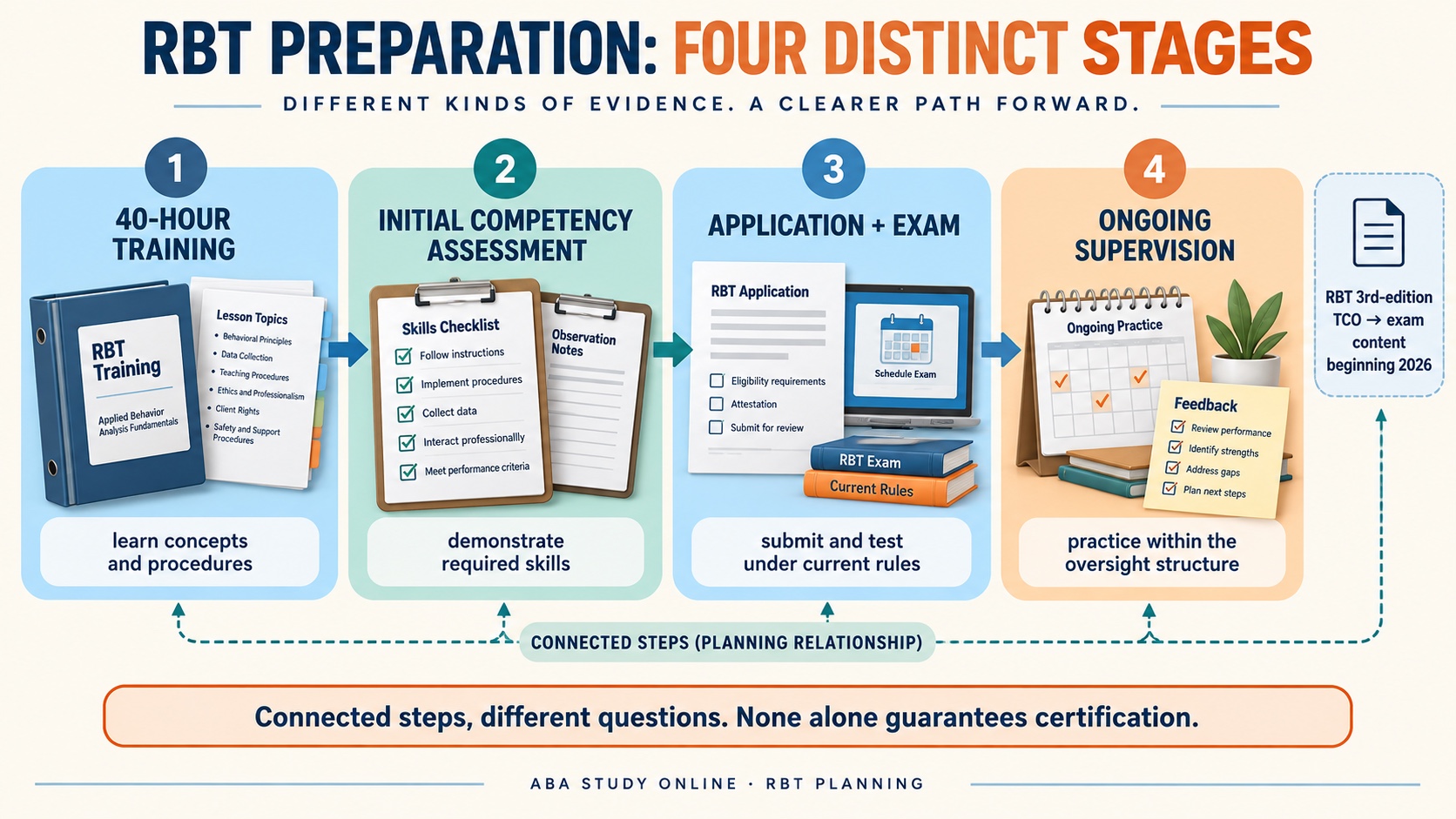
People often ask for the “RBT requirements” as if they were one test. A better mental model is to separate the questions each stage answers:
- Training: Have I completed the required instructional preparation and learned the relevant concepts and procedures?
- Initial competency assessment: Can I demonstrate the required skills under the current assessment process?
- Certification application and examination: Have I submitted the required materials and shown the knowledge measured by the current RBT examination?
- Ongoing supervision and maintenance: Am I practicing within the required oversight structure and keeping the credential in good standing?
These stages connect, but a completion certificate from a training course is not the same as a competency assessment, and a passing examination is not a substitute for ongoing supervision. The current handbook is the place to verify the requirements and timing that apply to an individual application. The BACB’s supervision guidance explains which roles can supervise, assess, or train RBTs under the current rules.
This distinction is useful for studying. If a learner misses a question about frequency recording, the next step may be a concept review. If a learner is unsure how to demonstrate a skill during an assessment, the next step may be supervised practice and feedback. If a learner has an application-status question, the next step belongs with the official application process. Calling all three problems “I need more flashcards” makes the plan less precise.
What the 2026 RBT exam update means
The RBT exam-content language changed for 2026. The current RBT Test Content Outline, 3rd edition, describes the content that appears on the RBT certification examination beginning January 1, 2026. The BACB’s outline page distinguishes the older RBT Task List, used through December 31, 2025, from the 3rd-edition Test Content Outline beginning in 2026.
“Third edition” refers to the exam content outline. It is not a new meaning of RBT and it is not a separate credential. The current outline organizes 43 tasks into six content areas: data collection and graphing, behavior assessment, behavior acquisition, behavior reduction, documentation and reporting, and ethics. The current handbook also describes an examination with scored and unscored questions and a 90-minute testing period. Check the live BACB handbook and examination information for the version and logistics that apply when you test.
For study planning, use the outline as a map rather than as a script to memorize. Start with the task family, create a plain-language explanation, connect it to a concrete example, and then ask what data or observation would show that the procedure was implemented correctly. The outline tells you the tested content boundary; your training and supervised practice help you make the content usable.
The BACB does not endorse a specific commercial study guide or guarantee that purchasing study materials will result in a passing score. A free explanation or practice question can support learning, but it should be labeled as original educational material, not official BACB exam content.
A practical example and checklist
Imagine Alex sees a clinic posting for an “RBT.” Alex has completed an introductory ABA course and has helped with classroom routines, so the acronym feels familiar. Before assuming that the job title proves eligibility, Alex asks four separate questions:
- What current BACB requirements apply to the certification application?
- Which approved training and initial competency-assessment process will document preparation?
- Who will be the RBT Supervisor or RBT Requirements Coordinator responsible for the work?
- Which current Test Content Outline should guide examination study?
Alex then keeps two notes: one for official requirements and one for personal study actions. The official note links to the current RBT Handbook and relevant BACB pages. The study note might say, “Review continuous versus discontinuous measurement, explain one example aloud, and bring questions to the supervisor.” That separation prevents a convenient study checklist from quietly becoming a certification rule.
Use this quick meaning check whenever you see the acronym:
- RBT expands to Registered Behavior Technician.
- It is a paraprofessional behavior-analysis certification, not just a casual job label.
- The role includes direction and close supervision.
- Training, competency assessment, examination, and ongoing supervision are separate stages.
- The current 2026 exam map is the RBT 3rd-edition Test Content Outline.
- Current BACB guidance and applicable local rules control when a summary is incomplete.
For related study, open the RBT Theory Blocks on ABA Study Online, try the free RBT practice questions, or look up a term in the ABA Definition Search. These destinations can help you learn the language behind the role without pretending to replace official certification instructions.
Common mistakes and FAQ
What does RBT stand for? Registered Behavior Technician.
Is an RBT the same as a BCBA? No. RBT is a paraprofessional certification and role. BCBA is a separate graduate-level certification with a different scope and pathway.
Can an RBT work without supervision? The current BACB description places RBT practice under the direction and close supervision of an RBT Supervisor and/or RBT Requirements Coordinator. Check the current handbook and applicable local requirements for the details that apply to your setting.
Is the RBT exam the same as the competency assessment? No. The written examination measures knowledge through the current exam process. The initial competency assessment is a separate demonstration and evaluation process.
What is the RBT 3rd edition? It is the current RBT Test Content Outline for examination content beginning January 1, 2026. It does not rename the credential or create a new level of RBT.
Does taking an RBT course make someone an RBT? No. A course is one part of preparation. The current BACB requirements, application, competency assessment, examination, and maintenance rules determine the certification process.
The simplest accurate meaning is this: an RBT is a trained and credentialed behavior technician who supports behavior-analytic services within a defined supervision system. Learn the term, then verify the current source before turning it into a requirement or a practice decision.