RBT License: Is It a License or a BACB Certification?
If you searched for RBT license, you may be trying to answer a very practical question: what credential do I actually need before I can work as a Registered Behavior Technician? The wording matters because the BACB describes RBT as a paraprofessional certification. A state behavior-analyst license, an employer’s onboarding requirement, and BACB certification are related ideas, but they are not automatically the same document.
This guide separates those routes and gives you a current 2026 checklist for deciding what to verify next. It does not determine your eligibility or interpret the law in a particular state. Use the current BACB RBT Handbook for certification requirements, then check the regulator, payer, employer, and service setting that apply to your situation.
Table of Contents
Short answer: what people mean by RBT license
There is a BACB RBT certification pathway. “RBT license” is commonly used as informal shorthand, but the BACB’s own materials call the credential an RBT certification. Whether a state, payer, employer, or service setting adds another requirement is a separate question that must be checked locally.
The cleanest way to route the question is to name the document or decision-maker. If the request comes from the BACB, look for the RBT Handbook, certification application, competency assessment, examination, or maintenance instructions. If it comes from a state agency, look for the agency’s behavior-analysis or professional-licensure rules. If it comes from an employer, ask which credential, supervisor relationship, background check, training record, and local onboarding documents the position requires.
That distinction prevents a common error: treating a 40-hour course certificate as if it were the final credential. Training is one eligibility component. The current route also separates competency assessment, application, examination, and ongoing supervision or maintenance.
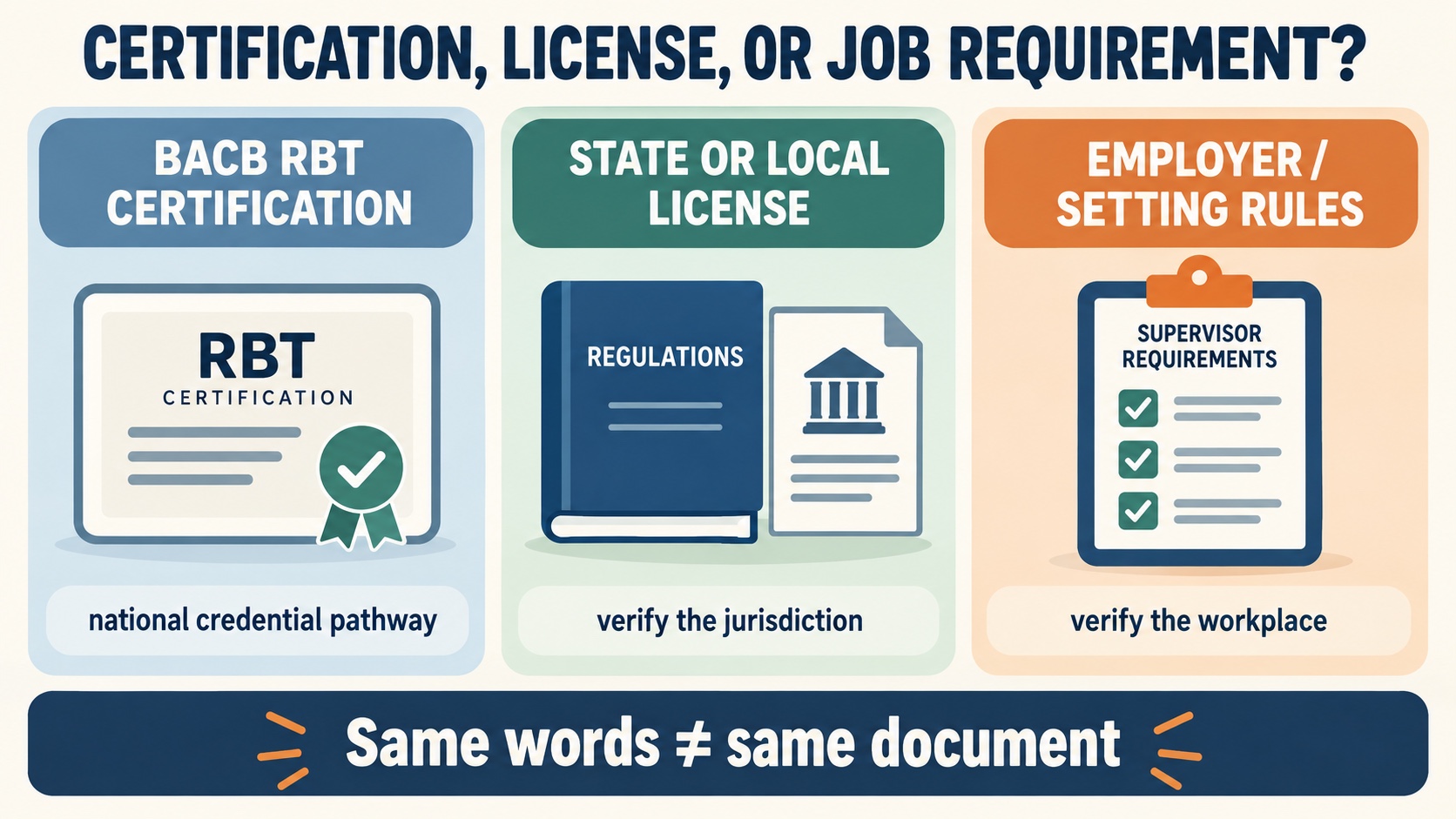
Three different requirements that get mixed together
Use this comparison as a routing tool, not as a universal legal checklist. The exact state and workplace rules depend on where and how services are delivered.
| Question | What it usually points to | Where to verify |
|---|---|---|
| Who issues the credential? | BACB RBT certification | Current BACB RBT page and Handbook |
| Who regulates professional practice in a jurisdiction? | A state or other local regulator, if a separate license or registration applies | Current government or regulatory source for that jurisdiction |
| What must I bring to a particular job? | Employer, payer, school, clinic, or service-setting requirements | Written job and onboarding instructions |
| What lets me use the RBT title? | Active certification status and compliance with applicable rules | BACB account/status information and current local requirements |
The table also explains why a page promising one universal “RBT license application” can be misleading. A state license page may be about a behavior analyst or assistant behavior analyst rather than an RBT. Conversely, an employer may use “license” casually when it really wants proof of an active BACB certification, supervision arrangement, or background screening.
What the current 2026 RBT route includes
The full step-by-step route belongs on the site’s how to get RBT certified guide. For this terminology question, the important point is that the credential is a sequence of separate checkpoints:
- Eligibility: the current Handbook describes age and education requirements plus the applicable criminal-background and abuse-registry checks.
- Training: applicants applying under the 2026 requirements complete at least 40 hours that meet the current curriculum and timing rules. The training must be completed over no fewer than 5 days and no more than 180 days.
- Initial Competency Assessment: after training, the applicant demonstrates entry-level competence using the current assessment packet. This is not the same as a course quiz.
- Application: the applicant creates or uses a BACB Portal account and submits the application and required records, including the current training and assessment documents.
- Examination: after the application receives an approved determination, the applicant follows the instructions to schedule and take the BACB RBT examination.
- Supervised practice and maintenance: an RBT works under the direction and close supervision of an RBT Supervisor and/or RBT Requirements Coordinator, and the credential must be maintained under the current rules.
Because the requirements and forms are date-sensitive, avoid building a personal checklist from an old blog post or a course sales page. The BACB’s current RBT page identifies the June 2026 Handbook and related 2026 resources as the place to start. If an older source says “Task List” or omits the current competency and maintenance changes, treat it as a prompt to verify, not as the final answer.
What RBT certification does and does not mean
The BACB defines RBT as a paraprofessional certification in behavior analysis. The role is connected to delivering behavior-analytic services, but it is not the same as becoming a BCBA, BCaBA, licensed behavior analyst, or independent clinician. The RBT works under the direction and close supervision of the responsible supervising professionals identified by the current BACB rules.
That boundary matters when a job description uses broad words such as “therapist,” “behavior specialist,” or “licensed technician.” Ask what duties are actually expected. An RBT may implement parts of a plan and collect or document information within the assigned role, but certification alone does not authorize independent diagnosis, independent treatment-plan design, or decisions that belong to a qualified supervisor or licensed professional under applicable law.
It also matters for study materials. Practice questions, flashcards, teaching tools, or an app can help you learn the concepts behind measurement, assessment, behavior acquisition, behavior reduction, documentation, and ethics. They cannot issue an RBT certification, sign an Initial Competency Assessment, approve an application, or replace supervision.
How to verify what a job or course is asking for
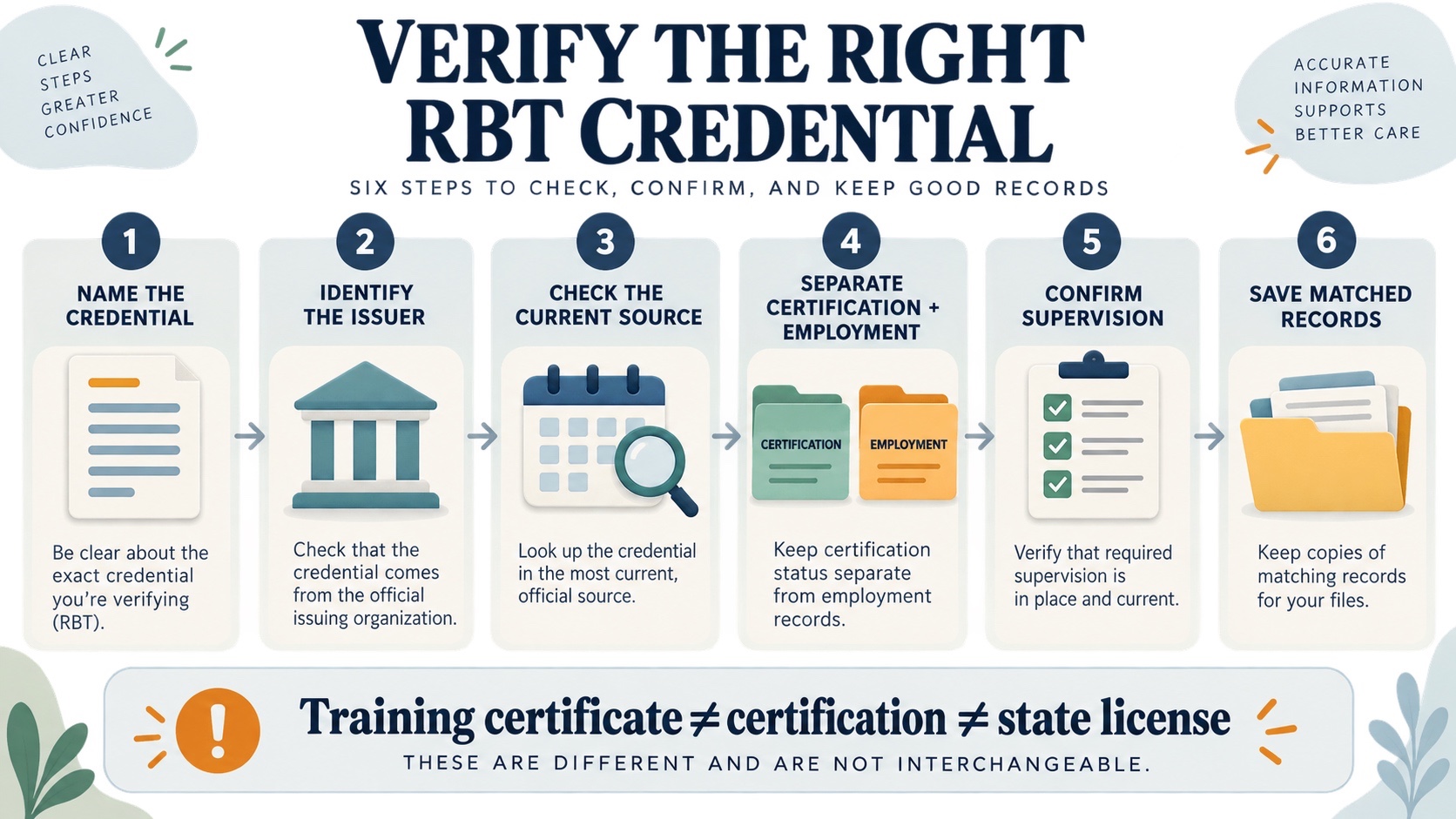
When someone says “you need an RBT license,” use this short verification sequence before paying for a course or submitting a document:
- Ask for the exact credential name. Is the request for BACB RBT certification, a state license, a registration, a background check, an NPI, or an employer-specific document?
- Identify the issuer. BACB, a state agency, a payer, a school district, and a private employer do not issue the same type of approval.
- Check the current source date. For BACB certification, begin with the current RBT Handbook and current application forms. For state rules, use the regulator’s own site.
- Separate eligibility from employment. A person can meet a BACB certification requirement and still need employer onboarding, local screening, or setting-specific documentation.
- Confirm the supervision plan. Ask who will supervise the work, what the role includes, how records are kept, and what happens if the supervisor changes.
- Keep the documents matched to the route. Training certificate, competency assessment, application approval, exam result, active status, and local license—if one applies—should not be treated as interchangeable proof.
Common mistakes
- Calling the BACB credential a state license. Use the name BACB uses: RBT certification.
- Assuming the 40-hour course is certification. Training is one component; it does not replace assessment, application, examination, or maintenance.
- Using an old checklist. The 2026 route and documents should be checked against the current Handbook.
- Assuming certification permits independent work. The RBT role remains tied to direction and close supervision.
- Applying for the wrong state credential. A state page about behavior-analyst licensure may not be an RBT route.
RBT license FAQ
Is an RBT a licensed professional?
The BACB describes RBT as a paraprofessional certification. Whether a separate state or setting requirement applies is jurisdiction- and role-specific. Do not use the BACB certification label as a substitute for checking local rules.
Does an RBT need a license to work?
There is no single answer that covers every state, employer, payer, or service setting. Start with the current BACB certification requirements, then ask the employer and the applicable regulator what additional documents are required for the specific role.
Is an RBT certificate the same as an RBT license?
No. A training or completion certificate proves that a course or training requirement was completed. BACB certification is a separate credential with an application, examination, supervision, and maintenance process. A state license or employer document, if applicable, is another separate route.
Can ABA Study Online provide an RBT license?
No. ABA Study Online can provide independent study explanations, practice, and tools. It does not issue BACB certification, state licensure, competency-assessor sign-off, or an employment authorization.
Official sources and study links
For the certification decision, read the BACB RBT page, the current RBT Handbook, the BACB Examination Information page, and the Recent and Upcoming Changes page. For study support, the RBT learning path, RBT practice questions, and ABA Definition Search can help you review concepts. They are learning resources, not certification or licensure decisions.