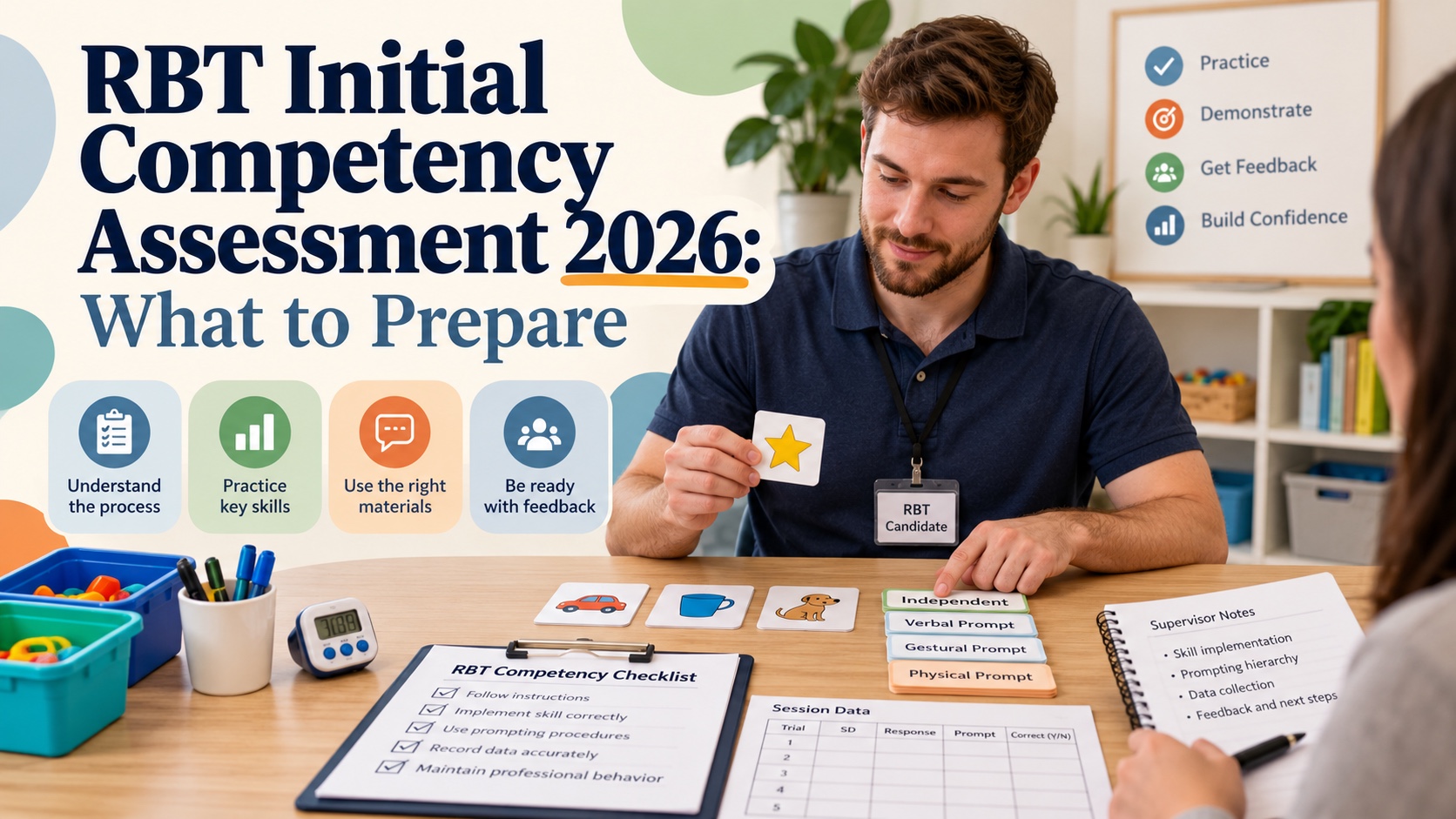
RBT Initial Competency Assessment 2026: What to Prepare
The 2026 RBT Initial Competency Assessment is a practical checkpoint for people pursuing RBT certification. It is not simply another vocabulary quiz. Preparation should focus on demonstrating the skills, procedures, data habits, and professional conduct described in the current BACB materials.
Use the current BACB packet and RBT Handbook as the authority. A study article, video, flashcard set, or practice worksheet can help you rehearse. It cannot conduct the assessment, decide that you are competent, or replace the responsible assessor’s judgment.
What the assessment is checking
In plain language, the assessment asks whether you can carry out important RBT-related tasks in a way that is observable, accurate, and consistent with the written plan. The current packet should determine the exact tasks, materials, criteria, and assessor instructions. Do not use a third-party summary as a replacement for that packet.
A strong preparation question is, “What would another trained observer need to see?” That moves study away from vague confidence and toward actions: setting up materials, presenting an instruction, implementing a prompting procedure, delivering a programmed consequence, collecting data, protecting confidentiality, and responding professionally when something is unclear.
Four preparation areas
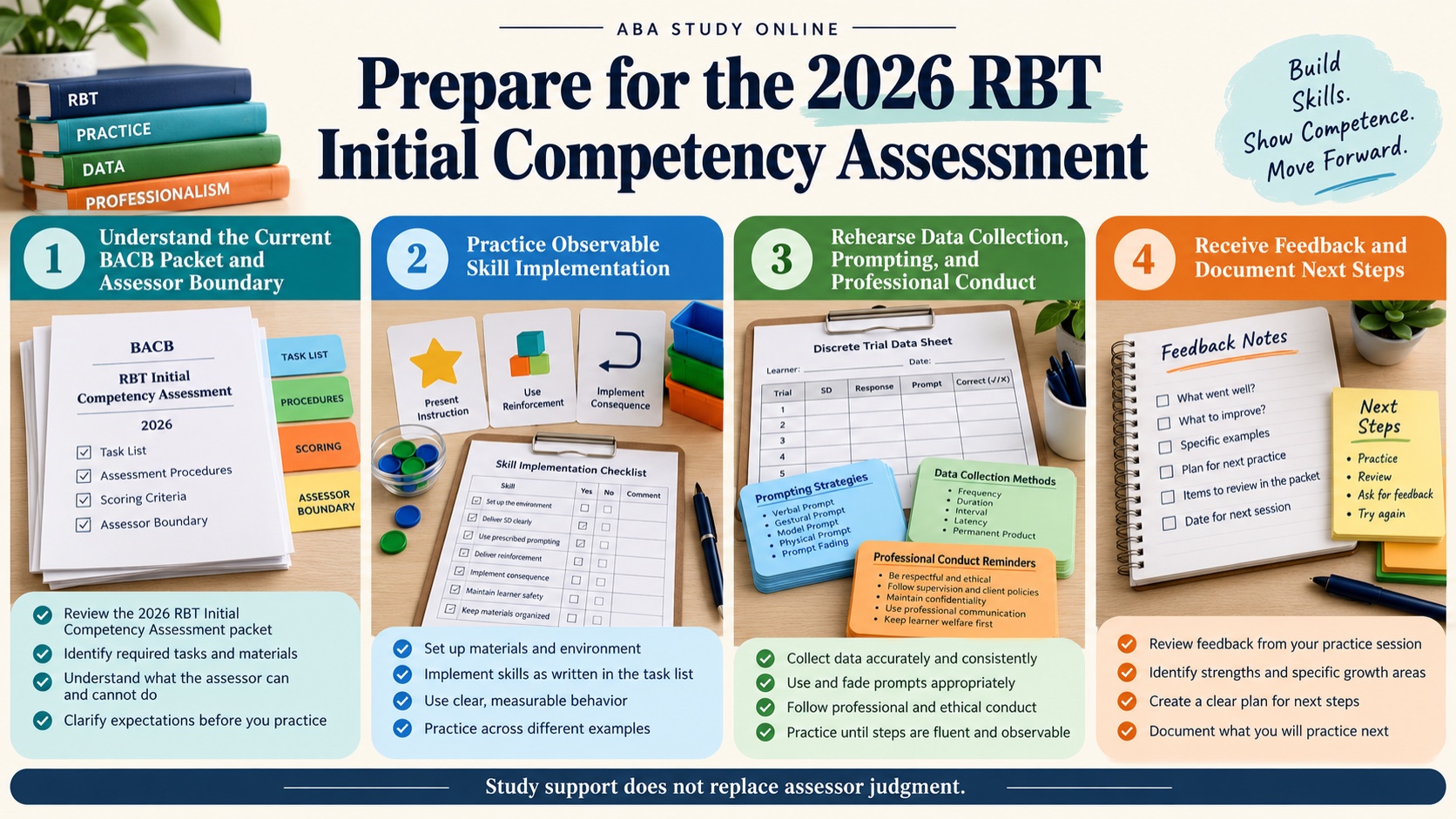
- Understand the current packet. Read the 2026 Initial Competency Assessment Packet and note the tasks, materials, scoring language, and assessor boundary. Highlight what must be demonstrated versus what must be explained.
- Practice observable implementation. Rehearse following instructions, arranging materials, delivering prompts as written, using reinforcement according to the plan, and maintaining a safe learning environment. Practice slowly first, then build fluency.
- Rehearse measurement and documentation. Practice the data system named by the program. Know what starts and stops an observation, how a response is counted, and how to record a missed step without guessing.
- Use feedback. Ask a qualified supervisor or assessor what was clear, what needs improvement, and what to rehearse next. Feedback should produce a specific practice action, not just a general confidence rating.
How to practice without pretending
Break each task into a small performance chain. First identify the instruction or setup. Then name the learner response you are watching for, the prompt level allowed by the plan, the consequence that follows, and the data entry you will make. After the rehearsal, write what actually happened. This structure makes it easier to spot whether the problem was preparation, implementation, measurement, or communication.
Use role-play carefully. A practice partner can help you check materials, timing, prompt delivery, and data recording. The partner should not tell you that you have passed an official assessment unless they are the responsible assessor operating within the current requirements. Practice is valuable because it reveals what to improve, not because it creates a private substitute credential.
For prompting, rehearse the hierarchy named by the program and the plan for fading prompts. For reinforcement, identify the programmed consequence and watch whether the target response changes over time. For data, practice recording the same response rule repeatedly. For professionalism, rehearse how you will ask for clarification when you do not know what to do.
One useful rehearsal is to narrate the procedure before you start: “I will arrange the materials, deliver the instruction, wait for the defined response, provide the programmed prompt if needed, deliver the planned consequence, and record the result.” The narration is not something to recite during the assessment unless requested. It is a private way to find missing steps before the performance becomes automatic.
Practice objective language as well. Instead of writing “the learner was uncooperative,” record the instruction, the observable response, the prompt delivered, the consequence, and the data. If you do not know whether an event belongs in the record, mark the uncertainty and ask for direction. Accurate uncertainty is safer than confident invention.
Assessor and supervision boundary
The BACB’s current materials identify the assessor and supervision responsibilities. A study website can explain terms and provide practice situations, but it cannot sign the packet or determine competency. An RBT candidate should not alter a client’s plan, invent a data rule, or practice an unapproved procedure simply to make a demonstration look successful.
If the task, setting, or instruction is unclear, ask the supervisor or assessor. If a procedure appears unsafe, follow the safety and reporting process. A professional answer is often not “guess and continue.” It may be “pause, protect the learner, document the relevant fact, and seek direction.”
The assessment is also a chance to notice your own performance conditions. Do you lose a step when materials are out of order? Do you forget to start the timer? Do you need a clearer written prompt hierarchy? These are practical study findings. Turn each one into a small rehearsal goal and check it again after a delay instead of trying to fix everything in one long session.
Keep the practice respectful and realistic. The goal is not to perform a theatrical demonstration or to make the learner fit the worksheet. The goal is to implement the specified skill accurately, respond to the learner’s behavior, protect dignity and safety, and communicate with the supervising professional. That mindset helps connect technical fluency with responsible service.
Before the appointment, confirm logistics with the assessor: which packet version applies, what materials are expected, how feedback will be given, and what to do if a task is unclear. Those questions are not signs that you are unprepared. They are part of using the current process responsibly and protecting the learner during practice with clear expectations before you begin and afterwards, as planned, with everyone informed before the session starts.
Common preparation mistakes
- Studying only definitions and never rehearsing observable actions.
- Practicing a procedure from an old packet without checking the 2026 source.
- Changing prompts, consequences, or measurement rules during practice without documenting the change.
- Confusing a smooth role-play with assessor approval.
- Ignoring professional conduct, confidentiality, or the supervision boundary.
- Collecting a score without writing the next practice step.
Use the ABA Study Online RBT learning path for concept review, the RBT questions for scenario retrieval, and the definition search when a term needs another explanation. Keep the 2026 BACB packet and handbook beside those resources.
FAQ
Is the 2026 RBT Initial Competency Assessment an exam?
It is a practical competency assessment, not simply a multiple-choice study quiz. The current BACB packet determines the tasks and assessment requirements.
Can an online course complete the assessment for me?
No. Online study can help you prepare, but a responsible assessor must conduct and document the assessment under the current requirements.
What should I bring to practice?
Use the materials, checklist, data system, and procedure identified by the current packet and your supervisor. Avoid inventing a universal practice kit that may not match your assessment context.