Free RBT Practice Exam: How to Study With the 2026 Format
Searching for a free RBT practice exam usually means you want to try questions before paying for a resource or scheduling the Registered Behavior Technician examination. That is a sensible first step, but a practice set should do more than display a percentage. It should use the current RBT content outline, explain the reasoning behind each answer, and show you what to review next.
The current 2026 RBT exam context is based on the RBT Test Content Outline (3rd ed.). A free online practice test is not a BACB exam and cannot guarantee a passing result. It is an unofficial learning tool. This guide explains the current format, what to look for in a useful free practice experience, and how to turn a weak result into a calmer study plan.
Quick answer: a free RBT practice exam can help you rehearse multiple-choice decisions, check your coverage of the six current content domains, and identify what to study. It cannot establish eligibility, reproduce secure BACB questions, or predict your official result. Use the current RBT TCO and Handbook as your authority, then use practice questions to test your understanding.
The current 2026 RBT exam format
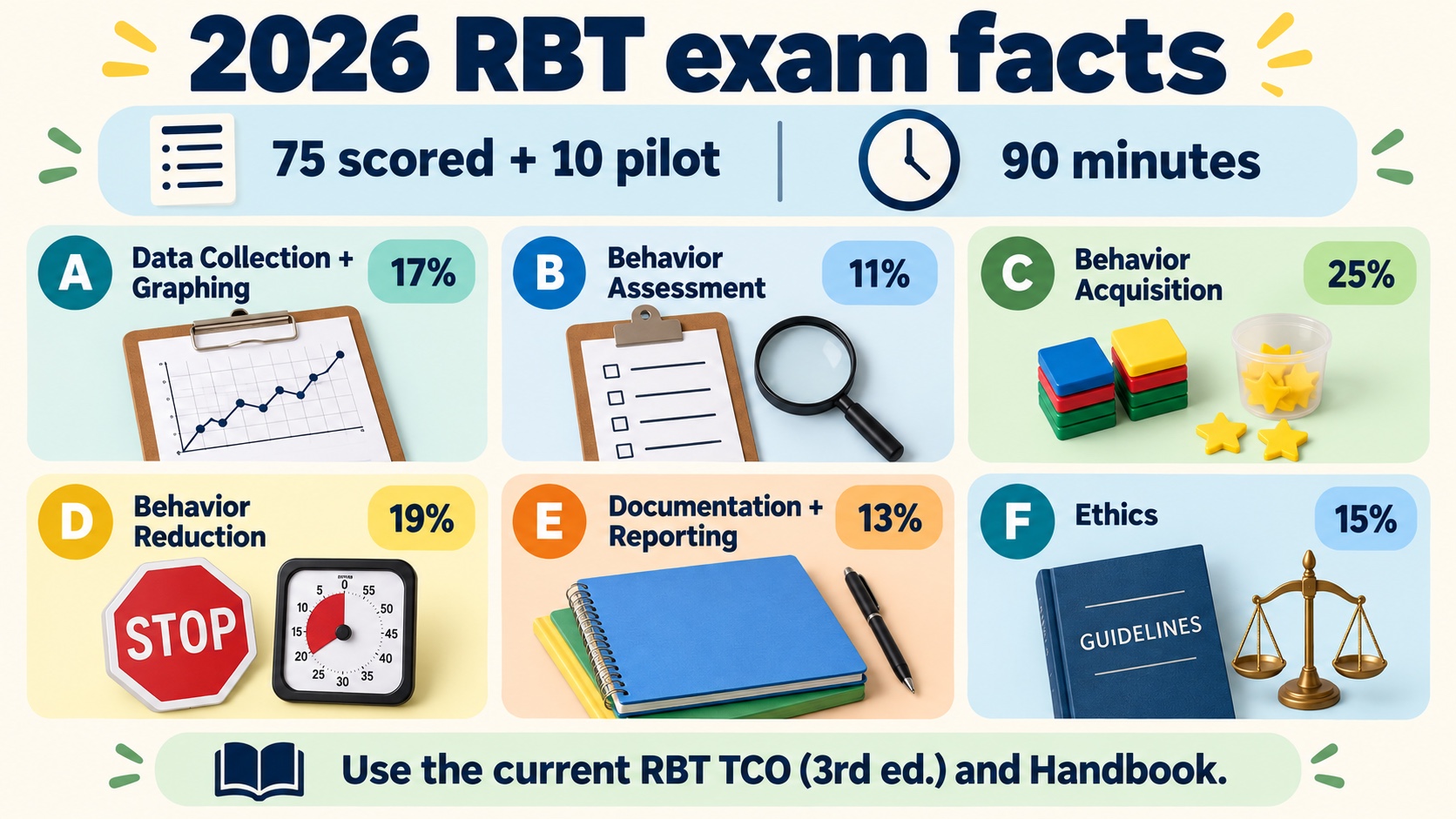
The RBT Test Content Outline (3rd ed.) describes the content that appears on the RBT certification examination beginning in 2026. It contains 43 tasks organized into six domains:
- A. Data Collection and Graphing: 13 questions, or 17% of the scored blueprint.
- B. Behavior Assessment: 8 questions, or 11%.
- C. Behavior Acquisition: 19 questions, or 25%.
- D. Behavior Reduction: 14 questions, or 19%.
- E. Documentation and Reporting: 10 questions, or 13%.
- F. Ethics: 11 questions, or 15%.
The TCO describes 75 scored questions and 10 unscored pilot questions. The current RBT Handbook says candidates have 90 minutes, each question has four possible answers with one correct answer, and the examination result is based on overall performance rather than a separate passing result for each content domain. That is why a practice site may offer an 85-question full simulation while still showing a domain breakdown for learning.
Keep two ideas separate: the practice format and the official exam facts. A free 25-question quiz can be useful for a quick warmup. An 85-question set can rehearse stamina and pacing. Neither becomes official simply because it uses a timer, labels itself “realistic,” or reports a percentage.
What to look for in a free practice test
Many search results promise a free RBT mock exam, instant results, no sign-up, or a full-length simulation. Those features can make a resource convenient, but convenience is not the same as quality. Before trusting the result, check the following:
- Current outline alignment. The page should identify the RBT TCO edition or the effective year. A resource that still uses older task-list language may not cover the 2026 exam context accurately.
- Coverage across all six domains. Practice should include measurement and graphing, assessment, acquisition, reduction, documentation and reporting, and ethics. A quiz about reinforcement alone is not a complete RBT practice exam.
- Clear, original questions. The provider should present independent practice items, not claim access to live BACB questions or encourage users to share secure content.
- Useful rationales. An explanation should show why the selected answer fits the facts and why the closest alternatives do not. A green checkmark without reasoning is weak feedback.
- Transparent scoring. The page should tell you how many questions you answered and whether the number is a learning score, a timed score, or a domain estimate. It should not imply that an unofficial percentage is the BACB passing standard.
- Respect for scope and supervision. Questions should not teach an RBT to invent procedures, change a behavior plan independently, or make clinical decisions that belong with a qualified supervisor.
Be careful with claims such as “exactly like the real test,” “guaranteed pass,” or “official questions.” The BACB’s RBT Handbook states that the Board does not endorse specific study guides or preparation materials and that purchasing preparation materials does not guarantee passing. A trustworthy free resource should make that boundary easy to see.
Short quiz or full simulation?
Choose the practice length based on the learning job. A short set is often better when you are learning a distinction for the first time. It gives you enough items to see a pattern without turning early practice into an endurance test. Use a longer set after you have reviewed the content and want to rehearse switching domains and maintaining attention.
A useful sequence is:
- Warmup: 10–25 original questions with immediate explanations.
- Focused review: a small domain set for the area that produced repeated errors.
- Mixed practice: questions from all six domains so you must identify the relevant concept before answering.
- Full simulation: a longer timed session, with breaks and device conditions chosen to rehearse your intended study routine.
Do not compare scores from different formats as if they were identical measurements. A 90% on ten familiar vocabulary questions and a 72% on a new mixed set answer different learning questions. Record the format, timing, question source, and whether you reviewed answers during the attempt.
A four-step practice and review loop
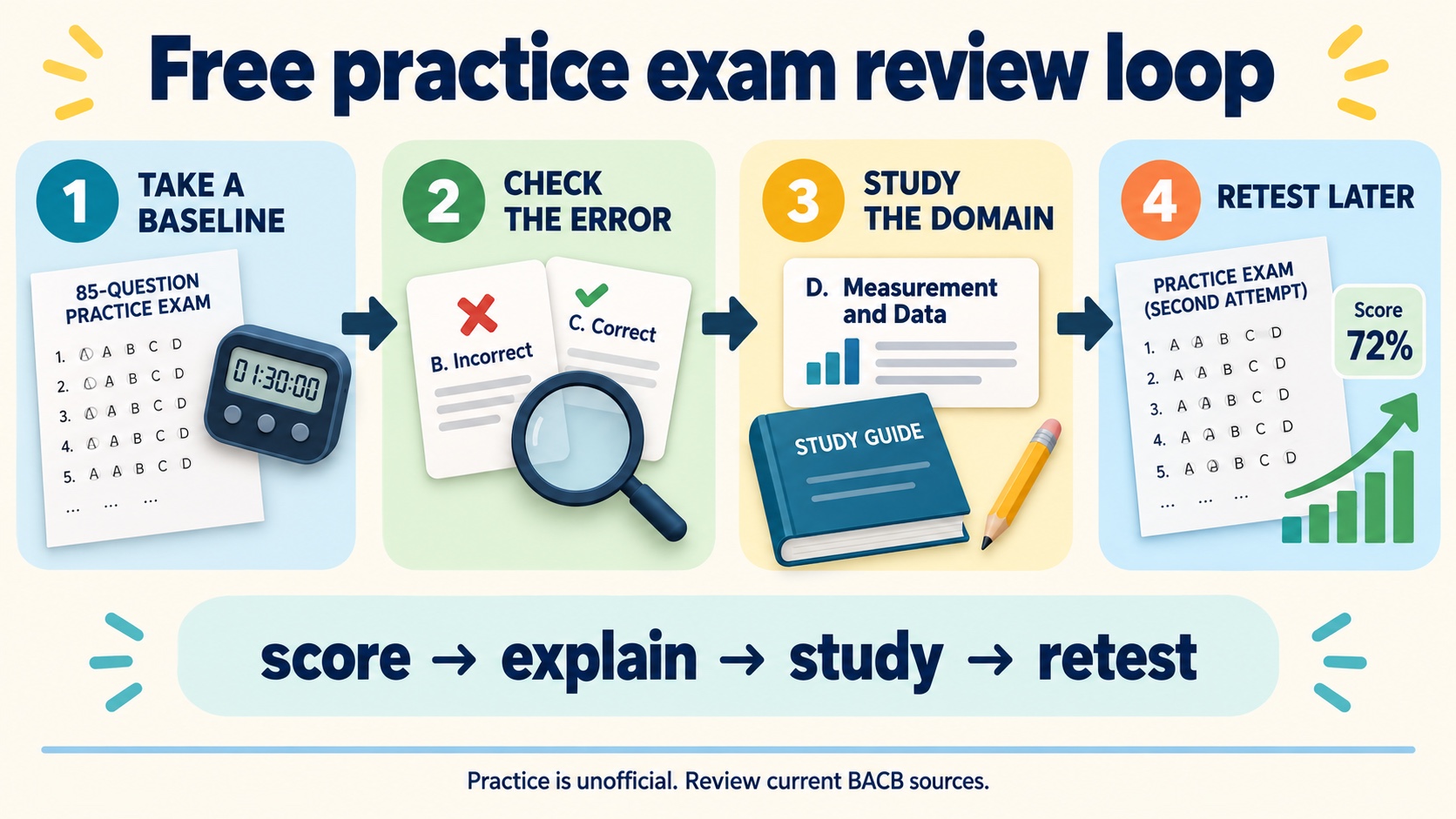
Use every free practice exam as one part of a loop:
- Take a baseline. Choose a defined number of questions. Commit to each answer before reading the explanation, and mark your confidence as low, medium, or high.
- Check the error. For each missed or low-confidence item, write what attracted you to your answer and the fact that should have changed your decision. Tag the item A through F.
- Study the domain. Return to the relevant TCO task, training material, supervisor instruction, or approved study note. Build a new example rather than copying the old answer.
- Retest later. Use a new question set after a delay. Look for improvement in explanation quality and transfer, not only a higher number.
How to learn from missed questions
Suppose a question describes a learner who starts a task one minute after an instruction. You choose duration because the scenario includes a time interval. The better answer may be latency, because the item is asking about the time from the instruction to the beginning of the response. The correction is not just “memorize latency.” Write the contrast: latency begins with the instruction and ends when the response starts; duration describes how long the response lasts. Then solve a new example with different facts.
For a behavior-acquisition item, ask what the RBT is supposed to implement and what the plan says. If a learner does not respond independently, the best next step may involve following the assigned prompting and fading procedure rather than inventing a new teaching sequence. Questions about reinforcement, chaining, discrimination, generalization, and maintenance should be reviewed through the written procedure and supervisor direction.
For behavior-reduction questions, identify the function, the replacement behavior, and the intervention that has actually been authorized. An RBT practice answer should not imply that a technician independently conducts a functional analysis, changes a treatment plan, or uses a restrictive procedure without training and supervision. For documentation and ethics items, look for objective reporting, timely communication, confidentiality, competence, cultural responsiveness, and the limits of the RBT role.
Also review correct answers that felt uncertain. A lucky selection can become a later error if the scenario changes. Write one sentence for the rule, one for the facts, and one for the closest distractor. That is more durable than storing the letter “B.”
Common mistakes to avoid
- Using an old edition without noticing: check for the RBT TCO (3rd ed.) and the 2026 effective context.
- Calling an unofficial test official: a free practice page is not issued or endorsed by the BACB.
- Chasing a magic pass percentage: use the score as study evidence, not a prediction or guarantee.
- Studying only definitions: RBT decisions also involve procedures, data quality, documentation, ethics, and supervision.
- Ignoring explanations: the rationale is where a wrong answer becomes a teachable distinction.
- Changing procedures independently: follow the assigned plan and seek clinical direction when the plan does not answer the situation.
- Sharing supposed live questions: protect examination security and use original practice material.
FAQ
How many questions are on the RBT exam?
The current RBT TCO describes 75 scored questions and 10 unscored pilot questions. The current RBT Handbook says candidates have 90 minutes. A practice site may use an 85-question simulation to represent the total testing experience; that does not make the practice exam official.
Is a free RBT practice exam official?
No. Free online practice tests are independent study resources. Use the BACB RBT TCO and Handbook for current exam facts, requirements, and preparation boundaries.
What should I do if my free practice score is low?
Do not simply repeat the same quiz. Tag the missed items by domain and error type, review the relevant task and training material, create a new example, and retest later with different questions.
Does a practice score predict whether I will pass?
No. Independent questions vary in wording, difficulty, coverage, and quality. A practice score is evidence from one study condition, not a BACB result or guarantee.
Where can I verify the current RBT exam content?
Start with the RBT Test Content Outline (3rd ed.), the RBT Handbook, and the BACB’s RBT resource page. If a study site makes a newer or different claim, compare it with those current sources.