RBT Exam Study Materials: How to Choose a Current 2026 Stack
Searching for RBT exam study materials can quickly become a shopping problem. One page offers a study guide, another sells flashcards, another promises realistic practice exams, and an app adds progress tracking or short videos. More resources do not automatically create better preparation. The better question is what each material helps you do, whether it matches the current examination content, and how you will use the feedback.
This guide gives you a practical way to audit and combine materials. It keeps the official BACB sources separate from independent study aids, and it keeps studying separate from the 40-hour training, Initial Competency Assessment, supervision, application, and certification decision. ABA Study Online provides independent educational explanations and practice; it is not BACB content, an endorsement, or a pass guarantee.
Quick answer: Start with the current RBT Test Content Outline (3rd ed.), the current RBT Handbook, the RBT Ethics Code, and the materials gathered from your qualifying 40-hour training and Competency Assessment. Then choose independent resources according to your gap: a guide or video for explanation, flashcards for retrieval, practice questions for application, a mock exam for pacing, and a workbook or error log for repair. You do not need to buy every format, and no study material can guarantee a passing result.
Keep the exam numbers together: the current RBT examination includes 75 scored questions and 10 unscored questions, for 85 questions total, with four answer choices and 90 minutes. The six domain percentages help you plan attention; they are not six separate passing thresholds.
Start with the official source layer
The official source layer answers questions that a commercial product should not answer for you. The BACB’s current RBT materials identify the RBT Test Content Outline (3rd ed.) as the examination content beginning in 2026. The BACB page also distinguishes the older RBT Task List (2nd ed.), which applied through December 31, 2025. A resource may still explain useful ABA vocabulary while using old labels, but you should not let an old outline control your current exam plan.
Save the current TCO where you study and use it as an audit map. It contains 43 tasks across six domains:
- A. Data Collection and Graphing: 13 questions, about 17% when rounded.
- B. Behavior Assessment: 8 questions, about 11%.
- C. Behavior Acquisition: 19 questions, about 25%.
- D. Behavior Reduction: 14 questions, about 19%.
- E. Documentation and Reporting: 10 questions, about 13%.
- F. Ethics: 11 questions, about 15%.
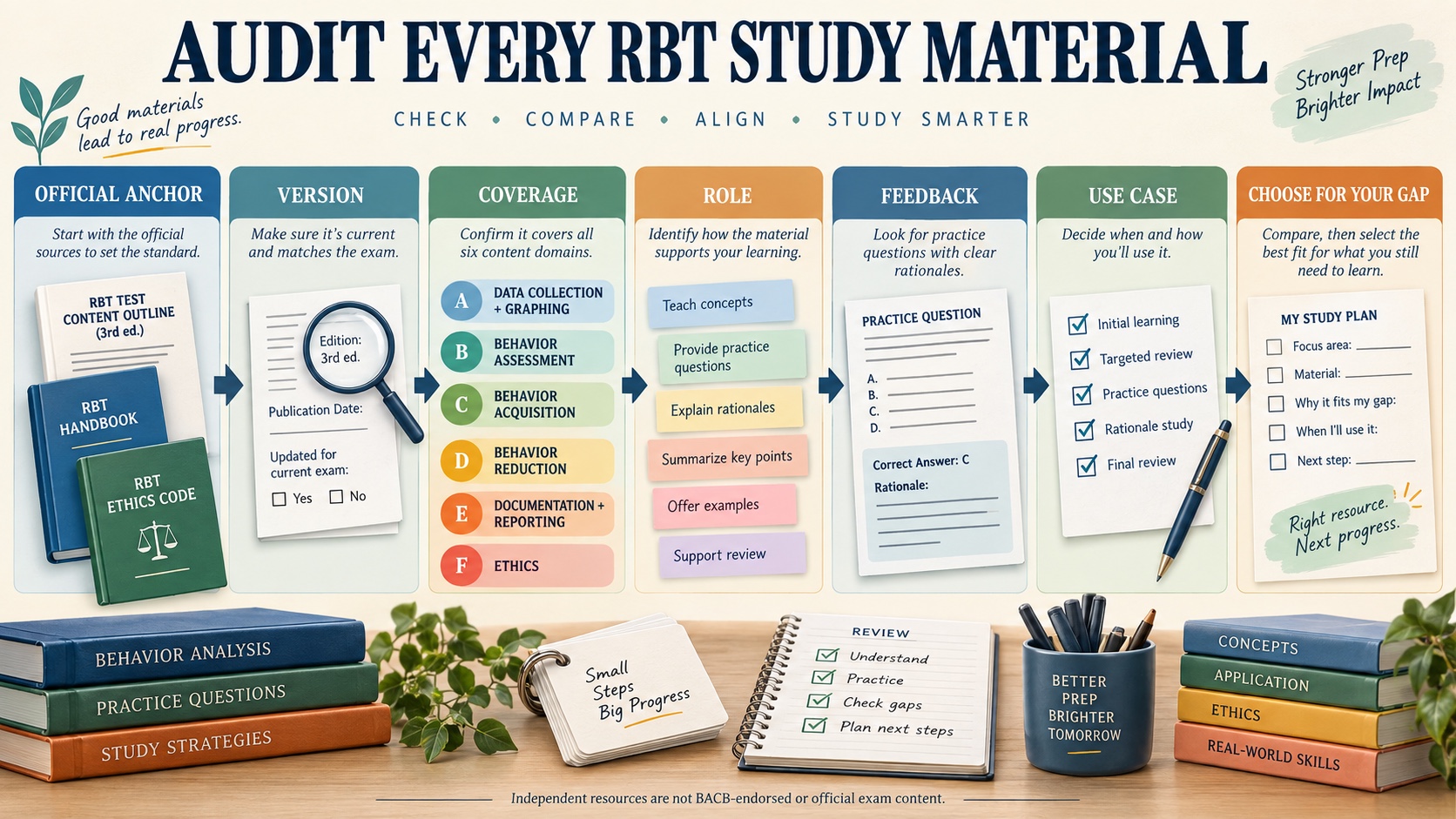
The Handbook recommends reviewing the current TCO and materials gathered from the 40-hour training and Competency Assessment. It also says the BACB cannot endorse specific study guides or other preparation materials, and that purchasing study materials does not guarantee that you will pass. That is not a reason to avoid independent resources. It is a reason to give them a limited, honest job in your plan.
How to evaluate each material type
Before you download or buy a resource, run the same six-question audit. Does it name the current TCO or clearly date its update? Can you map its sections to tasks and domains? Does it teach an entry-level RBT role rather than independent diagnosis or treatment-plan design? Does it explain answers instead of only displaying a score? Does it protect client privacy and distinguish unofficial practice from BACB material? Finally, does it solve your current gap?
Study guides and manuals
A study guide is most useful when the official outline feels too compressed. Look for plain-language definitions, small examples, comparisons, and a visible connection to the current domains. A guide should help you understand why a procedure fits a situation, not only provide a long glossary. Check the update date and scan for old Task List wording. A guide can organize learning, but it cannot replace the official requirements or prove eligibility.
Flashcards and short notes
Flashcards are good for retrieval: terms, measurement distinctions, ethical boundaries, task verbs, and short decision rules. They are weaker as your only resource because recognition of a definition is not the same as applying it to a workplace scenario. For each card, add a small “when would this matter?” prompt. If a card contains a client story, it should use de-identified or fictional information.
Practice questions and mock exams
Practice questions test application and help you discover uncertainty. Prefer original questions that identify the domain, use realistic entry-level wording, and explain why distractors are weaker. Be cautious with “real RBT exam questions,” leaked-question, or guaranteed-pass language. Independent questions are not live BACB items. A full mock exam adds pacing practice, but a high practice score is not an official readiness result and does not predict certification.
Videos, apps, and workbooks
Videos can make a confusing procedure concrete, especially when the explanation uses a short scenario and observable language. An app is helpful when it turns review into small, trackable actions: flashcards, section practice, audio review, progress, or a saved error queue. A workbook can slow you down in a useful way by requiring a written explanation. Evaluate the function, not the format. If the same resource repeats definitions but gives no feedback or retrieval opportunity, it may not fill a real gap.
Build a small RBT study stack
You can build a useful stack with four layers rather than collecting everything:
- Anchor: the current BACB TCO, Handbook, and Ethics Code. These control the edition, exam structure, and professional boundaries.
- Explain: one guide, training note, or video series that makes difficult concepts understandable. Choose one primary explanation source before adding another.
- Apply: a modest set of original practice questions organized by domain or task. Review the rationale; do not only count correct answers.
- Repair: flashcards, a workbook, an app queue, or a paper error log that turns misses into scheduled retrieval.
Use your baseline to decide which layer needs more weight. If you cannot explain measurement or prompting, return to the explanation layer. If you understand a definition but miss a scenario, use application questions. If you repeatedly forget a distinction after understanding it, use short retrieval sessions. If you know the content but run out of time, add a timed section or mock. This is more efficient than buying another general guide.
The RBT study guide can provide a broad map, while RBT practice questions can create application opportunities. The planned ABA Study Online app is suited to short review, flashcards, section practice, audio review, progress, and a saved error queue. The website and app are complementary destinations, not substitutes for the official BACB sources.
Use the stack in a two-week cycle
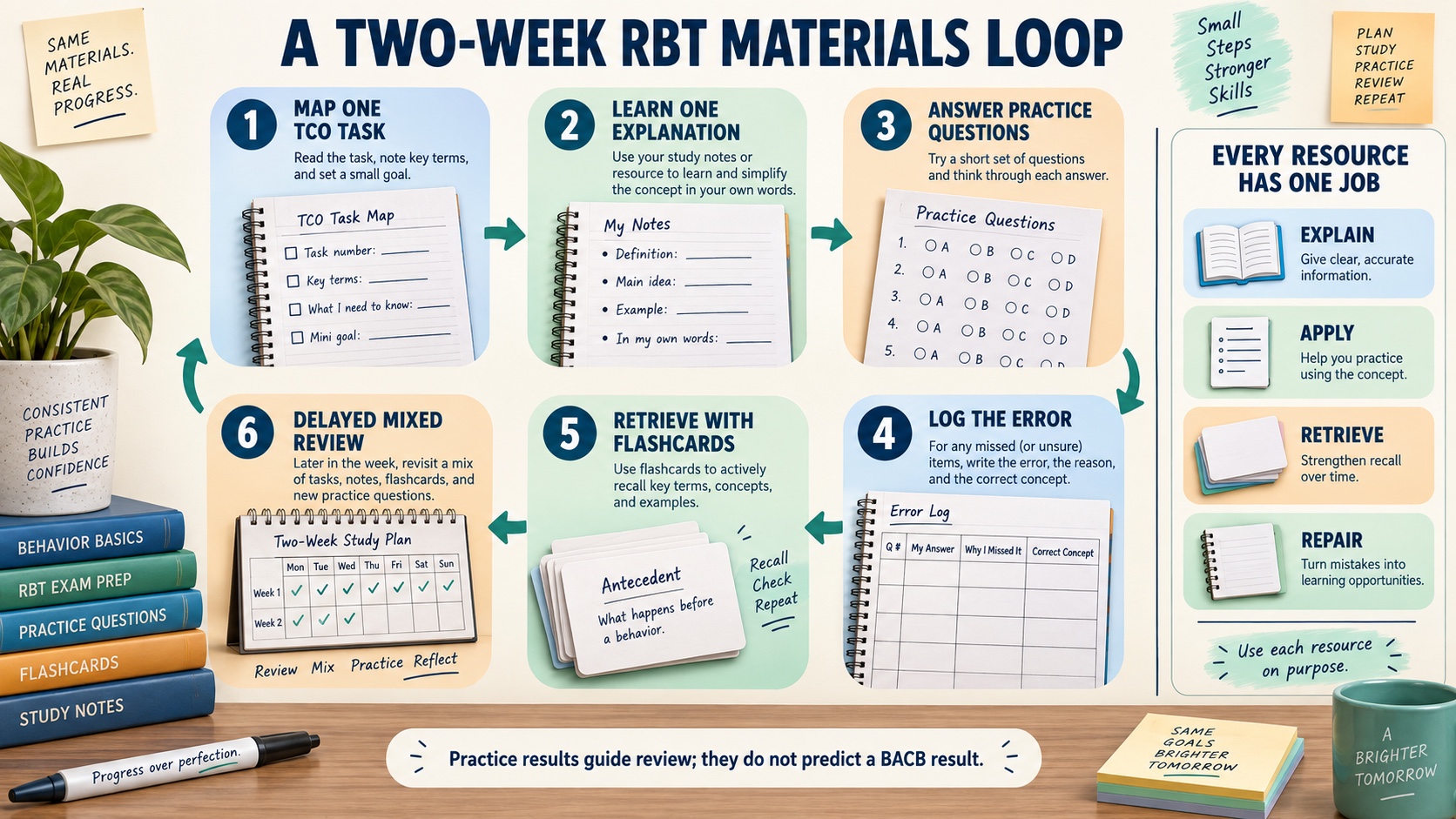
Here is a two-week example. It is a planning template, not a BACB requirement.
- Days 1–2: audit and baseline. Save the current TCO, check the edition on your existing materials, and answer a short mixed set without looking at notes. Record uncertainty as well as wrong answers.
- Days 3–5: repair one domain. Read one explanation, make a few retrieval cards, and answer original questions tied to the same task. Write one sentence explaining each correction.
- Days 6–7: mix the material. Move between two or three domains. Practice identifying the task before choosing a response, and keep RBT role boundaries visible.
- Days 8–10: repeat the weak distinctions. Use flashcards or an app queue for short sessions, then return to the guide only when the error log shows a concept gap.
- Days 11–12: add pacing. Complete a timed section or partial mock. Treat the result as evidence about pacing and review priorities, not as a passing prediction.
- Days 13–14: delayed retrieval. Re-test the errors from earlier in the cycle without rereading first. Update the plan and check any rule-sensitive question against the current official source.
A simple error log can include the TCO domain or task, the concept you confused, the evidence in the scenario, the role boundary, the reason the correct answer fits, and the date of your next retry. That log is more valuable than a shelf of resources you never revisit.
Common material-selection mistakes
- Letting an old edition lead: use the current RBT TCO (3rd ed.) for examination content beginning in 2026, even if an older resource still has helpful vocabulary.
- Buying by quantity: ten formats do not replace one clear explanation and a repeatable review loop.
- Studying only definitions: add scenarios that ask what to observe, record, implement, report, or bring to a supervisor.
- Trusting an “official” label: compare the claim with BACB pages and do not assume a logo, PDF, or score report means endorsement.
- Confusing a score with readiness: use practice results to choose the next review, not to predict a BACB result.
- Crossing the RBT role boundary: a study resource should not encourage independent diagnosis, treatment-plan authorship, or unsupervised changes to an authorized plan.
- Ignoring privacy: use fictional or de-identified examples and do not paste client information into an app, worksheet, or question bank without appropriate authorization.
RBT study-material FAQ
What is the best RBT exam study material?
There is no single best format for every learner. Start with the current official TCO and Handbook, then choose the format that solves your gap: explanation, retrieval, application, pacing, or error repair. Check currency and boundaries before relying on it.
Do I need an RBT study guide, flashcards, and a mock exam?
No. You need coverage and feedback, not a specific shopping list. A guide plus original questions and an error log may be enough; add flashcards or a timed mock only when they address a real weakness.
Are free RBT study materials useful?
They can be useful when they identify the current edition, explain the material accurately, and make their unofficial status clear. Free does not automatically mean current, complete, or BACB-approved. Audit free resources with the same six checks.
Should I study the RBT Task List or the 3rd edition TCO?
For examination content beginning in 2026, use the RBT TCO (3rd ed.) as your primary map. The older Task List may appear in legacy materials, so label it as historical or supplementary rather than letting it control your current study plan.
Can study materials replace the 40-hour training or Competency Assessment?
No. Study materials support learning. They do not replace the training, Initial Competency Assessment, supervision, application, official documentation, or certification requirements described by the BACB.
Is ABA Study Online an official RBT exam provider?
No. ABA Study Online provides independent educational content, practice, and planned app review tools. Use the BACB for current certification, eligibility, examination, and official-document decisions.