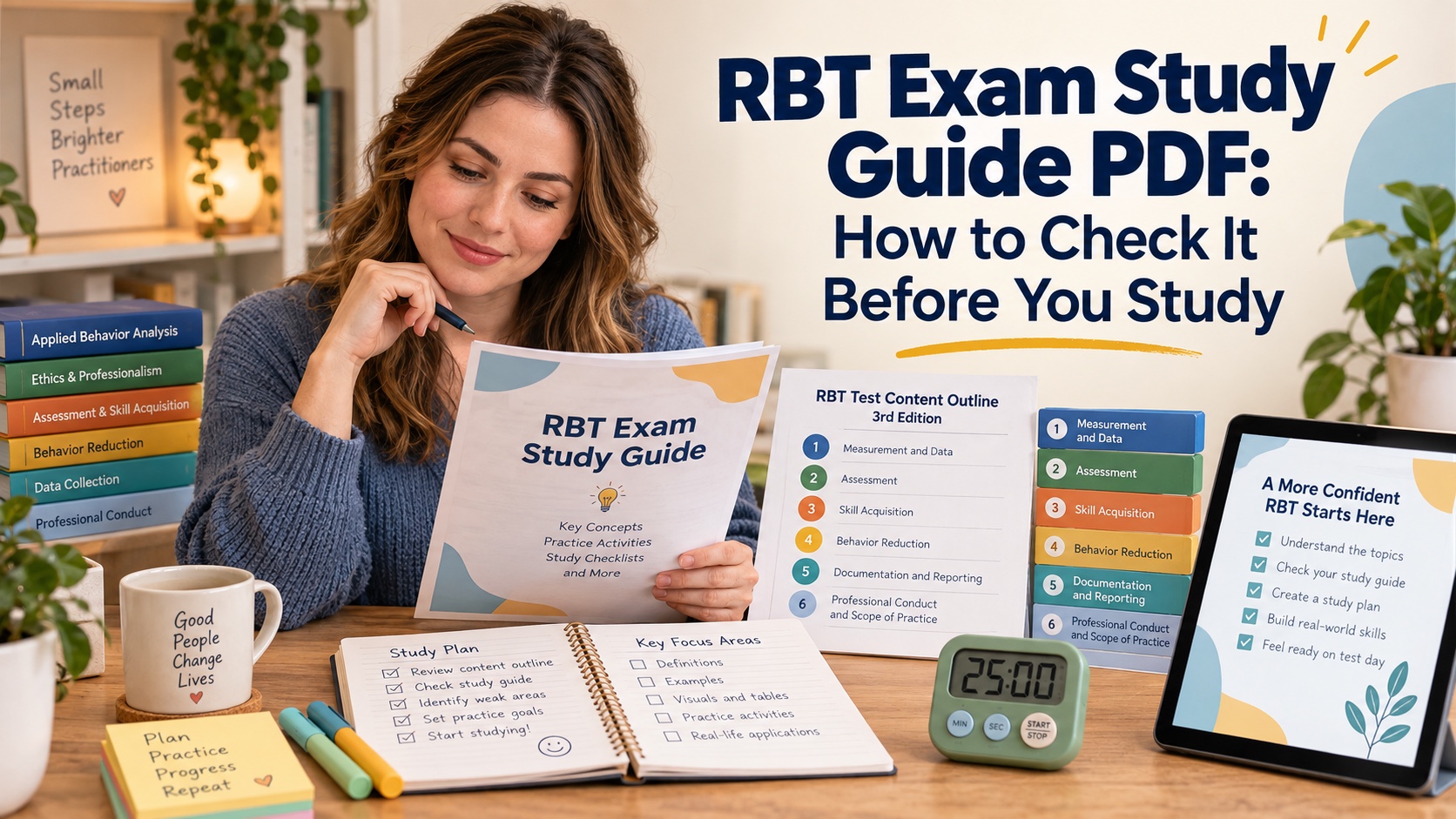
RBT Exam Study Guide PDF: How to Check It Before You Study
An RBT exam study guide PDF can be convenient. You can read it on a tablet, print a few pages, mark a difficult definition, or keep a checklist beside your practice questions. But PDF is a format, not a quality label. A file can look polished and still use an old outline, blur the difference between RBT and BCBA content, or give you pages to highlight without helping you make decisions.
The most useful audit begins with the current BACB source boundary. The RBT Test Content Outline (3rd ed.) describes examination content beginning in 2026. The current examination-information page lists 85 total RBT questions and 90 minutes, while the TCO describes 75 scored questions. A third-party guide can organize your learning, but it is not official exam content, a certification application document, or a pass guarantee.
Quick answer: what should the PDF contain?
A useful RBT exam study guide PDF should make five things visible: the current edition or source date, the six content domains, plain-language explanations, original practice with rationales, and a format you can use lawfully and accessibly. It should help you answer questions such as “What would I observe?”, “Which measurement fits?”, “What does the written procedure require?”, and “When should I ask the supervisor?”
Do not judge a guide by page count. A shorter document with accurate maps and strong examples can do more work than a long file that repeats vocabulary. Start by locating the guide’s source note, update date, author or organization, and explanation of what the PDF is—and is not.
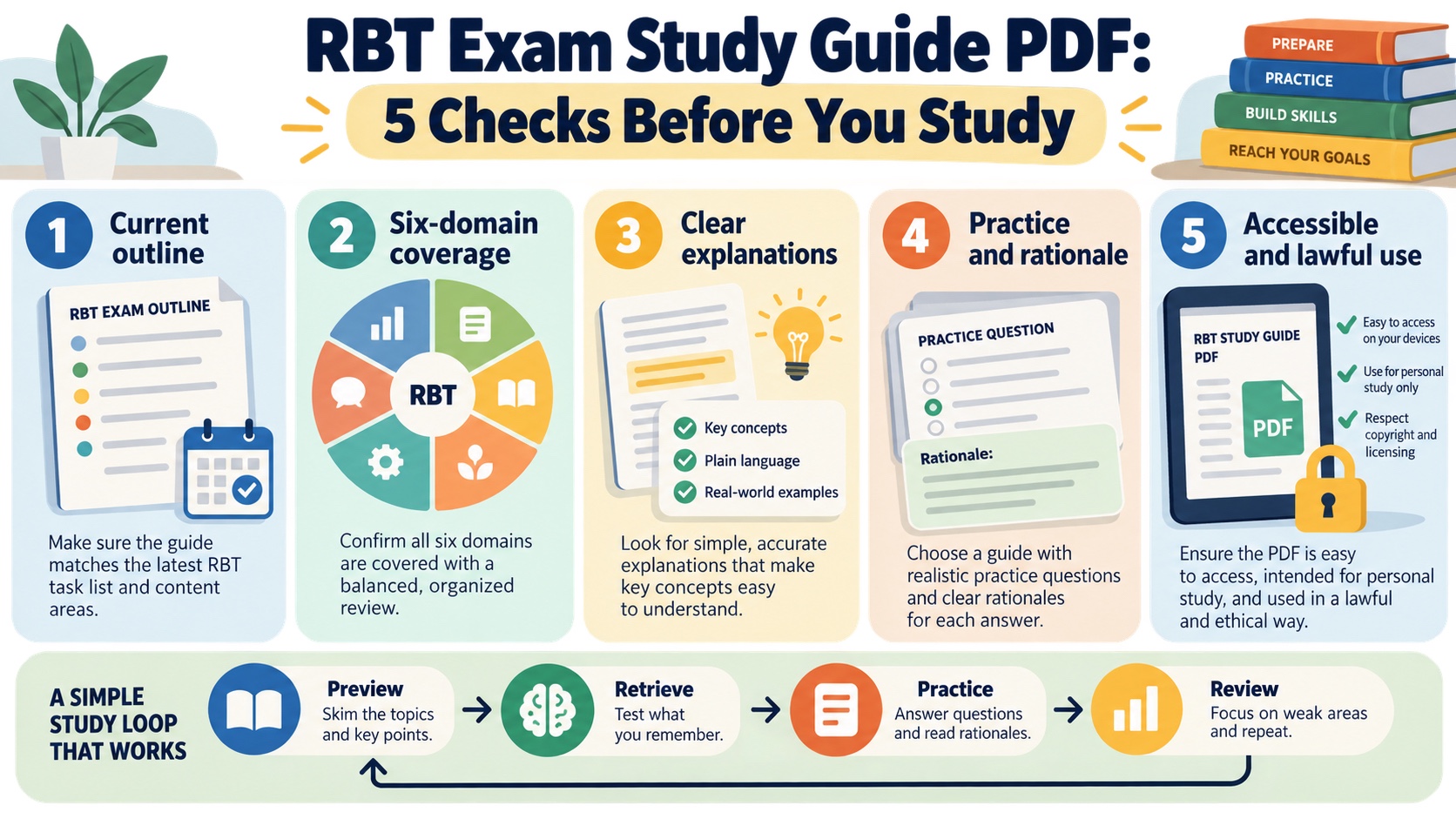
Five checks before you study
1. Check the current outline
Look for alignment with the RBT TCO (3rd ed.), not only an attractive “latest” badge. The current outline organizes 43 tasks into six domains: Data Collection and Graphing, Behavior Assessment, Behavior Acquisition, Behavior Reduction, Documentation and Reporting, and Ethics. If a PDF still organizes the exam around a retired edition without explaining the transition, pause before using it as your main map.
2. Check all six domains
Compare the PDF’s table of contents with the official domain names. A guide should not spend every page on reinforcement and prompting while treating assessment, documentation, or ethics as a final vocabulary page. Coverage does not mean every domain receives identical space. It means the guide tells you what kind of work and decision each domain contains.
3. Check the explanation quality
Good explanations connect a term to an observable example and a study decision. For frequency recording, the guide should show that the learner’s responses are counted during a defined observation period. For latency, it should show the time between a specified event and response onset. For objective documentation, it should contrast what was observed with a guess about intent.
4. Check practice and rationales
Practice questions should be original, clearly labeled as independent material, and followed by a rationale. A rationale should explain why the best answer fits the scenario and why a tempting alternative misses an important qualifier. Avoid any file that advertises recalled or secure BACB questions. Those claims are not a mark of quality, and sharing protected exam content is not a responsible study method.
5. Check accessibility and lawful use
Can you search the text, zoom the pages, read the contrast, and use the file on the device where you actually study? If printing is important, check margins and page breaks. Also read the license or download terms. Keep a guide for the use it permits; do not remove attribution, redistribute a paid file, or upload it to a public folder simply because it is easy to copy.
Turn a PDF into active practice
Begin with a short preview. Read the headings, mark the six domains, and choose one small target such as continuous measurement or prompt fading. Close the file and write what you remember. This retrieval step reveals whether the page changed your understanding or merely felt familiar while you were reading it.
Next, return to the explanation and create one plain-language example. If the target is permanent-product recording, write what lasting product would be counted and what would not count. If the target is a skill-acquisition procedure, identify the instruction, prompt, learner response, and programmed consequence. Keep the example fictional and within the RBT role.
Then answer a few original practice questions without looking at the answer. Record the domain, the task or concept, your selected answer, and the reason you chose it. When you miss, repair the smallest gap. You may need a definition, a measurement distinction, a sequence of procedure steps, or a reminder to contact the supervisor. Revisit the missed item later instead of rereading the entire PDF immediately.
ABA Study Online’s RBT learning path can provide structured concept review, the RBT questions route can provide retrieval practice, and the ABA Definition Search can clarify one term at a time. The planned app review loop can support shorter repeated sessions. These are independent study resources, not BACB materials or certification decisions.
What the PDF cannot replace
An exam study guide does not replace the required 40-hour training, the Initial Competency Assessment, the certification application, supervisor direction, ongoing supervision, the current RBT Handbook, or the official examination rules. Those documents and people answer different questions. A study PDF can help you review a prompting example; it cannot assess your competence, sign your application, or authorize a clinical procedure.
Keep the role boundary visible while you practice. RBTs assist with behavior-analytic services under direction and close supervision. If a scenario asks you to redesign a behavior plan, diagnose a condition, promise a result, or introduce an unfamiliar intervention, do not treat a study guide’s confident wording as authorization. Identify the need for supervisor direction and use the official source that applies.
Common PDF study mistakes
- Studying an old edition: confirm the RBT TCO version and the date the examination content applies.
- Highlighting without retrieval: close the file and explain the idea in your own words.
- Counting pages as coverage: compare domain and task coverage, not document length.
- Trusting “real questions” claims: use original public-source practice and clear rationales.
- Mixing credential tracks: label RBT content separately from BCaBA and BCBA preparation.
- Using a PDF as a rulebook: verify eligibility, supervision, testing, and ethics information in current BACB sources.
FAQ
Is a free RBT exam study guide PDF enough to pass?
No single PDF can establish readiness or guarantee a result. Use it as one study layer, verify its scope, practice application, and review all six domains with current official sources.
What edition should an RBT study guide use in 2026?
For examination content beginning in 2026, check alignment with the RBT Test Content Outline (3rd ed.). Use the current RBT Handbook and BACB examination information for pathway, testing, and policy details.
Can I make my own RBT study guide PDF?
Yes, you can make personal notes from lawful public sources and your training materials. Keep citations and version dates, do not copy secure exam content, and do not redistribute protected material without permission.