
RBT Exam Review: A Current, Practical Way to Study
A good RBT exam review is more than rereading a study guide or taking one more random quiz. It should show you what the current exam covers, why you missed a question, and what to practice next. The goal is not to memorize a pile of isolated terms. It is to build a repeatable loop: map the content, answer original scenario questions, explain every option, repair the weak area, and then test your timing.
This guide follows the current BACB examination information. The RBT exam is based on the RBT Test Content Outline (3rd ed.) from 2026. Practice questions on an independent study site are not BACB questions, and no practice score can guarantee a passing result. Use the current BACB Handbook and TCO as the authority for requirements, while using this review method to organize your learning.
Table of Contents
Start with the current RBT exam blueprint
The current RBT examination has 85 multiple-choice questions: 75 scored questions and 10 unscored questions. You have 90 minutes, and each question has four answer choices with one correct answer. The scored blueprint is organized into six content areas and 43 tasks. Questions are equally weighted, so the content-area percentages help you plan your review, but they do not create a separate passing score for each section.
| Content area | Scored questions | Approx. share | Review focus |
|---|---|---|---|
| Data Collection and Graphing | 13 | 17% | definitions, measurement, data display, and accurate recording |
| Behavior Assessment | 8 | 11% | observation, preference assessment, and the RBT’s role |
| Behavior Acquisition | 19 | 25% | teaching procedures, prompting, reinforcement, and generalization |
| Behavior Reduction | 14 | 19% | antecedent strategies, differential reinforcement, and safety boundaries |
| Documentation and Reporting | 10 | 13% | objective notes, communication, privacy, and reporting changes |
| Ethics | 11 | 15% | scope, confidentiality, professional conduct, and client dignity |
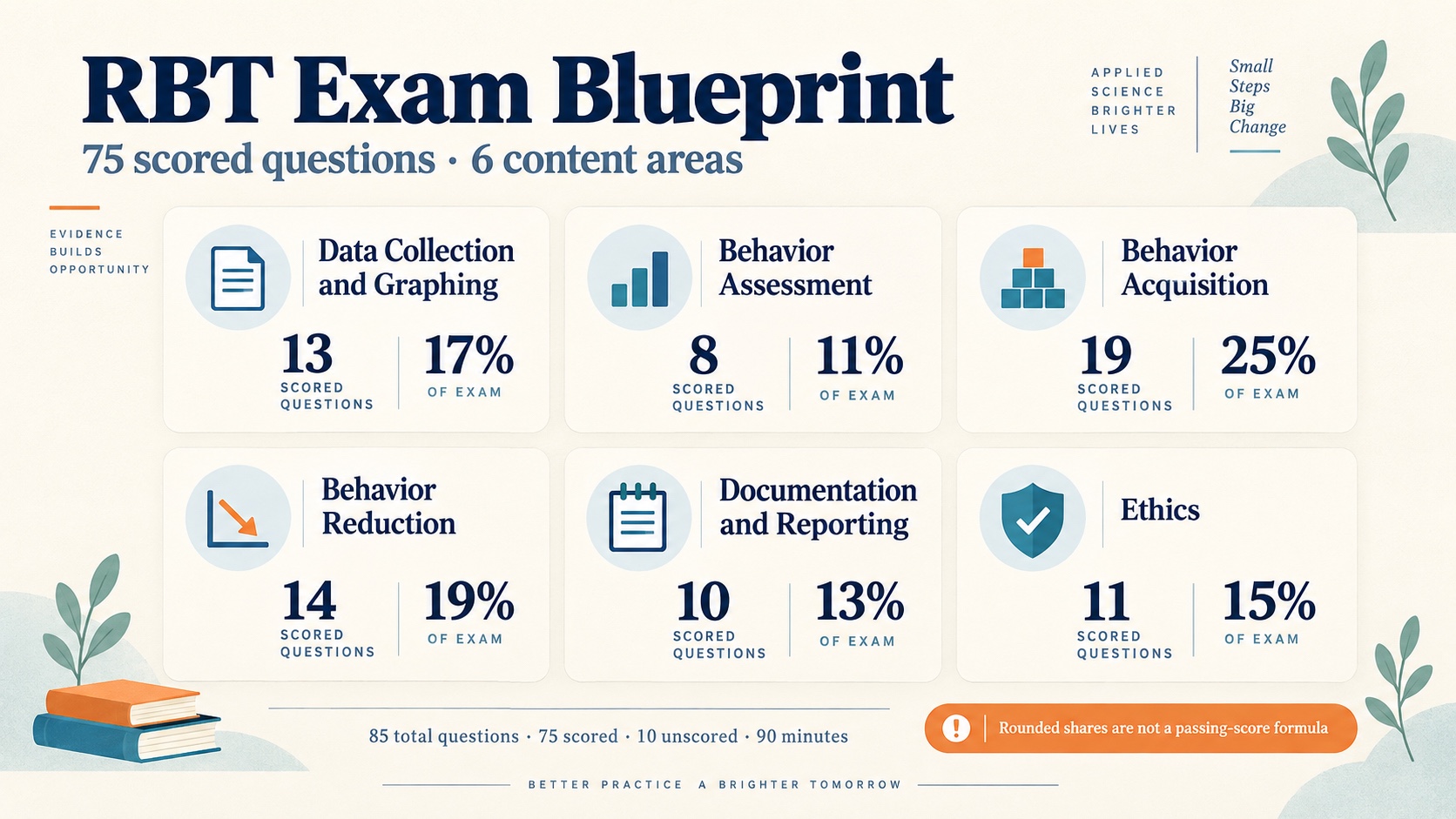
That table gives you a map, not a reason to ignore the smaller sections. A candidate who knows acquisition procedures but answers documentation or ethics questions casually still has a real gap. Start by finding your pattern of errors, then give more time to the areas that are both weak and heavily represented.
Build an error log before you do more questions
After a practice set, do not record only a percentage. For every missed question, write the content area, the task or concept, the answer you chose, the correct reasoning in your own words, and the reason your choice was tempting. This turns “I got it wrong” into information you can use.
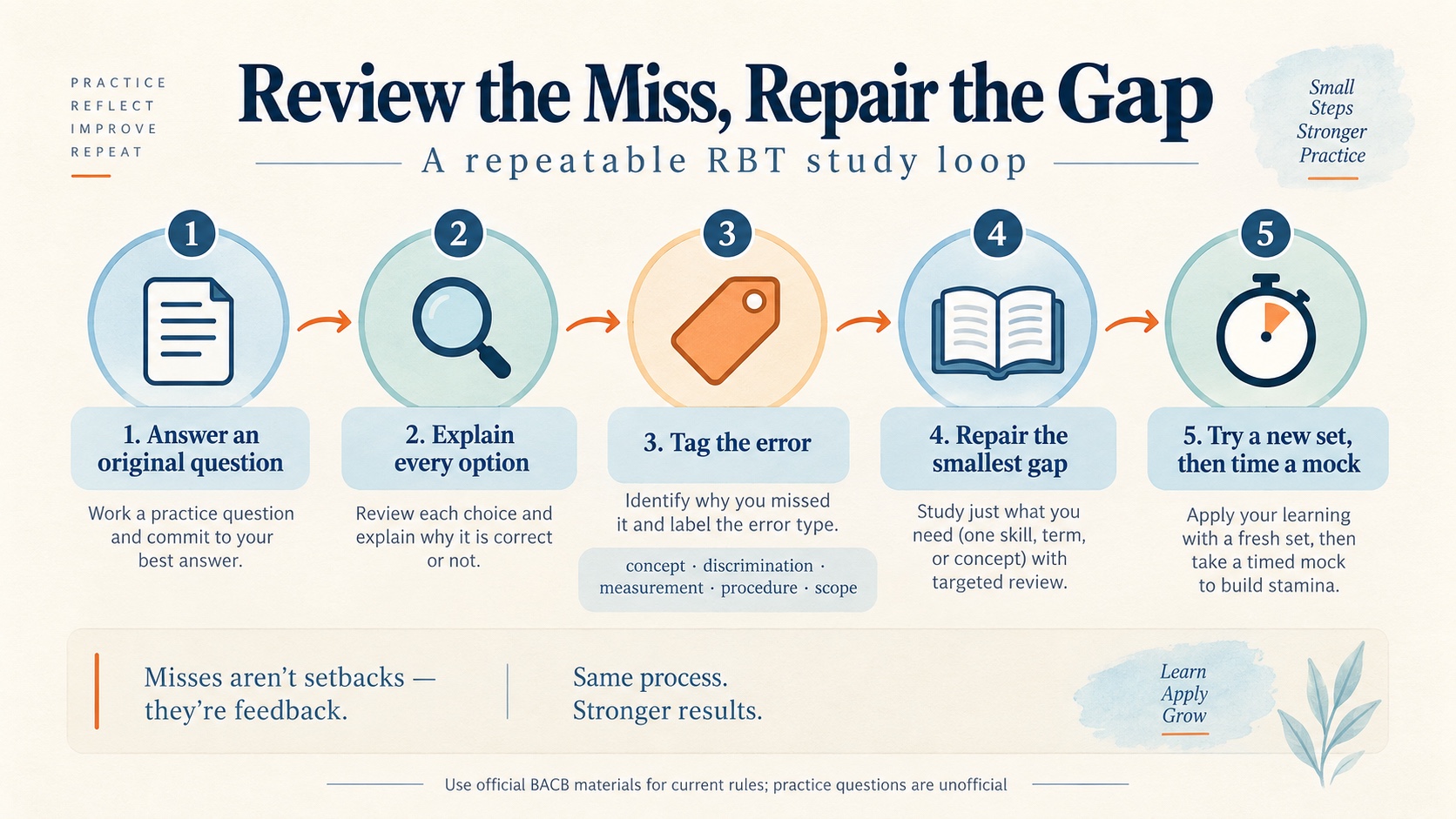
Most misses fit at least one of five categories:
- Concept error: you cannot define or distinguish the term.
- Discrimination error: you know both terms but miss the detail that separates them in a scenario.
- Measurement error: you confuse frequency, rate, duration, latency, or a graph feature.
- Procedure error: you understand the goal but choose the wrong sequence or prompt strategy.
- Scope or ethics error: you select an action an RBT should not take independently, or overlook privacy and dignity.
Tagging errors prevents a common trap: taking more and more mixed quizzes when the actual problem is one unresolved distinction. If three wrong answers all involve choosing between duration and latency, review that distinction and create a small example for each. If several misses involve what to report to a supervisor, practice objective wording and role boundaries instead of rereading every topic.
Review each content area with a different lens
Data Collection and Graphing deserves active practice. Say what is measured, identify when timing begins and ends, and check whether a graph displays the data the question describes. In Behavior Assessment, focus on what an RBT observes and records under a supervisor’s plan; do not turn a technician-level question into an independent diagnostic decision.
Behavior Acquisition is the largest scored area. Review reinforcement, prompting and prompt fading, stimulus control, shaping, chaining, discrete-trial teaching, naturalistic teaching, and generalization. For each procedure, ask: what is the learner doing, what is the antecedent, what response is being taught, and what consequence follows? That four-part explanation is more useful than a flashcard definition alone.
Behavior Reduction is not a collection of punishment vocabulary. Review antecedent strategies, functional communication, differential reinforcement, extinction-related effects, and safety procedures in the context of a supervisor-designed plan. Ethics and Documentation and Reporting deserve equal care: an RBT must protect confidentiality, use objective language, communicate changes, and follow the scope of the role. When a question feels like it invites improvisation, check whether the safest answer is to follow the plan and consult the supervisor.
Use a practice-and-explanation loop
Choose original, unofficial questions that resemble the level of decisions you are studying, but never copy, share, or reconstruct confidential BACB examination content. For each item, commit to an answer before reading the explanation. Then explain why the correct option fits and why each distractor does not. If an explanation only says “B is correct,” it has not taught you enough.
- Take a small untimed set from one content area.
- Review every answer, including guesses you got right.
- Tag each miss by content area and error type.
- Study the smallest concept that repairs the error.
- Answer a new set without looking at the previous wording.
- Write one sentence describing what you will notice next time.
Move from section practice to a timed mock
A timed mock is most useful after you can explain your mistakes in untimed practice. Use the official 90-minute structure as a pacing rehearsal, but do not mistake a practice score for a BACB result. Record where time went: long calculations, rereading dense scenarios, changing answers, or losing focus near the end.
After the mock, review in three passes. First, correct clear knowledge misses. Second, revisit questions you guessed correctly because they are fragile knowledge. Third, inspect unanswered or rushed items and decide whether the problem was pacing, reading, or content. The next practice set should target the biggest repair opportunity rather than simply repeat the full test.
Keep the review materials separate by purpose. The BACB Handbook answers current eligibility, examination, security, and retake questions. The Test Content Outline tells you what a technician should know and be able to do. Your error log tells you what you need to repair. A practice platform can organize questions, timing, and explanations, but it should not replace those official documents. This separation also makes your notes easier to trust: one page records the rule, one page records the concept, and one page records your own performance.
When a question uses an unfamiliar client or setting, translate it back to the same decision structure. Identify the observable response, the relevant antecedent or consequence, the measurement or teaching procedure, and the RBT’s role. If the scenario asks you to change a plan, diagnose a new function, or make a promise to a family without supervisor direction, pause before choosing an action. The strongest review habit is not guessing what the test writer wants; it is recognizing which professional boundary the scenario is testing.
A practical seven-day review routine
- Day 1: take a short baseline set and build your error log.
- Day 2: review Data Collection and Graphing plus Behavior Assessment.
- Day 3: review Behavior Acquisition with scenario explanations.
- Day 4: review Behavior Reduction and safety boundaries.
- Day 5: review Documentation and Reporting and Ethics.
- Day 6: complete a 90-minute practice simulation and note pacing.
- Day 7: repair the two most important error patterns; do not cram every term again.
This schedule is a study suggestion, not a BACB requirement. Adjust the order if your error log shows a different need. A focused 25-minute repair session can be more valuable than another full mock completed without review.
If you want to continue from this review method into section practice, original question explanations, and a timed simulation, you can use the RBT practice questions, the mock-exam area, and the ABA Study Online app. These are independent study resources, not BACB or Pearson VUE materials, and they do not guarantee a passing result.
RBT exam review FAQ
How many questions are on the current RBT exam? The examination has 85 multiple-choice questions: 75 scored and 10 unscored. The time limit is 90 minutes.
Which RBT content area should I study first? Start with the area where your error log shows the clearest weakness. If two areas are equally weak, Behavior Acquisition and Behavior Reduction have the largest approximate shares, but do not skip Ethics or Documentation and Reporting.
Are practice questions the real BACB questions? No. Secure BACB examination content must not be copied, shared, or reconstructed. Use original questions to practice decisions and explanations, then verify requirements in the current BACB Handbook and TCO.
What score should I get before taking the exam? The BACB does not publish a simple practice-score threshold that guarantees a pass. Look for stable reasoning across content areas, the ability to explain distractors, and realistic pacing instead of chasing one number.