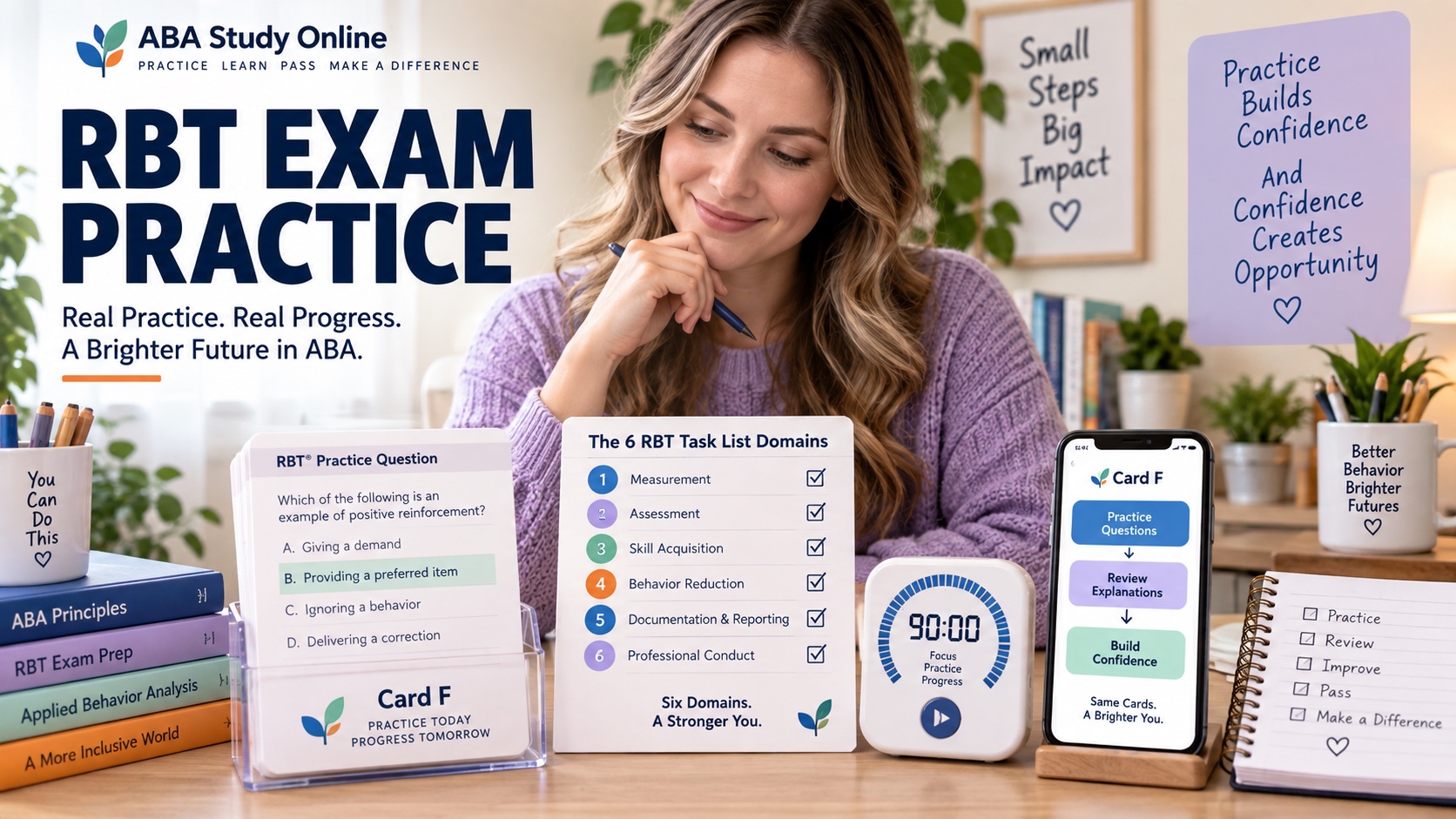
RBT Exam Practice: Choose the Right Practice Path
If you are searching for RBT exam practice, the most useful question is not “Which page has the most questions?” It is “What do I need this session to help me do?” A short set can teach a new distinction. A domain set can repair a weak area. A mixed set can show whether you can recognize the task without a label. A timed rehearsal can test pacing. An app session can help you return tomorrow instead of starting over.
This guide helps you choose between those practice jobs and explains where each one fits in an RBT study routine. It uses the current BACB examination boundary as the source check, but every independent question set remains unofficial. Practice can support learning; it cannot approve an application, reproduce secure exam content, guarantee a result, or replace the current RBT Handbook.
Table of Contents
The short answer: choose practice by goal
Use the smallest practice format that can answer your current question:
- Learning a new concept: choose a short, untimed set with a full rationale.
- Repairing one weak area: choose domain or task-focused practice.
- Finding your real pattern: choose a mixed diagnostic set without domain labels.
- Building stamina: choose a full-length, 90-minute rehearsal after you have a review method.
- Keeping momentum between longer sessions: choose app flashcards or section practice for a short return loop.
This approach avoids a common trap: treating every practice session as a mini exam. When you are still learning prompting, measurement, reinforcement, documentation, or ethics boundaries, feedback is the point. When you are testing pacing, constant feedback changes the job. Label the mode before you start so you know what the result can and cannot tell you.
The current RBT practice boundary
Beginning January 1, 2026, the RBT examination is based on the RBT Test Content Outline (3rd ed.). The BACB’s current examination information lists 85 questions, including 75 scored questions and 10 unscored questions, with 90 minutes to complete the examination. Each question has four possible answers and one correct answer, and the examination is delivered through in-person computer-based testing at authorized locations.
The TCO organizes 43 tasks across six domains: Data Collection and Graphing, Behavior Assessment, Behavior Acquisition, Behavior Reduction, Documentation and Reporting, and Ethics. These domains are a coverage map, not six separate pass cutoffs. An independent practice provider cannot know which of its questions would be scored on the BACB examination, and a practice percentage is not an official pass prediction.
Use the source boundary to evaluate a resource. A current practice page should identify the third-edition context, describe its questions as original or unofficial, explain how feedback works, and avoid “real RBT exam questions” or “guaranteed pass” language. The BACB states that it cannot endorse specific study guides and that buying study materials does not guarantee passing.
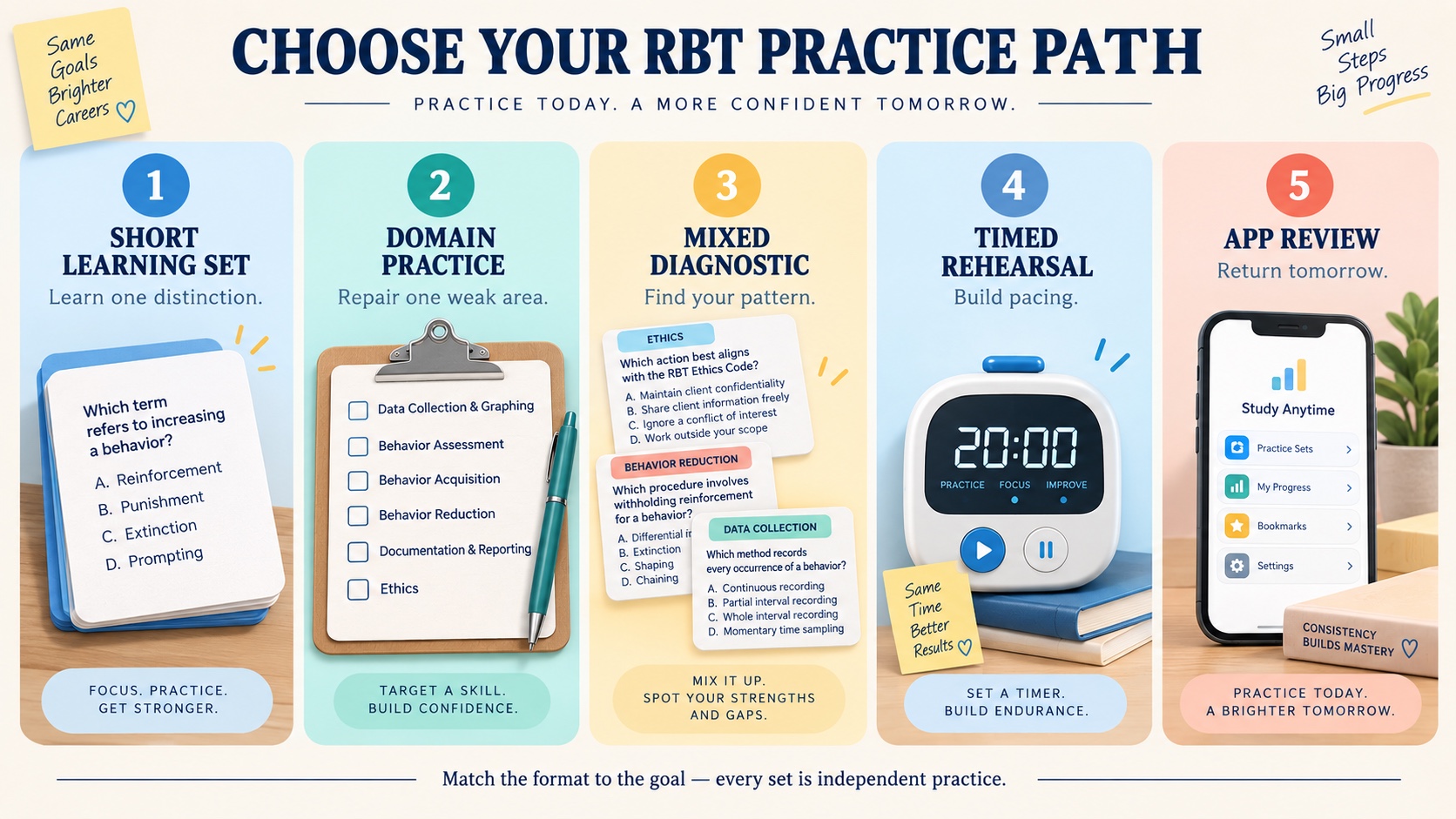
Five RBT exam-practice paths
1. Short learning set
Use five to fifteen questions when you are learning a distinction for the first time. Read each scenario carefully, commit to an answer, then inspect the rationale before moving on. The useful output is not a percentage; it is a sentence such as, “I confused duration with frequency because I ignored the response dimension.” This mode works well after a Theory Block, training note, or glossary review.
2. Domain-focused practice
Choose one current RBT domain when your error log shows a pattern. Data and graph questions may need measurement and observation-window practice. Behavior Acquisition questions may need prompting, shaping, chaining, reinforcement, or generalization comparisons. Documentation and Ethics questions may need role boundaries and objective communication. Domain focus is efficient when it follows evidence; it is less useful when you use it to avoid every other area.
3. Mixed diagnostic practice
Use a mixed set when you want to discover whether you can identify the relevant concept without seeing a domain label first. Mark confidence before checking the answer: sure, uncertain, or guess. A wrong answer marked “sure” signals a misconception. A correct answer marked “guess” signals fragile knowledge. A mixed set is a diagnostic conversation with your study plan, not a verdict about certification readiness.
4. Full timed rehearsal
Use an 85-question, 90-minute practice session when the goal is sustained attention and pacing. It should come after you have a way to review errors. During the session, read the stem, identify the relevant facts, choose the best answer, and move on when an item is taking too much time. Afterward, review the reasoning, not just the score. A full simulation cannot identify the scored items on the real exam.
5. App return practice
Use short app sessions between longer website study blocks. Flashcards can support retrieval; section practice can give you a focused next action; progress notes can show which area needs attention when you return. App practice is valuable because it lowers the effort of starting again, but it should connect to an error log or study map rather than becoming endless tapping without explanation.
When to switch from one mode to another
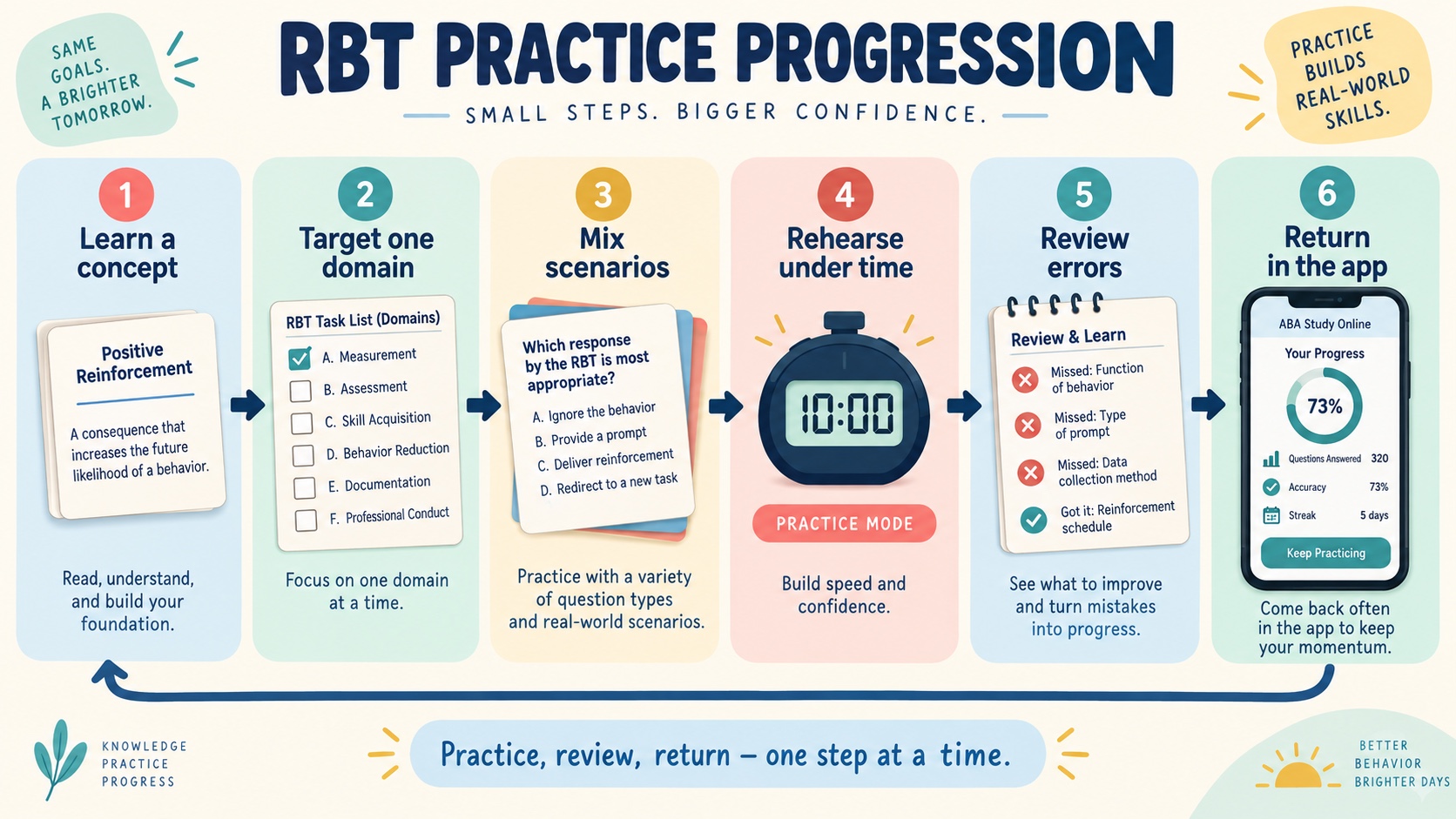
Switch modes when the evidence changes, not because a calendar says you must finish a certain number of questions. A practical sequence looks like this:
- Start small: use a short learning set and write down the distinction that still feels unclear.
- Target the pattern: choose a domain or task set and see whether the same error appears in new scenarios.
- Remove the label: use a mixed diagnostic set to test whether you can select the right concept from the context.
- Add time: use a longer rehearsal only when you can still review why options are right or wrong.
- Return later: use the app or a short new set after a delay so recognition becomes retrieval.
If a timed result drops sharply, do not automatically buy a new resource. Check whether fatigue, reading speed, question ambiguity, or one content gap explains the change. If a domain result is low, repair the concept and retry new scenarios. If results remain uneven, ask a qualified instructor or supervisor for help with the underlying distinction.
What a useful practice resource should include
Whether a resource is free or paid, inspect the learning design before trusting the headline:
- Current source label: it names the RBT TCO 3rd ed. and says when the content was checked.
- Track-specific coverage: it does not mix BCBA or BCaBA expectations into an RBT set without a clear reason.
- Original questions: it does not claim to reproduce secure BACB items or sell “guaranteed” access to the real exam.
- Useful rationales: it explains the controlling fact and why tempting alternatives are weaker.
- Review record: it lets you save a domain, task, confidence level, or mistake so the next session can respond to evidence.
- Honest score language: it treats the result as practice evidence rather than a BACB score report or pass prediction.
Also separate exam practice from certification eligibility. A question bank cannot replace the current 40-hour training, Initial Competency Assessment, application, approved determination, or ongoing requirements. Those decisions belong to the BACB Handbook and current official resources. Practice is one learning layer, not the whole certification pathway.
How the website and app can work together
ABA Study Online uses the website and app for different moments in the practice loop. The website is the discovery and depth layer: it can explain the current RBT boundary, offer free questions, connect a rationale to a Theory Block, and help a learner compare practice formats. The app is the return layer: flashcards, section practice, progress, audio review, and saved tools can make a short session easier to repeat.
That split means the app should not be treated as a copy of every website page or as an official exam simulator. Choose a website session when you need a longer explanation or a new practice destination. Choose the app when you already know the next small review action and want to keep the habit moving.
Practice mistakes that waste time
Choosing by question count only
A large bank can still be weak if the rationales are thin or the source edition is unclear. Choose the format that answers your current study question.
Using old-edition labels without checking the date
The current RBT examination content begins with the third-edition TCO in 2026. Save the edition, effective period, and source URL before making a long study plan.
Treating one score as a guarantee
A practice score belongs to one set under one set of conditions. Review confidence, error type, domain, and rationale quality before deciding what to do next.
Confusing study support with certification advice
Independent practice cannot approve an application or decide whether work hours count. Use the handbook, official application resources, and qualified supervision for those questions.
Start with the practice path that fits today
Try the free RBT questions on the website for scenario practice and detailed rationales. When you need a shorter return session, continue with flashcards, section practice, progress, and tools in the ABA Study Online app.
Try free RBT practice questions See the ABA Study Online app
FAQ and official sources
How many questions should I answer for RBT exam practice?
Use the number that fits the job. A short set is better for learning and rationale review; a mixed set is better for diagnosis; an 85-question, 90-minute set is appropriate for full-length pacing rehearsal. More questions are not automatically better if you never review them.
Is a free RBT practice test enough?
It can be a useful entry point if it is current, track-specific, original, and supported by clear rationales. It is not a substitute for training, the competency assessment, the application, the official handbook, or supervised preparation.
Can a practice score predict whether I will pass?
No. An independent practice score is evidence about that particular set. Use it to find patterns and plan the next study action; do not describe it as a BACB score report or pass guarantee.
Is the current RBT exam based on the third edition?
The BACB says the RBT examination content beginning January 1, 2026 is based on the RBT Test Content Outline (3rd ed.). Check the current BACB page and RBT Handbook whenever an edition or date affects your plan.
Is ABA Study Online an official BACB practice provider?
No. ABA Study Online offers independent educational explanations, original practice, and app-based study support. It does not claim BACB endorsement, access to secure exam items, certification approval, or a guaranteed result.
For current boundaries, read the BACB RBT page, the RBT Handbook, the BACB Examination Information, the RBT Test Content Outline (3rd ed.), and the BACB Test Content Outlines page. Use those sources for current requirements and exam boundaries; use independent practice only for learning and review.