RBT Exam Practice Test: How to Use One Well
An RBT exam practice test is most useful when it does two jobs at once: it gives you a realistic way to practice answering questions, and it shows you what to study next. A long list of questions can create a score without creating better decisions. Before you start, check whether the practice test reflects the current RBT examination structure, covers all six content areas, explains the answer choices, and clearly says that it is independent practice rather than BACB examination content.
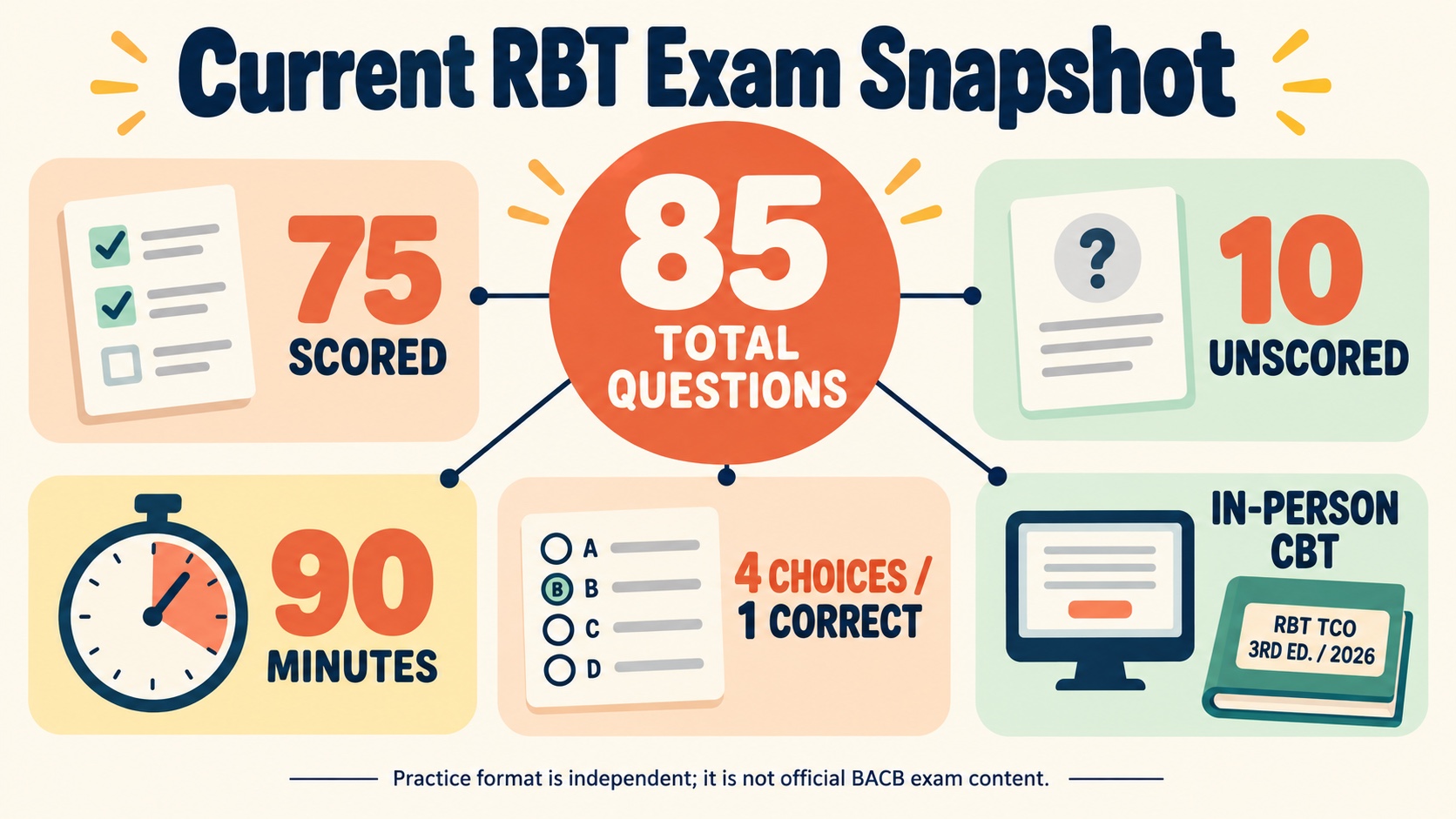
The current RBT examination is based on the RBT Test Content Outline (3rd ed.), which applies to examination content beginning in 2026. The BACB describes an 85-question examination with 75 scored questions and 10 unscored questions, four possible answers with one correct answer, and 90 minutes to complete it. This guide shows how to compare a practice test with that boundary, choose the right practice mode, review errors, and turn the result into a focused study loop.
Table of Contents
What a current RBT practice test should match
Start with the real examination boundary, then decide how closely your practice session needs to simulate it. A full-length practice test should normally use 85 questions and a 90-minute timer so that you can rehearse pacing and attention. That does not mean the practice provider knows which questions would be scored on the real examination. The 75-scored and 10-unscored distinction belongs to the BACB examination structure; an independent practice test should not pretend to reproduce the BACB scoring process.
| Check | Current examination boundary | What the practice test should do |
|---|---|---|
| Content edition | RBT Test Content Outline, 3rd ed., beginning in 2026 | State the edition and review date clearly |
| Question format | Multiple choice; four answers and one correct answer | Use original questions with one defensible best answer |
| Length and time | 85 questions in 90 minutes | Offer a full-length simulation and shorter learning sets |
| Content coverage | 43 tasks across six content areas | Show domain or task tags and avoid hiding a weak area |
| Scoring | Overall examination performance; questions are equally weighted | Explain results as practice evidence, not an official pass decision |
| Delivery | In-person, computer-based testing at authorized sites | Rehearse screen reading and pacing without calling an online quiz the real exam |
These checks help you spot stale material. A page that still presents the second-edition task list as the current RBT exam, omits the third-edition boundary, or uses a “real questions” promise needs careful review before you rely on it. Freshness is not just a year in a title. Look for the outline edition, the six current domains, original wording, and a transparent explanation of what the score means.
Check all six RBT content areas
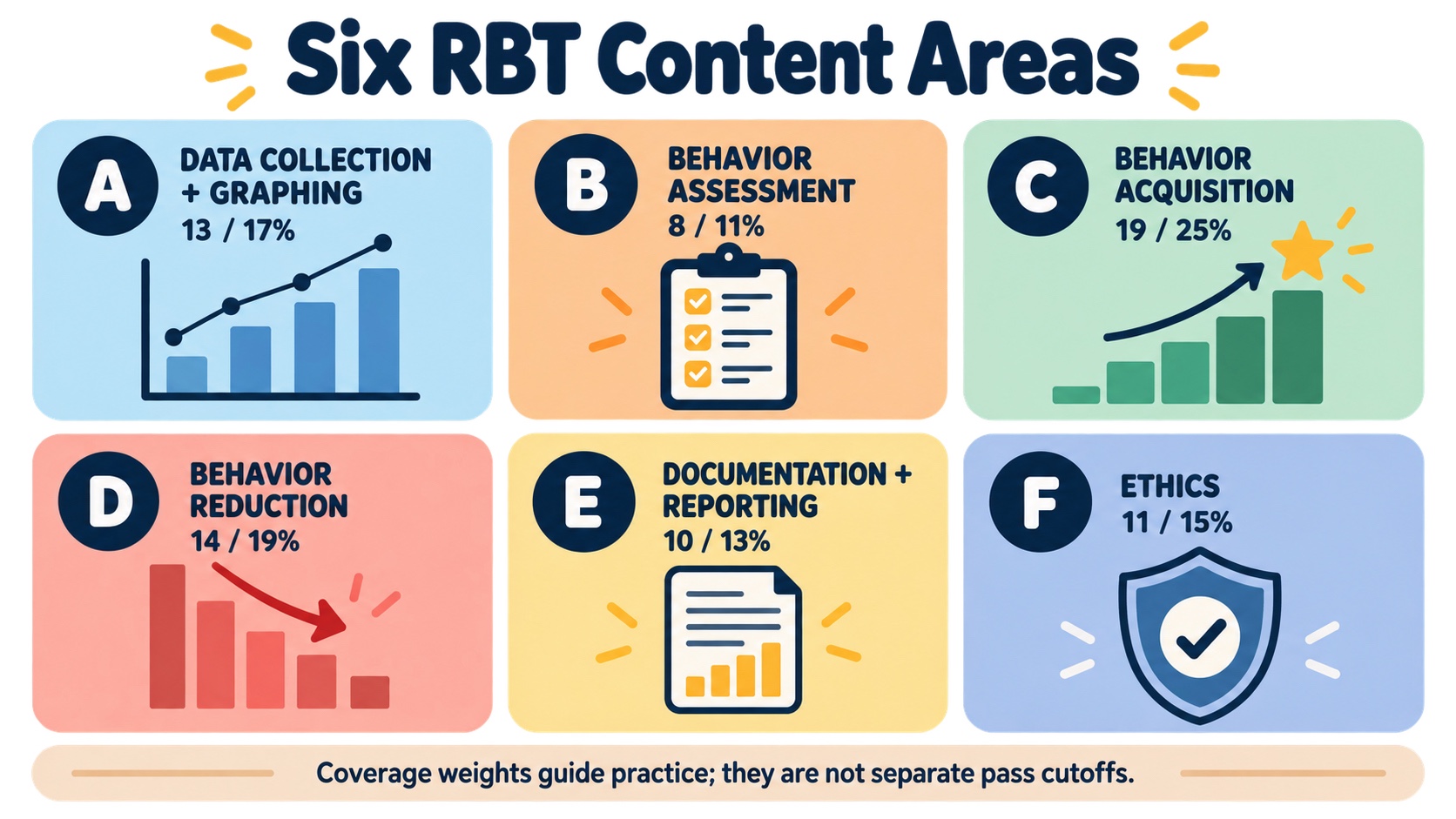
The current RBT Test Content Outline organizes 43 tasks into six content areas. The rounded percentages are useful for planning a balanced practice bank, but they are not six separate pass thresholds. The BACB states that questions are equally weighted and that the examination result is based on overall performance, not performance in each content area.
| Area | Questions in the outline | Rounded share | Practice focus |
|---|---|---|---|
| A. Data Collection and Graphing | 13 | 17% | Measurement, data entry, graphs, and observable descriptions |
| B. Behavior Assessment | 8 | 11% | Preference, skill-based, and functional assessment support |
| C. Behavior Acquisition | 19 | 25% | Teaching procedures, prompting, shaping, chaining, and generalization |
| D. Behavior Reduction | 14 | 19% | Functions, antecedent strategies, differential reinforcement, and extinction effects |
| E. Documentation and Reporting | 10 | 13% | Objective notes, confidentiality, communication, and reporting concerns |
| F. Ethics | 11 | 15% | Role boundaries, dignity, competence, supervision, and ethical conduct |
Behavior Acquisition and Behavior Reduction are the larger areas by question count, so they deserve enough practice to reveal whether you can apply procedures in scenarios. That is not a reason to neglect Data Collection, Documentation, or Ethics. A small area can still expose a gap that affects safe service delivery. A good practice report lets you see both the number of misses and the type of decision each missed item required.
Do not use the percentages as permission to memorize six headings. Within a domain, the tasks still ask you to choose a measurement, follow a procedure, notice a scope boundary, or communicate a concern. When comparing two practice tests, ask whether their explanations connect each question to a current task or simply attach a domain label after the fact.
How to choose a useful practice test
When several free or paid practice pages look similar, evaluate the learning design rather than the largest number in the headline. A useful test should pass these checks:
- Currentness: the page identifies the RBT Test Content Outline (3rd ed.) and does not quietly rely on an old edition.
- Coverage: the practice set represents all six content areas and lets you see which domain or task produced an error.
- Originality: the provider says the questions are independently written. “Real RBT exam questions” is not a responsible promise for an unofficial resource.
- Reasoning support: explanations identify the relevant fact, procedure, or role boundary and explain why tempting alternatives are weaker.
- Honest scoring: the score is described as a diagnostic for that practice set. It is not a BACB score report, official prediction, or pass guarantee.
- Usable format: you can pause for learning, mix domains for diagnosis, or use a 90-minute session for pacing without losing the review record.
A practice test can be valuable even when it is short. A 15-question diagnostic is a useful warm-up if it tells you what to repair. An 85-question test is useful when you need stamina and a mixed set. The important distinction is the job of the session, not whether one format is always superior.
Use three practice modes for different jobs
Mode 1: untimed learning practice
Use a small domain or task set when a concept is new. Read the scenario slowly, choose an answer before viewing the explanation, and write one sentence about the evidence that controlled your choice. This mode is appropriate when you are still learning measurement, prompting, behavior reduction, documentation, or ethics distinctions. It is not a test of speed.
Mode 2: mixed diagnostic practice
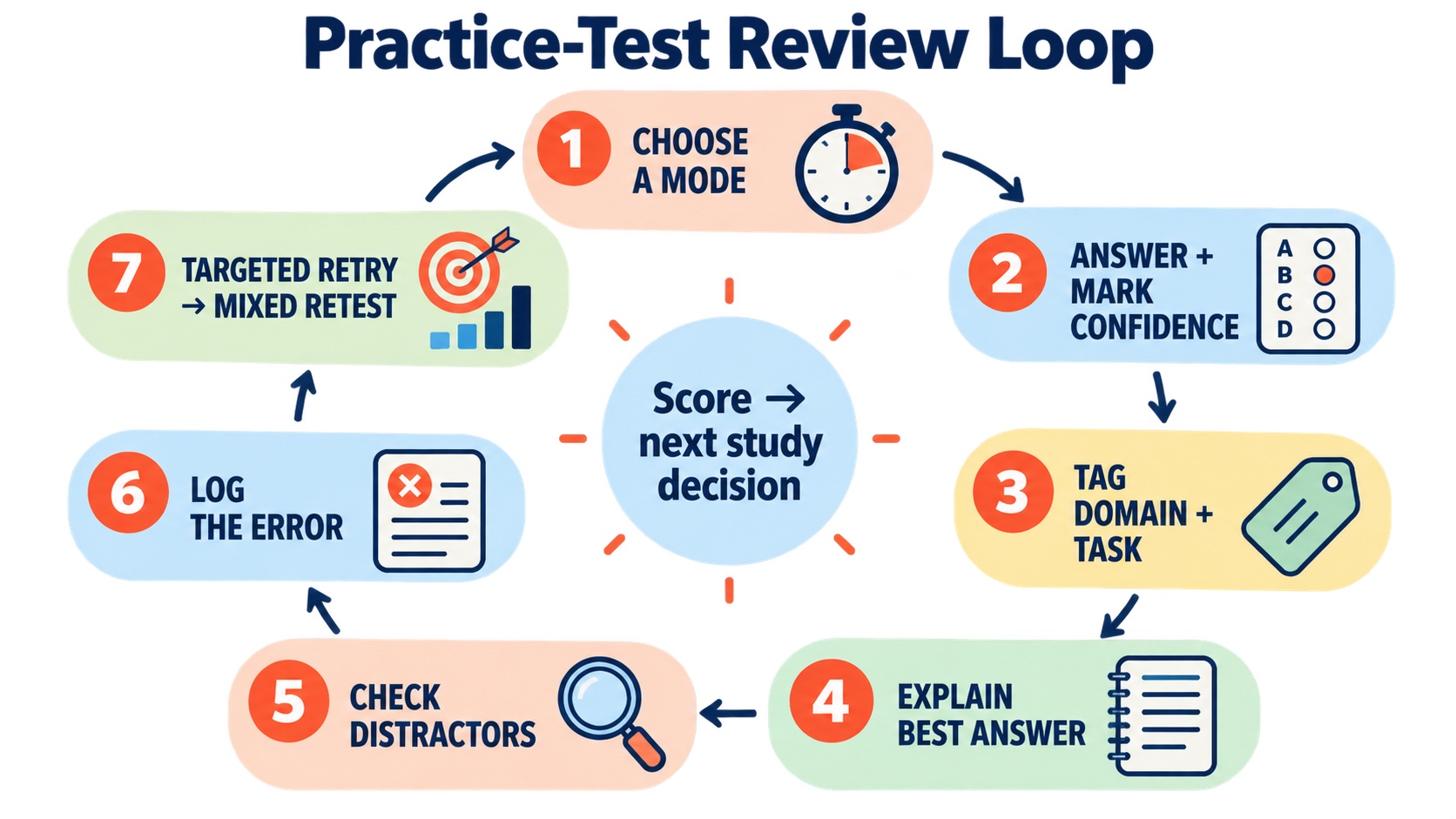
Use a mixed set without stopping after every item. Mark your confidence before checking feedback: sure, uncertain, or guess. A wrong answer marked “sure” may signal a conceptual misconception. A correct answer marked “guess” may signal fragile knowledge. That confidence label often tells you more than a percentage alone.
Mode 3: timed rehearsal
Use an 85-question, 90-minute practice session when the goal is pacing and sustained attention. Practice reading the stem, identifying the role and facts, selecting the best answer, and moving on when an item is consuming too much time. Flag uncertainty if the platform allows it, but do not manufacture pressure during every study session. Timed rehearsal should come after you have a basic method for reviewing content.
The three modes can use the same question bank, but they should not be interpreted the same way. Untimed practice measures learning with feedback. Mixed diagnostic practice measures patterns of understanding. Timed rehearsal adds pacing and fatigue. Keeping those purposes separate makes your next study decision clearer.
Review wrong answers instead of chasing a score
After each set, turn every meaningful miss into a small record. Start with the decision the question asked you to make, not the letter of the answer. Then classify the reason for the miss:
- Knowledge gap: you did not know the term, procedure, or definition well enough to retrieve it.
- Discrimination error: you knew both concepts but confused them in the scenario.
- Application error: you knew the rule but did not connect it to the facts in the stem.
- Reading error: you missed a qualifier such as “most appropriate,” “first,” “observable,” or “under supervision.”
- Pacing error: fatigue or time pressure changed how carefully you read or checked the options.
Next, record the content area and task if the practice provider supplies them. Write a short rationale in your own words, then explain why each tempting distractor is less suitable. For a measurement item, you might need to revisit the response dimension and observation window. For a behavior-acquisition item, you might need to distinguish prompting from reinforcement. For an ethics item, you might need to identify the RBT’s role and the step that belongs with the supervisor.
Finally, schedule a targeted retry. A retry should use a new scenario, not the same sentence with the answer memorized. If the distinction holds in a new example, add it to a later mixed set. If it fails again, return to a theory block, glossary entry, training note, or supervisor-led explanation before taking another full-length test.
What to do after your practice result
A low practice result is not a certification decision. First, check whether the result came from a broad knowledge gap, one heavily missed content area, unfamiliar wording, or poor pacing. Choose two high-value repair targets instead of trying to reread everything at once. Use short targeted questions, explain the rationale aloud or in writing, and then retest with new examples.
An uneven result deserves a domain-and-task review. If you missed several behavior-acquisition items, look for the shared decision: prompting, shaping, chaining, reinforcement, or generalization. If documentation and ethics items are weak, check whether you are confusing objective reporting with interpretation or stepping beyond the RBT role. A domain label is a starting clue, not a complete diagnosis.
A strong result is useful evidence that you handled that practice set. It is not proof that every current task is ready, and it cannot predict a BACB result. Try a fresh mixed set, change the examples, and make sure you can explain why the wrong options are wrong. Consistency across new scenarios is more informative than repeating one familiar test until the answers feel automatic.
A seven-day RBT practice routine
- Day 1 — Verify the map: save the current third-edition outline, list the six content areas, and choose one study goal for the week.
- Day 2 — Run a short diagnostic: use a mixed set, mark confidence before feedback, and identify the two most useful repair targets.
- Day 3 — Repair one larger area: study a Behavior Acquisition or Behavior Reduction cluster, then answer new scenario questions without notes.
- Day 4 — Repair one smaller area: practice data, assessment, documentation, or ethics so that coverage does not become an excuse to ignore a weak domain.
- Day 5 — Review errors: classify misses, write distractor explanations, and schedule targeted retries.
- Day 6 — Rehearse pacing: complete an 85-question, 90-minute set if you are ready for a full simulation. Treat the result as practice evidence.
- Day 7 — Retest and choose: use new examples for the recurring errors, then decide whether you need theory, targeted questions, another mixed set, or a longer mock session.
Common practice-test mistakes
Using a page that hides its edition
A current-looking title is not enough. If a resource does not identify the outline edition or explain when it was checked, treat its coverage claims cautiously.
Calling 75 questions the whole current exam
The BACB describes 85 questions in the RBT examination, including 75 scored and 10 unscored questions. A 75-question practice set can still be useful, but it should be labeled as a shorter practice format rather than presented as the complete current exam length.
Memorizing answer letters
Answer patterns are not transferable knowledge. Change the scenario and ask what evidence makes the best option fit the RBT role and the current task.
Interpreting one score as a guarantee
The BACB does not endorse specific study guides, and buying preparation material does not guarantee passing. An independent score belongs to that practice set. Use it to decide what to do next.
Confusing practice with eligibility
A practice test cannot replace the 40-hour training, Initial Competency Assessment, application, approved determination, or other current eligibility steps. Those requirements belong to the BACB Handbook and application process.
Ready to turn a practice set into a study loop?
ABA Study Online provides original, unofficial RBT practice questions for checking concepts and building a review record. Use the website for longer practice sessions, then use the ABA Study Online app for short flashcards, section review, progress checks, and saved mistakes between sessions.
FAQ and official sources
How many questions are on the current RBT exam?
The BACB lists 85 questions: 75 scored questions and 10 unscored questions. A full-length practice test can use 85 questions to rehearse the overall format, but it cannot identify which practice items would be scored on the real examination.
How long should an RBT exam practice test take?
For a full simulation, use the real 90-minute boundary. For learning, shorter untimed sets are often more useful because they leave room to read explanations and repair a concept.
Is an online RBT practice test the real exam?
No. The BACB examination is delivered in person through computer-based testing at authorized Pearson VUE sites. An online practice test can simulate questions and timing, but it is an independent educational resource.
What if my practice score is low?
Classify the misses, choose two repair targets, review the relevant concepts, and retest with new examples. Do not use a fixed percentage as an official readiness or passing rule.
Are ABA Study Online RBT questions official?
No. ABA Study Online questions, explanations, and practice tests are original, unofficial educational materials. They are not BACB-endorsed and do not reproduce live or retired examination content.