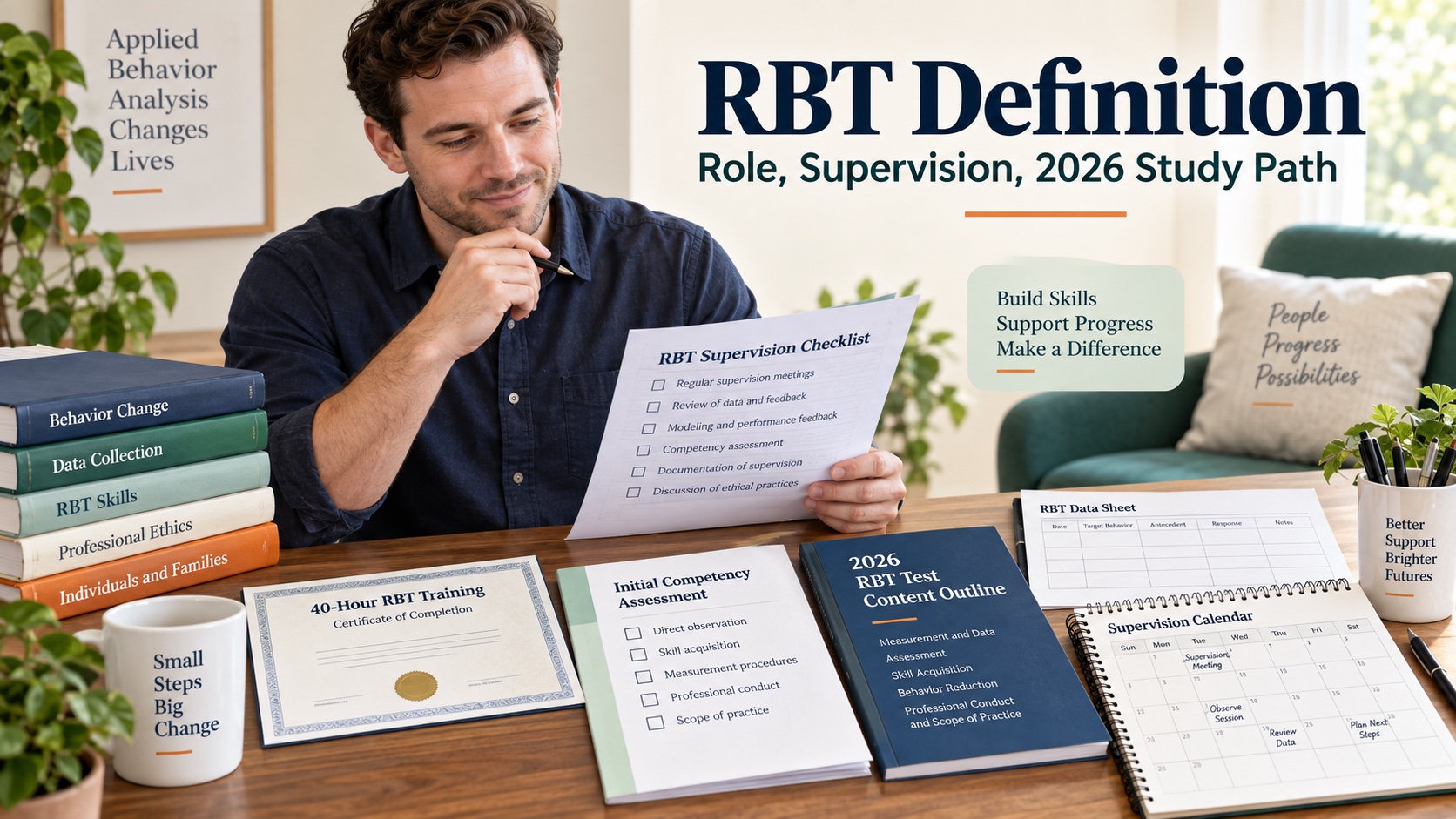
RBT Definition: What a Registered Behavior Technician Does
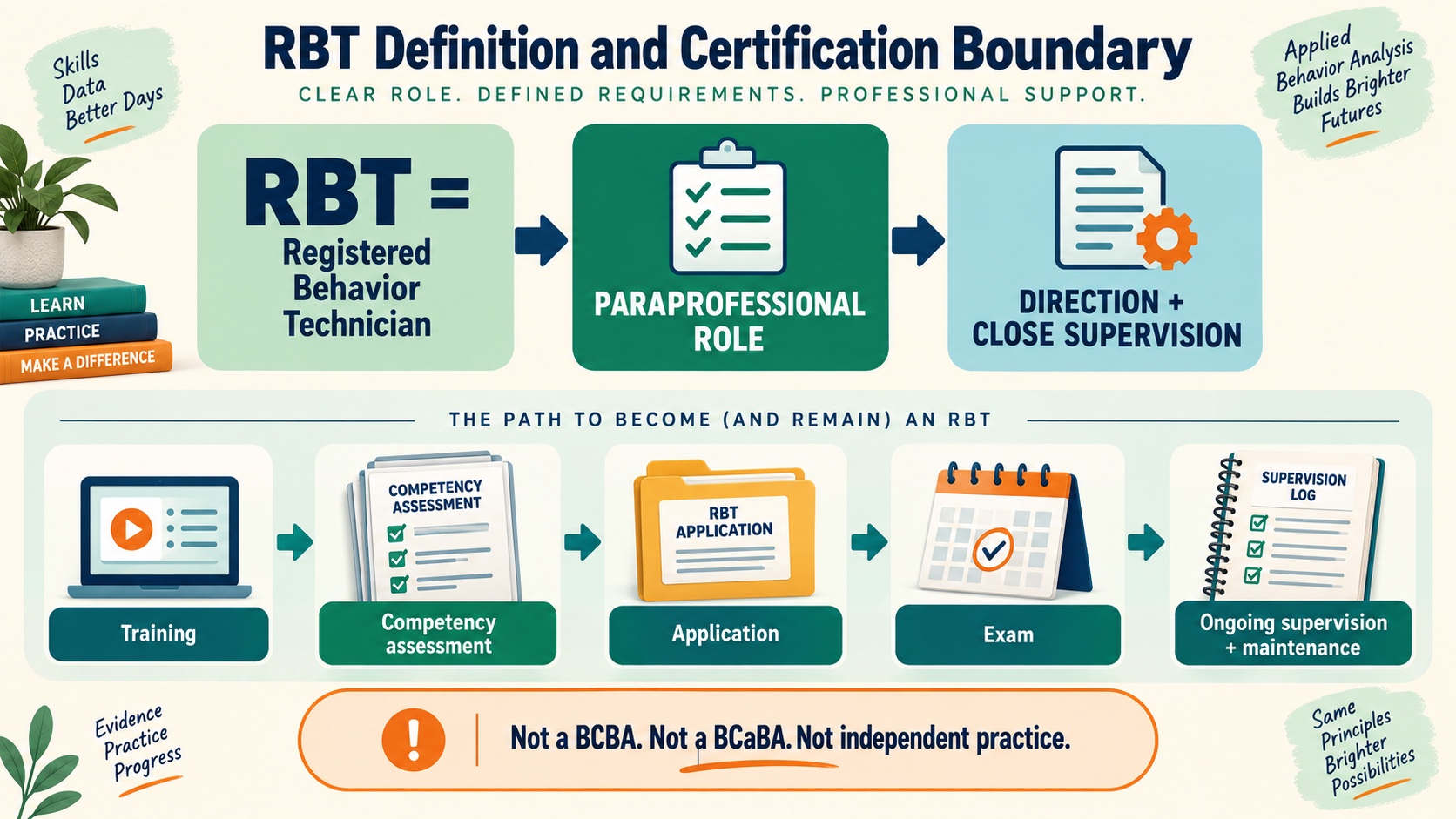
If you are looking for an RBT definition, the most useful answer has two parts: what the credentialed role is and what the role is not. A Registered Behavior Technician (RBT) is a paraprofessional certified in behavior analysis who assists with delivering behavior-analytic services under the direction and close supervision of an RBT Supervisor and/or RBT Requirements Coordinator.
That definition describes a supervised service-delivery role. It does not mean that an RBT is a BCBA, a BCaBA, an independent practitioner, or a person who can skip the current training, competency assessment, application, examination, and maintenance requirements. This guide explains the role in plain language and connects the definition to the current 2026 certification context.
Quick answer: RBT stands for Registered Behavior Technician. The BACB describes an RBT as a paraprofessional certified in behavior analysis who assists in delivering behavior-analytic services and practices under the direction and close supervision of an RBT Supervisor and/or RBT Requirements Coordinator who is responsible for the work performed. The RBT definition is about a supervised professional role; it is not a promise of independent practice.
What an RBT does
An RBT may help implement behavior-analytic programs designed and overseen by qualified supervisors. Depending on the setting and the plan, the work may include preparing materials, following teaching or behavior-reduction procedures, recording observable data, communicating session information, and participating in supervision and training. The exact tasks depend on the service plan, employer, client needs, and supervisor directions.
A helpful way to think about the role is “implement, observe, document, and communicate.” An RBT follows the current procedures, notices what happens, records behavior or skill information according to the plan, and brings questions or concerns to the supervisor. The RBT should not quietly redesign an intervention, interpret a complex clinical question alone, or promise a particular outcome to a family.
Where the definition applies
The title may appear in homes, schools, clinics, community programs, or other service settings, but the setting does not remove the supervision requirement. The materials, schedule, data system, and communication routine may look different from one workplace to another. The stable part of the definition is the relationship: the RBT assists with behavior-analytic services while the responsible supervisor or coordinator directs and oversees the work across the service team in every eligible setting.
For example, a supervisor may create a communication program that uses prompting and reinforcement. The RBT can prepare the materials, run the steps, record the agreed data, and report barriers or changes. If the learner stops responding or the procedure appears unsafe, the RBT should pause as directed and contact the responsible supervisor. The example illustrates role boundaries; it is not a universal treatment protocol.
The supervision boundary
Close supervision is central to the definition. The current RBT resource page identifies an RBT Supervisor and/or RBT Requirements Coordinator as responsible for the work performed. This means that the RBT’s daily activity belongs inside a supervision structure. The supervisor provides direction, feedback, training, and oversight appropriate to the role and the organization.
Supervision is not just a signature at the end of a form. A useful supervision relationship gives the RBT a way to ask questions, review data, practice skills, discuss ethics, and receive feedback. If an employer asks an RBT to make a decision outside the person’s training or role, the RBT should use the organization’s escalation process and contact the responsible supervisor.
RBT definition versus RBT certification
The role definition is not the same thing as the application route. The current RBT path includes several separate steps:
- Meet eligibility conditions: review the current handbook for age, education, background-check, and other applicable requirements.
- Complete the required training: the current 40-hour training rules and date window apply to the application period.
- Complete the initial competency assessment: the assessment uses the current packet and timing rules; a course quiz is not automatically the official assessment.
- Submit the application: keep the training certificate, assessment records, attestation, and other required documents.
- Take the examination: follow the current application determination and scheduling instructions.
- Maintain the certification: continue the required supervision, ethics, renewal, and professional-development steps.
Finishing a class can help someone learn the vocabulary and procedures, but it does not by itself make the person an RBT. Certification depends on the current BACB process. Likewise, having the credential does not mean that every task is appropriate in every workplace; role, competence, supervision, and the current service plan still matter.
What the 2026 update changes for study
The RBT resource hub identifies the RBT Test Content Outline, 3rd edition, as the exam-content reference beginning January 1, 2026. If you are studying now, check that your notes, flashcards, videos, and practice questions use the current outline. An old “RBT task list” label can be confusing if the material does not tell you which edition and date it follows.
The 2026 update does not change the basic definition into independent practice. The RBT remains a paraprofessional who works under close supervision. What changes for a learner is the need to align study materials with the current content outline, training requirements, competency packet, application instructions, and maintenance resources. Keep each source dated so that you know whether it is current, historical, or only a general teaching explanation.
Common misunderstandings
- “RBT means behavior analyst”: RBT is a specific paraprofessional credential and role.
- “An RBT can work independently”: the BACB definition places the role under direction and close supervision.
- “A course certificate equals certification”: training is one step; assessment, application, exam, and maintenance remain separate.
- “Supervision is only paperwork”: effective supervision includes direction, feedback, training, and oversight.
- “Any old study guide is current”: check the RBT 3rd-edition content reference and the current handbook.
- “The RBT decides the treatment plan”: implementation questions and clinical changes should go through the responsible supervisor.
FAQ
What does RBT stand for?
RBT stands for Registered Behavior Technician. It is a paraprofessional certification in behavior analysis.
What is the difference between an RBT and a BCBA?
An RBT implements behavior-analytic services under close supervision. A BCBA is a graduate-level professional who can practice independently and supervise RBTs and BCaBAs, subject to applicable rules and responsibilities.
Can an RBT change a client’s behavior plan?
An RBT should not independently redesign a plan. Questions, barriers, safety concerns, and possible changes should be communicated to the responsible supervisor through the organization’s process.
Can ABA Study Online certify me as an RBT?
ABA Study Online can provide explanations, free study materials, and practice resources, but it is not the BACB and cannot make a certification decision or guarantee an examination result.
For study support, see the RBT learning path, RBT practice questions, and ABA glossary.