RBT Course Online: How to Choose a Current Program
If you are looking for an RBT course online, you may want flexibility without wasting time or paying for a program that cannot explain its current documentation. Online delivery can be a valid format, but a course page is not the same thing as a certification application. The useful comparison is more specific: Does the course follow the current 2026 outline? Can you complete it within the required window? Who is responsible for the training? What will the certificate document? What happens after you finish?
This guide gives you a practical checklist for comparing online programs. It does not rank providers or promise certification. Before enrolling, compare the course with the current BACB RBT Handbook and the RBT 2026 40-Hour Training Requirements and Curriculum Outline.
Table of Contents
Short answer: can an RBT course be online?
Yes. The current RBT Handbook allows the required 40-hour training to be offered through an online training program, an employer, or a university. Online is a delivery format, not an approval label. The program still needs to satisfy the current curriculum, timing, instructional, trainer, and documentation requirements.
Look for a program that explains how it covers the 2026 outline in the context of behavior technician service delivery. The training must total at least 40 hours and be completed over no fewer than 5 days and no more than 180 days. A completion screen alone does not show that the course meets those conditions.
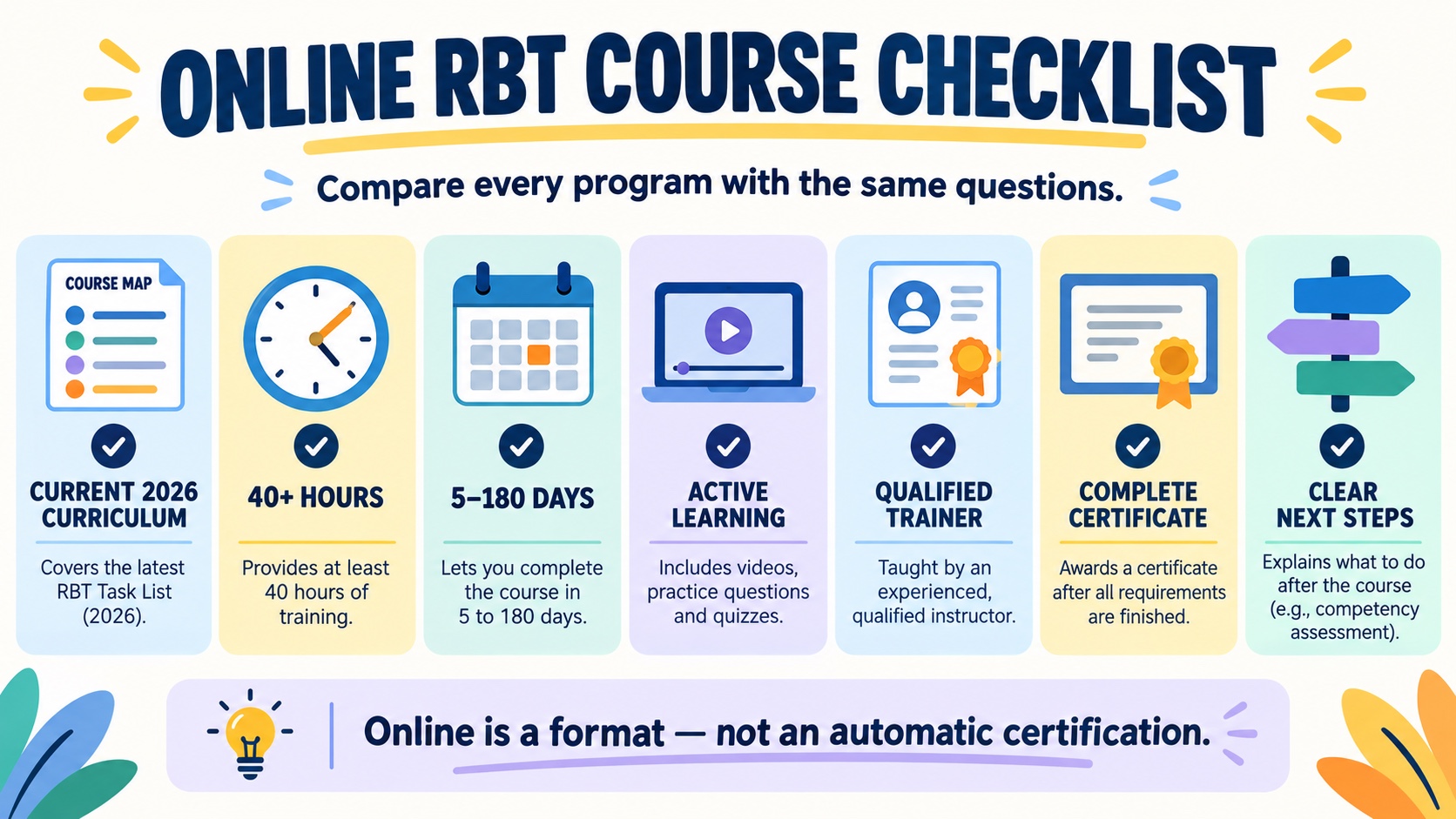
An online RBT course comparison checklist
| Check | What a clear program should explain |
|---|---|
| Current curriculum | How the lessons map to the 2026 RBT 40-hour outline rather than an unlabeled older course. |
| Total time | At least 40 hours of training, with a record of the time actually spent engaged in the course. |
| Calendar | How the platform records a start date and completion date within the 5-to-180-day window. |
| Learning activities | Examples, modeling, practice, feedback, quizzes, interactive activities, or discussion—not only assigned reading. |
| Trainer | The responsible trainer’s role, qualification, and oversight process are identifiable. |
| Certificate | The provider explains what the completion certificate contains and how it will be delivered. |
| Next steps | The course clearly separates competency assessment, application, examination, and supervision. |
Price and speed can matter to a learner, but they should come after the compliance and learning checks. A low-cost program that leaves you unsure about the certificate or the current outline may create more work later. A more expensive program is not automatically better either; ask for evidence of the things that affect your application and learning.
What to look for in the learning design
A useful online course helps you connect a concept to the behavior technician role. A lesson on measurement should do more than define frequency or duration. It should help you choose an observable measure, record it accurately, recognize a graph, and report what the data show. A lesson on behavior change should show how an RBT follows a written plan, implements prompting or reinforcement as directed, records the response, and communicates with the supervisor.
Look for a course that includes:
- Clear module outcomes: you can tell what you should be able to explain or do after the lesson.
- Concrete examples: scenarios show the difference between an observable description and an interpretation.
- Active practice: you answer, classify, graph, role-play, or make a decision rather than only watching.
- Useful feedback: explanations show why an answer or procedure fits the scenario.
- Role boundaries: the program does not teach an entry-level technician to independently redesign assessment or treatment decisions.
- Accessible support: you know how to ask a content question and how the provider handles technical problems.
Self-paced does not have to mean unsupported. Before paying, check whether the course has a visible help channel, reasonable progress information, captions or transcripts when needed, and a way to recover your record if a platform problem interrupts completion.
Also ask how the course handles pauses, technical failures, and a change in your schedule. A clear answer helps you protect both the learning experience and the completion record, especially when the course window is measured in calendar days rather than only login time.
Timing, trainer, and certificate records
Track the dates
Save your start date, planned finish date, and final completion date. The current requirement is no fewer than 5 days and no more than 180 days, counting the start and end dates. If the platform does not make dates easy to verify, ask how the provider will document them before you begin.
Check the responsible trainer
The current training outline describes a responsible trainer who is a BCaBA, BCBA, or BCBA-D with the required supervision training. Some training can be delegated to assistant trainers under the outline’s conditions. A program should be able to identify who is responsible for the training and how records are maintained.
Read the certificate before you need it
The current certificate requirements include the applicant’s name and BACB ID, training start and end dates, the amount of time spent in training, responsible-trainer information, assistant-trainer information when applicable, and the required statement that the program is designed to meet the 2026 eligibility requirement and is offered independent of the BACB. Keep the certificate with your other application records.
What happens after the course?
Course completion is one stage of the RBT pathway. The Initial Competency Assessment is a separate demonstration of skills. The certification application, relevant background and registry checks, examination authorization, and examination are also separate steps. After certification, RBT practice takes place under the direction and close supervision described in the current handbook.
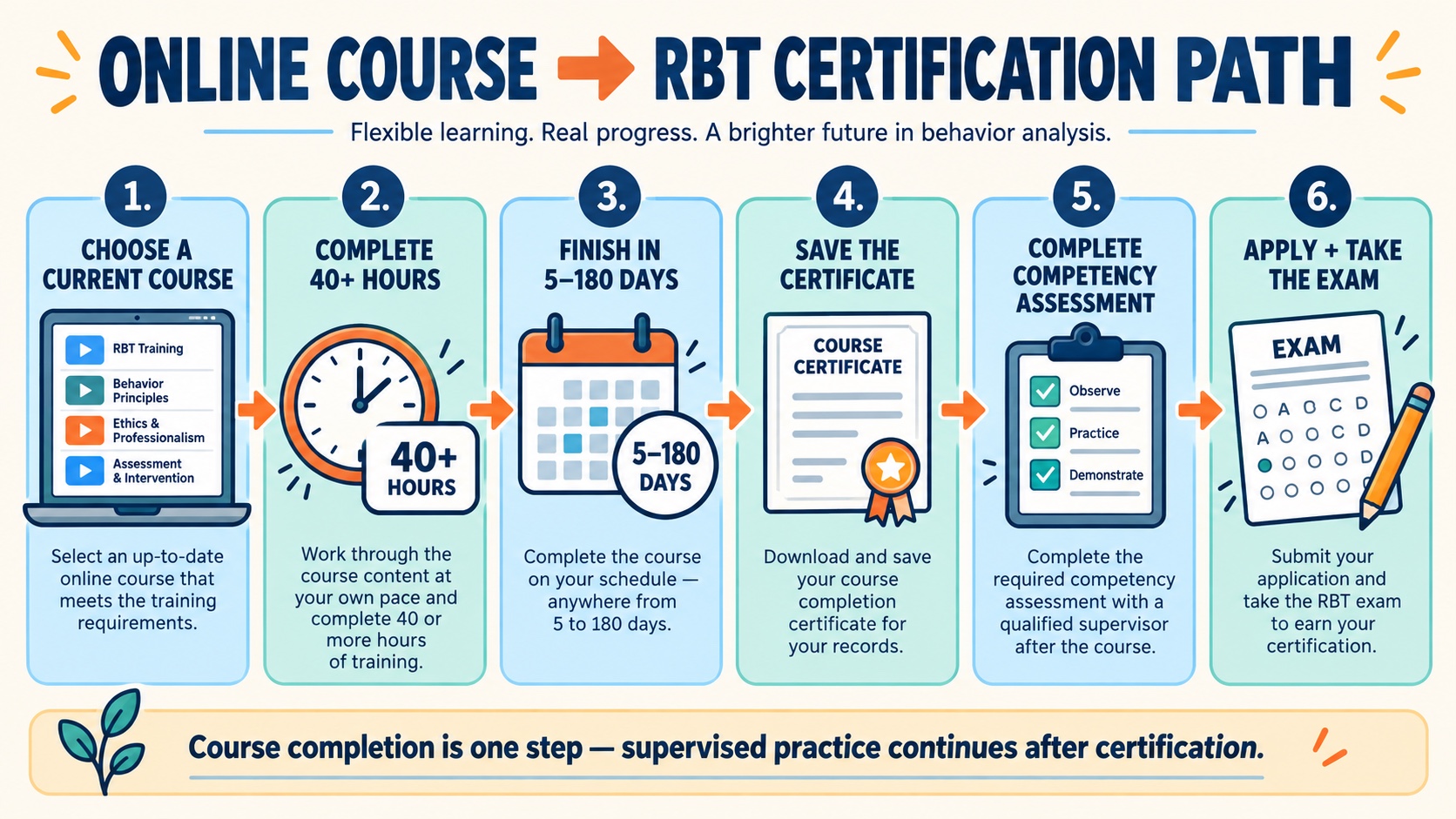
This is why “online RBT certification” deserves careful reading. A provider may be describing an online training course, but no course completion page can erase the remaining certification requirements. Compare the provider’s description with the official handbook before relying on the wording.
Red flags before you enroll
Pause when a program:
- calls itself an official BACB course or promises BACB approval without a precise source;
- does not identify the current training outline or responsible trainer;
- offers only reading and a final quiz while counting every minute as training time;
- encourages completion outside the current 5-to-180-day window;
- promises that the course makes you certified or guarantees a passing score;
- treats a course quiz as the Initial Competency Assessment; or
- cannot explain how you will receive and correct the certificate.
A red flag is a reason to verify, not automatic proof of misconduct. The BACB’s current handbook and training outline should control when a marketing page is vague or contradictory.
How to use the course as study
Make a small study record alongside your course progress. For each module, save one plain-language definition, one observable example, one data or procedure decision, and one question for your supervisor. Organize review by the current RBT exam domains: data collection and graphing, behavior assessment, behavior acquisition, behavior reduction, documentation and reporting, and ethics.
When you miss a practice item, classify the reason. Was it a measurement problem, a prompt or reinforcement distinction, a role-boundary mistake, a documentation issue, or a rushed reading of the scenario? This makes an online course more than a completion task.
You can use the RBT learning path for structured review, free RBT questions for application practice, the ABA glossary for quick definitions, and the ABA Study Online app for repeatable review. These are learning resources, not BACB endorsements, certification services, or provider recommendations.
FAQ and official sources
Is an online RBT course valid?
Online delivery can be valid when the program meets the current RBT 2026 training requirements, timing window, instructional expectations, trainer conditions, and certificate rules.
How long does an online RBT course take?
The current training must include at least 40 hours and be completed over no fewer than 5 days and no more than 180 days. A provider may structure the learning differently within that boundary.
Does finishing an online course make me an RBT?
No. Competency assessment, application, applicable checks, examination, and supervised practice remain separate parts of the pathway.
Does the BACB recommend online course providers?
No. The BACB publishes requirements and resources but does not provide or recommend a 40-hour training program. Compare a provider’s current documentation with the official sources.