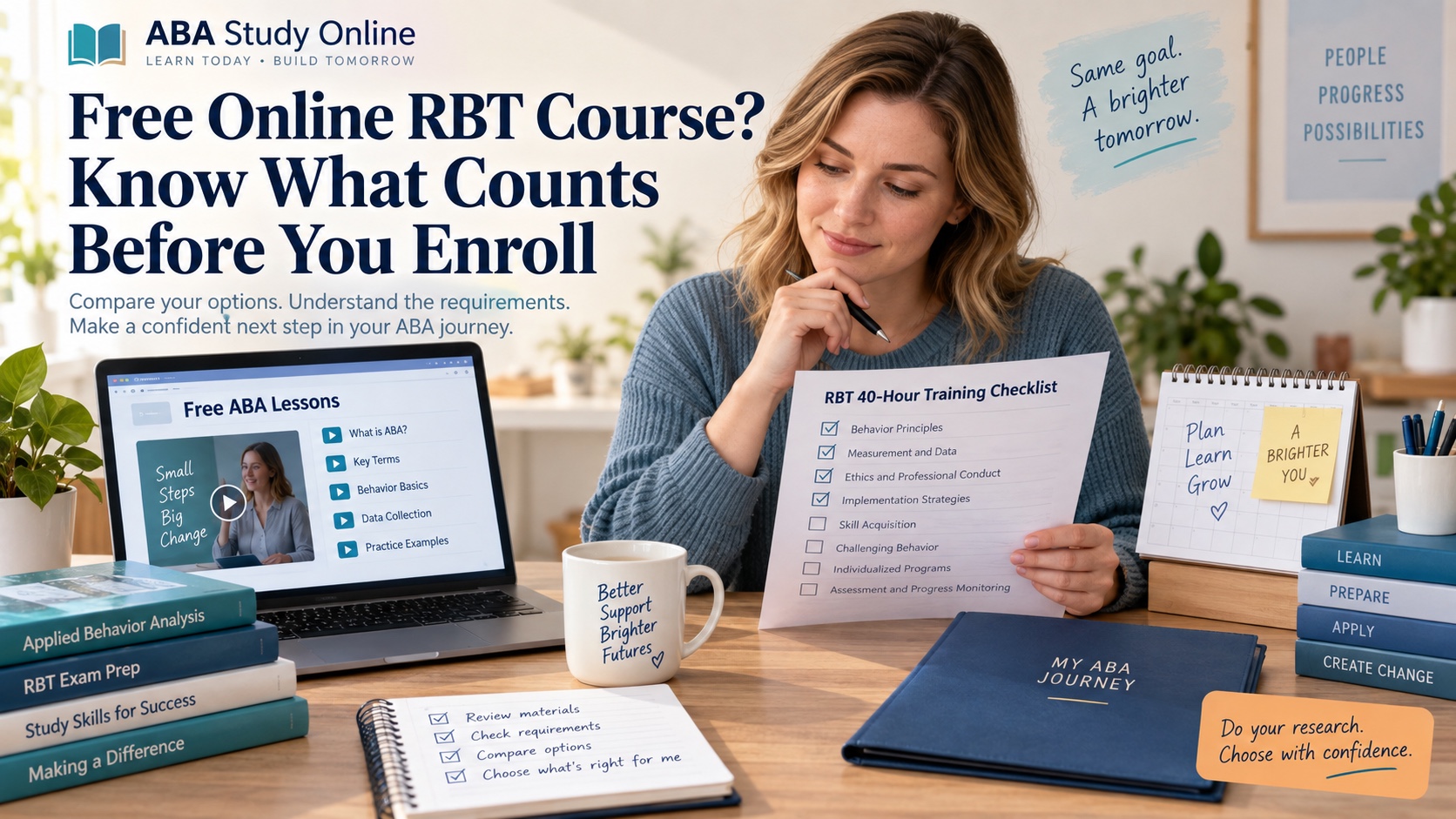
Free Online RBT Course? Know What Counts Before You Enroll
If you are searching for an RBT course online free, you may be looking for an affordable way to learn ABA basics or complete the training stage for certification. Those are different goals. A free glossary, video series, quiz, or app preview can help you learn, but it is not automatically a qualifying 40-hour RBT training program.
The current BACB requirements are the safest comparison point. Review the RBT Handbook and the 2026 RBT 40-Hour Training Requirements and Curriculum Outline before you rely on any course for an application.
Table of Contents
Short answer: can an RBT course be free and online?
Online delivery can be part of a qualifying 40-hour training program, and some ABA learning materials can be free. But “online” and “free” do not prove that a course meets the current RBT training requirements. Check the curriculum, hours, completion window, active learning, trainer qualifications, records, and certificate.
Use the word “course” carefully. A page that teaches one concept may be a study lesson. A qualifying 40-hour program is a documented training experience with a defined curriculum and responsible oversight. If a provider cannot explain that difference, do not assume that a completion badge will support an application.
Free study resource versus qualifying training
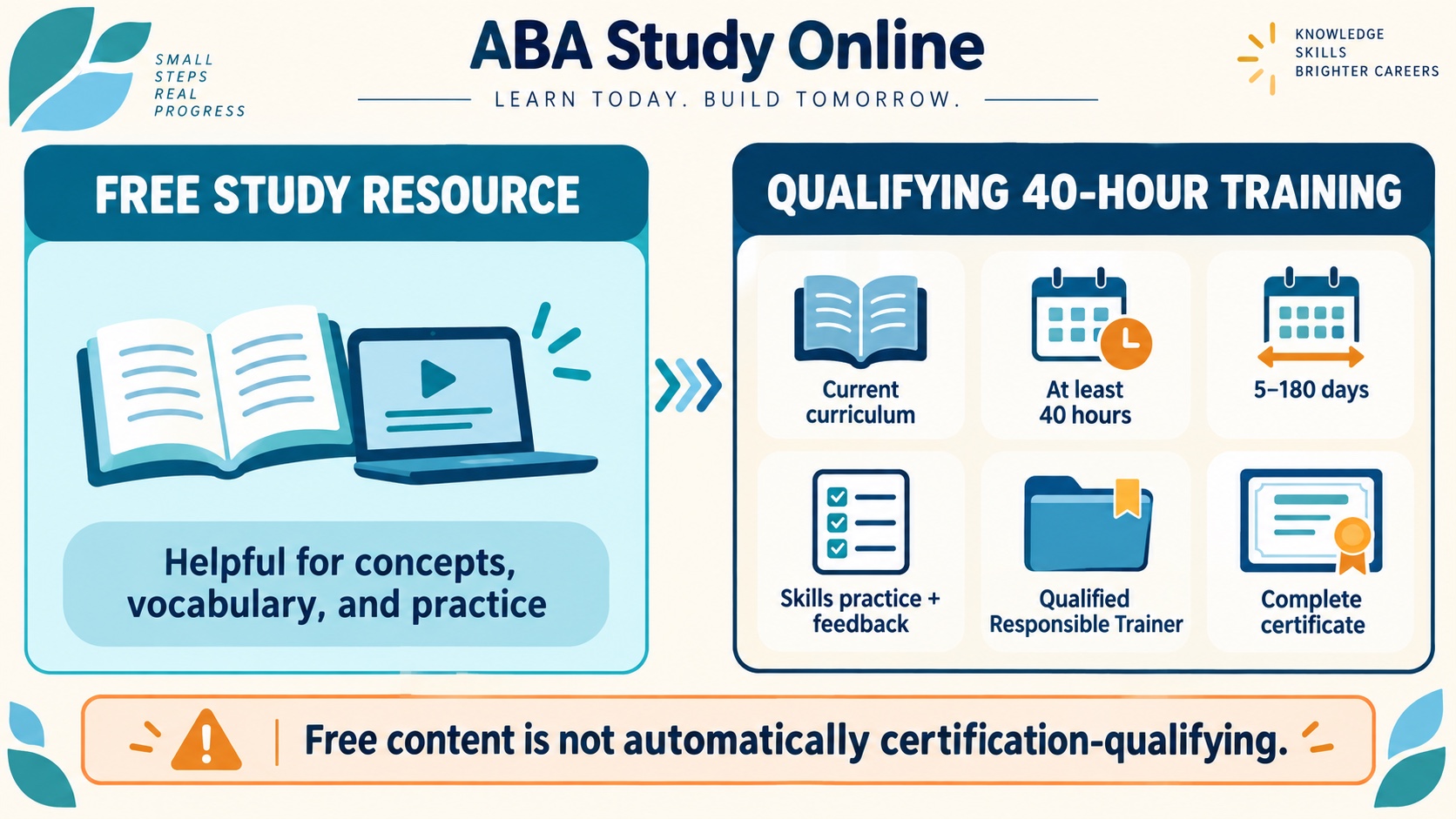
A free study resource may include articles, flashcards, videos, sample questions, a glossary, or a short introductory course. These resources are useful for building vocabulary and deciding whether RBT work interests you. They can also help you prepare before formal training or review after a lesson.
A qualifying program must answer more specific questions. What current RBT curriculum does it cover? How is the 40-hour duration recorded? When does the five-to-180-day window begin? What modeling, feedback, quizzes, interactive activities, or instructor discussion are included? Who is the Responsible Trainer, and what does the certificate document?
“Free” can describe access while you learn; it cannot remove the requirements that make training qualifying. A free resource should be labeled honestly as study support unless the provider can show that the complete program meets the official standard.
The current 40-hour requirements
For applicants applying on or after January 1, 2026, the training must cover the current RBT 2026 curriculum and total at least 40 hours. The training must be completed in no fewer than 5 days and no more than 180 days. The official outline allows online, in-person, or blended delivery, but assigned reading alone cannot count toward the overall duration.
The training must include behavioral-skills-training components. The official outline gives examples such as video-based or didactic instruction, modeling with examples and nonexamples, in vivo role-play with feedback, content quizzes, interactive activities, and instructor-led discussion. A playlist with no completion record or feedback process may be educational without being a qualifying program.
A qualified Responsible Trainer oversees the training and the documentation. The current outline describes a Responsible Trainer who is a BCaBA, BCBA, or BCBA-D with the required supervision training, subject to the official conditions. The certificate should identify the training and applicant details required by the source document.
What online delivery should explain
An online provider should make the learning experience visible. Look for a course map, progress record, completion window, interactive tasks, opportunities for feedback, and a way to contact the trainer. “Self-paced” can be a valid format, but it should not mean that the provider cannot tell you how time and participation are documented.
Ask how role-play is delivered. Does the course use live sessions, recorded demonstrations, submitted practice, or another method? How do you receive feedback? Which activities are required, and which are optional? These details help you distinguish a structured training program from a collection of free lessons.
Also check whether the page uses unsupported language. “BACB-approved course,” “guaranteed RBT certification,” and “real exam questions” are not substitutes for the current handbook and training outline. Independent study content should say what it is and what it is not.
Pay attention to the difference between a preview and a complete program. A preview may show the teaching style or one module while leaving the full curriculum, assessment activities, trainer review, and certificate process inside a paid or supervised program. That is not necessarily a problem; it simply means you should not evaluate the preview as if it were the entire training experience.
A checklist before you enroll
- Read the outline: confirm that the program maps to the current RBT 2026 curriculum.
- Check the clock: confirm at least 40 hours, five-to-180-day completion, and how progress is recorded.
- Check the learning: look for instruction, modeling, practice, feedback, quizzes, or discussion—not reading alone.
- Check the trainer: identify the Responsible Trainer and ask how oversight works.
- Check the certificate: ask what information appears on the final documentation and how you receive it.
- Keep the boundary: remember that training is one stage; competency assessment, application, examination, and supervision remain separate.
If the provider cannot answer these questions before payment, save the page and ask for clarification. A transparent answer is more useful than a large discount or a countdown timer.
Keep a copy of the course description and the final certificate together. If the course changes its page later, your saved record shows what you evaluated and what the provider documented when you completed the training.
This habit makes later questions much easier to answer before you make an application decision or ask a supervisor for help about the course.
How to use free materials safely
Free content still has a valuable place in your plan. Use it to learn basic ABA vocabulary, practice measurement distinctions, review ethics concepts, and decide which questions to ask during formal training. Keep a short list of concepts you understand and concepts that need an instructor’s explanation.
After you enroll in a qualifying program, continue using free resources as review, not as a replacement for the required course activities. Practice questions can help you identify a gap, but they do not sign a certificate or conduct the Initial Competency Assessment. Use the current BACB packet when you reach that stage.
FAQ and official sources
Is there a free RBT course that counts for certification?
Do not assume that a free course counts. Verify the complete current 40-hour requirement set, trainer oversight, active learning components, completion window, and certificate documentation with the provider and the BACB source documents.
Can the 40-hour RBT training be online?
Yes, the current outline allows online, in-person, or blended delivery. Online format still needs the required curriculum, duration, behavioral-skills-training components, qualified oversight, and documentation.
Does a free RBT course make me certified?
No. Training is one step in the pathway. The competency assessment, application, examination, and ongoing supervision requirements remain separate.
Official sources: Start with the RBT Handbook, the 2026 RBT 40-Hour Training Requirements and Curriculum Outline, and the BACB’s RBT guidance page.