RBT Competency Test: Assessment or Certification Exam?
Searching for an RBT competency test can be confusing because people use “test” for two different steps. One is a practical competency assessment in which an evaluator documents whether required RBT skills have been demonstrated. The other is the BACB certification examination, a separate multiple-choice appointment delivered through Pearson VUE. They are connected parts of the certification journey, but they are not the same test.
The safest first step is to identify which document or deadline you are facing. If you have completed the required training and need an initial competency assessment, study the current assessment packet and coordinate with a qualified assessor. If you have already completed the eligibility steps and received approval to test, prepare for the certification examination using the current RBT Test Content Outline and Handbook. A practice-question score cannot replace the practical assessment, and a skills demonstration cannot replace the certification examination.
Table of Contents
Short answer: what does RBT competency test mean?
In everyday search language, RBT competency test usually means one of these:
- Initial competency assessment: a practical evaluation completed after the required training and before the RBT certification application route is complete. The assessor documents demonstrations of required skills using the current BACB packet.
- Recertification competency assessment: a later assessment connected to maintaining an RBT credential. It uses its own current BACB requirements and packet; do not assume the initial and recertification documents are interchangeable.
- RBT certification examination: the separate multiple-choice examination required after the applicable eligibility and application steps. Current BACB examination information lists 85 questions and 90 minutes for the RBT examination.
When a website says “competency exam,” read the details before studying. Does it mention a supervisor or assessor, skill demonstrations, role-play, a client, or an assessment packet? That language points toward the practical assessment. Does it mention Pearson VUE, multiple-choice questions, a test center, the RBT Test Content Outline, or timed practice? That language points toward the certification examination.
The two assessments people may mean
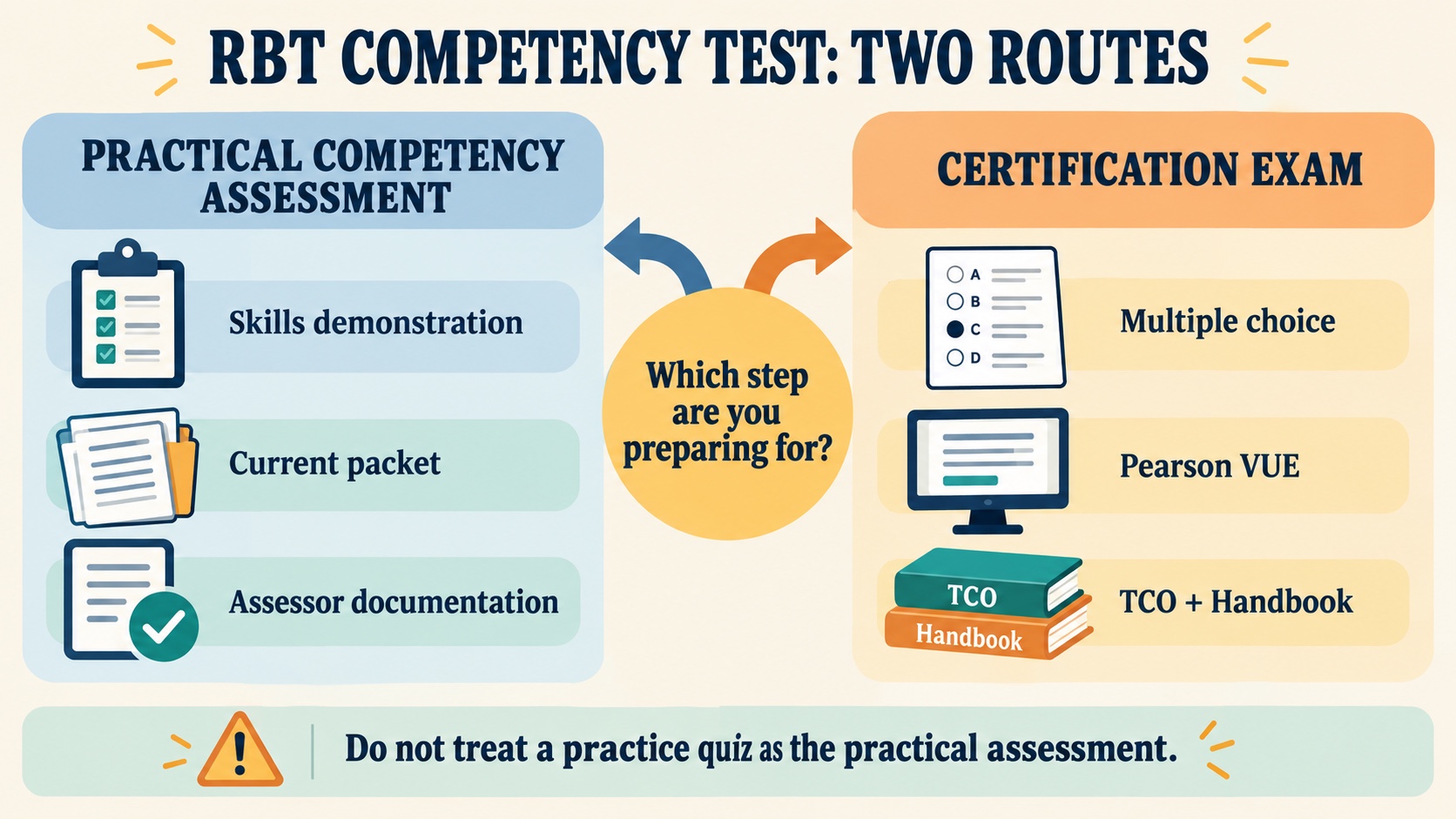
The practical assessment asks whether the applicant can demonstrate specified skills in the required assessment context. It is not simply a shorter version of the certification exam. An applicant may know the definition of a measurement procedure and still need to demonstrate how to implement it, record data, or update a graph.
The certification examination asks the candidate to select answers to multiple-choice questions. It samples knowledge and application across the current RBT examination blueprint. It does not function as a live observation of how a person performs a skill with a client or in a role-play.
This distinction also changes what “practice” should look like. Flashcards and scenario questions can support examination preparation. They can help with terminology, discrimination, and application. They cannot document that a candidate completed the official competency assessment. Conversely, repeated role-play and feedback can improve performance during a practical assessment, but they do not show whether the candidate can read and answer a timed multiple-choice form.
What the 2026 initial competency assessment involves
BACB’s current RBT resources identify an Initial Competency Assessment Packet effective January 1, 2026. The packet organizes the assessment into skill areas such as measurement, assessment, skill acquisition, behavior reduction, documentation, and professional conduct. The exact instructions, required signatures, assessment options, and version details belong to the current BACB document, so use the packet itself rather than an old checklist copied by a study website.
The current packet lists 19 task items. Some tasks allow an assessment with a client or through role-play. Within the skill-acquisition and behavior-reduction group, three tasks must be demonstrated with a client. That detail matters because a learner cannot safely assume that every item can be completed by talking through a hypothetical example.
A practical assessment may require the applicant to show actions such as:
- implementing continuous or discontinuous measurement procedures;
- entering data and updating graphs;
- conducting a preference assessment;
- collecting ABC data;
- implementing teaching, prompting, prompt-fading, chaining, shaping, or discrimination procedures;
- responding to behavior-reduction and documentation tasks within the RBT role; and
- demonstrating professional and ethical behavior under the applicable supervision structure.
This list is a study orientation, not a replacement for the official form. The current packet controls the task wording, acceptable assessment type, completion instructions, and submission expectations. If a supervisor, assessor, employer, or BACB resource gives a current instruction that differs from a general article, follow the applicable official or supervising instruction and resolve the question before the assessment.
How to prepare for the practical assessment
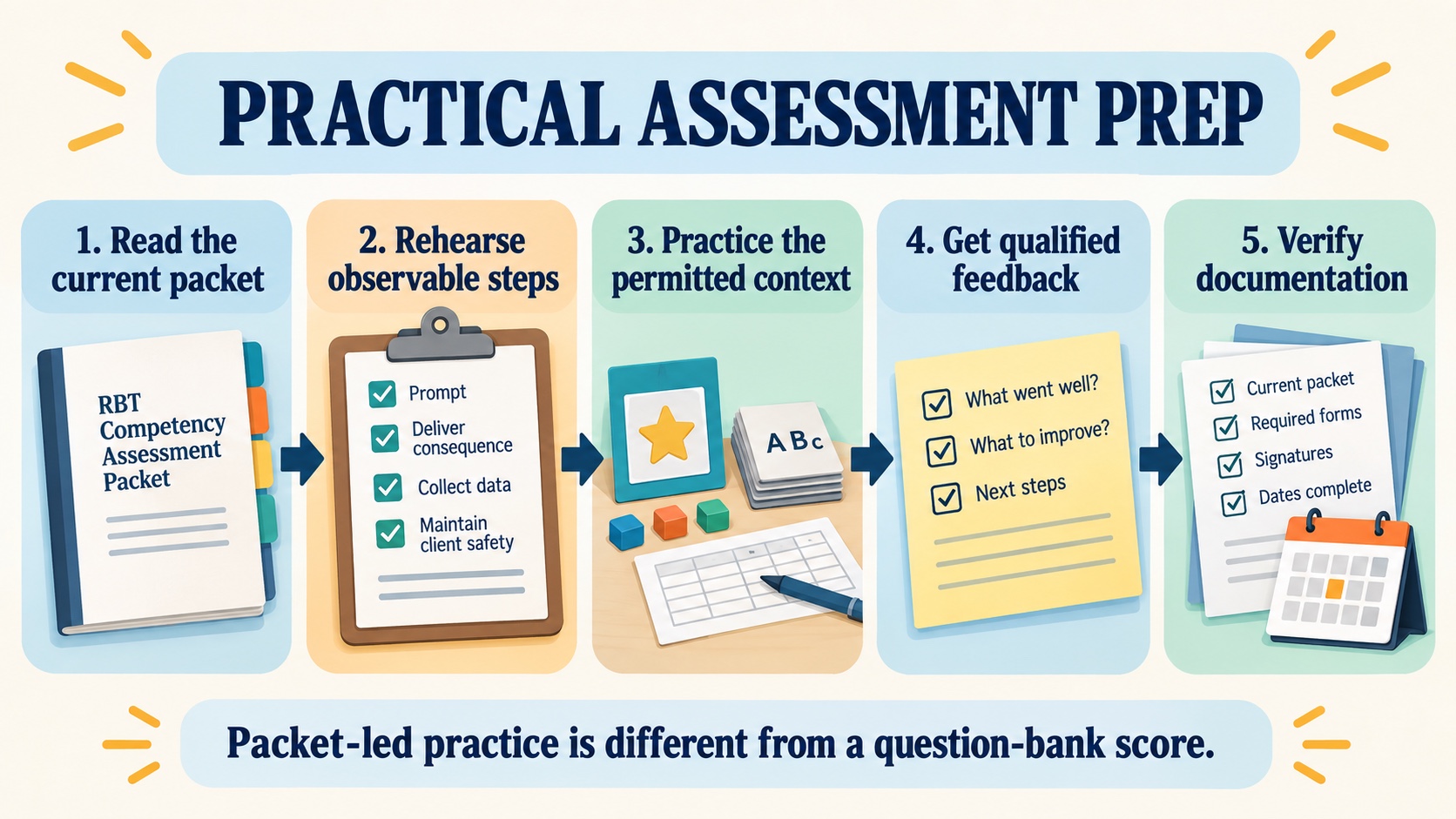
- Start with the current packet. Confirm the effective date and download the version linked from BACB resources. Keep the packet open while planning practice.
- Turn each task into observable steps. For a measurement task, identify the behavior dimension, define the scoring rule, practice recording, and explain what the resulting data mean. Avoid studying only labels.
- Rehearse the permitted context. Know whether the task may be assessed with a client, through role-play, or by another listed method. Do not invent a client scenario or arrange an assessment outside the assessor’s instructions.
- Ask for feedback on performance. Practice should reveal whether the step was clear, safe, accurate, and within the RBT role. A checklist is useful, but feedback from the responsible qualified professional is what makes the rehearsal meaningful.
- Separate knowledge gaps from performance gaps. If you cannot explain a term, return to instruction or flashcards. If you know the term but cannot implement the step, use demonstration, modeling, role-play, and feedback.
- Verify documentation before submission. Check names, initials, signatures, dates, task completion, and packet version according to the current instructions. Do not assume a screenshot or informal note is an accepted substitute.
Practice questions still have a place. A question about latency, preference assessments, prompting, or data integrity can help you retrieve the concept before you demonstrate it. But a question bank should be described as study support, not as the official competency assessment. The practical task is about what you can do and document in the required context.
How the certification examination is different
The RBT certification examination is a separate BACB examination delivered in person through authorized Pearson VUE testing sites. Current BACB examination information lists 85 questions and 90 minutes, with 75 scored questions and 10 unscored pilot questions. Candidates should answer all questions; they are not told which items are pilot items.
For the examination, prepare from the current RBT Test Content Outline and RBT Handbook. Use practice questions to rehearse careful reading, discrimination among answer choices, scenario application, and pacing. Review incorrect and uncertain answers with an error log. A practice result can show a study need, but it is not a BACB score prediction or certification result.
The examination route also has a different administrative sequence. Eligibility, application approval, scheduling, identification, accommodations, and test-center rules are governed by current BACB and Pearson VUE information. A website article should not promise that passing a practice set, completing an online quiz, or watching a video establishes eligibility.
A simple decision path
Use this quick check before opening a study resource:
- Are you being asked to demonstrate skills or complete a packet? Open the current Initial or Recertification Competency Assessment materials and confirm the assessor, context, and effective date.
- Are you scheduling a multiple-choice appointment? Open the current RBT examination resources, TCO, Handbook, and Pearson VUE information.
- Are you unsure which step is next? Ask the responsible supervisor, assessor, requirements coordinator, or the BACB through its official support route. Do not use a generic “competency test” page as a substitute for eligibility advice.
- Are you studying for both? Keep two folders or study lists: practical demonstrations and examination knowledge. Link each task to the correct evidence of readiness.
Common mistakes and safer study habits
- Calling the certification examination a competency assessment: name the practical and multiple-choice routes separately.
- Using an old packet: check the current BACB resource page and effective date before rehearsing task details.
- Memorizing task names without performing them: practice observable steps, recording, explanation, and feedback.
- Assuming every task is role-play: read the packet’s assessment-type options and client-demonstration requirements.
- Using an unofficial score as proof of readiness: treat it as study evidence only.
- Practicing outside the RBT role: keep examples within current supervision, ethics, and scope boundaries.
- Ignoring documentation: incomplete or incorrectly versioned paperwork can create an administrative problem even when the learner understands the skill.
ABA Study Online’s RBT learning resources and free questions can support concept retrieval, while the app can support flashcards, section practice, and progress review. Use the mock-exam area for examination rehearsal. For the practical assessment itself, keep the current BACB packet and responsible assessor’s instructions as the controlling documents.
FAQ and sources
Is the RBT competency test the same as the RBT exam?
No. The practical competency assessment documents performance of required skills. The RBT certification examination is a separate multiple-choice BACB examination.
Can I complete the RBT competency assessment online?
Do not assume a generic online quiz is an accepted assessment. The current BACB packet defines the permitted assessment types and documentation. Confirm the applicable route and arrangements with the responsible qualified assessor.
What should I study for an RBT competency assessment?
Study the current BACB packet task by task, rehearse observable steps in the permitted context, receive feedback, and verify documentation. Use questions and flashcards as supporting retrieval practice, not as proof that the practical assessment is complete.
What should I study for the RBT certification examination?
Use the current RBT Test Content Outline and Handbook, then practice multiple-choice reading, application, pacing, and error review. Confirm current examination details with BACB before scheduling.
Can an RBT competency test guarantee certification?
No. Certification depends on meeting the applicable BACB requirements and completing the required steps. A study resource cannot guarantee eligibility, approval, a passing examination result, or certification.