RBT Competency Assessment: The 2026 Initial Assessment Explained
An RBT competency assessment is a supervised evaluation of whether an applicant can perform the tasks required for Registered Behavior Technician certification. For applicants using the current process, the BACB’s Initial Competency Assessment Packet is effective January 1, 2026. It is completed after the required training and submitted with the certification application.
The assessment is easy to misunderstand because it is not one ordinary test. The assessor may observe a task with a client, use role-play, or conduct an interview depending on the instructions for that task. The current packet also has specific rules about timing, assessor qualifications, organization relationships, documentation, and which skill-acquisition or behavior-reduction tasks must be demonstrated with a client.
What the RBT competency assessment is
The RBT Initial Competency Assessment is an official evaluation of an applicant’s competent performance across all 19 task items in the current packet. It is one part of the RBT certification process. It is not the RBT examination, not the 40-hour training itself, and not a general employer orientation.
A course can teach the concepts needed to prepare. A supervisor can provide feedback and practice opportunities. A study website can explain measurement, preference assessments, prompting, session notes, and professional boundaries. But the official assessment must be conducted, documented, and signed according to the current BACB packet. A practice worksheet cannot replace the official form, and no website can guarantee application approval or examination performance.
Keep the word initial visible in your notes. An initial competency assessment is for an applicant working toward initial RBT certification. A recertification competency assessment belongs to a different point in the certification cycle and should be checked against its own current packet. Do not download a form from an old course folder and assume it is the right document for today’s application.
The 2026 structure and task groups
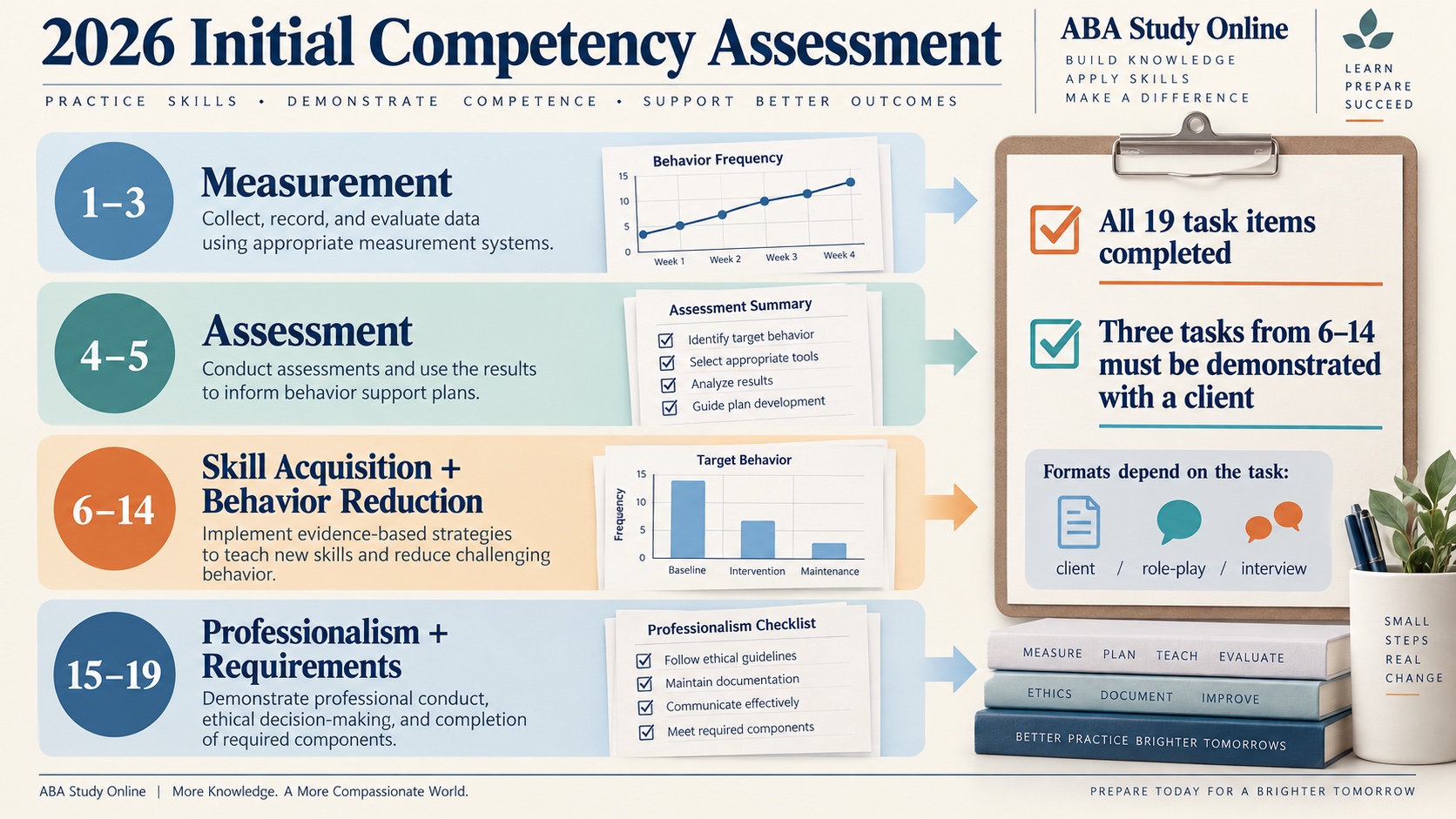
The current packet organizes the 19 task items into broad groups. You do not need to memorize the packet as a wall of text; you do need to understand what kind of performance each group is asking you to show.
- Measurement: implementing continuous and discontinuous measurement procedures and entering data or updating graphs.
- Assessment: conducting preference assessments and collecting ABC data.
- Skill acquisition and behavior reduction: implementing procedures such as discrete-trial or naturalistic teaching, chaining, shaping, discrimination training, prompting and prompt fading, token systems, crisis or emergency procedures according to protocol, and one selected intervention area listed in the packet.
- Professionalism and requirements: generating objective session notes, explaining client dignity and professional boundaries, describing RBT supervision standards, and recognizing when to seek clinical direction.
The packet’s organization is a study map, not permission to improvise procedures. For example, “implement crisis/emergency procedures according to protocol” means the applicant must follow the protocol that governs the service context. It does not mean an RBT should invent a crisis procedure, use an unapproved response, or practice outside training and supervision.
One detail is especially important: three tasks from the skill-acquisition and behavior-reduction section must be demonstrated with a client. That does not mean all 19 tasks must be performed with a client. The assessment instructions for each task determine whether client, role-play, or interview formats are available.
Client, role-play, and interview formats
The current packet describes three assessment types:
- With a client: the assessor observes the applicant performing the task with a client who is receiving behavior-analytic services.
- Role-play: the applicant performs in a situation similar to one that could occur with a client, with another person acting in the client role when the circumstances do not permit a client evaluation.
- Interview: the applicant describes or discusses the relevant concept and gives examples and nonexamples when applicable. The current packet allows interview questions to be tailored to workplace parameters or current clients.
These formats are not interchangeable in every situation. If the packet says a task must be demonstrated with a client, a verbal explanation or a role-play does not automatically satisfy that requirement. If a task permits an interview, the applicant still needs to answer accurately and connect the explanation to safe professional practice. Ask the responsible assessor how each task will be evaluated before the assessment begins.
The assessment may be conducted over one or more sessions. The current packet also allows in-person evaluation, live evaluation through the internet, or observation of recorded videos created specifically for the assessment. The assessor remains responsible for following the packet and ensuring that the evaluation is a competent, documented process.
Who conducts and documents the assessment
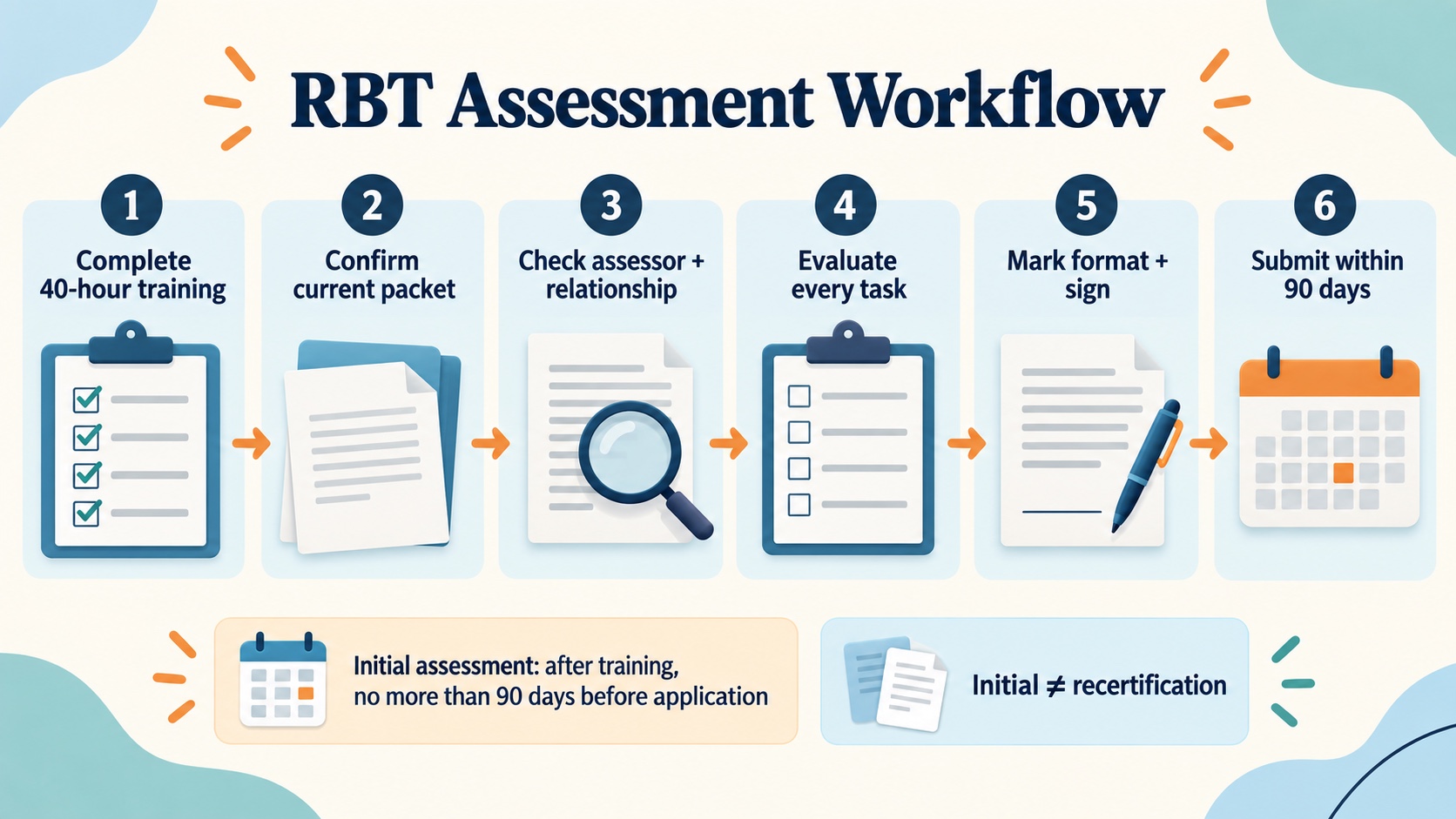
The current packet identifies a responsible assessor who is an active BCaBA or BCBA certificant and has completed the required 8-hour supervision training. That responsible assessor oversees the assessment, ensures the requirements are followed, signs the final attestation, maintains assessment records, and remains responsible for quality even when assistant assessors complete portions.
An assistant assessor may be used when the responsible assessor has confirmed the person’s proficiency through direct observation and the person holds an active RBT certification or higher. The responsible assessor may use more than one assistant assessor, but delegation does not remove the responsible assessor’s oversight and sign-off responsibilities.
The relationship rule is also important. The responsible assessor, assistant assessors, and applicant must be employed by or have a contractual relationship with the same organization. That organization must also be the entity providing services to the client involved in the assessment. The packet describes additional relationship expectations when a BCaBA or RBT serves as an assessor. This is why “my friend is a BCBA” is not enough to establish that the person can conduct and sign the assessment in the required context.
Timing matters as well. The current initial assessment must be completed after the 40-hour training and no more than 90 days before the RBT certification application is submitted. After each task is observed as competent, the assessor initials the task and marks the assessment type. Once all tasks are completed, the responsible assessor signs and dates the final attestation. The BACB states that a completed official Initial Competency Assessment must be submitted with the application and that non-BACB forms will not be accepted.
If competence is not demonstrated on a task, the packet allows corrective feedback and another assessment opportunity on a later day. Corrective feedback may not be delivered on the final assessment of that task. This makes the evaluation a learning and quality process, not a single surprise performance where an applicant is expected to guess what went wrong.
How to prepare without copying the packet
Use the official packet as a checklist of performance areas, then prepare in five layers:
- Define the behavior: know what competent performance would look and sound like for the task.
- Practice with feedback: rehearse data collection, teaching procedures, professional communication, and documentation with a qualified supervisor or trainer.
- Check the context: use the client’s approved protocols, materials, safety procedures, and supervisor direction. Do not create a new intervention just to make a practice demonstration look impressive.
- Prepare examples and nonexamples: this is especially useful for interview tasks such as client dignity, boundaries, supervision standards, and seeking clinical direction.
- Organize records: confirm the correct packet version, assessment dates, assessor names and credentials, marked formats, signatures, and application timing.
Do not copy the 19 task descriptions into a public worksheet or treat a third-party “answer key” as official. The goal is to understand and demonstrate the task safely, then complete the current BACB form with the responsible assessor.
A fictional planning example
Imagine Jordan has completed the 40-hour training and is preparing for an initial assessment. Jordan first opens the current BACB packet and checks the effective date. Jordan then confirms that the responsible assessor is an active BCaBA or BCBA with the required supervision training and that the organization relationship fits the packet.
Before the assessment, Jordan asks which tasks will be assessed with a client, which can use role-play, and which may be evaluated through interview. Jordan practices objective session notes and explains when to seek clinical direction. The assessor identifies the three skill-acquisition or behavior-reduction tasks that must be demonstrated with a client and makes sure the client context is appropriate. After each competent performance, the form is marked. Jordan keeps personal study notes separate from the official packet and does not include unnecessary client-identifying information.
Common mistakes and checklist
- Using an old form: confirm that the packet is the current Initial Competency Assessment Packet effective January 1, 2026.
- Confusing initial and recertification: the two assessments serve different stages and may have different documents.
- Assuming every task needs a client: only the specified skill-acquisition/behavior-reduction subset has the current client-demonstration rule.
- Choosing an assessor only by title: qualification, supervision training, relationship, oversight, and sign-off responsibilities all matter.
- Submitting a homemade form: the current packet says non-BACB forms will not be accepted.
- Ignoring timing: an initial assessment completed too early may not fit the current application window.
- Sharing client details in study materials: practice privacy and use only the information necessary for the assessment.
Before submitting an application, confirm:
- The 40-hour training is complete.
- The current official packet was used.
- All 19 task items were demonstrated competently.
- The correct client, role-play, or interview format was marked for each task.
- The responsible assessor completed the final attestation and retained required records.
- The assessment falls within the current application timing window.
For related RBT study, explore RBT Theory Blocks, practice concepts with free ABA questions, or review definitions in the ABA Definition Search. These are natural study links; this informational page does not add a conversion CTA.
FAQ and official sources
How many tasks are in the 2026 RBT Initial Competency Assessment? The current BACB packet says all 19 task items must be completed.
Do all RBT competency-assessment tasks require a client? No. The packet specifies that three tasks from the skill-acquisition and behavior-reduction section must be demonstrated with a client. Other tasks use the format allowed in their section, which may include client, role-play, or interview.
Who can conduct an RBT competency assessment? The current packet identifies a responsible BCaBA or BCBA assessor who has completed the required 8-hour supervision training, along with defined relationship and oversight requirements. Confirm the complete requirements in the packet.
Is the competency assessment the RBT exam? No. It is a separate performance assessment that is part of the certification application process. The RBT examination has its own current official information and content outline.
How soon before applying can I complete the initial assessment? The current packet states that it must be completed after the 40-hour training and no more than 90 days before submitting the RBT certification application.