RBT Competency Assessment Practice: A Safe Preparation Plan
Searching for RBT competency assessment practice usually means you want to know what to rehearse before a qualified assessor observes you. That is a sensible question, but practice and assessment are not the same event. Practice helps you organize materials, explain your decisions, and perform a skill with feedback. The formal RBT Initial Competency Assessment is the official evaluation that a qualified assessor completes and signs.
The current BACB packet is effective January 1, 2026. It requires all task items 1–19 to be completed, uses client demonstration, role-play, or interview depending on the task, and requires three tasks from the skill-acquisition and behavior-reduction group to be demonstrated with a client. The safest preparation plan rehearses the skill families without copying secure exam content, fabricating client data, or treating a practice checklist as an official signed result.
Table of Contents
What competency-assessment practice can and cannot do
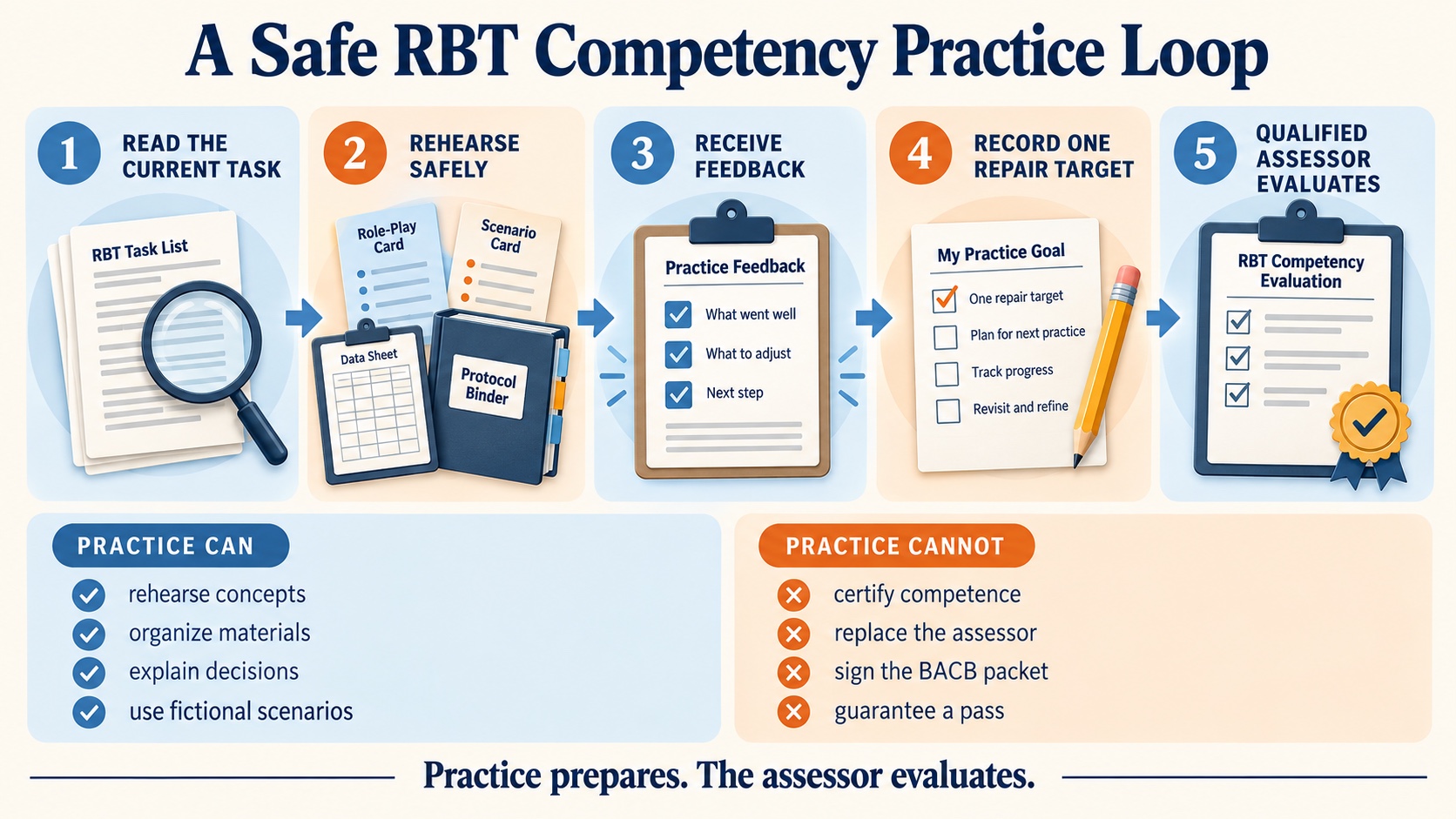
Practice prepares you to show competence; it does not certify competence. You can rehearse a measurement procedure with a neutral scenario, role-play how you would prompt a learner, or explain when you would ask for clinical direction. A qualified assessor must still evaluate the required tasks, mark the assessment type, complete the BACB form, and sign the final attestation.
Do not search for “real assessment answers” or try to memorize a script that ignores the situation. Competent performance depends on the evidence, the written protocol, client dignity, safety, and the supervisor’s direction. A practice session should make your reasoning more flexible, not turn it into a performance detached from the learner or service plan.
The 2026 packet at a glance
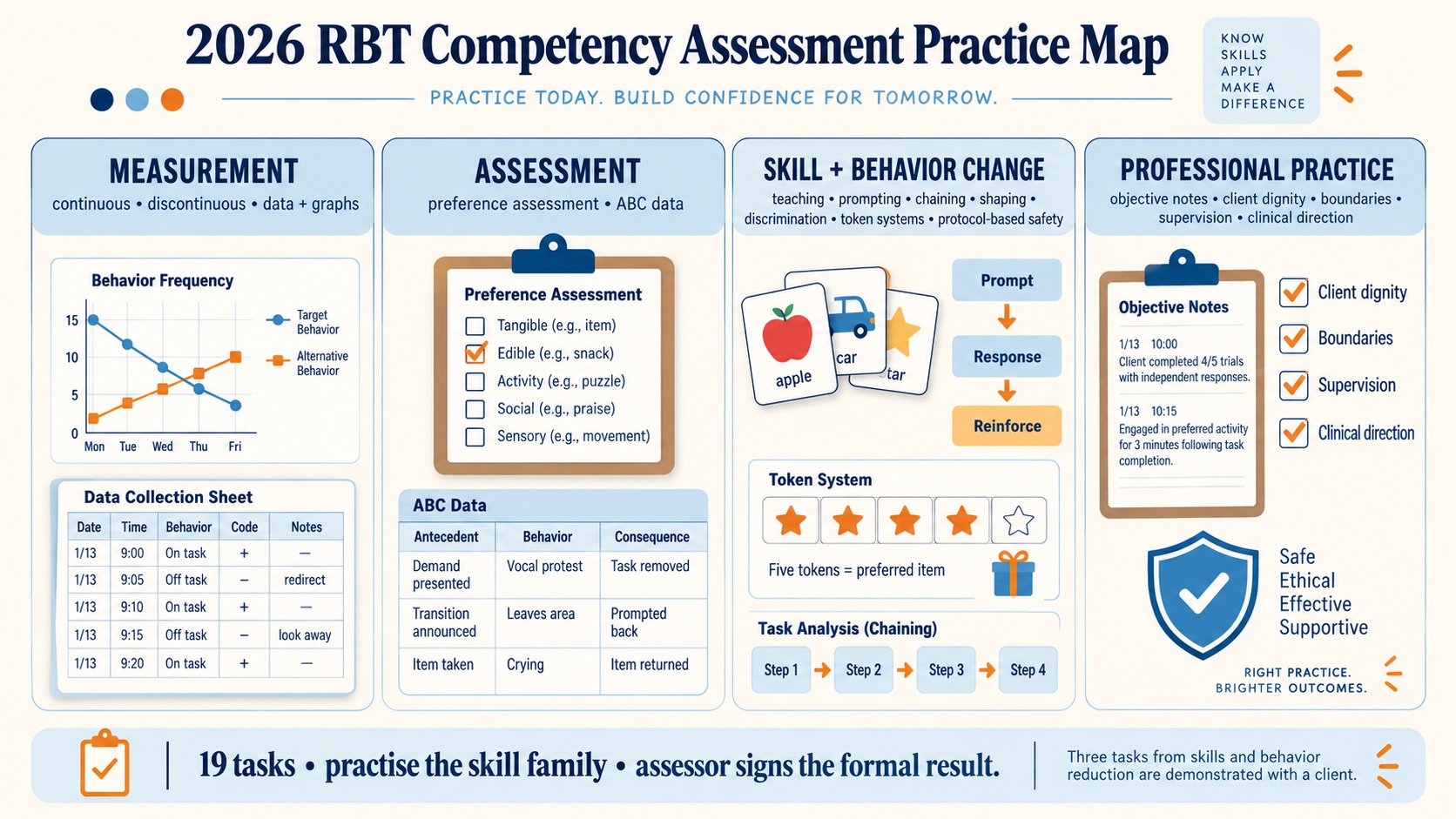
The 2026 RBT Initial Competency Assessment Packet groups the 19 tasks into four useful practice families:
- Measurement: continuous measurement, discontinuous measurement, and entering data or updating graphs.
- Assessment: preference assessments and ABC data collection.
- Skill acquisition and behavior reduction: teaching, prompting, chaining, shaping, discrimination training, token systems, crisis or emergency procedures, and one selected intervention area.
- Professionalism and requirements: objective session notes, client dignity, professional boundaries, RBT supervision standards, and when to seek clinical direction.
The packet says three tasks from the skill-acquisition and behavior-reduction section must be demonstrated with a client. The exact assessment type depends on the task and situation. Some tasks can be observed with a client or through role-play; some may use an interview. The assessor—not a generic online quiz—determines whether the demonstration is competent.
Practise measurement, data, and graphs
Measurement practice should make the recording rule visible. Choose a simple, fictional scenario and state what counts as an instance before you record anything. For continuous measurement, rehearse a clear rule for frequency, duration, latency, or another named measure. For discontinuous measurement, practise following the interval rule exactly instead of switching to a convenient moment.
Then enter the data and update a simple graph. Before you decide that performance changed, check the labels, units, dates, and scale. A useful practice review asks:
- Could another trained person understand what I recorded?
- Did I follow the operational rule rather than my impression?
- Can I explain what the graph shows without claiming more than the data support?
- What would I ask my supervisor before changing a procedure?
Keep fictional practice data separate from a client’s actual record. Never place identifying information into an online quiz or public worksheet. If your workplace has a data system, use the approved training process and follow supervision instructions.
Practise stopping as well as starting. If the measurement rule is unclear, the client is distressed, the materials are unavailable, or the written plan does not match the situation, pause and seek direction. A calm explanation of why you stopped is often more professionally useful than forcing a technically polished response that creates risk.
Practise assessment routines
For preference-assessment practice, rehearse the sequence: prepare the materials, describe the available options, observe the selection, record the result, and follow the written procedure. The exact arrangement may vary by protocol. The point is not to recite one universal script; it is to show that you can follow the assessment instructions and record what occurred.
For ABC data, use a fictional or supervisor-approved scenario and separate the antecedent, observable behavior, and consequence. Avoid adding an inferred function as though it were directly observed. A strong practice explanation can say, “This is what I observed, this is what happened immediately before and after, and this is the question I would bring to my supervisor.”
When the practice involves a real client, use only an approved setting with appropriate consent, privacy, and supervision. Do not recruit a friend to act as a client for an intervention that could cause distress or risk. Role-play is useful for many steps, but it is not permission to practise a crisis procedure without the required protocol and supervision.
Practise teaching and behavior-reduction procedures
Skill-acquisition practice should make the teaching decision observable. For a discrete-trial or naturalistic teaching rehearsal, identify the target, arrange the relevant materials, deliver the instruction or opportunity, use the planned prompt, reinforce the response according to the protocol, and record what happened. Then practise prompt fading: explain what evidence would tell you to reduce support and what you would do if the learner needs more support.
For chaining, shaping, discrimination training, or token systems, prepare a small scenario and explain the part of the procedure you are responsible for. For behavior reduction, do not invent a new intervention. Practise implementing the written plan, describing the safety boundary, and seeking clinical direction when the situation does not match the protocol.
The 2026 packet also includes crisis or emergency procedures according to protocol. This is a supervision and safety boundary, not an invitation to simulate unsafe events casually. Review the approved procedure with your supervisor, know where the relevant materials and emergency contacts are, and do not perform a crisis procedure for practice without the required conditions.
Practise professionalism and interview responses
Several tasks are easier to overlook because they look like conversation rather than performance. Practise writing an objective session note from a short fictional scenario. Remove judgments, diagnoses, and vague adjectives; include what occurred, what you did, and what data or response was observed.
Prepare brief examples for client dignity and professional boundaries. Your example should name the situation, the respectful action, and when you would ask a supervisor for guidance. For supervision standards, study the current RBT Handbook and be able to describe your responsibility to participate in supervision and communicate concerns.
Finally, practise the question “When would you seek clinical direction?” A safe answer is situation-specific: when a client’s response does not match the plan, a safety concern appears, data are unclear, a procedure is not producing the expected effect, or you are asked to do something outside your training or authorization. Do not answer as if an RBT independently changes a behavior plan.
A repeatable practice-session routine
- Choose one task family: avoid trying to practise all 19 tasks in one rushed session.
- Read the current source: use the BACB packet, your approved protocol, and your supervisor’s instruction.
- Rehearse with a safe scenario: use fictional data, role-play, or an approved client context; do not use personal data in public tools.
- Explain the decision: say what you observed, what you did, what you recorded, and what you would ask next.
- Get feedback: ask a qualified supervisor or trainer to identify one specific repair target.
- Record progress without pretending it is an assessment: your study log can show practice date and next step, but only the formal BACB packet can document the official result.
The ABA Study Online RBT learning path, RBT practice questions, and app review tools can help with concepts, terminology, short scenarios, and saved mistakes. They cannot observe a client, evaluate a formal competency task, sign the BACB packet, or replace a responsible assessor.
RBT competency assessment practice FAQ
Can I practise the RBT competency assessment online?
You can practise concepts, role-play, explanations, and selected skills online when the activity is safe and appropriate. The formal 2026 assessment may use in-person observation, live internet observation, or recordings created specifically for the assessment, according to the packet and assessor’s process. An online quiz alone is not the formal assessment.
Can an app sign my RBT competency assessment?
No. An app can support study and practice, but a qualified responsible assessor must evaluate the tasks and sign the official BACB form. Non-BACB substitute forms are not accepted for the application.
How many tasks are on the 2026 RBT competency assessment?
The current packet requires all 19 task items. Three tasks from the skill-acquisition and behavior-reduction section must be demonstrated with a client. The packet also includes tasks evaluated through interview or role-play, depending on the task and circumstances.
When should I complete the initial competency assessment?
The current packet says it must be completed after the 40-hour training and no more than 90 days before submitting an RBT certification application. Confirm the current packet and application instructions before scheduling.
Official sources and study links
Start with the BACB’s 2026 RBT Initial Competency Assessment Packet, the RBT resource page, the Supervision, Assessment, Training, and Oversight page, and the application processing updates. For study support, use the RBT learning path, RBT practice questions, and ABA Study Online app. Recheck the official packet before an assessment because versions, forms, and requirements can change.