RBT Competency Assessment Practice Test: 19 Skills to Rehearse
If you searched for an RBT competency assessment practice test, the first thing to know is that the BACB Initial Competency Assessment is not the same as a multiple-choice exam. The current packet, effective January 1, 2026, asks an assessor to evaluate whether an applicant can competently perform all 19 task items. Depending on the task, the assessment may use a client, role-play, or interview.
That difference changes how you should study. You can use practice questions to review concepts, but you also need to rehearse objective measurement, data and graphs, assessment procedures, teaching and behavior-reduction skills, session notes, boundaries, and when to seek clinical direction. This guide turns the official packet into a preparation map without pretending that a checklist or commercial mock test can determine competence.
Table of Contents
Short answer: is it a written practice test?
No. The official RBT Initial Competency Assessment is a performance assessment. The assessor gives the applicant an opportunity to perform each task and evaluates whether the task was completed competently. Some tasks can be evaluated through role-play or interview, while the packet gives more specific instructions for the tasks that must involve a client.
A useful practice test therefore has three parts: a knowledge check, a realistic rehearsal, and feedback from a qualified person. A question such as “What is duration?” may help you review terminology, but it does not show that you can collect duration data accurately, select the correct recording procedure, or explain a result in context. Prepare for the action and the explanation.
The 19-task competency map
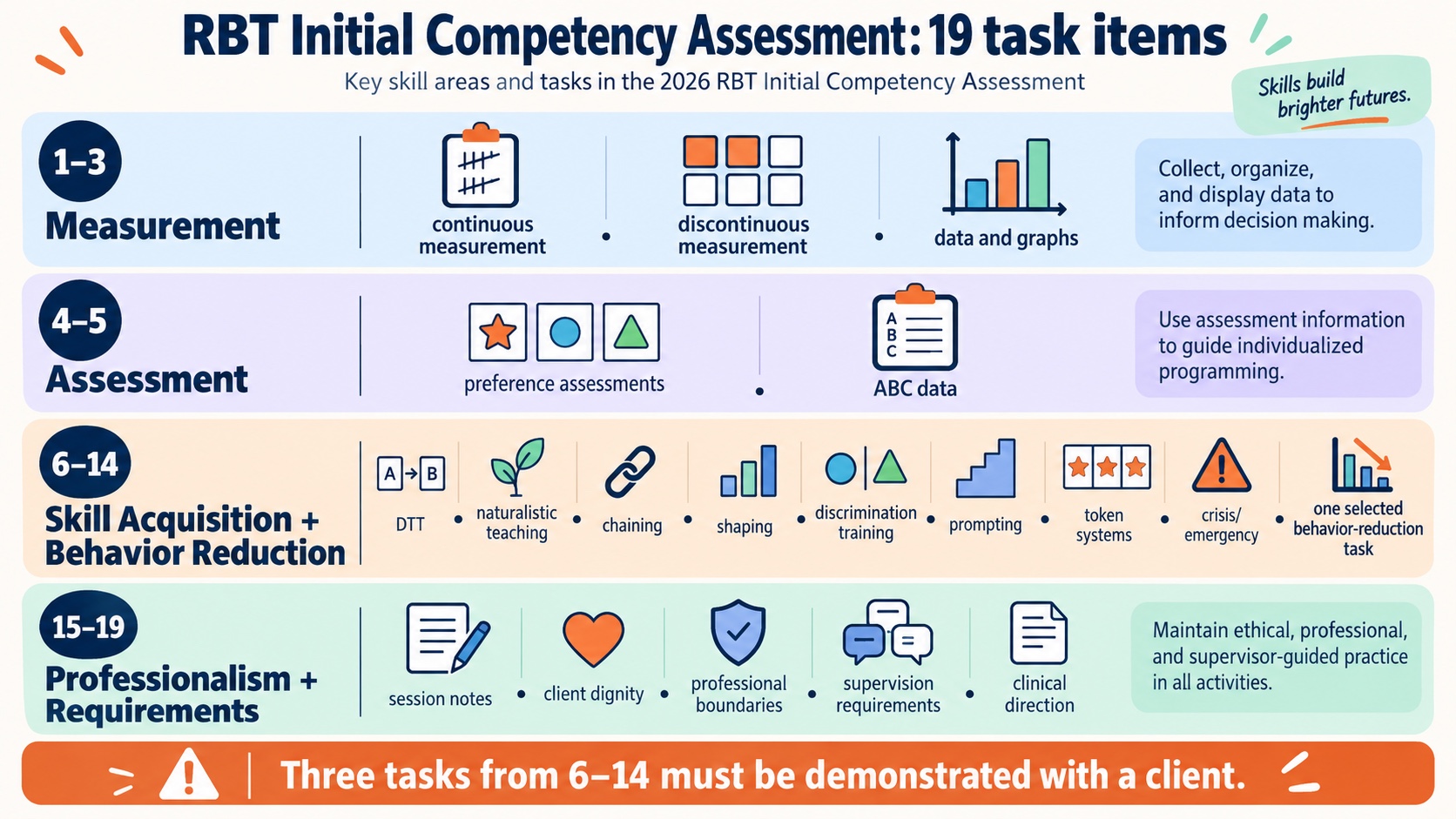
The current packet groups the assessment into four sections. All task items 1–19 must be completed, and the completed BACB form must be submitted with the certification application. The section map is a study organizer, not permission to skip a task:
- Tasks 1–3, Measurement: continuous measurement, discontinuous measurement, and entering data or updating graphs.
- Tasks 4–5, Assessment: conducting preference assessments and collecting ABC data.
- Tasks 6–14, Skill Acquisition and Behavior Reduction: discrete-trial teaching, naturalistic teaching, chaining, shaping, discrimination training, prompting and prompt fading, token systems, crisis/emergency procedures according to protocol, and one selected behavior-reduction task.
- Tasks 15–19, Professionalism and Requirements: objective session notes, client dignity, professional boundaries, BACB supervision standards for RBTs, and a situation in which you would seek clinical direction.
Three of tasks 6–14 must be demonstrated with a client. The remaining task-specific options may include role-play or interview, but the assessor must follow the official packet rather than choosing the easiest format for every skill.
How to practice each skill safely
Start with the exact language in the official packet, then turn each line into an observable rehearsal target. For measurement, practice defining the response, selecting continuous or discontinuous measurement when instructed, recording data, and updating a simple graph. Ask a supervisor or trainer to check whether your entries match the procedure rather than judging the graph only by appearance.
For assessment tasks, rehearse how you would present choices during a preference assessment and how you would record antecedent, behavior, and consequence information without adding an interpretation. A practice partner can read a short scenario while you collect data. Afterwards, compare your record with the agreed observation rules and discuss what information is still missing.
For teaching and behavior-reduction tasks, practice the sequence, prompting, reinforcement, data collection, and error-correction steps from the approved program or protocol. Do not invent a client intervention for the purpose of checking a box. Crisis or emergency procedures must follow the organization’s approved protocol and the direction of the qualified professional responsible for the case.
For professionalism tasks, write an objective session note from a neutral description, give an example of protecting dignity, and rehearse a boundary statement that keeps your role clear. Also practice saying what information would lead you to seek clinical direction. The goal is not to sound impressive; it is to recognize when a decision belongs with your supervisor.
Client, role-play, and interview assessment types
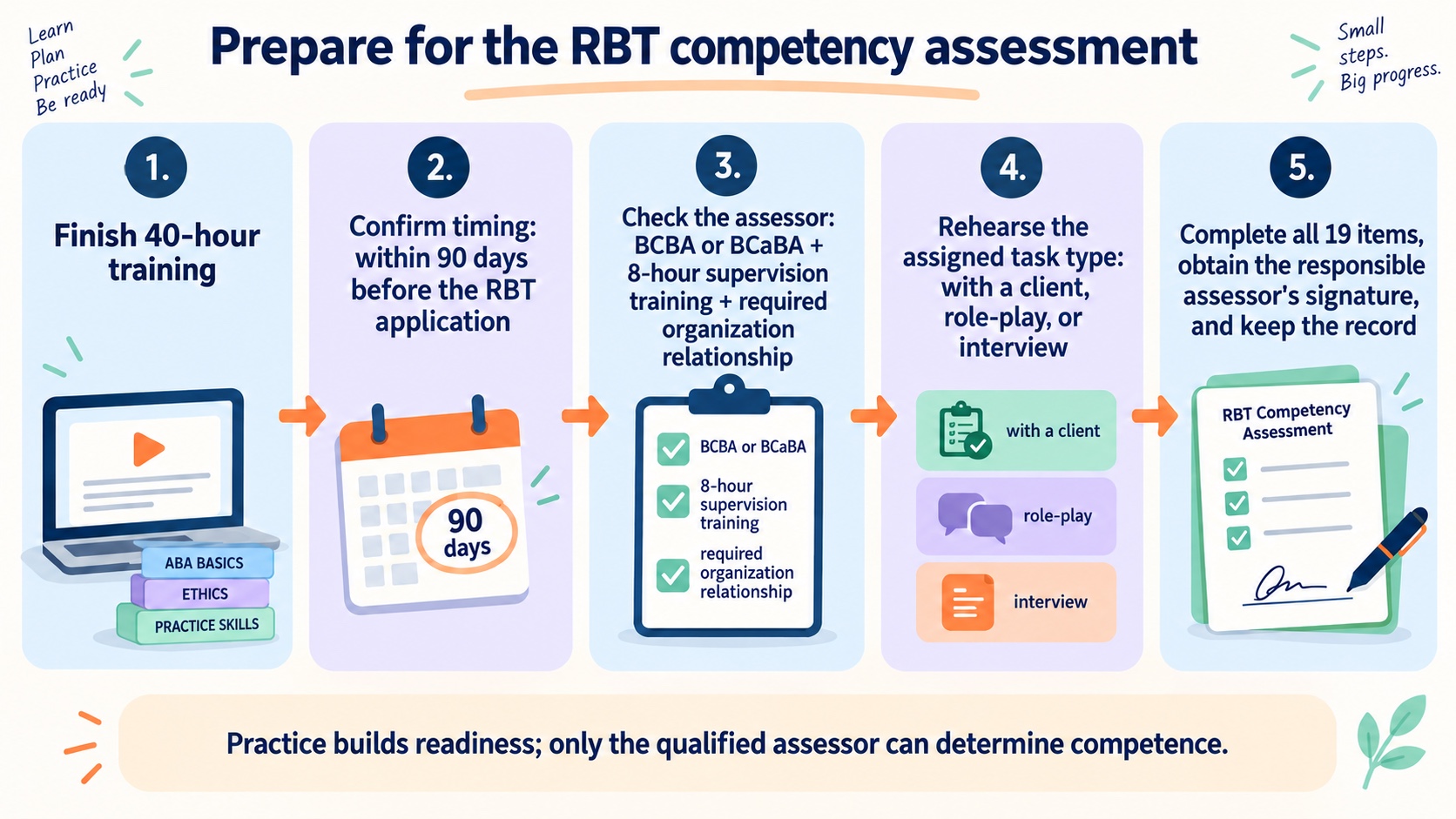
The packet describes three possible assessment types. With a client means the assessor observes you performing the task with a client receiving behavior-analytic services. Role-play means another person acts in a situation similar to what might occur with a client when a client evaluation is not appropriate. Interview means the assessor asks you to describe or discuss the concept and, when relevant, provide examples and nonexamples.
These formats are not interchangeable just because they feel convenient. The packet says three tasks from 6–14 must be demonstrated with a client, and task 13 crisis/emergency procedures and task 14’s selected behavior-reduction option have their own assessment-type limits. Ask the responsible assessor which tasks will use which format before the assessment session. Then rehearse that same format so you are practicing the actual performance demand.
Timing and assessor requirements
Complete the Initial Competency Assessment after the 40-hour training is complete. The current packet says it cannot be completed more than 90 days before submitting an RBT certification application. That timing rule makes an old practice form risky: even if the skills remain familiar, the version and timing must match the current certification process.
The responsible assessor must be an active BCaBA or BCBA who has completed the 8-hour supervision training. The assessor must have the required employment or contractual relationship with the applicant and the client organization, ensure the assessment follows the packet, sign the completed assessment, and maintain records. Assistant assessors may conduct some portions when they meet the packet’s proficiency, certification, and relationship requirements and remain under the responsible assessor’s oversight.
Do not pay an unrelated tutor to “sign off” because they helped you study. A study partner can support rehearsal, but only the qualified assessor operating under the official requirements can complete and sign the competency assessment. Confirm the relationship and qualifications before you schedule the session.
Completion and documentation rules
After the assessor observes a task performed competently, the assessor initials the task and marks the assessment type used. When all tasks have been completed competently, the responsible assessor signs and dates the final attestation. The completed BACB Initial Competency Assessment is submitted with the certification application, and non-BACB forms are not accepted.
The assessment can occur over one or more sessions, in person, live through the internet, or through recorded videos created specifically for the assessment. Keep a clear record of the dates, the assessor or assistant assessor involved, and which tasks were evaluated. The responsible assessor must maintain assessment documentation for at least seven years.
Keep the practice checklist separate from the official form. A checklist can show that you rehearsed prompting or data collection; it cannot replace the BACB packet, the assessor’s initials, the assessment-type selection, or the final signature. This separation protects both the applicant and the assessor when the application is reviewed.
Common preparation mistakes
- Studying only multiple-choice questions and never practicing the actual performance.
- Using an old competency packet instead of the current January 2026 version.
- Assuming every task can be completed through role-play when three tasks from 6–14 must involve a client.
- Entering interpretations in ABC data or session notes instead of observable descriptions.
- Practicing crisis or behavior-reduction procedures outside the approved protocol.
- Scheduling the assessment before the 40-hour training is complete or outside the 90-day window.
- Asking a tutor or coworker who does not meet the assessor rules to sign the official form.
- Finishing the skill demonstration but forgetting initials, assessment-type marks, signatures, or record retention.
RBT competency assessment FAQ
Is the RBT competency assessment a written exam?
No. It is a performance assessment of the tasks in the current BACB packet. You may still use written questions to review concepts, but the official assessment evaluates competence through the permitted client, role-play, or interview formats.
How many tasks are on the RBT competency assessment?
The current Initial Competency Assessment has 19 task items, and all items 1–19 must be completed. Three tasks from the skill-acquisition and behavior-reduction group, tasks 6–14, must be demonstrated with a client.
Can the RBT competency assessment be done by video?
The current packet allows the assessment in person, live via the internet, or through recorded videos created specifically for the assessment. The responsible assessor still controls the evaluation and must follow the packet’s requirements.
Who can assess an RBT applicant?
The responsible assessor is an active BCaBA or BCBA who has completed the 8-hour supervision training and meets the organization and relationship requirements. Assistant assessors may participate only within the packet’s qualification and oversight rules.
Does passing a practice checklist guarantee RBT certification?
No. A practice checklist supports rehearsal, but it cannot guarantee competence, application approval, exam success, or certification. Use it to identify what to practice before the official assessor evaluates the current packet.
For concept review, the RBT learning path can organize measurement, teaching, behavior reduction, and professionalism topics. For additional question practice, use the RBT practice questions, but keep that work separate from the hands-on competency assessment.