RBT Competency Assessment 2026: What to Prepare
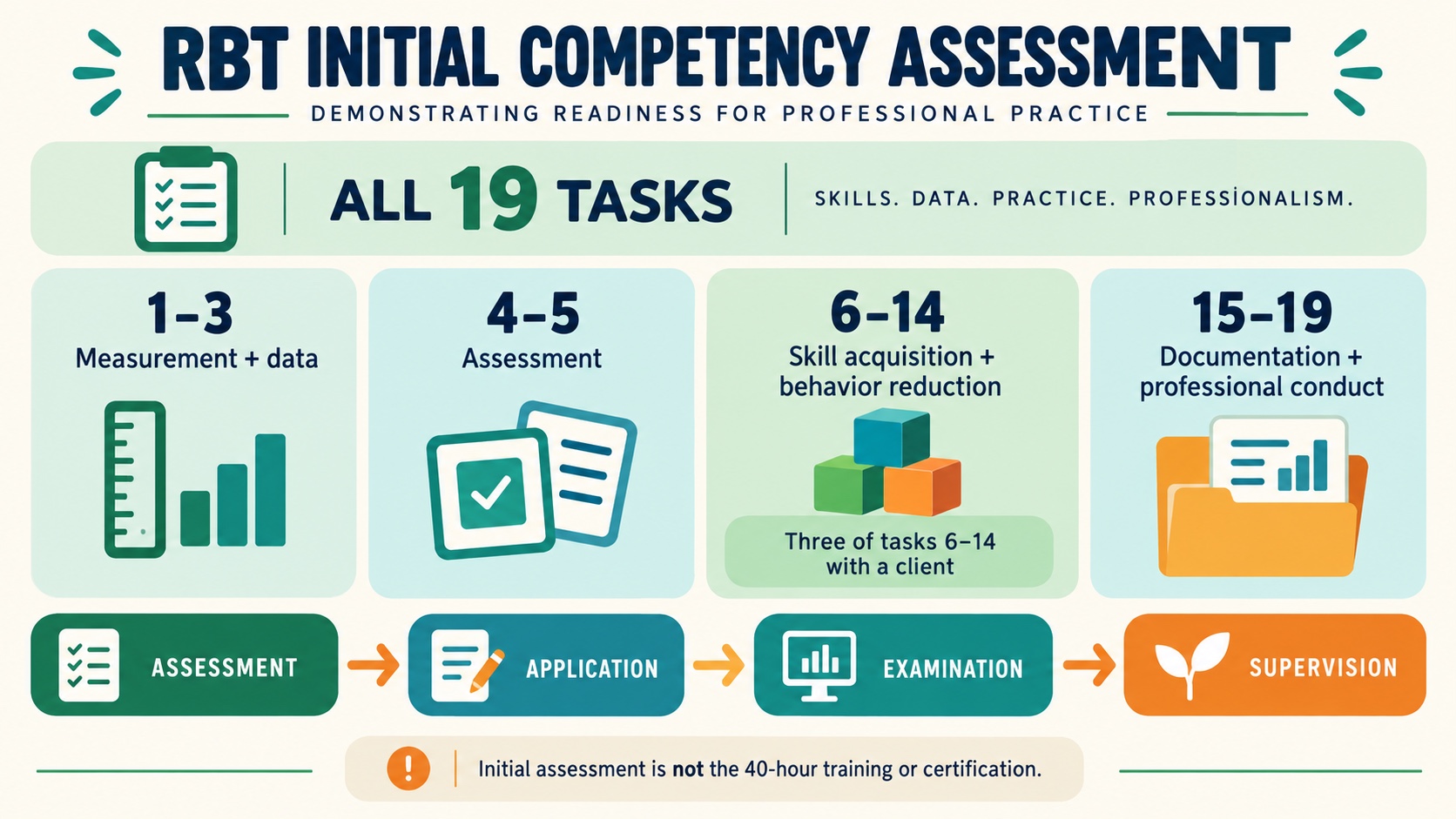
If you are searching for the RBT competency assessment 2026, you are probably trying to understand what must be demonstrated before the rest of the certification process can move forward. The current Initial Competency Assessment Packet is organized around 19 tasks. It checks practical readiness in measurement, assessment, skill acquisition, behavior reduction, documentation, and professional conduct.
This guide explains the structure in plain language. It does not replace the official packet, a qualified assessor, or the current BACB RBT Handbook. The packet effective January 1, 2026 is the source to use for the exact form and instructions.
Table of Contents
Short answer: what does the 2026 assessment check?
The Initial Competency Assessment Packet says that all tasks 1–19 must be completed. The assessor records the applicant’s name and BACB ID, identifies the organization when applicable, and marks the assessment type for tasks that allow more than one format. The form is not a multiple-choice test. It is a structured demonstration of job-related skills.
That means preparation should be active. Review a measurement procedure, practice entering data, explain what you are doing, follow the written plan, and ask for feedback from the person responsible for the assessment. Reading a definition is useful, but it is not the same as implementing the skill.
The 19-task structure
Tasks 1–3: measurement and data
The first group covers continuous measurement, discontinuous measurement, and entering data or updating graphs. Prepare by matching the measurement to the behavior and the situation. Be able to describe what you are recording, use the procedure consistently, and keep the record accurate enough for later review.
A useful study routine is to compare frequency, duration, latency, interval procedures, and other measures with small examples. Then practice taking a short data set and representing it on a graph. The point is not to perform a decorative calculation; it is to show that the data reflect the defined behavior.
Tasks 4–5: assessment
The next two tasks cover preference assessments and ABC data collection. Review the steps of the assessment procedure you are instructed to use, how to present choices, how to record selections, and how to document antecedent, behavior, and consequence events objectively.
Keep observation separate from interpretation. A brief ABC record can describe what happened before and after a behavior without proving a function. If you are unsure about a procedure or a safety concern, follow the plan and contact the responsible supervisor rather than inventing a new assessment method.
Tasks 6–14: skill acquisition and behavior reduction
This group covers teaching and behavior-reduction skills, including discrete-trial teaching, naturalistic teaching, chaining, shaping, discrimination training, prompting and prompt fading, reinforcement, and implementing behavior-reduction procedures. The official packet states that three of tasks 6–14 must be demonstrated with a client.
Prepare by practicing the sequence, not by memorizing a speech. Identify the teaching target, arrange materials, follow the written procedure, deliver the planned consequence, and record the learner’s response. For behavior reduction, stay within the plan and your role. Competency includes knowing when to ask for direction.
Tasks 15–19: documentation and professional conduct
The final group checks documentation, reporting, and professional requirements. Review how to write objective session information, communicate relevant events, protect confidentiality, and use the current ethics and supervision expectations. A strong note states what was observed and what procedure was implemented; it does not turn a short session into an unsupported diagnosis.
Client demonstrations and role-play
The packet allows an assessment type of “with a client” or “role-play” for the listed tasks, but it adds a specific requirement: three of tasks 6–14 must be demonstrated with a client. That detail matters when you plan your assessment. A role-play can help you rehearse, but it cannot be treated as a substitute for the client demonstrations the packet requires.
Ask the qualified assessor how the session will be organized, which tasks will be observed with a client, what records you should bring, and how feedback or a repeat demonstration is handled. The assessor—not an online article—determines how the official evaluation is conducted within the current packet.
Before the day of the assessment, make a small readiness table with one row for each task. Record the procedure you are practicing, the materials you need, the kind of data you will collect, and the question you will ask if the situation changes. This keeps preparation concrete without trying to predict the assessor’s exact wording. It also gives you a respectful way to notice a gap early and request supervision before the formal evaluation.
How to prepare without memorizing a script
- Map the task: write the skill in observable terms and identify the materials or data needed.
- Practice the procedure: rehearse with a supervisor or appropriate role-play partner, following the plan rather than improvising.
- Explain your decisions: practice saying what you are measuring, why the next step follows the plan, and what you would document.
- Review feedback: keep a short list of skills that need another attempt.
- Check the packet: use the current form before the assessment so you do not study from an outdated checklist.
Practice questions and flashcards can support vocabulary, measurement distinctions, and scenario reading. They cannot conduct the competency assessment. Use them as preparation around the live demonstration, not as evidence that the official packet has been completed.
What the assessment does not replace
The Initial Competency Assessment is one stage of the RBT pathway. It is separate from the 40-hour training requirement, the certification application, the RBT examination, and ongoing supervision. Passing or completing the assessment does not by itself grant RBT certification.
It is also separate from the RBT Recertification Competency Assessment used later for maintenance. Do not download a renewal packet when you need the initial packet, and do not assume an old form reflects the 2026 requirements.
Common preparation mistakes
- Studying only definitions: the assessment asks you to implement and document skills.
- Ignoring the three-client rule: role-play practice is helpful, but three tasks from 6–14 must be demonstrated with a client.
- Using a recycled checklist: start with the packet effective January 1, 2026.
- Inventing procedures: follow the written plan and ask the supervisor when the correct next step is unclear.
- Confusing assessment with certification: keep every stage of the pathway separate.
FAQ and official sources
How many tasks are in the 2026 RBT Initial Competency Assessment?
The official packet requires all 19 tasks to be completed. The task groups cover measurement, assessment, skill acquisition, behavior reduction, documentation, and professional conduct.
Can the RBT competency assessment use role-play?
For tasks with multiple assessment-type options, the packet lists client or role-play. However, three of tasks 6–14 must be demonstrated with a client, so role-play cannot replace that specific requirement.
What should I use as the final checklist?
Use the 2026 RBT Initial Competency Assessment Packet and the current RBT Handbook. The BACB page on supervision, assessment, training, and oversight can help clarify the responsible roles.