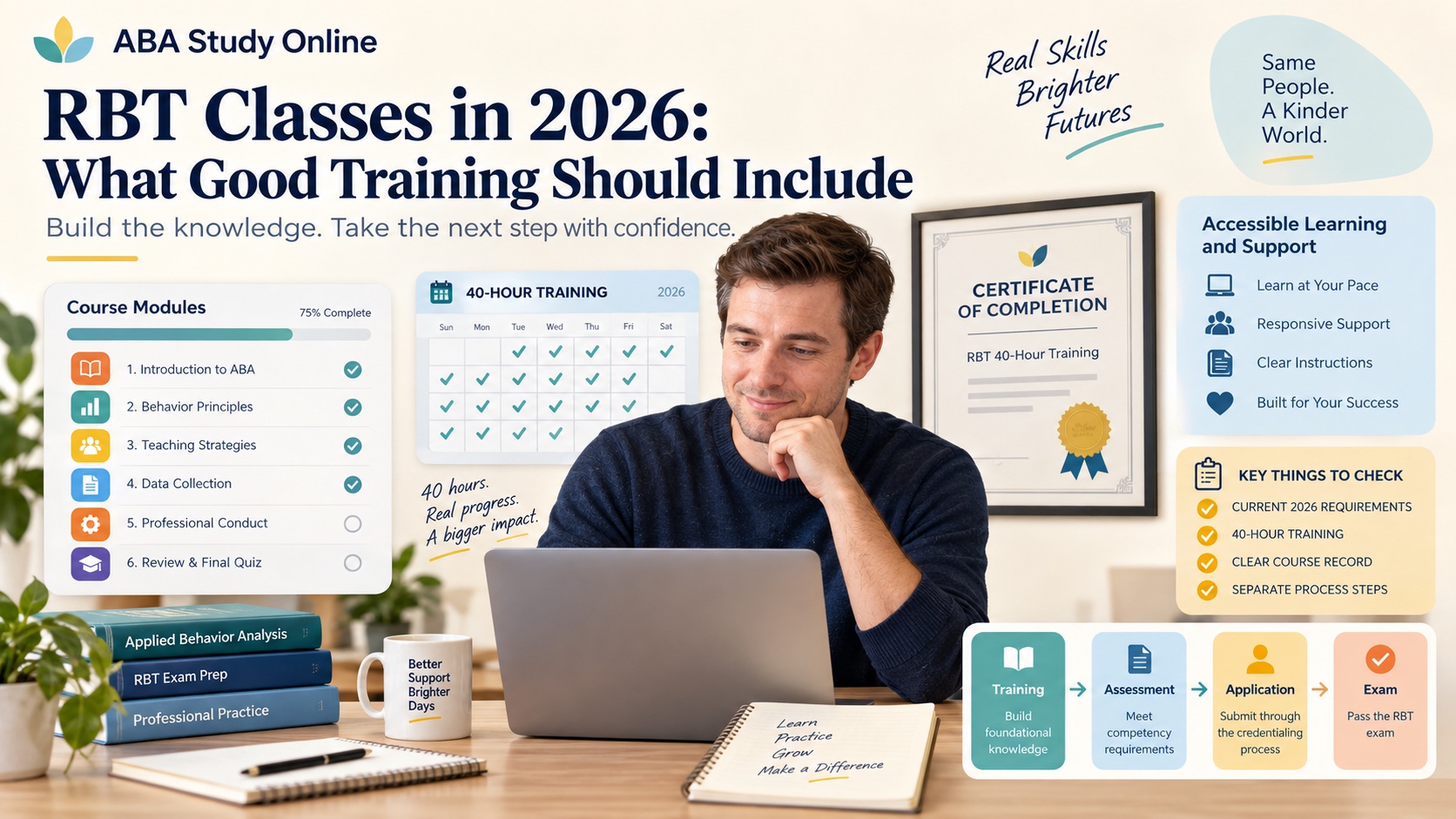
RBT Classes in 2026: What Good Training Should Include
If you search for RBT classes, you may find online courses, employer training, university programs, exam-prep packages, and short job-orientation lessons. They are not interchangeable. The right choice depends on whether you need the current 40-hour training required for the RBT application, additional exam preparation, or an employer’s local onboarding.
In 2026, a strong RBT class should make its curriculum, timing, instruction, support, completion record, and limits clear before you enroll. The BACB permits the 40-hour training to be offered by an employer, university, or online program, but the BACB itself does not provide training, certificates, or provider recommendations. Training is one step in a larger process; it is not the certification by itself.
This guide shows what to compare, how to spot vague course claims, and which questions to ask before paying. Use the current RBT Handbook and RBT 2026 40-Hour Training Requirements and Curriculum Outline as the source of truth.
Table of Contents
What “RBT classes” should mean
The phrase “RBT classes” describes a format, not a single BACB product. A class may be live, self-paced, employer-sponsored, university-based, or online. It may be designed to satisfy the 40-hour training requirement, or it may only review exam vocabulary. Read the course description for the actual deliverable rather than assuming that every class with “RBT” in its title has the same role.
Before comparing prices, write down the result you need:
- 40-hour training: structured learning that meets the current BACB training requirements and produces the documentation needed for the application.
- Exam preparation: practice, explanations, pacing work, or review of the current RBT Test Content Outline. This can support preparation but is not the 40-hour training unless the provider clearly says it is.
- Employer orientation: workplace-specific information about policies, clients, schedules, documentation, and supervision. It may be important after hiring but does not automatically replace the required training.
- Competency assessment: a separate evaluation with a qualified responsible assessor. A quiz inside a course is not automatically the official initial competency assessment.
A provider that combines several services may be useful, but the page should label which person or organization supplies each one. “All-inclusive” is not a substitute for a clear list of training hours, assessment responsibility, application support, and fees.
Separate training from the rest of the process
RBT preparation becomes easier to evaluate when you draw the process as separate handoffs. First, you complete the required training. Then you complete the initial competency assessment with an eligible assessor. You submit the certification application through your personal BACB Portal account. After the BACB reviews the application and authorizes testing, you schedule the examination through Pearson VUE. Passing the examination and meeting the active-supervision requirements are additional steps.
That sequence matters when a class advertisement uses words such as “certification,” “approved,” or “exam included.” Ask what the statement means in operational terms. Does the provider offer instruction, issue a training certificate, arrange an assessment, help organize application documents, or simply explain the process? The current BACB supervision and training guidance identifies the roles and resources involved; use it to check the handoff.
Check the current curriculum and timing
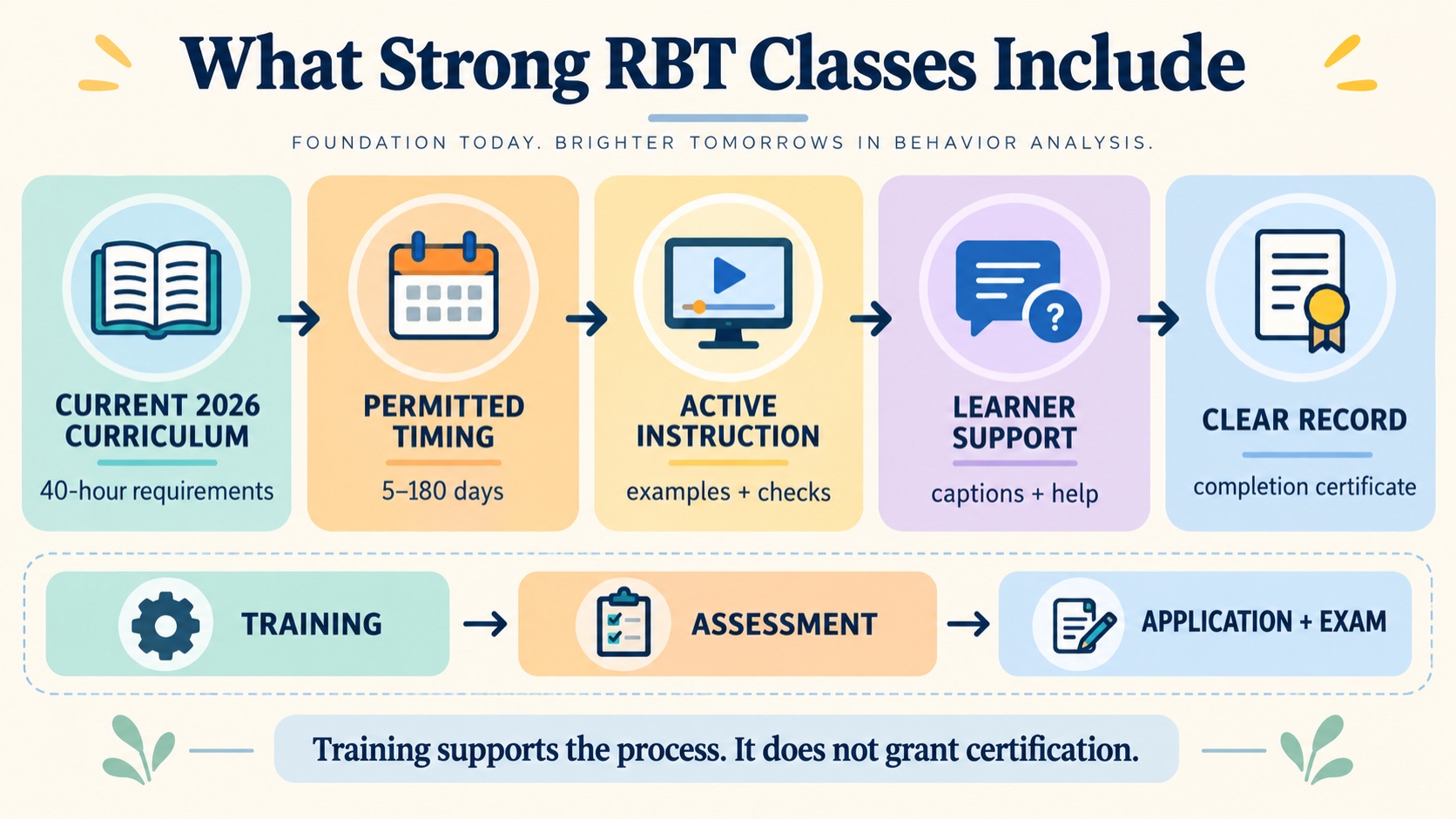
The first quality check is whether the provider names the current training source. In 2026, look for the RBT 2026 40-Hour Training Requirements and Curriculum Outline, not only an old “task list” label or a generic promise to prepare you for ABA work. A good course explains how its modules address the required content and where a learner can review the outline.
The current handbook also sets a completion window: the training must be completed in no fewer than five days and no more than 180 days, counting the start and end dates. A self-paced platform should show how your start date, progress, and completion date are recorded. If a course claims that you can finish in a weekend, ask how that claim fits the current minimum-day requirement before you enroll.
Check the course clock carefully. “Forty hours of access” is not necessarily the same as forty hours of required training. Ask whether the stated hours refer to instructional content, required activities, quizzes, discussion, or total platform access. The provider should explain what counts as completion and how a certificate is issued.
Do not confuse a current curriculum with a guarantee that every question on the examination will look like the class. The BACB describes the RBT Test Content Outline, 3rd edition, as the examination content beginning January 1, 2026. A class can teach the underlying content and help you practice, but it should not claim to reproduce secure examination items or guarantee a result.
Look for teaching quality and learner support
A compliant-looking outline is necessary, but it does not tell you whether the class will help you learn. Before purchase, preview a lesson or read the learning description. Strong instruction usually includes plain-language explanations, concrete examples, knowledge checks, opportunities to apply a concept, and feedback that explains why an answer is better than a distractor.
Accessibility and support matter in an online class. Check whether videos have captions or transcripts, whether the player works at a usable speed, whether the slides are readable, and whether you can ask questions when a term or example is unclear. Ask how long access lasts and what happens if a video, quiz, or certificate record fails. A low price is less useful if a technical problem prevents you from documenting completion.
Look for examples that respect the RBT role. A class should distinguish following a behavior plan from independently designing a comprehensive intervention, collecting data from interpreting every clinical decision, and receiving supervision from providing unsupervised services. Role-appropriate examples help prevent a learner from memorizing professional language without understanding the boundaries.
Finally, look for update information. Requirements, forms, and examination outlines can change. A provider should say what it does when a source changes, whether existing learners receive updated material, and how the version of the curriculum is identified in the course record.
Verify the completion record and boundaries
Before paying, ask to see a sample or description of the completion certificate. It should be clear who the provider is, whose name appears on the record, what training was completed, and which dates apply. You should not have to reconstruct the basic evidence from screenshots of a progress bar.
Also ask what the course does not provide. A transparent provider will separate its training certificate from the initial competency assessment, BACB application decision, examination authorization, and Pearson VUE appointment. It will not use the BACB name or logo in a way that suggests endorsement without evidence of an official relationship.
Keep your own copy of the course description, receipt, completion record, and certificate. If the provider later changes its website, your records make it easier to explain what you completed and when. Follow the current handbook for application documents rather than relying on an old email or a sales-page summary.
Compare providers with a practical checklist
Use these questions when comparing two or three RBT classes:
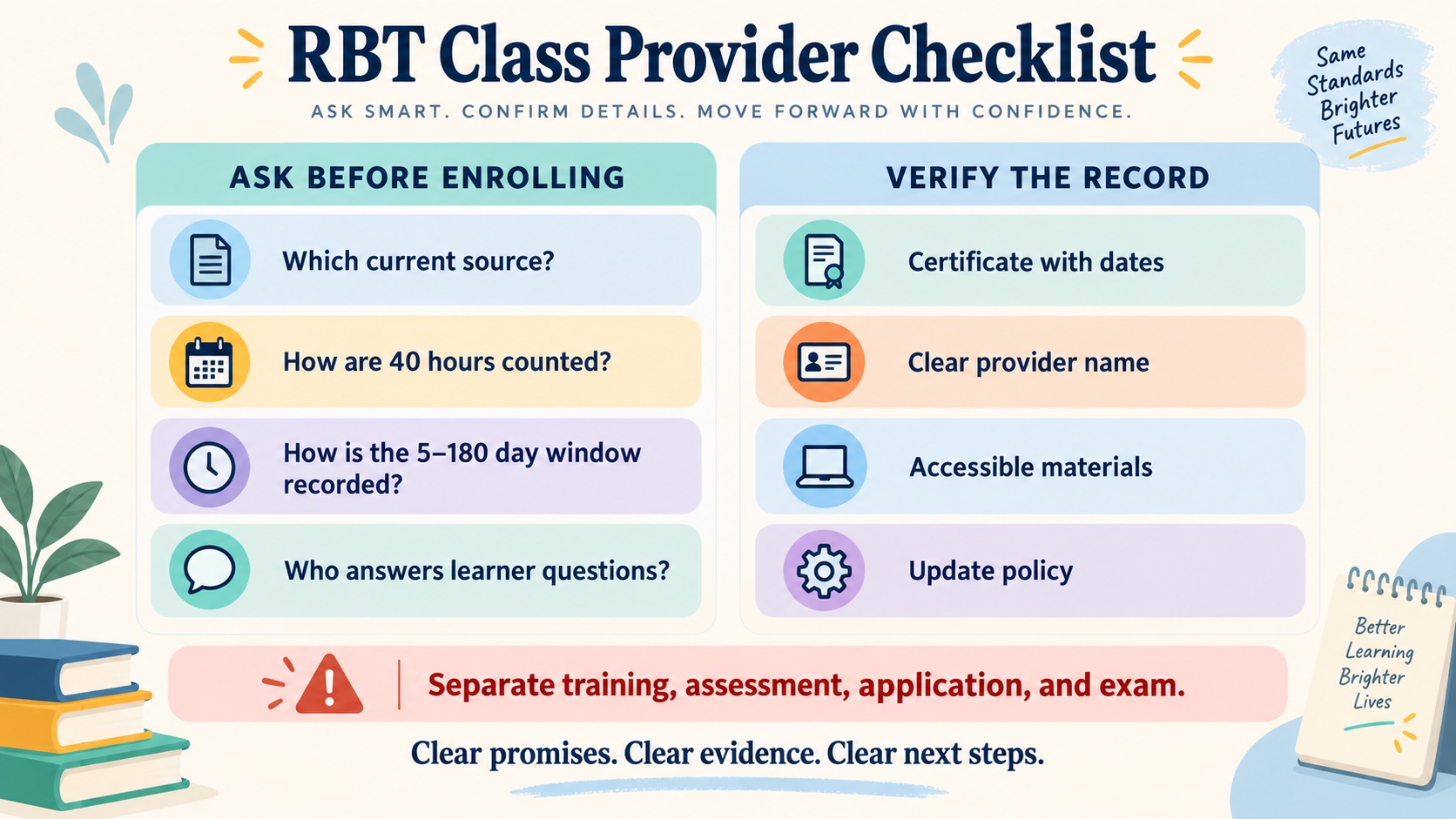
- Which current source does the class follow? Look for the 2026 40-hour requirements and curriculum outline, with a version date or clear update statement.
- How are the 40 hours counted? Ask what activities count, how progress is recorded, and how the five-to-180-day window is documented.
- Who teaches or supports the course? Find out whether questions are answered by a real instructor or support team and how quickly help is available.
- What accessibility features are included? Check captions, transcripts, readable materials, playback controls, and mobile or desktop access.
- What certificate is issued? Confirm the provider name, learner name, training description, dates, and delivery method on the completion record.
- What is separate? Ask whether the advertised package includes only training, or also an assessment, application support, exam review, or employer onboarding.
- What happens after a requirement changes? Ask whether course updates are included and how the version history is communicated.
- What is the refund or access policy? Read the practical terms before you start, especially for long access periods or bundled services.
What happens after the class
Completing a class gives you a training record, not an automatic certification. Check the current RBT Handbook for the remaining application steps, including the initial competency assessment and the documents required in your BACB Portal account. If the application is approved, follow the authorization instructions before scheduling the exam.
For exam review, use the current RBT Test Content Outline and label third-party questions as unofficial. Short practice sessions can help you retrieve definitions, discriminate similar concepts, and explain why an answer fits. ABA Study Online’s RBT practice questions and RBT exam resources can sit alongside the official requirements; they do not replace the training certificate, assessment, BACB review, or examination.
After a passing result, review the status and supervision steps that apply to you. The class is the foundation for the process, not permission to practice independently. Keep the source boundary visible whenever you compare a course badge, a practice score, and an official BACB decision.
Common mistakes
Choosing a class because it says “approved”
Ask what the word means and who is doing the approving. A marketing phrase is not enough. Verify the current curriculum, completion record, and provider boundaries against BACB sources.
Finishing too quickly
The current training window includes a five-day minimum and a 180-day maximum. A fast-access promise should not be treated as permission to ignore the timing rule.
Assuming a quiz is the competency assessment
Course quizzes can check learning. The initial competency assessment is a separate step with its own packet, responsible assessor, timing, and documentation.
Using old materials
Ask which edition and curriculum outline the class follows. The current RBT examination content beginning in 2026 uses the 3rd-edition TCO, while training requirements have their own current outline.
Buying a bundle without reading the handoffs
Bundled support can be convenient, but every service should have an owner, deliverable, and fee. If those details are vague, compare a clearer provider before enrolling.
FAQ and official sources
What are RBT classes?
RBT classes can refer to the required 40-hour training, exam preparation, employer orientation, or another learning format. Read the course description to identify which deliverable you are actually buying.
Can I take RBT classes online?
Yes. The BACB states that the 40-hour training may be offered by an employer, university, or online program. Confirm that the course follows the current requirements and documents the required completion window.
Do RBT classes make me certified?
No. Training is one part of the process. The initial competency assessment, BACB application review, authorization, examination, and applicable active-supervision steps are separate.
How long should RBT classes take?
The current RBT training requirements set a 40-hour training and a completion window of no fewer than five days and no more than 180 days. Follow the current handbook and curriculum outline for the details that apply to your application.
What should I use after RBT classes?
Use the current BACB handbook and outline for official requirements, then use targeted practice to review concepts and application. Keep unofficial study tools separate from the official application and certification decision.