RBT Class: How to Evaluate a 2026 Training Program
Looking for an RBT class can feel like comparing dozens of similar promises. One course may emphasize speed, another may advertise a certificate, and a third may focus on videos or quizzes. The important question is not which page has the loudest headline. It is whether the program is designed to meet the current BACB training requirements and whether it gives you enough practice to use the material.
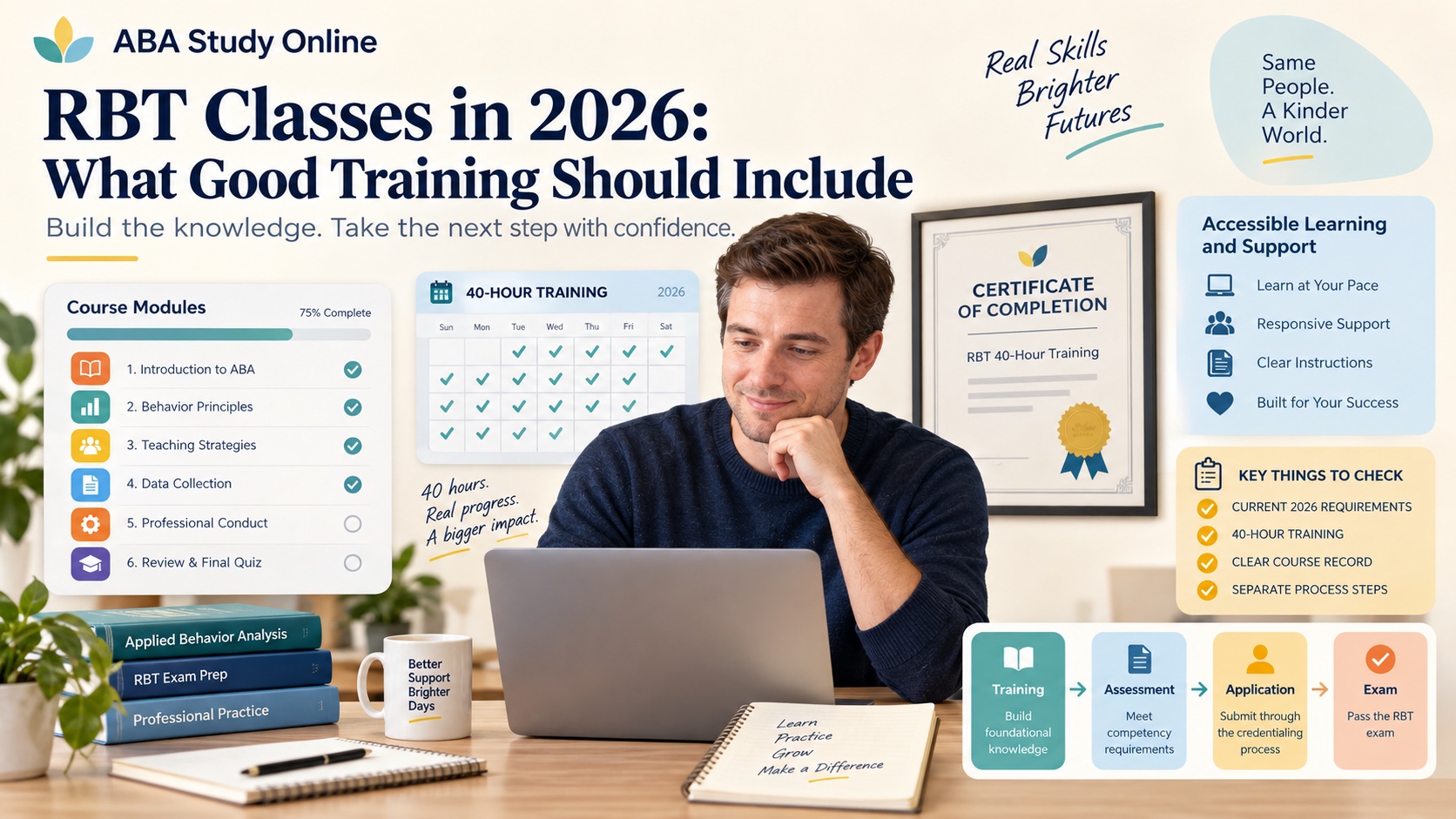
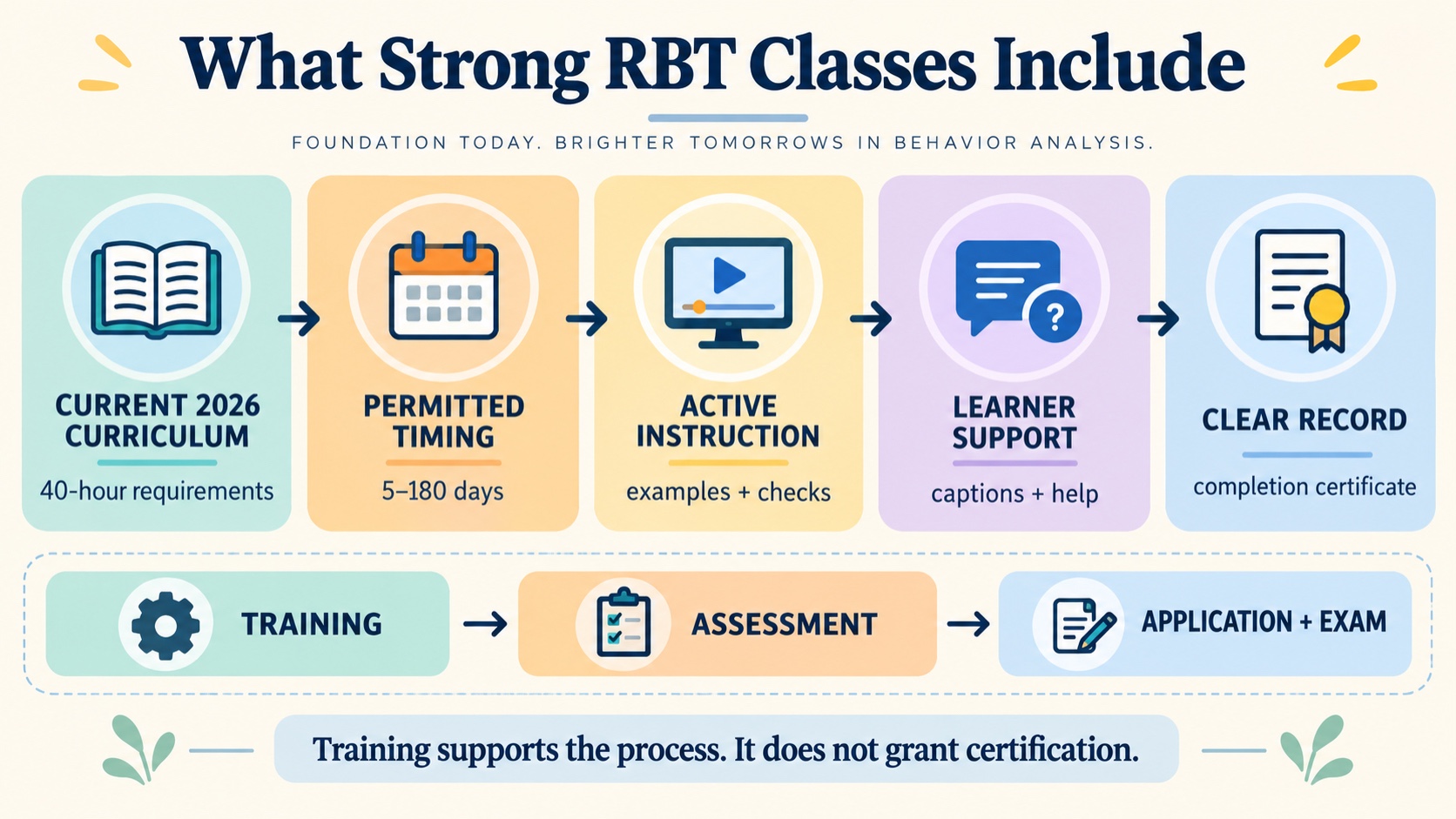
For applicants applying on or after January 1, 2026, the BACB’s 40-hour training requirements are the starting point. A class should cover the required curriculum, take at least 40 hours over no fewer than 5 days and no more than 180 days, and include meaningful behavioral skills training components. Completing a class is one part of the RBT pathway; it does not by itself create an RBT certification.
What a strong RBT class should show
Before enrolling, look for a public syllabus or curriculum outline. It should make it possible to see how the class addresses behavior-technician service delivery rather than offering a generic introduction to psychology. The BACB curriculum includes areas such as preparing for service delivery, measurement, assessment participation, skill-acquisition procedures, behavior-reduction procedures, documentation, and professional conduct. The labels may differ slightly, but the provider should be able to explain the connection.
Also check how progress is recorded. A timer alone is not the same as evidence that you completed the required training. Ask whether the program records your start and end dates, module completion, quizzes or activities, and the information needed for a completion certificate. Save your own copy of the certificate and course documentation. If a provider cannot explain what appears on the certificate, that is a reason to pause before paying.
The 2026 time and delivery requirements
The current BACB training document says the training must total at least 40 hours, be completed in no fewer than 5 days, and be completed in no more than 180 days. The start and end dates count in the day calculation. A class that promises a one-week finish may fit the minimum time window, but the provider still needs enough instructional depth and participation to meet the curriculum and delivery requirements.
Training may be structured online, in person, or as a combination. Online does not mean “watch anything whenever you want.” The requirements describe behavioral skills training components that may include didactic instruction, modeling with exemplars and nonexamples, role-play with feedback, quizzes, interactive activities, or instructor-led discussion. Assigned reading by itself may not count toward the overall training duration.
Why practice and feedback matter
RBT work is practical. You may need to record a measurement, follow a written teaching procedure, respond to a safety concern, communicate an observation, or identify when a question belongs with a supervisor. A class that only asks you to recognize vocabulary may leave you unprepared for those decisions.
Look for examples and nonexamples, demonstrations, role-play, and feedback. A useful activity might ask you to choose an operational definition, practice recording an event, or identify the next step when a learner does not respond to a prompt. The point is not to rehearse secure examination items. It is to build observable skills and explain the reason for a decision.
Good feedback should tell you what was correct, what needs revision, and how to try again. If a class gives only a completion percentage, add your own error log. Write the concept, the decision you made, the feedback you received, and the next practice date. That record can make a short online lesson more useful than a much longer course with no active retrieval.
Check the trainer and records
The BACB’s training requirements identify a Responsible Trainer who is a BCaBA, BCBA, or BCBA-D and has completed the required 8-hour supervision training. The Responsible Trainer designs or oversees the training, identifies themself in the training documentation, maintains records, and ensures the program meets the requirements. Some duties may be delegated to qualified Assistant Trainers, but responsibility and oversight still matter.
This does not mean every RBT class needs to be marketed as a BACB product. The BACB does not provide 40-hour training, completion certificates, or course recommendations. A provider should describe its own program accurately and should not use BACB language to imply endorsement. Ask who the Responsible Trainer is, how the course is monitored, and how you can contact the provider about the certificate.
It is also worth checking access before you enroll. Can you pause and revisit a lesson? Are captions or transcripts available? Is the feedback delivered by a qualified instructor rather than an automated score? Practical details do not replace the BACB requirements, but they affect whether you can complete the training carefully and retain what you learned today.
What comes after the class
Completing an RBT class is not the final application step. The current Handbook also addresses education, age, background and abuse-registry checks, and the Initial Competency Assessment. The assessment is a separate demonstration of competency with an assessor and has its own timing and documentation requirements. After the applicable eligibility steps are approved, the examination is scheduled through Pearson VUE.
Keep the class certificate, dates, trainer information, and assessment records together. Then compare your checklist with the current RBT Handbook before submitting an application. Requirements can change, and a course page may not be updated at the same time as the BACB source.
Common enrollment mistakes
- Choosing the shortest course automatically: duration matters, but curriculum and behavioral skills practice matter too.
- Confusing a certificate with certification: a provider’s completion certificate documents training; the BACB administers the RBT credential.
- Skipping the trainer check: identify the Responsible Trainer and confirm how oversight appears in the records.
- Assuming old training rules still apply: compare the course with the 2026 BACB requirements and current Handbook.
- Expecting a class to guarantee employment or a pass: no course can remove the application, assessment, examination, supervision, or employer steps.
FAQ
Can an RBT class be online?
Yes. The 2026 training requirements allow online, in-person, or combined delivery, but the program still needs the required curriculum, duration, behavioral skills training components, and documentation.
Does any 40-hour course qualify?
No. Check the current BACB training requirements, trainer qualifications, delivery activities, date window, and certificate details. A course title alone does not establish compliance.
Does finishing an RBT class make me certified?
No. Training is one eligibility component. The current pathway also includes other requirements, an initial competency assessment, an application, and an examination.
Official sources
- BACB 2026 40-Hour Training Requirements and Curriculum Outline
- BACB RBT Handbook
- BACB Supervision, Assessment, Training, and Oversight
- BACB Registered Behavior Technician resources
If you want a structured place to review RBT concepts after comparing a class, the RBT learning path can organize explanations and original practice. It is an independent study resource, not a BACB certification program, official training certificate, or pass guarantee.