
RBT Certification in Utah: BACB Steps, State Rules, and Medicaid Checks
If you search for RBT certification Utah, you may be trying to find a state application, compare a behavior technician job, or understand what Utah Medicaid expects. The answer becomes much clearer when you separate the systems involved: the Registered Behavior Technician credential follows the national BACB pathway, while Utah adds professional-law, program, employer, and payer questions that depend on the work setting.
This guide is a routing map, not an individual eligibility decision. It explains the current BACB sequence, distinguishes Utah behavior-analytic licensing and Behavioral Health Technician certification from RBT certification, and summarizes the Utah Medicaid supervision and telehealth boundaries worth checking before you start a role. Use the linked official sources for the date, service, and employer involved in your situation.
Table of Contents
Short answer: what RBT certification in Utah means
RBT certification is a BACB credential, not a Utah version of the credential. The BACB describes the RBT as a paraprofessional certification in behavior analysis. RBTs assist in delivering behavior-analytic services under the direction and close supervision of an RBT Supervisor and/or RBT Requirements Coordinator who is responsible for their work.
Utah matters after that national credential question. Utah law has separate categories for licensed or registered behavior-analytic professionals, and Utah also has a Behavioral Health Technician pathway in Title 58, Chapter 60. Utah Medicaid uses “behavior technician” in its Autism Spectrum Disorder Services manual and sets its own provider, supervision, service, and telehealth requirements. Those terms can overlap in a workplace without being interchangeable credentials.
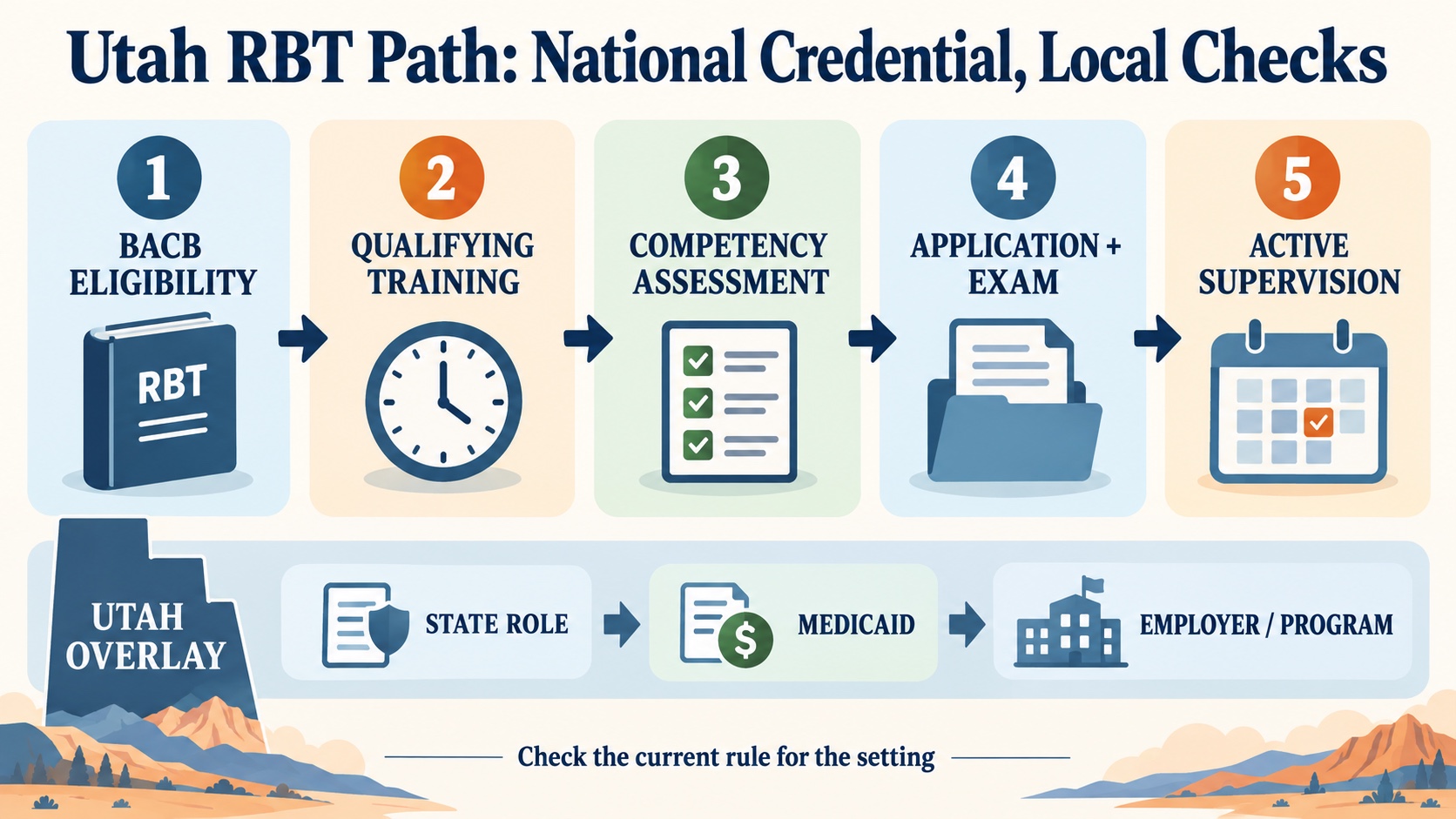
The four layers to keep separate
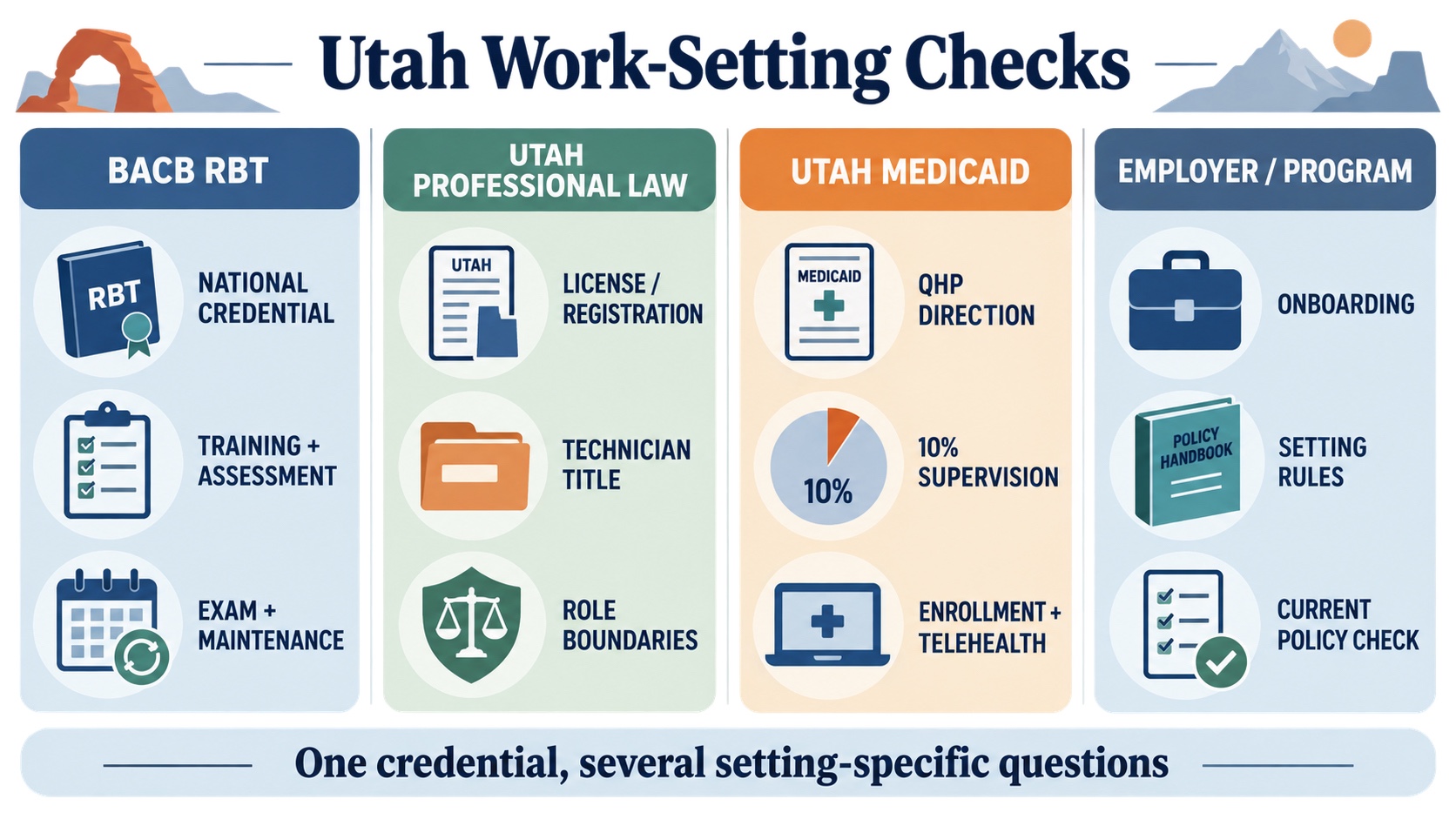
Search results often use “certification,” “licensure,” “registration,” “enrollment,” and “supervision” as if they were one process. For a Utah job or application, ask which layer a document belongs to:
- BACB certification: the national RBT eligibility, training, competency assessment, application, examination, and maintenance pathway.
- Utah professional-law category: a licensed behavior analyst, licensed assistant behavior analyst, behavior specialist, assistant behavior specialist, or a Utah Behavioral Health Technician may be governed by a different statutory route.
- Utah Medicaid or payer rule: a covered-service policy may define the qualified professional, technician role, supervision, service code, provider enrollment, documentation, or telehealth arrangement.
- Employer or program rule: a clinic, school, waiver program, or contractor can add onboarding, background-check, competency, and documentation requirements.
This model prevents a common error: treating a Utah Medicaid manual or state application as though it issues BACB certification. It also prevents the opposite error: assuming that passing the BACB examination answers every question about Utah licensure, Medicaid billing, or a particular service program.
The BACB route for a Utah candidate
Use the current BACB RBT Handbook as the controlling checklist for your application date. The broad sequence is:
- Confirm current eligibility. Review the handbook for age, education, background-check, and other requirements that apply when you plan to apply. Do not use an old Utah job post as your certification checklist.
- Complete qualifying training. Check the BACB’s current RBT training requirements, keep the completion record and dates, and confirm that the course is designed for the current BACB process.
- Complete the Initial Competency Assessment. Training and competency assessment are different checkpoints. The assessment demonstrates relevant performance; a course certificate alone does not complete this step.
- Submit the application. Keep your legal name, identification, training record, assessment record, and supporting documents consistent. If the application is delayed, return to the current handbook rather than assuming an older timeline still applies.
- Prepare for and take the examination. Use the current BACB examination information and content outline. Practice questions can help you rehearse concepts, but they are not secure BACB questions and cannot guarantee a result.
- Maintain the credential and supervision relationship. Active RBT practice involves ongoing supervision, ethical conduct, and current maintenance requirements. The RBT role is supervised paraprofessional practice, not independent behavior analysis.
Keep the documents in separate folders: training, competency assessment, application, examination, and maintenance or supervision. That organization makes it easier to explain your status to a Utah employer without describing a training course as active RBT certification.
The ABA Study Online RBT learning hub can organize theory review, and the RBT practice-question route can help you rehearse applied decisions. These are independent learning resources; they do not replace BACB forms, assessment, examination authorization, or supervision.
Utah licensing and technician terms
Utah’s professional-law pages make it important to name the exact title being discussed. Title 58, Chapter 61, Part 7 covers behavior-analytic licensing and registration categories, including behavior analyst, assistant behavior analyst, behavior specialist, and assistant behavior specialist. Those categories answer a different question from whether a person holds the BACB RBT credential.
Utah also has a Behavioral Health Technician pathway in Title 58, Chapter 60. The state law describes state certification qualifications for a behavioral health technician. That is a Utah statutory term and pathway; it should not be presented as a Utah-issued RBT certificate or as an automatic substitute for the BACB RBT process.
At the same time, a Utah employer or payer may use “behavior technician” as a job or service-delivery label. Utah Medicaid’s Autism Spectrum Disorder Services manual describes a behavior technician as a paraprofessional who assists in delivering behavior-analysis services under the direct supervision of a qualified health professional. A workplace may therefore ask about both your BACB credential and the local role or payer requirements.
Ask the organization to write down the exact title, issuing body, supervisor, and purpose of each requirement:
- Is the document proving BACB RBT certification?
- Is it a Utah professional license or registration?
- Is it Utah Behavioral Health Technician certification?
- Is it an employer competency or onboarding record?
- Is it required for Medicaid enrollment, a waiver service, or a specific claim?
Utah Medicaid, supervision, and telehealth
Utah Medicaid’s Autism Spectrum Disorder Services manual, updated January 2026, provides the payer-specific framework. It says ABA treatment programs must be designed and supervised by a qualified health professional and may be delivered by an assistant behavior analyst or behavior technician. The qualified health professional remains responsible for clinical direction, supervision, case management, and the support staff’s work.
The manual also states a supervision baseline for the tiered model: the qualified health professional must supervise at least 10% of the time the member is receiving direct services from a technician or assistant behavior analyst, and at least 50% of that supervision must be direct. The current manual and the member’s authorization should control the exact service arrangement; do not turn one payer rule into a universal BACB supervision statement.
Provider enrollment is another separate layer. Utah Medicaid directs providers to use the PRISM portal for enrollment and application tracking. An RBT or behavior technician may deliver services inside an enrolled organization while the organization or qualified professional handles provider enrollment, claims, prior authorization, and documentation. Ask who is enrolled, which provider type is billing, and how your credential and supervision are recorded.
Telehealth must be read with the service code and current policy. The Utah Medicaid manual allows remote supervision of a technician or assistant behavior analyst when clinically appropriate and when documentation supports the telehealth arrangement. It also limits which services may be delivered through telehealth. The practical question is not simply “Can an RBT do telehealth?” It is “Which Utah Medicaid service, who is present, who is supervising, and what does the current authorization allow?”
For a Utah Medicaid-connected role, ask:
- Which Utah Medicaid or managed-care program is involved?
- Who is the qualified health professional responsible for the treatment program and supervision?
- How will the 10% supervision baseline and direct-supervision portion be documented?
- Who is enrolled through PRISM and whose provider information is used for claims?
- Is the service face-to-face, remotely supervised, or delivered through a payer-approved telehealth model?
- Which current manual, authorization, or bulletin supports the answer?
A Utah RBT checklist
Use this order when you are planning certification or comparing a Utah role:
- Start with BACB. Record the current RBT Handbook version and list the national steps that apply to your application date.
- Build a dated evidence folder. Keep training, competency assessment, application, examination, and active-supervision records separate.
- Name the Utah title. Ask whether the role uses RBT, behavior technician, Behavioral Health Technician, behavior specialist, assistant behavior specialist, or another title.
- Identify the supervisor. Ask who designs or directs the program, who is responsible for the work, and how supervision is documented.
- Check the payer. If Utah Medicaid or a waiver is involved, identify the manual, authorization, provider enrollment, billing, and telehealth requirements.
- Recheck before starting. Return to the current BACB and Utah sources if your employer, payer, service, or application date changes.
Common mistakes to avoid
- Looking for a Utah RBT certificate instead of starting with BACB: RBT certification follows the national BACB pathway.
- Confusing RBT with Behavioral Health Technician: Utah’s Chapter 60 pathway is a separate state term and should not be renamed as RBT certification.
- Confusing behavior analyst licensure with RBT certification: Utah Chapter 61 professional categories apply to different roles and responsibilities.
- Treating a course as certification: training, competency assessment, application, examination, and maintenance remain separate steps.
- Ignoring the qualified professional: Utah Medicaid places clinical direction and responsibility for support staff with the qualified health professional.
- Generalizing telehealth: label the payer, code, authorization, participant, and supervision arrangement before applying a remote-work answer to a different setting.
RBT certification Utah FAQ
Does Utah issue RBT certification?
The RBT credential follows the BACB’s national certification pathway. Utah has separate professional-law and technician terms, plus payer requirements, but those should not be presented as a replacement for the BACB RBT process.
Is a Utah Behavioral Health Technician the same as an RBT?
Not automatically. Behavioral Health Technician is a Utah statutory term and pathway under Title 58, Chapter 60. RBT is a BACB paraprofessional certification. An employer or payer may ask about both, so confirm the exact title and purpose of the requirement.
What does Utah Medicaid require for a behavior technician?
The current Autism Spectrum Disorder Services manual places the technician under a qualified health professional’s direction and supervision, describes QHP responsibility for the support staff’s work, and sets a supervision baseline for the tiered model. Check the current manual and authorization for the service involved.
Can an RBT work with Utah Medicaid through telehealth?
Utah Medicaid allows some remote supervision or telehealth arrangements when clinically appropriate and documented, while limiting other services. The answer depends on the service, code, authorization, member, people present, and supervision arrangement; it is not a blanket yes or no for every Utah job.
Does Utah Medicaid enrollment make someone an RBT?
No. Provider enrollment is an administrative payer process, often handled through the organization or qualified provider. Personal RBT certification follows the BACB route, while enrollment, claims, supervision, and documentation follow the applicable Utah payer rules.
Sources and verification notes
- BACB: Registered Behavior Technician certification resources and BACB: RBT Handbook
- Utah Medicaid: Autism Spectrum Disorder Services Provider Manual
- Utah Medicaid: Provider Manuals index and Utah Medicaid: Become a Medicaid Provider
- Utah Code Title 58, Chapter 61 and Utah Code Title 58, Chapter 60
- Utah DOPL: Behavioral Health Coach and Technician laws and rules
- Utah DSPD: Service Code Descriptions
- ABA Study Online RBT learning hub, RBT practice questions, and free resources