RBT Certification Training Programs: How to Compare Your Options
If you are comparing RBT certification training programs, the most important question is not which course has the loudest promise. It is whether the program gives you a qualifying training experience, complete records, and a clear understanding of what still comes next. The current BACB requirements set the standard; each provider decides how to teach within that standard.
This guide gives you a practical way to compare programs without treating a course certificate as the same thing as RBT certification. Use the current BACB RBT Handbook and the 2026 RBT 40-Hour Training Requirements and Curriculum Outline for the rule that applies to your application.
Table of Contents
Short answer: what should a program provide?
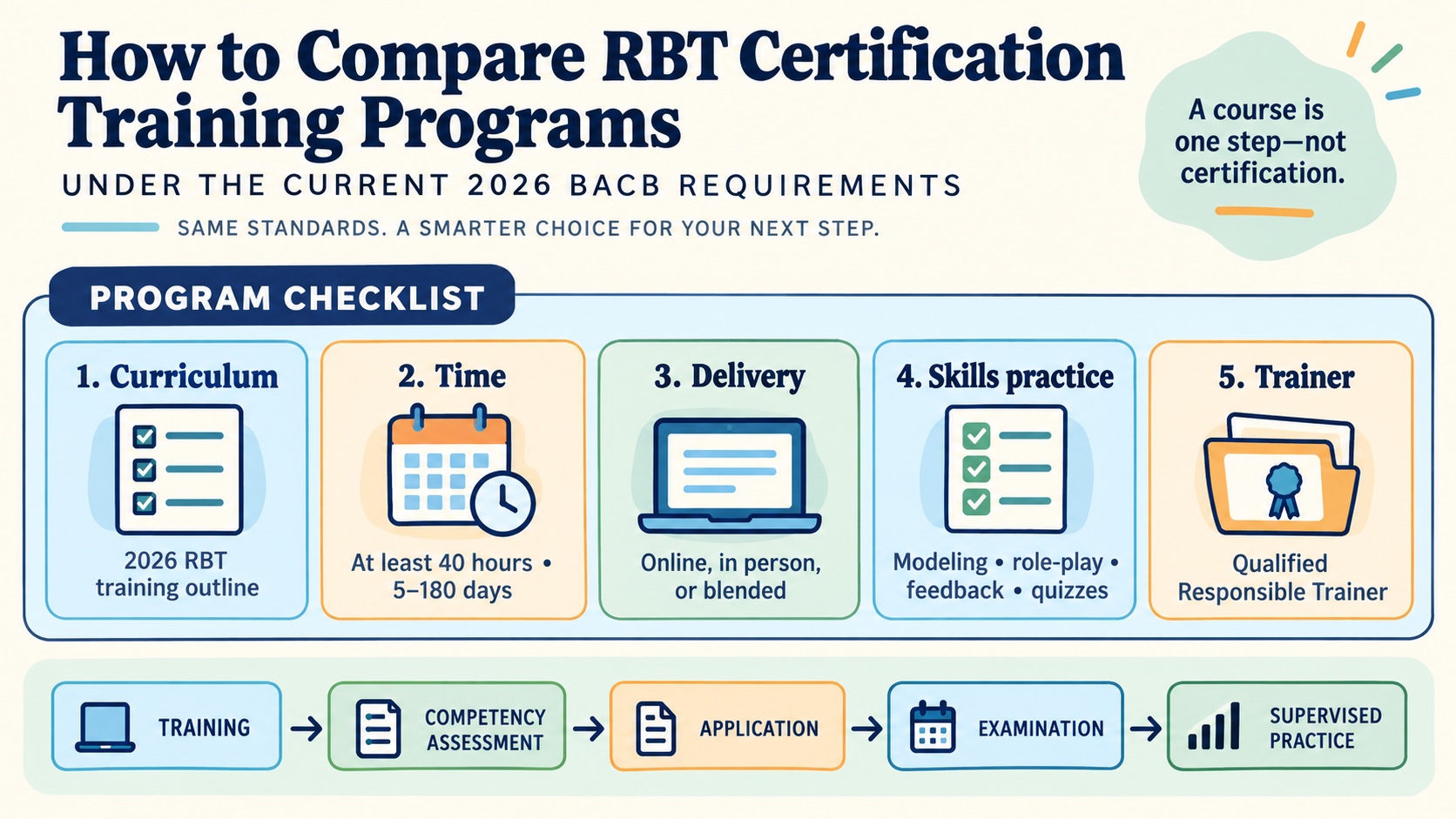
A strong RBT training program should make five things easy to verify:
- Curriculum: the program covers the current RBT training outline rather than an old or generic introduction to ABA.
- Time: you can complete at least 40 hours over no fewer than 5 days and no more than 180 days.
- Delivery: the provider explains whether the program is online, in person, or blended and how participation is documented.
- Skills practice: the experience includes teaching methods such as modeling, role-play with feedback, quizzes, interactive activities, or instructor-led discussion.
- Trainer and records: a qualified Responsible Trainer oversees the training and the final documentation identifies what the BACB requires.
Price, schedule, and learner support still matter. They become useful comparison points after the program passes this basic requirements check. A low price is not a bargain if the course cannot show how it meets the current outline or if you cannot obtain a complete certificate.
A qualifying course is not certification
The word “certification” makes course pages confusing. A qualifying 40-hour training program is one part of the RBT pathway. It does not, by itself, make you an RBT, approve your application, or reserve an examination appointment.
The current pathway also includes an Initial Competency Assessment, an application and required documentation, an examination, and ongoing supervision after certification. The BACB’s RBT guidance page describes the role as a paraprofessional certification whose work is performed under the direction and close supervision of an RBT Supervisor or RBT Requirements Coordinator. Keep that boundary visible while you compare courses.
A useful mental model is to treat the course as a documented learning stage. It should prepare you to understand behavior-analytic service delivery and demonstrate that you completed the required training. It should not promise that completing its checkout page guarantees a credential or a passing result.
The five-part program comparison checklist
1. Check the curriculum, not just the title
Ask for the course outline before you pay. The current training document includes content areas such as introduction to applied behavior analysis, measurement and data, assessment, behavior-change interventions, and preparing for service delivery. The sections can be taught in different orders, but the program should explain how its lessons map to the current requirements.
Be cautious with a page that says “40 hours of ABA” without showing the RBT-specific curriculum. A broad ABA course may be interesting and still fail to answer the training requirement you are trying to meet.
2. Verify the schedule and the clock
The current rule is at least 40 hours, completed in no fewer than 5 days and no more than 180 days. A program can be self-paced, but “self-paced” should not mean that time and completion records are invisible. Ask when the training window begins, how progress is recorded, what happens if you pause, and how the provider issues the final certificate.
Assigned reading alone cannot count toward the overall training duration. Look for actual instruction and learning activities rather than a large folder of readings with no structured participation.
3. Compare delivery by learning quality
Online, in-person, and blended delivery can all be workable. The format is less important than whether it helps you practice the skills and receive usable feedback. An online program should say how discussions, demonstrations, quizzes, and role-play are handled. An in-person program should explain the schedule, attendance record, and what happens when a learner needs extra practice.
Choose the format you can complete with attention. A beautiful dashboard cannot compensate for missed sessions, unclear deadlines, or no way to ask a trainer why two procedures look similar.
4. Look for behavioral-skills-training components
The 2026 outline allows a combination of video-based or didactic instruction, modeling with examples and nonexamples, in vivo role-play with feedback, content quizzes, interactive activities, and instructor-led discussion. The exact mix may differ by program. What matters is that the provider explains how the learning moves beyond passive reading.
For example, a lesson about prompting should give you a way to recognize a prompt, practice describing the learner’s response, and receive feedback on the next step. A quiz can check recognition; feedback helps you understand why an answer fits the procedure and why a tempting alternative does not.
5. Confirm the Responsible Trainer and certificate
The BACB training outline identifies a Responsible Trainer who is a BCaBA, BCBA, or BCBA-D with the required 8-hour supervision training. The Responsible Trainer designs or oversees the training, identifies themself in the documentation, and remains responsible for meeting the requirements even when assistant trainers help deliver sessions.
Before enrolling, ask what the completion certificate contains. It should be more useful than a generic “course completed” email. The official outline provides a certificate model and documentation expectations, so compare the provider’s process with that source. You should be able to keep a copy of the certificate and understand which dates, hours, trainer details, and applicant information it records.
Online, in-person, or blended delivery
Online training is not automatically less valid, and in-person training is not automatically better. Use three practical questions:
- How do I interact with instruction and receive feedback?
- How does the program track the required time and completion window?
- What support exists if I do not understand a scenario or need to repeat a skill?
If a provider answers those questions clearly, the format becomes a fit decision. If the page relies on “finish instantly,” “guaranteed pass,” or “official exam questions,” treat that language as a warning. Independent training can support preparation, but it cannot sell access to secure BACB examination content.
Records, support, and warning signs
Save the program description, enrollment receipt, schedule, progress record, trainer information, and final certificate in one folder. Keep the version or date of the official requirement you used for comparison. Requirements can change, and a clean record makes it easier to ask a supervisor or the BACB about an application question.
Warning signs include a missing curriculum, no clear training window, no explanation of skills practice, a certificate that omits basic identifying details, and language that implies the provider is endorsed by the BACB without evidence. The BACB specifically directs applicants to its own handbook and resources rather than recommending private training programs. A program may be useful without being officially endorsed.
What comes after training?
Once you finish a qualifying program, do not skip straight from “certificate downloaded” to “I am certified.” Review the current Initial Competency Assessment requirements, prepare the application materials, follow the examination instructions, and arrange the supervision that applies after certification. The ABA Study Online RBT learning path can help you review concepts, while free practice questions can help you identify gaps. These are study resources, not substitutes for the current BACB handbook or a required assessment.
FAQ and official sources
Can RBT certification training be online?
The current 40-hour training may use an online, in-person, or blended format. Check that the program still covers the required curriculum, time window, behavioral-skills-training components, qualified trainer oversight, and documentation.
How long does RBT training take?
The training must total at least 40 hours and be completed in no fewer than 5 days and no more than 180 days under the current 2026 training requirements. Your provider may offer a shorter calendar, but it cannot compress the requirement below those boundaries.
Does finishing a 40-hour course make me an RBT?
No. It is one training stage. The competency assessment, application, examination, and supervision requirements remain separate.
Official sources: Review the RBT Handbook, the 2026 RBT 40-Hour Training Requirements and Curriculum Outline, and the BACB page on supervision, assessment, training, and oversight before making a final decision.