
RBT Certification in Texas Online: What to Check First
If you are searching for RBT certification Texas online, separate the national credential from Texas licensing rules before you enroll. The Registered Behavior Technician (RBT) certification is administered by the BACB. Texas TDLR regulates behavior-analyst and assistant-behavior-analyst licenses and describes exemptions for some paraprofessionals working under a licensed professional’s direction. A Texas license exemption is not a Texas-issued RBT certification.
Online training may be convenient, but the word “online” does not prove that a course meets the current BACB requirement. Use the current BACB RBT Handbook and ask a provider for its curriculum, certificate, dates, and competency-assessment plan. Then ask the Texas employer how its setting, supervision, background-check, and payer rules affect the job.
Table of Contents
The short answer
Start with BACB requirements, not a Texas “RBT license” form. The BACB pathway may include eligibility checks, current 40-hour training, an initial competency assessment, application documents, and the RBT examination. The live handbook controls the version and timing. After certification, RBTs work under the direction and close supervision described by BACB and the employing organization.
BACB certification and Texas licensing
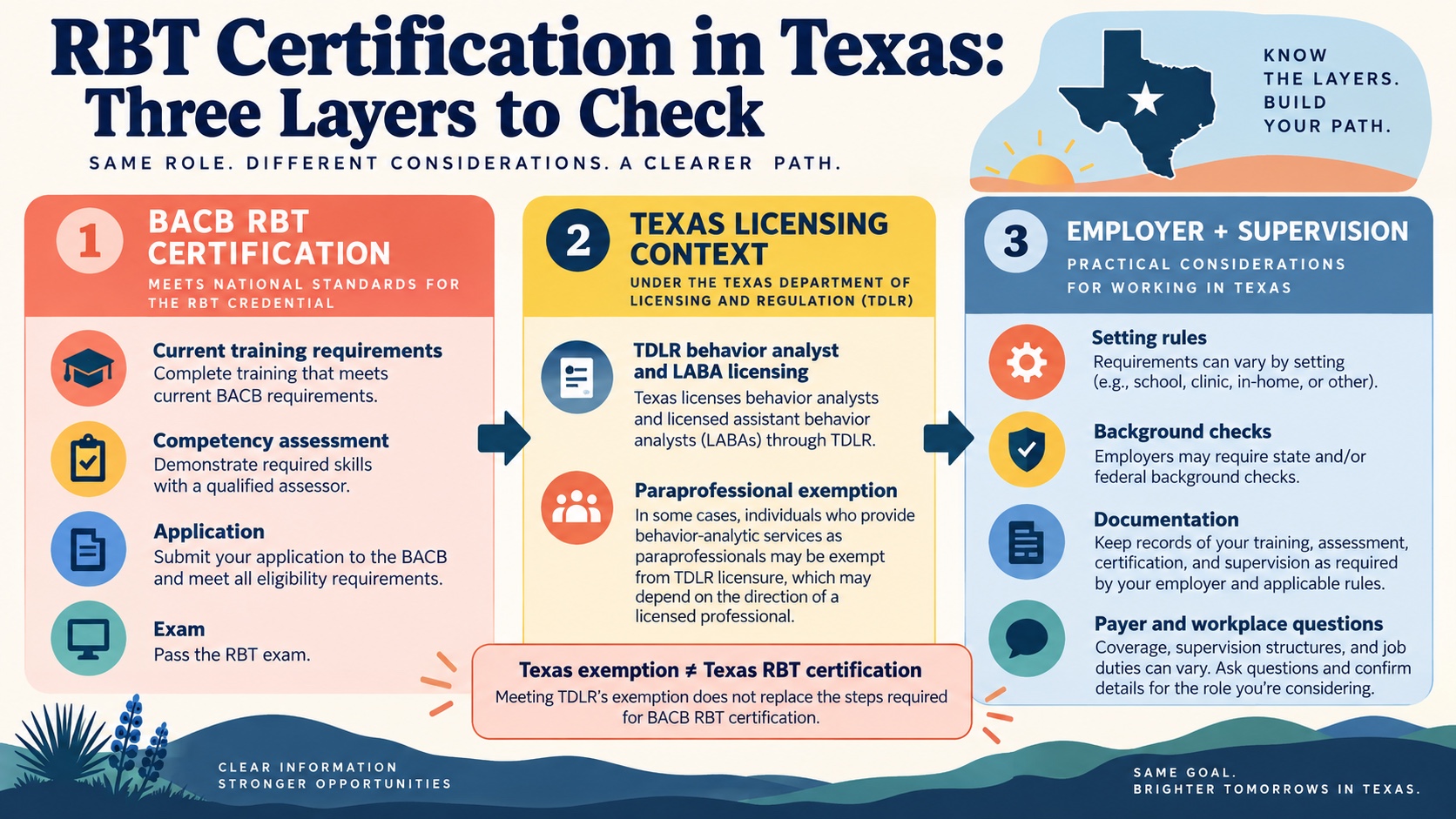
Texas TDLR’s current behavior-analyst licensing page says that people using the licensed behavior analyst or licensed assistant behavior analyst titles, and people practicing applied behavior analysis unless exempt, must meet the applicable licensing rules. It also lists exemptions for paraprofessionals such as behavior technicians when services are provided under the extended authority and direction of a licensed behavior analyst or licensed assistant behavior analyst.
That state language should be read narrowly. It does not mean every person who calls themselves an RBT is automatically cleared to work in every setting. The employer still has to confirm the supervision structure, client-service model, background checks, and payer or school requirements. Do not use a paraprofessional exemption to claim an LBA or LABA title.
Texas location and workplace can change the practical checklist. A clinic may require one set of onboarding documents, a school may add district and student-safety rules, and an in-home provider may have different caregiver communication and travel policies. These requirements do not replace the BACB pathway, but they can determine whether you are ready to begin a specific job. Ask for the employer’s written expectations before you pay for a course or schedule your assessment.
If you are moving into Texas from another state, confirm that your BACB certification is active and that the new organization understands your current status. Ask who is responsible for supervision, how data and incidents are documented, and where your training and assessment records should be stored. Never assume that a previous employer’s supervision plan automatically transfers to a new client or organization.
The current BACB RBT path
- Check the current handbook: confirm the age, education, background, abuse-registry, training, and assessment rules for your application date.
- Choose qualifying training: ask the provider how its course meets the current BACB curriculum and certificate requirements.
- Complete the competency assessment: use the current packet and an eligible assessor; a course completion badge is not the same event.
- Submit the BACB application: use the official portal and requested attestations.
- Schedule the exam: follow current BACB examination instructions rather than a training provider’s older summary.
- Maintain the credential: follow the applicable supervision, professional-development, ethics, and recertification rules.
Keep your documents organized: training certificate, competency paperwork, application confirmation, examination correspondence, and supervision records. Protect client information and never place confidential clinical notes in a personal study folder.
A simple document folder can include the current BACB handbook link, your training certificate, competency assessment paperwork, application receipt, exam correspondence, and employer onboarding checklist. Keep the folder secure, separate from client records, and update it when BACB or Texas publishes a new instruction.
How to evaluate online training
Ask five questions before paying:
- Does the provider explain which current BACB requirement the course is designed to meet?
- Does the course state its dates, curriculum, instructor qualifications, and certificate language?
- How are attendance, interaction, assessment, and identity documented?
- How will you complete the separate competency assessment?
- Will the employer accept the documents for onboarding in the Texas setting?
ABA Study Online’s RBT resources, free question previews, and app review tools can support terminology and scenario practice. They do not replace the BACB course, competency assessment, exam, supervision, or Texas employer checks.
What to ask a Texas employer
- Must I already hold active BACB RBT certification, or will the organization hire me while I complete the pathway?
- Who is the licensed behavior analyst or assistant behavior analyst responsible for the service model?
- Which background check, abuse-registry check, health screening, and onboarding documents are required?
- Will I work in a clinic, school, home, or community setting, and what setting rules apply?
- How are supervision, data, incidents, and caregiver communication documented?
Written answers are valuable when rules differ by organization. If the job description conflicts with the BACB handbook or TDLR page, pause and ask the employer or relevant agency to clarify the rule before starting work.
Also ask what happens when you are unsure during service delivery. A clear escalation route matters: you should know whom to contact, how urgent concerns are reported, how safety procedures are documented, and how a supervisor reviews a change before it is implemented. Those answers are part of responsible preparation, even though they are not a substitute for the certification requirements.
Finally, treat the current official pages as live documents. Save the link and the date you checked it, but return to the source before submitting an application. That habit matters during requirement transitions and helps keep a Texas-specific article from becoming an outdated promise. It also gives you a reliable record to discuss with your supervisor.
Good documentation makes the next step easier and reduces avoidable confusion during training, application, onboarding, and supervision.
Keep questions specific, current, and tied to the official source.
Common mistakes
- Looking for a Texas RBT license number: confirm whether the request is for BACB certification or workplace onboarding.
- Calling an RBT an LBA: these are different credentials and titles.
- Assuming any online course qualifies: verify current BACB curriculum and certificate details.
- Ignoring supervision: the Texas exemption language depends on the direction and authority of licensed professionals.
- Using an old 2026 checklist: open the live BACB handbook before submitting documents.
FAQ and official sources
Does Texas issue a separate RBT certification?
The BACB administers RBT certification. Texas TDLR regulates behavior-analyst licenses and describes exemptions for some paraprofessional work; that is not the same as issuing an RBT credential.
Can I complete RBT training online in Texas?
Online delivery may be available, but verify that the course meets the current BACB requirements and that the employer accepts the resulting documents.