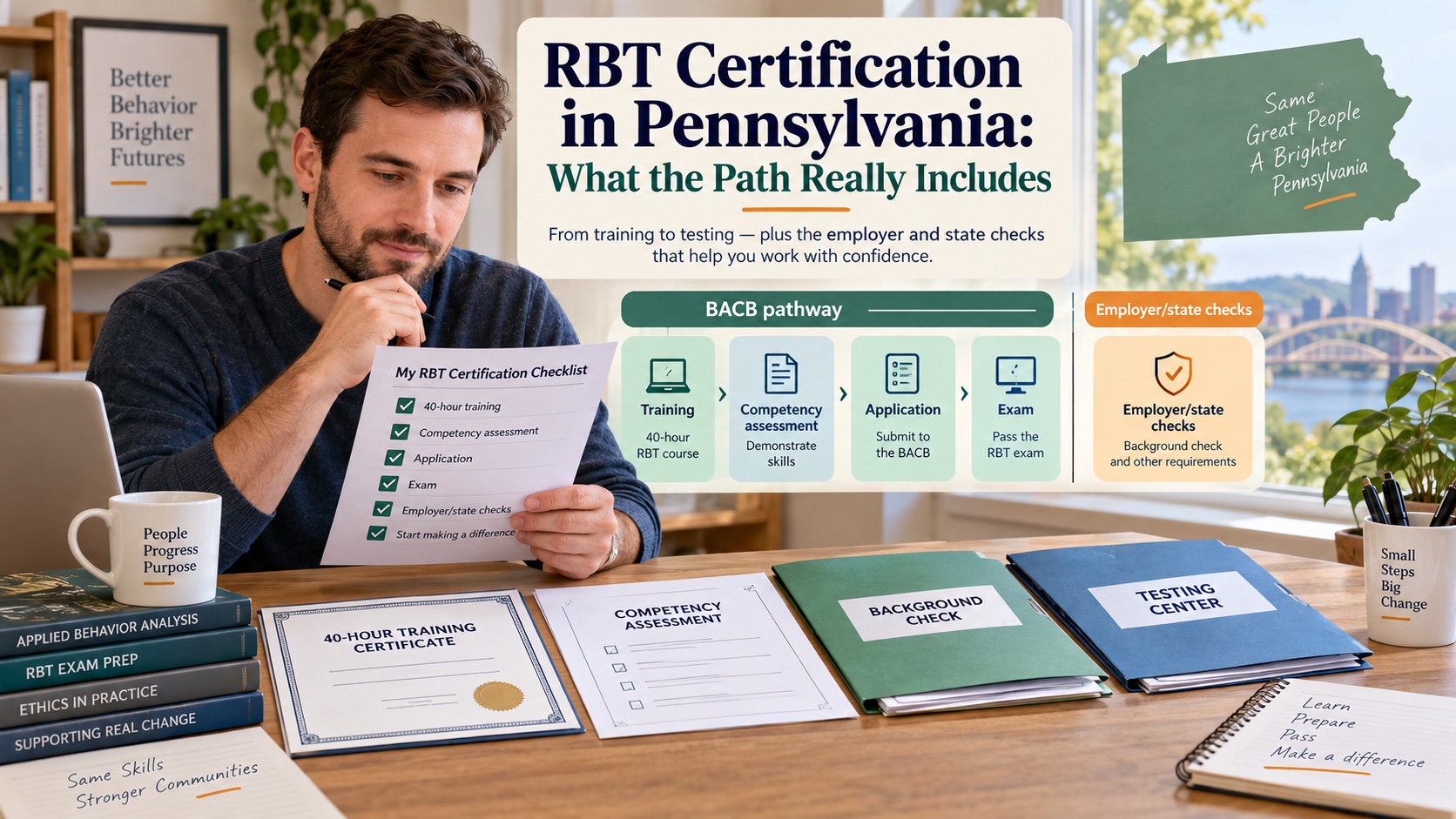
RBT Certification in Pennsylvania: What the Path Really Includes
If you are looking for RBT certification in Pennsylvania, the main certification is the national Registered Behavior Technician credential administered by the Behavior Analyst Certification Board. Pennsylvania does not turn the BACB RBT exam into a separate state exam. You still need to follow the current BACB handbook, and the organization, school, payer, or service setting where you work may add its own requirements.
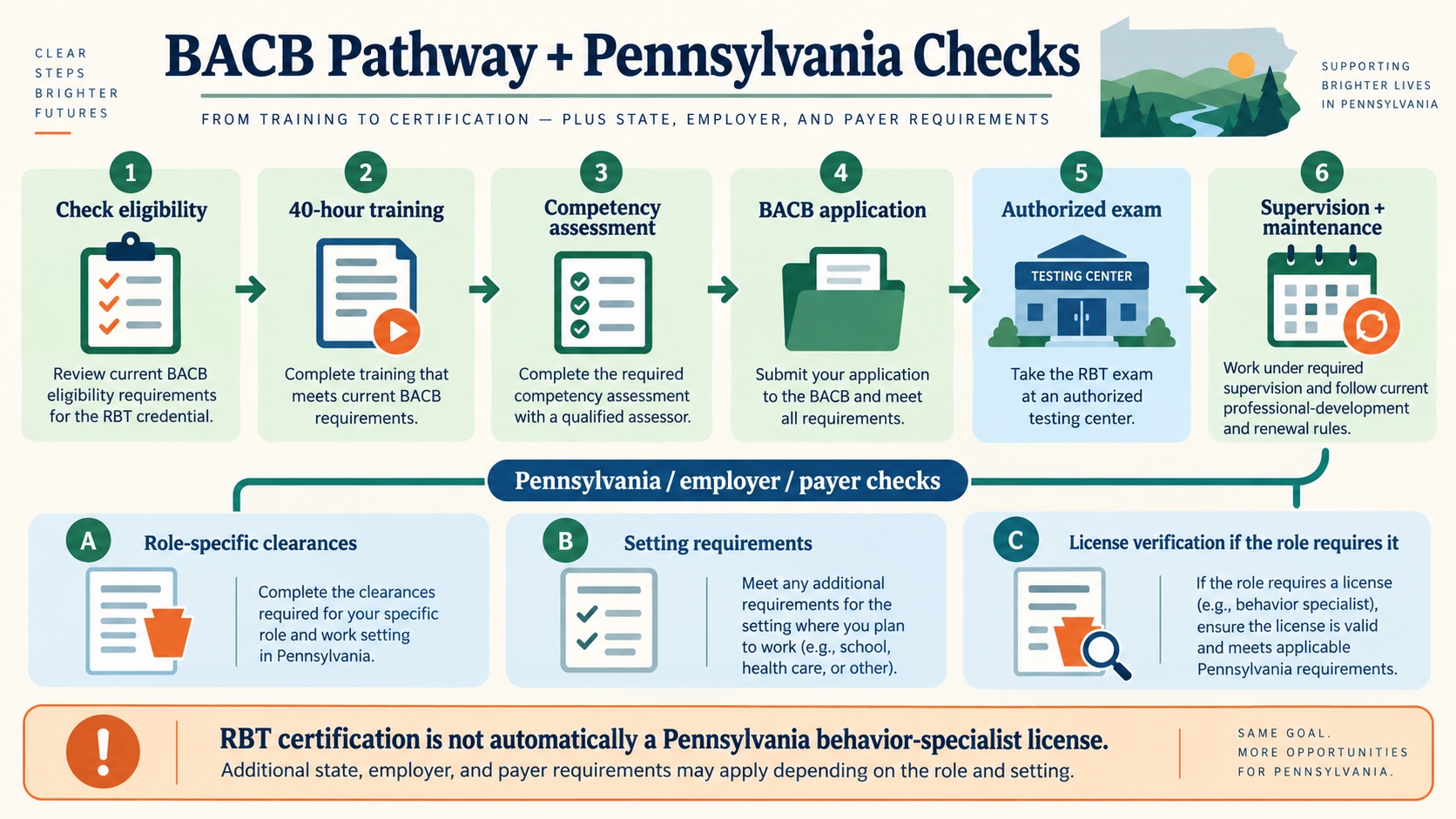
One distinction prevents a lot of confusion: RBT certification is not the same thing as Pennsylvania behavior-specialist licensure. A behavior specialist license is a different state credential with different education and experience requirements. It should not be treated as an automatic requirement for every RBT position, and RBT certification should not be presented as a substitute for a license when a role requires one.
Table of Contents
The BACB RBT pathway
The current RBT pathway is organized through BACB requirements, application documents, an initial competency assessment, and the RBT examination. The current handbook is the source of truth for the version that applies to your application. In 2026, the examination uses the RBT Test Content Outline (3rd ed.), and the handbook includes updated eligibility and documentation instructions.
- Check eligibility. Review the current age, education, background-check, and abuse-registry requirements.
- Complete the required training. Use a 40-hour training that meets the current BACB curriculum and timing rules.
- Complete the competency assessment. An appropriately qualified assessor must use the current packet and sign the required documentation.
- Submit the certification application. Upload the current forms and supporting records through your BACB account.
- Wait for the applicable authorization. Follow the current instructions before scheduling the exam through Pearson VUE.
- Take the examination and maintain the credential. Keep up with supervision, ethics, professional-development, and recertification requirements that apply after certification.
What to prepare in 2026
Do not build your application from an old RBT checklist found in a discussion forum. The current handbook says applicants applying on or after January 1, 2026 use the 2026 eligibility requirements and the RBT 3rd-edition examination content. It also describes timing and documentation details for the 40-hour training, attestation, background checks, and competency assessment.
Use one folder for your training certificate, competency packet, background-check information, abuse-registry information when applicable, application receipts, and BACB messages. The dates matter. If a supervisor, attesting certificant, or assessor must complete a form within a stated window, record that deadline instead of assuming that a completed course stays valid forever.
Your exam preparation should follow the current RBT outline, not a BCBA or BCaBA study guide. Free RBT practice questions can help with application and recall, while free resources can support terminology review. These are study aids; they do not approve an application or replace BACB documents.
What Pennsylvania changes—and does not change
Pennsylvania matters because the job context can add questions about licensure, supervision, Medicaid or other payer participation, school employment, background checks, and internal training. Those questions depend on the role and organization. They do not change the fact that the RBT certification application and exam are handled through BACB processes.
The Pennsylvania Department of State publishes a separate behavior-specialist licensure snapshot. That credential has its own degree, experience, coursework, and state-license conditions. Read it if a job posting asks for a behavior specialist license, but do not use it as an RBT application checklist. If you need to verify a Pennsylvania professional license, use the state’s PALS verification route.
State language can also appear in an employer’s job title. “Behavior technician,” “behavioral health technician,” and “RBT” are not always used as perfect synonyms. A position may use one title while requiring a different combination of education, training, experience, or supervision. Ask which duties you will perform, who signs your documentation, and whether the organization expects you to maintain BACB certification or another credential.
Pay attention to the difference between eligibility and employment readiness. Meeting BACB eligibility rules lets you pursue the certification pathway; it does not promise a Pennsylvania job, payer enrollment, a particular hourly rate, or permission to practice outside the supervision structure. Employment and service-delivery decisions remain tied to the organization, the client’s program, and the applicable state or payer rules.
Ask a prospective employer which credential the position requires. A clinic may hire RBTs under the direction and close supervision of an RBT Supervisor or RBT Requirements Coordinator. A school, insurer, or public program may have additional onboarding rules. Get those conditions in writing when they affect hiring, billing, or the services you may provide.
Questions for employers and service settings
- Do you require active BACB RBT certification before the start date, or will you support the application process?
- Who will serve as the RBT Supervisor or Requirements Coordinator?
- What Pennsylvania background-check, child-safety, health, or workplace documents are required?
- Does the payer or program have a separate enrollment or credentialing rule?
- What ongoing supervision, professional development, and documentation will the organization provide?
- Does the role actually require a Pennsylvania behavior-specialist license, or is that a different position?
If a Pennsylvania role involves children, schools, healthcare settings, or public funding, ask the hiring organization which clearances and onboarding documents it requires in addition to BACB records. Keep those documents in a separate state/employer folder so you can see which item belongs to certification and which item belongs to the workplace. This simple separation makes renewals and job changes easier.
Pennsylvania RBT checklist
- Read the current BACB RBT Handbook and RBT resource hub.
- Confirm the 2026 requirements and current exam outline that apply to your application date.
- Complete the required training and competency documentation within the stated windows.
- Submit the BACB application with current forms and keep account messages.
- Schedule the authorized exam through the current Pearson VUE route.
- Ask your Pennsylvania employer or program about additional rules.
- Keep certification, supervision, ethics, and recertification records after you pass.
When a requirement changes, use the effective date that matches your application or recertification situation. Do not combine a 2025 checklist, a 2026 handbook, and a job-board summary as if they were one rule set. Save the official page and document version you used, then ask your attesting certificant or supervisor when a question depends on your individual circumstances.
Before you submit anything, compare each document with the current form name in your BACB account. A complete-looking packet can still be delayed when an older form, missing signature, or unclear date is uploaded. If the portal gives you an action item, follow that message and keep a copy of what you resubmitted.
FAQ and official resources
Is there a separate Pennsylvania RBT certification?
The RBT certification pathway is administered by BACB. Pennsylvania employers and programs may have additional requirements, but do not assume there is a separate state RBT exam without a specific official rule for your role.
Does RBT certification make me a Pennsylvania behavior specialist?
No. A behavior specialist license is a separate Pennsylvania credential with separate requirements. Check the job description and state licensing information for the role you want.