RBT Certification in New Jersey: BACB Steps, State Boundaries, and Employer Checks
If you search for RBT certification NJ, you are probably trying to answer a practical question: what do I actually need before I can work as a Registered Behavior Technician in New Jersey? The safest answer begins with a distinction. The RBT credential is a BACB certification pathway, while New Jersey also has separate rules for licensed applied behavior analysts and for particular employers, schools, providers, and contracts. Those layers can interact, but they are not the same credential.
This guide explains the decision path without turning one employer’s checklist into a statewide law. Use the current BACB materials for the certification route, then confirm the requirements of the New Jersey role you are applying for. If a program mentions Medicaid, a school district, a state contract, background checks, or additional supervised experience, treat that as a role-specific question to verify directly.
Table of Contents
Short answer: what RBT certification in New Jersey means
New Jersey does not appear in the state sources reviewed here as creating a separate, universal “New Jersey RBT license” that replaces the BACB credential. The practical route is to review the current BACB RBT requirements, complete the required training and competency steps, apply and test through the BACB route when eligible, and then confirm the rules attached to the job or service setting.
That wording matters because New Jersey’s Division of Consumer Affairs describes licenses for applied behavior analysts and assistant applied behavior analysts. Those are professional licenses for the LBA/LaBA level and should not be presented as though every RBT applicant must obtain the same license. An RBT works in a different role and under the supervision and direction required by the applicable credentialing and service arrangement.
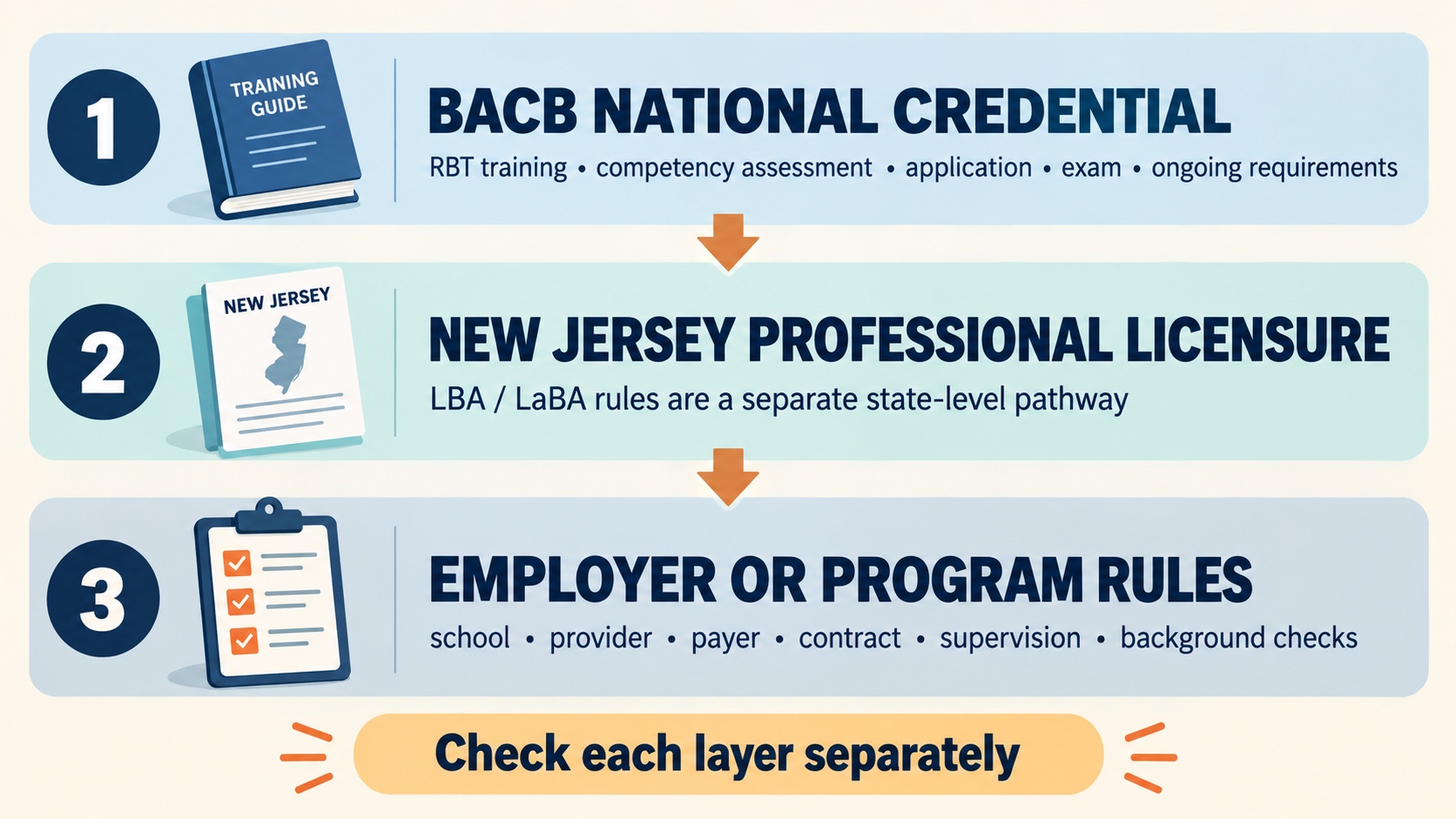
In other words, “RBT certification NJ” is best understood as a three-part research task:
- National credential: What does the current BACB RBT pathway require?
- State boundary: Is the position also affected by a New Jersey license, regulation, or agency rule?
- Actual role: Does the employer, school, provider, or contract add requirements for this setting?
The national BACB RBT route
The BACB is the starting point for the RBT certification pathway. Its current RBT materials and handbook are the right place to verify eligibility, application steps, examination information, and ongoing certification responsibilities. A search result, training company, or old checklist can help you find a topic, but it should not override the current BACB page.
At a high level, the pathway usually involves several connected but different tasks:
- Check the current eligibility route. Review the current RBT Handbook and the BACB’s listed requirements for age, education, background information, training, assessment, and supervision. Requirements can change, so record the handbook version or page you used.
- Complete the required training. The training requirement is not the same as passing the examination. Keep the completion record and confirm that the training meets the current BACB standard.
- Complete the competency assessment. The competency assessment is a separate step in which the candidate demonstrates relevant skills. Do not treat a course certificate as proof that this assessment has been completed.
- Submit the application correctly. Follow the current application instructions, provide the requested documents, and respond to any background or eligibility issue through the channel the BACB identifies.
- Prepare for the examination. Use the current RBT examination resources and content outline. A practice question can support study, but it is not secure BACB content and cannot guarantee a result.
- Maintain the credential and role. After certification, supervision, renewal, ethics, and other ongoing responsibilities still matter. An applicant should understand what the employer and supervising credentialed professional expect before accepting an offer.
The important study habit is to keep these steps in separate columns. Someone may have finished training but not completed the competency assessment. Another person may be eligible to apply but still need to schedule the exam. A third person may be certified but applying to a program with additional hiring conditions. Separating the stages prevents a vague “I completed the course” answer from being mistaken for full certification.
What New Jersey regulates separately
New Jersey’s Division of Consumer Affairs maintains an ABA area for the State Board of Applied Behavior Analyst Examiners. The state materials focus on the licensure and regulation of applied behavior analysts and assistant applied behavior analysts, including LBA and LaBA terminology. Those pages are useful because they show that New Jersey professional licensure exists, but they do not establish a universal separate RBT license requirement.
New Jersey education and agency pages can also distinguish BACB certifications from state qualifications for particular professional roles. This is why a job title alone is not enough. “Behavior technician,” “paraprofessional technician,” and “RBT” may be used in related settings, while the exact education, supervision, background, training, or licensure rules depend on the program and the service being delivered.
Some New Jersey documents use language that includes an RBT credential as one way a paraprofessional technician may qualify. That supports the idea that the BACB credential can be relevant to New Jersey programs. It does not mean every program has identical hiring standards, and it does not convert every program document into a statewide RBT licensing statute.
Employer and program requirements
The most common source of confusion is a program-specific requirement being repeated as if it were the state’s universal certification rule. A New Jersey employer may ask for a current RBT credential, a high school diploma or equivalent, a background check, CPR or safety training, a driver’s license, a language skill, or experience with a particular population. A school district may have its own hiring and supervision process. A provider working under a contract may need to follow that contract’s staffing standard.
For example, a New Jersey Department of Children and Families behavioral-services request describes behavioral technicians in a particular service context and includes RBT certification among possible qualifications alongside other experience or education pathways. That is useful context for someone reading a job posting connected to that program. It should not be rewritten as “every New Jersey RBT must have one year of supervised experience.” The document’s scope is narrower than that claim.
Ask the hiring contact five direct questions:
- Does this role require an active BACB RBT credential before the start date, or can the employer support the pathway?
- Which current handbook, contract, payer, or school rule is the requirement based on?
- Who provides supervision, and how is supervision documented?
- Are there additional background, safety, health, transportation, or experience checks?
- Does the role involve a setting with a separate New Jersey license or provider enrollment requirement?
Written answers are especially helpful when a job posting uses broad phrases such as “state certified” or “licensed behavior technician.” Ask the employer to name the credential and the issuing body. That small clarification can prevent an applicant from paying for the wrong course or assuming that a state license is required when the posting actually means BACB certification.
A New Jersey RBT checklist
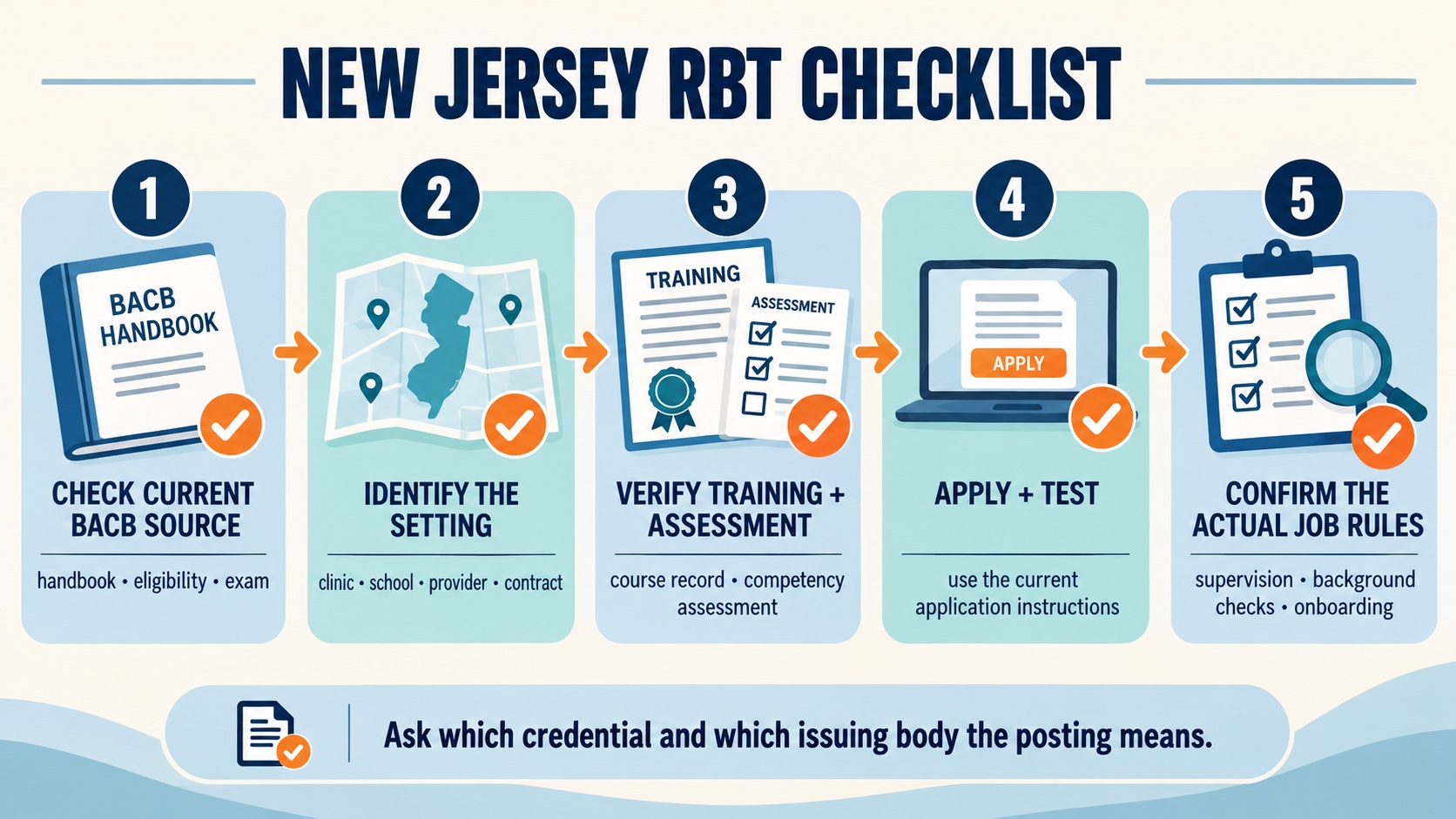
Use this sequence before you spend money on a course or submit an application:
- Start with the current BACB source. Save the RBT Handbook and examination links you used, including the date you checked them.
- Identify the exact job setting. Is it a clinic, home-based provider, school, state-funded program, early-intervention service, or another arrangement?
- Separate credentials. Write down whether the posting asks for BACB RBT certification, a New Jersey LBA/LaBA license for another role, or a program-specific qualification.
- Verify training and assessment. Check that the course and competency assessment match the current BACB pathway before paying or scheduling.
- Ask about supervision and onboarding. Confirm who supervises the work and which additional checks are required for the setting.
- Recheck before applying. Review current official pages again if the application has been delayed, because forms, fees, handbook language, and testing instructions can change.
Common mistakes to avoid
- Searching only for a state-branded course: first confirm whether the requirement comes from the BACB, New Jersey, or the employer.
- Calling an LBA/LaBA license an RBT license: these roles and credentialing pathways are not interchangeable.
- Using an old PDF as the current rule: historical program documents may be valuable context but should not replace current official instructions.
- Assuming one contract applies everywhere: label DCF, Medicaid, school, and provider requirements by their actual scope.
- Confusing training with certification: keep training, competency assessment, application, examination, and ongoing supervision as separate checkpoints.
- Accepting a vague job description: ask which credential, issuing body, and current rule the employer means.
RBT certification NJ FAQ
Do I need a New Jersey license to become an RBT?
The sources reviewed for this guide do not show a universal separate New Jersey RBT license that replaces BACB certification. New Jersey does regulate and license applied behavior analyst-level roles, while individual employers and programs may add their own conditions. Confirm the exact position with the employer and current state source.
Is BACB RBT certification valid in New Jersey?
BACB certification is the national RBT credential route, and New Jersey program materials may recognize RBT certification as a qualification. The credential does not automatically answer every hiring, payer, school, or contract question, so verify the setting-specific requirements.
Can I work as a behavior technician without RBT certification?
That depends on the employer, program, and role definition. Some settings may hire a technician while the person completes a pathway or may accept another education and experience route. Other postings may require an active RBT credential before work begins. Read the actual posting and ask the hiring contact which standard applies.
Does New Jersey require one year of experience for every RBT?
No universal conclusion should be drawn from one program document. A state contract or service request may include supervised experience as one qualification for that specific context. Treat it as a scope-limited requirement unless a current statewide authority says otherwise.
Where should I check before enrolling?
Start with the current BACB RBT page and handbook, then check the New Jersey Division of Consumer Affairs ABA pages and the requirements for the specific employer or provider. If those sources conflict, pause and ask the issuing organization for written clarification before paying or submitting documents.
Sources and verification notes
- BACB: RBT certification and application resources
- New Jersey Division of Consumer Affairs: ABA and Applied Behavior Analyst Examiners
- New Jersey applied behavior analyst licensure FAQ
- New Jersey proposed language on paraprofessional technicians
- New Jersey DCF behavioral-services request for a specific program context
- New Jersey Department of Education behavior resources
- ABA Study Online RBT learning hub and RBT practice questions