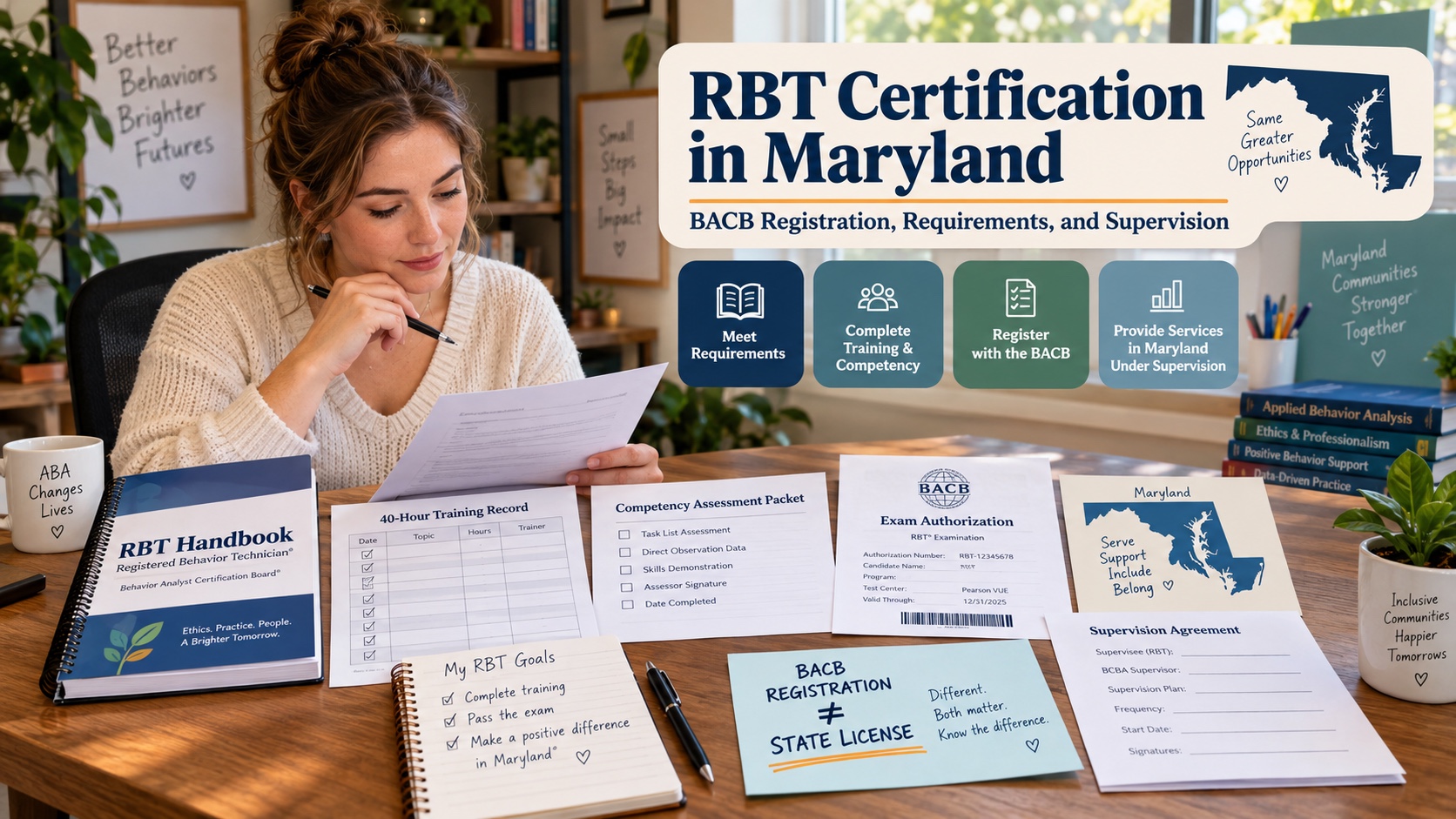
RBT Certification in Maryland: BACB Registration, Requirements, and Supervision
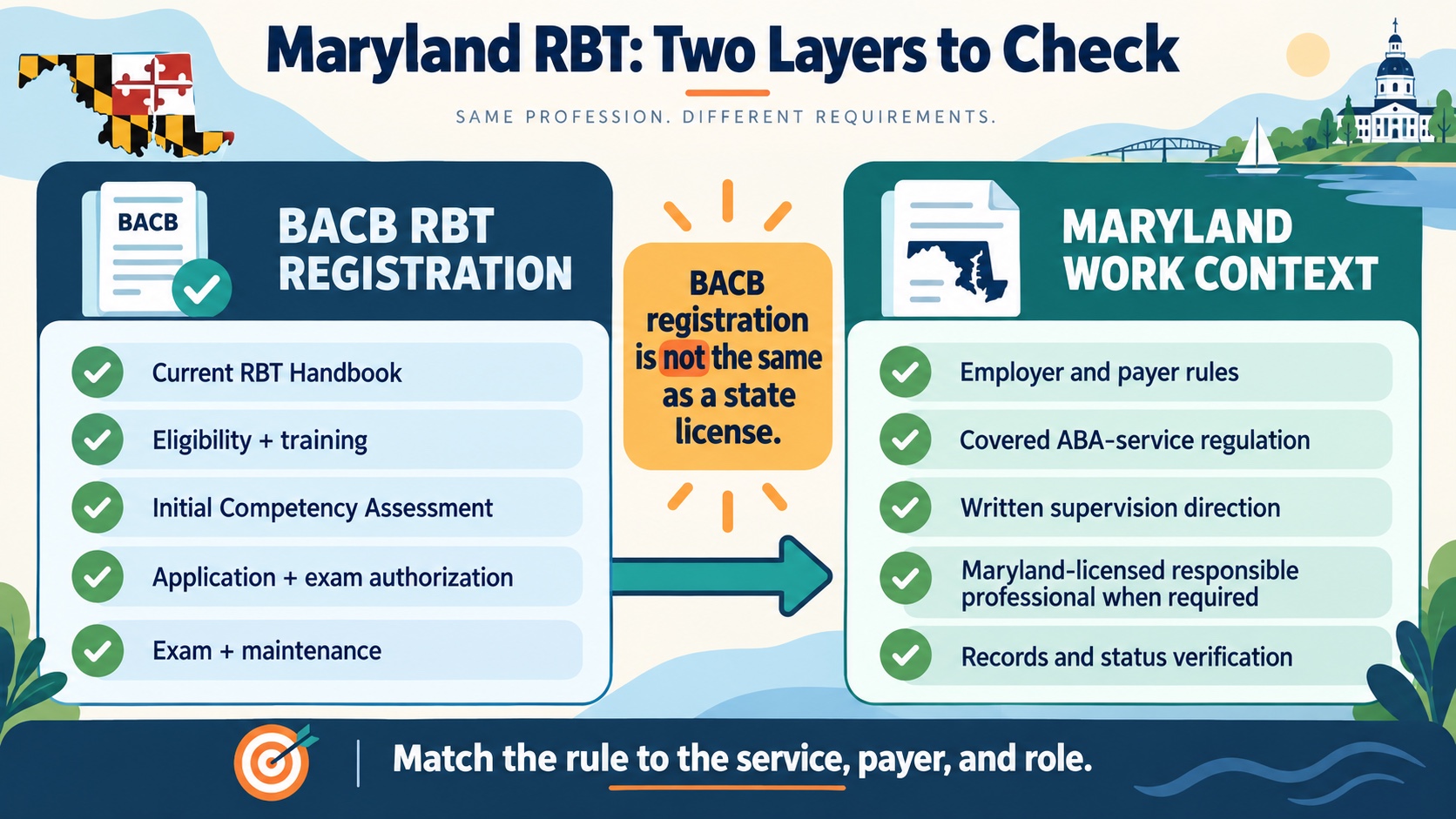
RBT certification in Maryland is generally a BACB credential, not a separate Maryland RBT license issued by the state. To become a Registered Behavior Technician, you follow the current BACB RBT application path. After that, the work context still matters: Maryland regulations, Medicaid program rules, an employer’s policies, a client’s service arrangement, and supervision requirements may add conditions for providing services.
This distinction prevents two common mistakes. One is searching for a Maryland RBT exam when the certification process is administered by the BACB. The other is assuming that BACB registration alone answers every question about working with a Maryland provider or payer. It does not. The exact requirement depends on what service you will provide, who employs you, and which Maryland rule or program applies.
This guide maps the current BACB steps and the Maryland context without making a personal licensure or employment decision. Check the live BACB RBT Handbook and the applicable Maryland regulation before submitting an application or accepting a role.
Table of Contents
What RBT certification means in Maryland
The Registered Behavior Technician credential is administered by the Behavior Analyst Certification Board. The BACB describes an RBT as a paraprofessional certification in behavior analysis. RBTs assist in delivering behavior-analytic services under the direction and close supervision of an RBT Supervisor and/or RBT Requirements Coordinator who is responsible for their work.
Maryland’s official materials use the BACB credential in state service rules. For example, the Maryland regulation governing certain Medicaid ABA services defines an RBT provider as someone currently registered by the BACB and also lists age, education, supervision, and written-relationship conditions. That is a Maryland service-context rule. It should not be copied automatically into a different employer, payer, or private-practice arrangement.
Maryland also regulates the practice of behavior analysis through the Board of Professional Counselors and Therapists. The state’s behavior-analyst license page describes requirements for a licensed behavior analyst, including current BCBA or BCBA-D certification and a qualifying graduate degree. That page is not an RBT application page. It helps show why the BCBA/LBA role and the RBT role should not be treated as the same credential.
The BACB RBT certification path
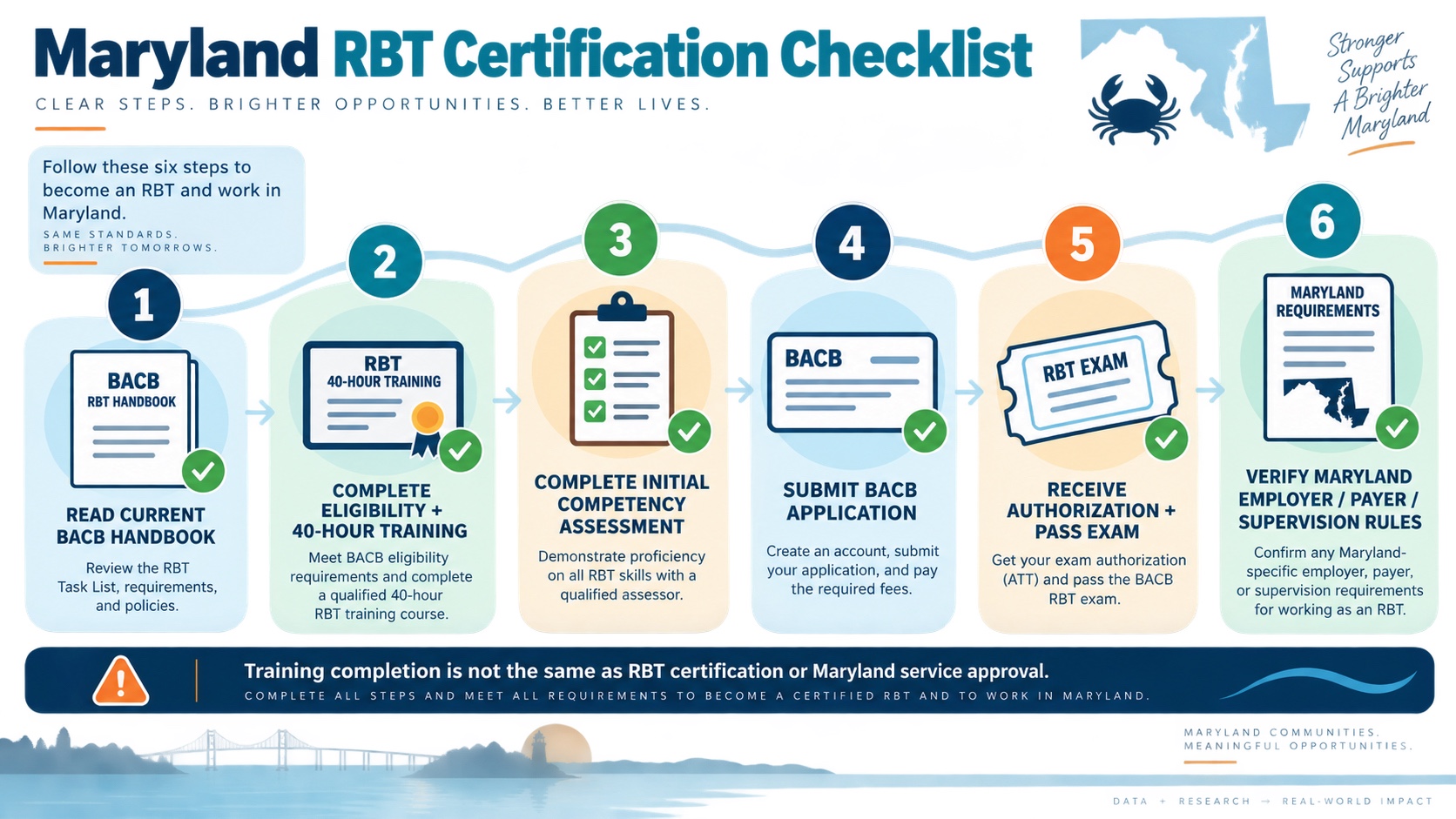
The current BACB materials control the application steps. In broad terms, a prospective RBT should:
- Read the current RBT Handbook. Start with the live version because requirements, forms, and transition dates can change.
- Meet the eligibility requirements. Confirm the current age, education, background-check, training, and other requirements described by the BACB for your application.
- Complete the required training. Use the current RBT 40-hour training requirements and curriculum outline. A course advertisement or old PDF is not enough evidence that the training fits the current rule.
- Complete the Initial Competency Assessment. This is a separate performance-assessment step. The qualified assessor and current packet matter, and training completion does not automatically equal competency assessment completion.
- Submit the application through the BACB process. Upload the documents and complete the attestation or other steps required by the current handbook.
- Receive examination authorization and schedule the exam. Testing logistics are controlled by the BACB and its designated testing partner. Do not assume a Maryland location or date is available before authorization.
- Maintain the credential. After certification, follow the current RBT supervision, professional-development, renewal, and ethics requirements.
These steps are a study map rather than an eligibility determination. The BACB’s application-processing page states that it cannot decide whether a person’s specific education, coursework, or training qualifies outside the formal application review. If your documents are unusual, preserve the source version and ask the BACB or a qualified supervisor for the appropriate next step.
What Maryland adds to the context
Maryland’s rules matter because certification and permission to provide a particular service are not always the same question. A state regulation can define the people who may render a covered service, the supervision relationship, and the records a provider must keep. A Medicaid rule can apply to Medicaid-funded ABA services without being a universal rule for every private employer. An employer can set onboarding conditions without changing the BACB’s certification requirements.
In the Maryland COMAR chapter for Applied Behavior Analysis Services, the RBT-provider section lists several conditions for the covered provider context. It includes being at least 18 years old, being currently registered by the BACB, having a high school diploma or national equivalent, working under the direction of a licensed psychologist or licensed behavior analyst, and having the supervisory relationship documented in writing. Read the exact current regulation for the service and provider type involved.
The same Maryland chapter also distinguishes a behavior technician who is in the process of obtaining BACB certification from an RBT who is already registered. That distinction can affect a provider’s staffing and enrollment rules. A job advertisement that says “BT/RBT” may therefore describe two different statuses. Ask which status the employer means, what timeline applies, and who is responsible for the supervision.
For questions about a Maryland state behavior-analyst license, use the Maryland Board of Professional Counselors and Therapists. For questions about BACB registration, use the BACB RBT Handbook and portal. If the question is about Medicaid enrollment or covered services, use the current Maryland Medicaid regulation or provider guidance. These are separate source routes.
Supervision and written responsibility
RBT certification is not independent practice. The RBT works within a supervision structure, and the supervisor or requirements coordinator has responsibilities for the RBT’s work. The BACB’s supervision page and RBT Handbook provide the credential-level rules. Maryland’s covered-service regulation may use different wording, such as “under the direction of” a licensed psychologist or licensed behavior analyst. Keep both layers visible.
Before starting, ask the organization to identify:
- which person is the BACB RBT Supervisor or Requirements Coordinator;
- which person is the Maryland-licensed professional responsible for the covered service, if that rule applies;
- how ongoing supervision, observation, feedback, and documentation will occur;
- which service, payer, and employer rules are being used;
- what you should do when a procedure is unclear, a client’s situation changes, or a task is outside your training; and
- how the organization will record your BACB status, training, background check, and renewal evidence.
A supervisor’s title alone does not answer every question. Verify the relationship, the current credential status, the Maryland license when required by the service context, and the written responsibility chain. If the answer changes depending on the client or payer, request the exact policy or regulation reference.
Documents to verify before you work
Create a small source folder rather than relying on screenshots or a job-posting summary. Include:
- Current BACB RBT Handbook: use the version that applies to your application or maintenance period.
- Training record: keep the provider, dates, hours, curriculum reference, and completion evidence.
- Competency assessment record: confirm that the correct current packet and qualified assessor were used.
- BACB application and status evidence: save confirmation and check the official credential status rather than relying on an employer spreadsheet.
- Written supervision arrangement: know who supervises the work and what happens when the relationship changes.
- Maryland context document: identify the regulation, Medicaid program rule, employer policy, or contract that creates the additional condition.
- Renewal and professional-development records: after certification, keep the evidence needed for the current RBT maintenance process.
A practical Maryland timeline
Suppose a Maryland employer offers a BT position and says the employee can become an RBT after training. First, ask whether the position is for a BT who is still obtaining BACB registration or for an RBT who must already be registered. Next, read the current BACB path and complete the required training and assessment. Then ask which person will supervise the work and which Maryland service or payer rule the provider is following.
When the application is submitted, keep the confirmation and respond to any BACB action item through the official portal. Do not schedule the examination based only on a course completion email. Wait for the official authorization process and verify the testing instructions. After certification, confirm how the employer will document active registration and ongoing supervision.
This sequence is deliberately slower than copying a checklist from a job ad. It protects the applicant from confusing a training certificate with certification, a state service rule with a universal license, or a supervisor’s informal promise with a written arrangement.
Common mistakes
- Looking for a Maryland RBT license application. Start with BACB RBT certification and then check the Maryland context that applies to the service.
- Calling a 40-hour course “RBT certification.” Training is one step; competency assessment, application, authorization, examination, and maintenance are separate steps.
- Assuming Medicaid rules apply to every job. A covered-service rule is not automatically the rule for every private employer or payer.
- Confusing a BT and an RBT. A person in the process of obtaining BACB registration may have a different status from a currently registered RBT.
- Ignoring the written supervision relationship. Ask who is responsible and how the records will be maintained before services begin.
- Using an old handbook or PDF. RBT requirements and forms can change; use the live BACB page and current application-processing guidance.
FAQ and official sources
Is there a Maryland RBT certification?
The RBT credential is administered by the BACB. Maryland rules may recognize or require current BACB registration in a particular service or payer context, but that is different from a separate Maryland RBT license. Confirm the exact current rule for your work setting.
How do I become an RBT in Maryland?
Follow the current BACB RBT path: review the handbook, meet eligibility requirements, complete the required training, complete the Initial Competency Assessment, apply, receive examination authorization, pass the exam, and maintain the credential. Then verify any Maryland employer, payer, supervision, or service requirements.
Does Maryland require RBT supervision?
RBTs work under supervision under BACB requirements. Maryland’s covered ABA-service rules also specify supervision or direction and written responsibility conditions. The applicable supervisor and exact documentation depend on the service and payer context.
Can a 40-hour course make me an RBT?
No. The course is only one part of the certification process. You still need the current competency assessment, application and document review, examination authorization, examination, and maintenance requirements.
Where can I verify the rules?
Use the BACB RBT page and RBT Handbook for certification. Use the Maryland ABA-services regulation for the covered service context and the Maryland behavior analyst license page for state licensure questions.
ABA Study Online’s RBT study guide and RBT practice questions can help organize learning, but they do not determine BACB eligibility, Maryland licensure, payer enrollment, or whether a particular employer’s supervision arrangement complies with current rules.